“Searching for You”
In a world of rejection….
the tears of the moon become thick
The sky is darkened
The universe is sad because of you
Rough winds carry you afar
Sadness fills your shadow
The night devours my soul
The cold wind stings my heart
Loneliness surrounds my body
Longing for a new place to hope
Where the oceans kiss the blue sky
The shattered heart I cannot bear
A bruise that scars my soul
If I ever dream, dream of a new life,
dream of love in the future,
It is okay…it will be with you
If I see destruction and know suffering
It will be okay to suffer with you
If I go to a distant land, full of charm and your memories
You will come with me
Your love is my love
Uncategorized
Book Launch Event: “Vodou and Christianity in Interreligious Dialogue”
Book Launch Event: “Vodou and Christianity in Interreligious Dialogue”
Dr. Celucien Joseph is inviting you to a scheduled Zoom meeting.
Topic: Book Launch Event: Vodou and Christianity in Interreligious Dialogue
Time: Nov 26, 2023 06:00 PM Central Time (US and Canada)
You are invited to a Zoom meeting.
When: Nov 26, 2023 06:00 PM Central Time (US and Canada)
Register in advance for this meeting:
https://us02web.zoom.us/meeting/register/tZwtd–rqz4iGtM-f0vKv4kT75pHsIKL84I8
After registering, you will receive a confirmation email containing information about joining the meeting.


November 2023 Itinerary and Speaking Engagements
November 2023 Itinerary and Speaking Engagements
Those of you who can and know how to pray, say a little prayer for brother Lou for the month of November. I need all the prayers in the world and all the angels in heaven to intervene on my behalf for these interesting speaking engagements. What was I thinking to say YES to all these events and invitations😊😊😊
· Thursday, November 7: I will be giving a paper at the Colloque International sur la Contribution d’Haïti à l’émancipation des peuples (lutte globale contre l’esclavage et la colonisation)/ International Conference on Haiti’s Contribution to the Emancipation of Peoples (global fight against slavery and colonization) on the recent literature on the Haitian Revolution, published in the past decade or so. It is called “Rethinking ‘The Haitian Turn,’ from 2012 to 2023: An Assessment of the Most Recent Literature on the Haitian Revolution in English.”
· Saturday, November 11: I will be interviewing Dr. Pierre St Louis on “Christian Mission and the transmission of the Gospel in Haiti” for the Center for Faith, Reason, and Dialogue (CFRD).
· Saturday-Monday, November 18-21: At the American Academy of Religion’s annual conference (San Antonio, TX), I will be presenting two papers. My first presentation will be on the topic of “Vodou and Christianity in Interreligious Dialogue and the Roots of Religious Disagreement.” My second presentation will be on the subject of “Pope John Paul II, the Haitian Episcopal Conference of the Catholic Bishops, and the Emergence of Liberation Theology in Haiti.”
· Sunday, November 26: I will be moderating the book launch event for my new co-edited book “Vodou and Christianity in Interreligious Dialogue ” (Pickwick Publications, 2023) via zoom. You will get to hear from the other coeditors and contributors of this excellent and much-needed volume.
· Wednesday, November 29: I will be giving a talk to a group of talented College Preparatory students at the Metairie Park Country Day School (Metairie, LA). The title of my talk is “Haitian Vodou and Haiti’s Connections with Louisiana through a common religious and cultural heritage.”
· Wednesday, November 29: Pascal Robert, the host of “This is Revolution podcast,” will interview me on “The Lifetimes and Significance of Jean Price-Mars.”
L
“Vodou and Christianity in Interreligious Dialogue” is Published!
Hello Good People!
My new co-edited volume, “Vodou and Christianity in Interreligious Dialogue” is now available on Amazon to order. This is the first book in the English language that attempts to foster interreligious dialogue between Haiti’s two dominant religions. It will not be the first one.
Get it as your Christmas present and get a copy for your friends as well!

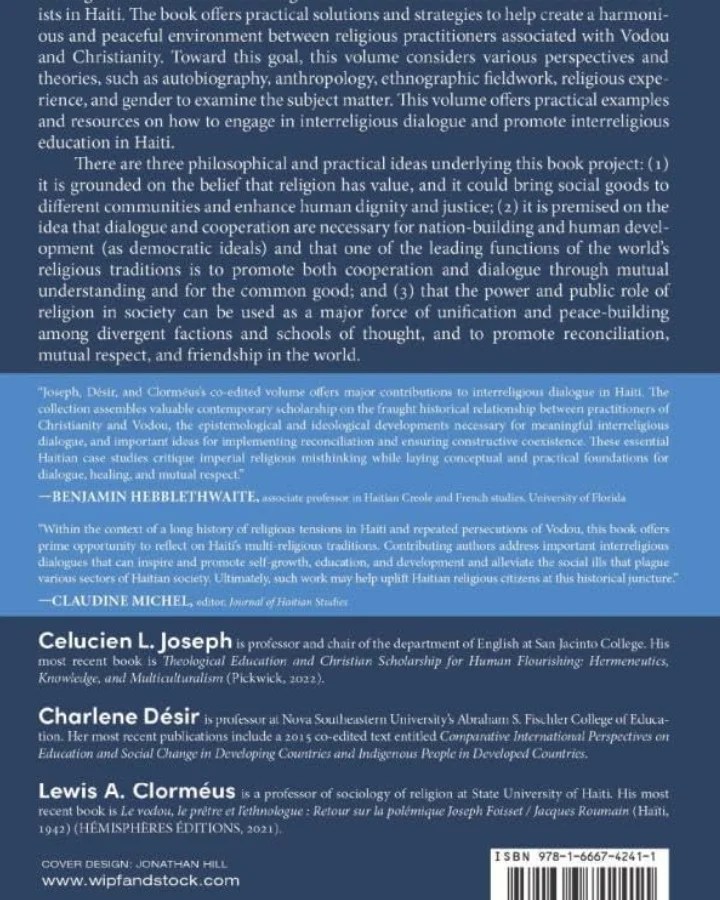

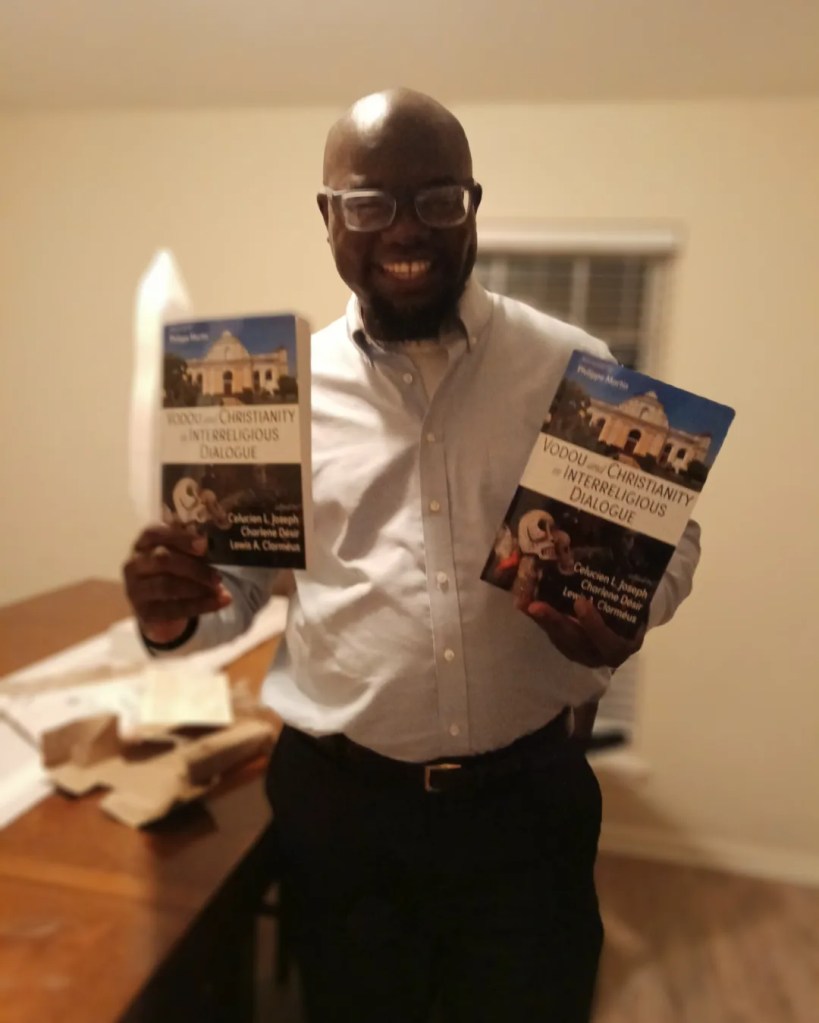
Author copies of my new book just arrived!
I am so happy this book is finally out. I’ve worked so hard on this book. In the process, God has been so gracious to me to grant me both physical and intellectual energy to complete this enormous task. Not only have I served as the book’s general editor; I translated three chapters ( 2, 6, 9) in English that were originally written in French. The book has ten chapters. I also contributed a chapter (chapter 10) to the book. In addition, I translated from French the foreword written by the renowned French religious scholar Philippe Martin. (This is not a complaint. I am not afraid to work hard. I am grateful to my amazing coeditors and the brilliant contributors as well as those who have endorsed the book.)
It was all a labor of love. I want both committed Vodouyizan and Christians to live in peace and harmony in Haiti and beyond Haiti, and my desire is for both groups to learn how to be tolerant and respectful toward each other. My prayers is that both committed Vodouyizan and Christians would use religion as a force for nation-building and a resource to maximize democracy in Haiti and its diaspora.
Ten Productivity Strategies
Ten Productivity Strategies
1. Prioritize people in all your work and success.
2. Have a broad vision of life and think about how it relates to the consequences of your ideas and work.
3. Know your strength and use it to inspire and empower people.
4. Do not be ashamed of your weakness; rely on others’ strength to fill in the gaps.
5. Value human relationships and do not mistreat the people you work with or those you depend on to get the work done.
6. Teach others what you know and do your work effectively.
7. Use your knowledge, skills, and talent to change the human condition in your community and in the world.
8. Do not focus too much about what you would like to become in life; rather, be committed to the steps that will take you there.
9. Do not lose a sweat about what people are thinking about you.
10. Be honest, treat all people with respect and kindness, and live in peace with all people.
Reflections on Ten Big Issues in the American Evangelical World
Reflections on Ten Big Issues in the American Evangelical World
1. Theory and Praxis: there exists a profound disconnect between the Evangelical theoretical understanding of the Christian faith, and the christological praxis of the faith or the call for followers of Christ to actively engage in the everyday reality (and mess) of the human experience (i.e., the existential struggles and traumas of the people in need). In this sense, American Evangelicalism has become a type of social problem, not the solution to the social problems in the culture.
2. Grace and empathy: Christian grace and empathy have become a rare thing to find in the Evangelical practice, especially concerning the existential problems of human pain and suffering in contemporary societies. As a practice, the Evangelical grace has been compartmentalized discriminatorily to respond to the needs of a selected few in society. Empathy has also become a preferential option expressed and demonstrated toward a selected group. The problem of grace and empathy could be particularly observed in the Evangelical reaction and response to the problem of mass incarceration, immigration debates, police brutality, food scarcity, the Israelite-Palestinian conflict, as well as in the American government’s response to the Russian-Ukraine war and the Israel-Hamas war.
3. Caring for the poor and the homeless: the biblical call to care for the poor and the homeless is a quality that is not inherent in today’s Evangelical faith and practice. Acts of kindness and charity toward the marginalized and the economically-disavantaged groups are often done and associated with certain seasons and holidays of the year ( Christmas, Thanksgiving, short-term mission trips to foreign countries). In other words, caring for the poor and the homeless is not a way of life in American Evangelical Christianity, and unfortunately, in many Evangelical circles, it is sometimes associated with socialism.
4. The sanctity of life: in American Evangelicalism, the concept of the sanctity of life is deeply connected to political decisions and legislations. It has become a political vote and an association with a political party. Life is deemed sacred because it could be secured through the process of political and judicial legality.
Also, the biblical mandate to preserve and defend life has been reduced to a particular
phase of the human development and a monolithic view of the human life: the stage of the unborn. It’s not carried through the whole life of the individual after birth.
5. Religious freedom: in the Evangelical mindset, religious freedom is connected directly to the rights and freedom of American Christians to practice their faith freely, openly, and without any restraints. Evangelicals defend and guarantee such rights and liberties for American Christians only; they are often silent on the struggle of other religious faiths and non-christian groups to have these same rights applied and guaranteed to them in society.
Evangelicals have become dependent on the state to make (and maintain) the practice of religion a freedom and a right, and the practice of freedom and rights a religious association, correspondingly.
6. Politics: in various American Evangelical circles, politics has become a partisan phenomenon that is based on a selective-value system or theory that is often short of a thorough moral assessment of political leadership and actions. This particular reaction to contemporary politics has become an accepted practice in contemporary American Evangelicalism, what we might call the demoralization of American politics. There is no moral compass deployed to assessing the value-system and ethical worldview of a political leader associated with the political party often aligned with American Evangelicals. Within this framework, it could be said that American Evangelical values and worldview when it comes to matters of legislations, and political leadership and actions are not universally shared with global (other) Christians elsewhere.
7. War and freedom: there’s an obsession with the culture of war that it is deeply ingrained in the Evangelical mind and commitment to the American state. American Evangelicals generally support the American government’s decision to go to war because the Christian faith has been taken captive by the government. The idea is that the survival and continuous maintenance of the Christian faith in the American society is dependent upon the preservation and the defense of American democracy and freedom within and in the world. Hence, Evangelicals not only support the American government’s decision to go to war because of the fear of losing national sovereignty; the matter also pertains to the Evangelical obsession in spreading the American gospel of democracy and freedom in the world. Hence, Evangelicals gave pledged its undivided allegiance to the state because they see the government as its ally, meaning it’s the guardian of Christian liberty and the American state as the advocate of Christianity in society.
8. Peace-building and peace-making: in the same line of thought with the previous thesis, American Evangelicals understand peace-making or peace-building in the most political sense. The project of Christian peace-making is often construed as the goal of the American government. American Evangelicals believe that genuine societal peace is intrinsically dependent upon the government’s decisions and interventions. To put it another way, the project of Christian peace-building is intertwined with the American Christian nationalist ideology. This is the antithesis of Jesus’ declaration to his followers to “become peacemakers” in the world. From a christological point of view, peace-making or peace-building is an intentional decision and a deliberate practice of children of God. It is the sons and daughters of God who are the peacemakers in the world, and it is this community of peace that is mandated to propagate and practice peace in society. The state is not inherently a practitioner, a doer, or a builder of peace in the world.
9. Justice and Fairness: justice in Evangelical circles does not necessarily mean transformative justice and holistic justice for all people and for those who might be culturally and ethnically different. Because of the close association with American Evangelicalism and Christian nationalism, not only justice as a concept is associated with the task of the American government; many Evangelicals have blindly subscribed to a definition of justice, as defined politically by the state or the American government. In other words, the biblical concept of justice (rooted in the ethical character of God) and the Christian call to practice justice (grounded in God’s moral attributes) have become subservient to the legal practice and judicial sense of justice, which is often flawed, partial, and non-transformative.
In the biblical narrative, justice is not only an essential attribute of God. It is the fundamental rule or moral compass that God deploys to govern the world and assess morally the decisions and affairs of world governments and the global populations. Divine mercy is often associated with divine mercy, and justice is said to be one of the most visible markers of the people of God in the world.
10. Theory of the Good life: the concept of the good life in American Evangelicalism is measured by American exceptionalism and triumphalism in the world, as well as the idea of Western democracy and freedom as a global phenomenon. American exceptionalism and Western concept of democracy and freedom challenge the biblical understanding of Christian liberty and “freedom in Christ;” they also contradict the biblical virtues and the call to pursue (and practice) humility, hospitality, global peace, reconciliation, harmony, servant leadership, and not to regard oneself far more superior than another individual. This theory of the good life also promotes the doctrine of the (cultural) superiority of nations and the (cultural) inferiority of other nations.
The christological definition of the good life lies in the imitation of Christ’s character, that is to be a servant to others and to promote human dignity and preserve the sanctify of life.
“God is not a Terrorist: on Human violence, Acts of terrorism and war, and the Quest for Global Peace and Reconciliation”
“God is not a Terrorist: on Human violence, Acts of terrorism and war, and the Quest for Global Peace and Reconciliation”
*In this post, I write and reflect upon the current conflict between the Israelite government and Hamas, a terrorist group, from the perspective of a committed follower of Christ, a pacifist, and Christian theologian. It is good to say that I am not a political scientist and activist. My primary audience here is Christians and American Evangelicals.
I am also using this trio-lens to make sense of the military catastrophes in Gaza leading to the death of innocent people and children in the same way Hamas continues to wage war aggressively towards its Jewish neighbors, including both children and vulnerable people in the region. While I condemn Hamas’ terrorist attack, it is also ethical to think morally and responsibly about the Israelites’ military retaliation and its aftermath consequences in this region of the world.
In this post, I write about the problem of human violence, terrorism, and war. I am also interested in the importance of intercessory prayer and the project of peace-making, human liberation, and reconciliation toward human flourishing in the world.
The problem of war and violence
War is never kind to any human being and any nation. War defers human empathy and compassion, and it is the antithesis of human flourishing in society and the reconciling project of God in the world. Every act of terrorism is a challenge to peace and harmony in the world. Military interventions and invasions almost always leave a scar on the life of the victims and the vulnerable. Acts of violence not only cause pain and suffering in the human experience; violence like war counters the essential meaning and purpose of love in the world. It is a rare happening in modern times that defensive wars and acts of violence have helped to solve human conflict or contribute to human resolution. Blessed are those who pursue peace and work toward reconciliation in their community and in the world–toward human flourishing in the world.
The correlation between acts of terrorism and acts of violence is evident. Violence, whether physical, psychological, or systemic, is a grave affliction on society and an affront to our shared humanity. It breeds fear, suffering, and division, undermining our collective progress and well-being. Violence often arises from a breakdown in communication, lack of empathy, or unresolved conflicts. Instead of resolving issues, it perpetuates a cycle of harm, leaving lasting scars on individuals and communities. It is crucial that we advocate for non-violent alternatives, promote tolerance, empathy, and education to address the root causes of violence and strive for a world where conflict is resolved through peaceful means, fostering a safer and more harmonious coexistence for all. Both acts of terrorism and acts of violence are a menace to peace-building and universal harmony.
1. War is a tragic failure of diplomacy, often resulting from the inability to resolve conflicts through peaceful means.
2. Violence begets violence, creating a cycle that is difficult to break and often leads to further conflicts.
3. The human and societal costs of war are immense, causing loss of life, physical and emotional trauma, and economic devastation.
4. The psychological toll of violence on individuals and communities can lead to long-lasting trauma and mental health issues.
5. Wars are often driven by a complex interplay of political, economic, and social factors, making them difficult to prevent.
6. The arms industry profits from war and violence, creating incentives that can perpetuate conflicts.
7. Peacebuilding and conflict resolution efforts are essential to prevent and mitigate the impacts of war and violence.
8. War and violence disproportionately affect vulnerable populations, including women, children, and marginalized communities.
9. International cooperation and diplomacy are crucial for preventing and resolving conflicts on a global scale.
10. The world should strive for a future where peaceful dialogue and cooperation replace war and violence as the means to address differences and disputes.
The promise of peace and reconciliation
Peace is the cornerstone of human civilization, a fundamental aspiration that transcends borders and cultures. It serves as the bedrock for progress, prosperity, and the well-being of societies. In the absence of peace, conflict and instability prevail, hindering development and causing untold suffering. Beyond its obvious moral imperative, peace enables nations to allocate resources towards education, healthcare, and infrastructure rather than defense. It nurtures an environment where dialogue and diplomacy can resolve disputes, promoting cooperation and unity. Moreover, peace fosters individual security, mental well-being, and social harmony. It is the catalyst for innovation, collaboration, and the pursuit of higher ideals, making it an essential foundation for a brighter, more equitable future.
Jesus Christ has called his followers to pursue peace and to pray for their enemies and those who persecute them. The God of the Bible is called the God of peace. Yahweh promises benedictions to those who are called peacemakers. It is the men and women who work strategically, intentionally, and methodically toward peace-building and peace-making who are called “children of God.” They are given the title “peacemakers” because their intentions and actions are linked to the peace-making character of God. They are called children of God because they love and pursue peace like God himself; hence, they are imitators of God. It is only the peacemakers who are called sons and daughters of God. Peace-making is a distinctive divine attribute that illustrates what divine love and empathy look like in public.
The significance of intercessory prayer
The command to “pray for the peace of Jerusalem ” (Ps. 122:6) is not an invitation not to pray for the peace of other nations and other people in the world.
The God of the Bible is not a terrorist and does not support the genocide of human beings, whom he created in his image and holds accountable for their actions and words. God is not a supporter of apartheid, a system that celebrates human freedom on on hand and supports human oppression and incarceration on the other hand.
How shall we think about the present war between the Israelite government and Hamas, and the destruction and militarization of Gaza by the Israelite military forces?
How shall we think biblically, responsibly, and morally about the ongoing killing, through acts of war and invasion, of Palestinian children and women, Palestinian Christians and Muslims, and the innocent people in both Israel and Gaza?
To move forward, I would like to turn my attention to the referenced text about the call to prayer in light of the Israel-Hamas ongoing conflict and war.
1. The call to prayer is indiscriminate and intercessory prayer is a universal divine gift. God accepts prayers from all people as long as they are done in sincerity and transparency. However, it is the prayer of the peacemakers, the oppressed, the poor, and the marginalized in the world that prompts God to act liberatively and compassionately in their favor. In the most distinctive way, it is the prayer of the righteous that moves the Divine to act selectively and without hesitation for their rescue.
2. The God of the Bible is the Maker of all people and does not favor any nation because of its ethnicity, race, culture, global status, geo-political location, military hegemony, economic power, ancestral lineage, etc.
3. The God of the Bible presents himself as a sovereign and universal Deity. In other words, Yahweh is not a “tribal deity” or the “God of a particular nation” who is restricted to certain geographical borders and human groups or races.
4. The global God has no religious affiliation and national identity. He is not a Christian. He is not a Muslim nor is God a Vodouyizan. He is certainly not a Jew, an American, a Nigerian, or a Palestinian. God is not male or female. God is not a queered deity nor is God a transgender in the manner we’re using the term in contemporary times.
5. To defend the rights of the Palestinians to live peacefully and in freedom in their territory is not unbiblical and anti-christian. To promote the liberation of Palestinians is not an anti-Semitic sentiment nor is it a violation of the declaration of the Universal Human Rights Treaty. All oppressed people should be set free and live freely as imago dei.
6. Correspondingly, to defend the rights of Jews to live peacefully and in freedom without the possibility of being invaded by terrorist groups such as Hamas is not anti-biblical and anti-christian. Like their Palestinian neighbors, the Jews have the rights to live without fear of being invaded or terrorized.
7. Biblical Christianity does not favor the state of Israel and condemn the Palestinian people. This is not the way of God. Rather, it is the political strategy and program of the powerful nations that continue to use the Israelite-Palestinian conflict to maintain global political and economic control and military hegemony in the so-called Middle-East and in the world.
8. Biblical Christianity is not equivalent to American Evangelicalism and Christian nationalism in the United States and Western Christian Europe. Biblical Christianity is a universal faith that transcends the geo-political message and affairs of the nations.
Christian nationalism is an ideology that contradicts the global scope and universal politics and good news of Jesus.
*The concept of the nation or the idea of the nation-state is a modern construct (see
“Imagined Communities: Reflections on the Origin and Spread of Nationalism” by Benedict Anderson).
9. American Evangelicalism does not have a monopoly on Christianity and the Biblical faith. American Evangelicalism intertwined with American patriotism and imperialism is an anti-biblical position; it is idolatrous and counters the ethics and ways of Jesus.
a) If American Christians are going to support the state of Israel and its military defense against terrorist groups like Hamas, they also have a moral responsibility to condemn military invasion that will kill innocent Palestinian children and vulnerable groups in Gaza, and they should condemn any imperial interventions that violate the sacredness of life, as wellas human and natural rights. This is a gesture of moral equivalency.
b) American Christians must condemn both acts of terrorism against the Jews in Israel and oppressive Israelites’ policies against the Palestinians.
c) If American Evangelicals are going to defend the right of land of the Jewish people because of their historical connection to the biblical story of the (Promise) land, and because of their ancestral affiliation with Jesus the Jewish Messiah, they also have a biblical obligation to defend the life, right, and liberation of Palestinian Christians who are their brothers and sisters in the Jewish Messiah. Both American Christian and Palestinian Christians pledge allegiance to the same God and worship the same Savior and Lord Jesus. This is a matter of theological equivalence and spiritual connection.
d) As members of the universal church who are united spiritually in Jesus the Lord, American Christians are closer to Palestinian Christians spiritually, theologically, and religiously. Apostle Paul commands followers of Jesus to support first their spiritual family and help one another because they are united as one in the Messiah. In Christ, there are no Jews; there are no Palestinians. Rather, there are followers of Jesus who are one in Christ; they are spiritually and communally connected in Christ; they are sustained and preserved together by the power of the same Lord; and they share a common life and breathe together through the same Savior-Christ.
10. To be an Evangelical Christian does not mean to support automatically acts of military invasion, acts of terrorism, and acts of violence toward innocent people and marginalized groups–whether we are talking about the Jews in Israel and the Palestinians in their territory.
To bring this reflection to a close, I would like to go back to Psalm 122: 6, “Pray for the peace of Jerusalem.” Many Evangelical Christians use this verse to defend the state of Israel politically and its military defense in the region. Other Scriptures also call followers of Christ to seek and pursue peace; pray for global peace and universal reconciliation; and not to approve of moral evil and ethically-suspect human actions in the world (Ps. 34:14). The people of God are not only commanded to be peacemakers in the land and country they live; they are also urged to pray for the peace and human flourishing in other territories and countries (Jeremiah 29:7). Peace is a contagious human phenomenon. If we pursue peace and practice peace wherever we are, our peace-making orientation and strategy will eventually have an impact on other people.
Mutual Love and Empathy in Public
Interestingly, there is an ideological parallel between the peacemaker and the righteous in the biblical account. Doing what is morally right and ethically sound will lead to a peaceful life. In the biblical narrative, a nation is favored by God not because of its geo-political location, military capabilities, cultural competency, or a robust economy. Yahweh will honor a people and a nation that pursue peace and live righteously and harmoniously. Yahweh puts stress on the agency of a people and a nation-state to be ambassadors of peace, and he also includes the active participation of followers of Christ to realize the peace-making project in the world.
Apostle Paul understood clearly that God the Liberator of the oppressed and marginalized of the world desire followers of Christ to pray for global peace in a world full of conflict, tension, and despair:
“I urge, then, first of all, that petitions, prayers, intercession and thanksgiving be made for all people— for kings and all those in authority, that we may live peaceful and quiet lives in all godliness and holiness” (Timothy 2:1-2).
Next time you pray and act, do the following:
1. Pray for the mutual peace of the Jewish and Palestinian people, and pray for their reconciliation and unity. However, there won’t be no peace without liberation and reconciliation.
2. Pray, act, and work collaboratively with your neighbors and those in power to put an end to terrorism, occupation, and violence in this region of the world.
3. You should never prioritize the life of one group while undermining the sanctity of life of another group. All life is sacred no matter where people live and regardless of their ethnicity, religion, culture, and immigration status.
4. Hold your government and politicians accountable for their unjust actions and unfair policies towards vulnerable groups, marginalized populations, and politically-and economically weak nations and territories.
5. Avoid propagating false narratives to humanize one group of people and question the dignity and humanity of other people.
“Eske relijyon Krisyanis lan se eritaj moun nwa ak Afrik: 3 ETID?”
Men twa premye etid ke nou fè sou topik plizyè moun t ap tan n lan: Eske relijyon Krisyanis lan se heritaj moun nwa ak Afrik? Seri a gen senk etid. Nou fini ak twa premye yo.
1. Eske Relijyon Krisyanis lan se Eritaj Moun Nwa Li Ye? Oubyen se Relijyon Esklavajis li Ye ? (Premye Pati): https://lnkd.in/gcG6dRj6
2. Eske Relijyon Krisyanis lan se Eritaj Moun Nwa Li Ye? Premye dirijan Afriken kretyen (Dezyèm Pati): https://lnkd.in/gKdTPGK5
3. Eske Relijyon Krisyanis lan se Eritaj Moun Nwa Li Ye? Krisyanis Afriken an Ejip (Twazyèm Pati): https://lnkd.in/gVGVdyU5
“Ghosts of Love’s Past”: A New Poem
“Ghosts of Love’s Past”
My new poem, “Ghosts of Love’s Past,” made my head hurt in the process of writing it and finding the right words and expressions to lament a love that was strong and eternal and now is lost and defeated. It took me about two weeks to write its final form.
This poem is about losses, downfalls, and defeats, and it does not look forward to future hope/s nor does it anticipate eschatological optimism. Therefore, you must buckle up your seatbelt and move on.
I would like to dedicate this poem to those who are (still) lamenting the ghosts of a past love. Yet I would like to encourage you to be strong and to reinvent yourself for better. Iin the words of the track and field sprinter champion Sha’ Carri Richardson, “[You are Not] I’m Not Back. [You are] I’m Better.”

“Ghosts of Love’s Past”
I dreamed that night when our love was lost.
A love once burning, now begins to wane.
I dreamed that night when you told me I was the reason.
In silhouettes of time, we found our shared journeys incomplete.
The mutual touch that once banished every care,
now left us both feeling lost and broken.
I dreamed of melodies that frustrated the lovers’ hearts.
You sent me blank pages and unfinished sentences to say I’ve lost you,
and dried purple orchids in springtime’s grace made it true.
The love that once bloomed in winter’s delight, now weakens.
Like an autumn seed, it fell among the wildflowers in the graveyard.
As we must no longer stay,
we crossed the river solo.
I won’t write to you anymore.
You don’t need to read my secret thoughts.
You had sworn to curse the memories that once tied our fragile hearts.
I had chosen not to cross your borders.
From body to heart, our souls drifted apart,
falling in the storm shuts down light and joy.
In emptiness, we both drowned, buried our wars, and our defeats.
I took ships and boats to part ways.
The promises you made are now shattered and torn.
Our dreams now lie in dust.
I created new itineraries where the sea does not exist.
I want to forget you like a sailor.
You are done loving me—
To abandon a love now lost in eternal flights.
“Irresistible Sins and Grace Irresistible”
“Irresistible Sins and Grace Irresistible”
There are some sins that are so irresistible and one must commit them passionately even though you will regret them later. You can always ask the good Lord for extended grace and generous forgiveness, what John Piper calls “future grace.” (Good People: this is bad theology. Don’t tell anyone you heard that from Doctor Lou who holds a PhD in Systematic Theology and Ethics.😂)
This week alone, I committed two deadly sins, and one of the same sins twice that goes against my dietary practice . I have not regretted them. In fact, it was delightful to do them. Both sins contradict and even revolt against my lactose intolerant immune system.
1. The sin of Nachos from Ms. Emily Danielle’s cuisine: Wiwi made me the most enticing, delicious, and incredibly tasty nachos twice this week. Both of them were full of cheese–I mean, generously cheesy. I mean it was quite a lot; Emily, my daughter-chef did not measure the amount of cheese she integrated into the recipe. No good father will ever say NO to a hard-working daughter 😊😊😊
2. The sin of Ice cream after the Lionel Richie’s concert: after we attended Lionel Richie’s concert last night, we went out to get some dessert. I craved the butter pecan ice cream. I ate the full scoop and wanted to have more. Lol
Please don’t ask me for more details about my stomach! Or how is it doing this morning? This is confidential information. Lol