Gwo Envitasyon pou Asiste First Annual Haitian Heritage Symposium
Ki le: Samdi, 27 Me @ 11 to 5 pm.
Ki Kote Lap Fe: African American Research Library and Museum (Fort Lauderdale, Florida)
Map tan n tout moun.
Gwo Envitasyon pou Asiste First Annual Haitian Heritage Symposium
Ki le: Samdi, 27 Me @ 11 to 5 pm.
Ki Kote Lap Fe: African American Research Library and Museum (Fort Lauderdale, Florida)
Map tan n tout moun.
Invitation to the First Annual Haitian Heritage Symposium
Where: African American Research Library (Fort Lauderdale, Fl)
When: Saturday, May 27, 2017, from 11:00 to 5:00 pm.
*This invitation is in English.
Racism and racial/racist ideologies are not distractions to the Gospel; they are indeed Gospel issues. The problem of race in modernity and post-modernity is a profound theological conundrum.
If the message and messenger of the Gospel can’t heal the deep racial wound of American Evangelicalism and American society, then they’re not relevant to the modern life and should be rejected. If the messenger segregates Gospel issues and race issues, there lies a problem with the messenger’s understanding of the telos of the Gospel, which is arguable reconciliation. Reconciliation has both horizontal and vertical aspects. The Gospel provides the remedy for individuals to be reconciled with God; this act of reconciliation urges individuals to be reconciled with each other.
The Burden of Race is the Burden of the Gospel.
I’m deeply saddened by this report below:
By Jemar Tisby

Five Theses on Feminism
1. Feminism does not mean the feminist has to hide her weaknesses before men. To have weakness is inherent to both men and women; in other words, to be human means to be weak. The human nature necessitates that we experience weakness as part of the human experience and reality.
We learn, grow, and mature through our weaknesses, and can become more fulfilled as we accept weaknesses as shapers of our feminist identity.
In the same line of thought, as part of the social construction project of masculinity, as an early age, little boys are trained and men correspondingly are taught to devoid themselves of any public emotion or feminist tendencies—whatever that means. We teach men to be tough, brave, emotionless, and insensitive to pain and suffering. This is nothing but a defective form of masculinity.
2. Feminism is not the antithesis of motherhood or should it be equivalent to childlessness. There should not be a tension between motherhood and feminist self-agency and self-expression. A mother can be a fierce feminist just like a feminist can be a nurturing, loving, and relational mother.
On the other hand, not all women are called to be mothers in the same way not all men are called to be fathers. Motherhood is a choice the same way some men choose not to be fathers. Genuine motherhood is a commitment in the same way authentic fatherhood is an intentional commitment.
3. Feminism does not mean the conscious feminist has to hide the emotional and nurturing side of her life and identity as a woman (Yes, men can be/are emotional and nurturing subjects.)
In other words, being a feminist does not mean one has to “block in public” her feelings, emotions, or passion. Feminism does not mean devoid of passion nor does it equate only with reason. Both men and women are individuals of passion and reason, and we complement each other through various means of passion and reason.
4. Feminism does not mean independence and autonomy from men in the same way masculinity should convey male autonomy and independence from women. Men and women become more effective in their pursuits and endeavors when they complement each other and live in relation to each other.
True feminism just like authentic masculinity is a life of interconnectedness, mutual reciprocity, and interdependence. True feminism (as masculinity should be) is both an egalitarian and complementarian conviction and sets of practices.
5. Feminism is not the antithesis of masculinity. Masculinity is not equivalent to patriarchy nor should manhood be a hindrance to feminist expression and sensibility. To be a feminist does not necessarily mean one has to get involved in constant battles with men in order to display courage and resistance. Some men in society are also victims of the patriarchal system. (Patriarchy is not a monolithic order nor is it a unified system. There are different forms of patriarchy.) However, women suffer more from this male-rule society, and men in general benefit from our patriarchal order.
By contrast, men and women need to work together to deracinate systemic and structural oppression and any form (sexual, verbal, physical, emotional, etc.) of violence that engender tension between the two sexes or the forces that foster enmity between the male and female gender.
* I’m still trying to frame my thought around the subject of feminism and its complexity as both a theoretical framework and sets of practices. I also know my five theses are grounded on a heterosexual worldview. That does not mean I have excluded the LGBTQ community in this discourse nor is it intentional to undermine the human dignity that is inherent to the gay, the lesbian, the transgender or the queer individual.
Moreover, I confess my own articulation of these theses are products of my own patriarchal practice, ideology, and conviction. I’m on this journey to learn, to be changed, and to alter my ideas or modify my perspective (s) if deems necessary. Hence, I’m asking my Feminist friends and other critics to be patient with me on this journey.
————————————————————————
Some Recommended Texts
1. Feminist Theory
• In Other Worlds: Essays in Cultural Criticism, and The Postcolonial Critic: Interviews, Strategies, Dialogue by Gayatri Spivak
• Gender Trouble, and the Psychic of Power by Judith Butler
• The Reproduction of Mothering by Nancy Chodorow
• The Dialectic of Sex by Schulamith Firestone
• The Feminine Mystique by Betty Friedan
• Psychoanalysis and Feminism by Juliet Mitchell
• The Politics of Reproduction by Mary O’Brien
• Woman, Native, Other: Writing, Postcoloniality and Feminism by T. Minh Ha Trinh
• In a Different Voice: Psychological Theory and Women’s Development by Carol Gilligan
• A Vindication of the Rights of Woman by Mary Wollstonecraft
• The Erotics of Talk: Women’s Writing and Feminist Paradigm by Carla Caplan
• Feminist Postcolonial Theory: A Reader edited by Reina Lewis and Sara Mills
2. Black Feminism and Black Feminist Theory
*Also, the literature on Black Womanist and Feminist Hermeneutics—religious, biblical, and theological–is quite substantial and very rich!
“Yon ti Koze sou Dyalòg sou Rezo Sosyal Yo e Imilite Entèlektyèl”
Ampil moun sou Facebook pa konnen kòman pou dyaloge. Se kont yo vin fè ak lòt moun pou moutre ke yo konnen tou. Reyalite a yo pa konpran vrèman menm si yo bay tandans sa.
Moun sa yo pa gen pasyens pou tande sa yon lòt moun ap di. Yo pagen pasyens pou pran sans pawòl ki ekri. Sak nan tèt yo a se sa yo kwè sèlman. Yo pa fè diferans ant yon bagay ki ideyoloji e yon bagay ki verite. Yo repete ampil lòt bagay lòt moun ap di san yo pa fè rechèch sou sa oubyen verifye eske sa yo tande a se verite osinon se voye monte moun sa ap voye monte (pwopaganda).
Epi tou menm mou sa yo se espesyalis nan tout sijè: sikoloji, istwa, sosyoloji, jeyografi, relijyon, teyoloji, istwa, politik, antwopoloji, lang, dwa, e tout lòt matyè mwen pa mansyone la. Yo pagen limit!
Mezanmi ban m di yon bagay ki trè itil. Se yon ti konsèy oui.
Yon moun ki onèt avèk tèt li e yon moun ki rele tèt li entèlektyèl dwe gen imilite paske li konnen li pa yon espè oubyen espesyalis nan tout bagay. Li konnen ke li gen ampil bagay li pa konnen paske sa li gen konsyans ke li genyen ampil bagay pou l apran nan men yon moun ki pase ampil tan lekòl ap etidye yon matyè kelkonk.
Dezyènman, moun sa konnen limit intèlèktyèl li sou yon matyè kelkonk. Twazyèman, moun sa genyen yon atitid pou l apran nan men yon lòt moun ki konnen pase l. Katrièman, moun sa rekonèt li ka anrichi konesans li lè li dispoze tèt li oubyen espri li pou l tande yon lòt moun ki ka fèl wè yon lòt rezon oubyen panse yon lòt fason.
Anfen se ti remak sa yo mwen te vle fè sòti jodi a.
Pase bon dimanch Ayisyen konpatryòt mwen yo!
An n apran nan lavi sa ansanm. An mache nan imilite!
What is Christianity?
When Hougan Dada Dagbo Hounon Houna II Visited Haiti:
On the Connection between Haiti and Benin (Dahomey)

Last week, Dada Dagbo Hounon Houna II, the spiritual chief of Vodou Hwendo of Benin, visited Haiti. Benin is also the birth place of Vodou. A large population of the African slaves, who were forcibly brought to the French island of Saint-Domingue during the early sixteenth and the end of the eighteenth century, founded the Republic of Haiti in 1804, and originated from the Benin (Dahomey) Empire. The Haitian and Benin people have cultural, spiritual, and ideological connections and similarities.
In his itinerary in the Caribbean nation, during the Holy Week of Easter, Dada Dagbo Hounon Houna II visited the historic city of Gonaives and attended a ceremony dedicated to Papa Legba in one of the most sacred sites (spiritual pilgrimage) of the Vodou religion in the country: Lakou Souvenance.
The African ancestors of the Haitian people left the African continent 300 years ago; such an attempt to reconnect Haiti and West Africa has never happened before. Hence, Mr. Houna’s visit to the Black Republic was a historic event in the history of African Diaspora.
I would like us to think critically about the following questions:
1) Did the new President (Jovenel Moise) of Haiti invite Houna to come to Haiti? or
2) Was he invited by the Vodou sector in Haiti?
3) What was the objective (should we say “objectives”) of his visit to Haiti?
4) Is this an important visit for the Vodou community?
If it is, explain in a few words…
5) Given the on-going success and spread of Protestant Christianity in Haiti, is his visit politically connected to reduce the impact of Christianity in Haiti?
*Recent studies on the role of Christianity in the Haitian society have estimated about 45 % of the Haitian population embrace Protestant Christianity–in rejection to the Vodou religion or Islam, which is emerging slowly in Haiti.
5) Are there any cultural, spiritual, and political implications about his visit?
What do you think?
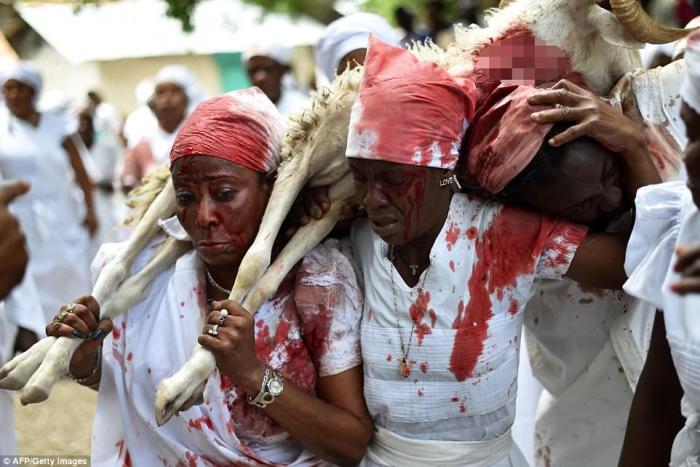
To read about the historic event, click on the links below:


A 15 Year Research Project on Religion in Haiti
The next book I want to write about Haiti will be a complete religious history of the Haitian people. It will be a five volume work on the religious experience and diversity of the Haitian people and their African ancestors. This is a 10 to 15 year intellectual project. The tentative book titles are as follows:
1. “Before Ayiti: African Traditional Religion, Christianity, and Islam: The Religious Experience of our Ancestors” (Volume 1)
* I have already written two chapters on this book.
2. “The Faith of Haiti’s Founders” (Volume 2)
* I have already written a 46-page draft on the religious sensibility of Toussaint Louverture.
I continue my research on the religious commitment of President Alexandre Petion and King Henry Christophe.
3. “Haiti’s God: The Birth of Protestant Christianity in Haiti” (Volume 3)
4. “Catholic Christianity in Colonial Saint-Domingue and Postcolonial Haiti” (Volume 4)
5. “The Concept of God in Haitian Intellectual History and Literature” (Volume 5)
 drcelucienjoseph, "Thinking and Meditating"