“Education Matters and Public Policies Against Educating Poor American Families Hurt Them and Hurt the Future of this Country”

“Education Matters and Public Policies Against Educating Poor American Families Hurt Them and Hurt the Future of this Country”

Today in the middle of class lecture as we were discussing some of the major themes (i.e. reason vs faith, education, the intellectual life) in James Baldwin’s novel, “Go Tell it on the Mountain,” I took a short pause from that to teach my students about the implications of the message of this novel to their personal and public life, and the impact of Baldwin’s ideas on the civil and political societies.

I turned to them and looked at the class intently, and declared: “Every area of our lives engages the political life; whether we want to acknowledge it or not, conscious or unconscious about it, life is about making political decisions.”

I made that statement in class so that my students could reflect critically about the value of education that is promoted in the novel by the major character John when he uses reason and his intellect to balance the seemingly tension between faith and reason. Arguably, the point I wanted to convey to this group of young men and women (the oldest one in the classroom is in her late 30s, the rest of them are between 16 to 21 yrs old) was this, in the form of a question I asked them: “Where in the world would you pay $ 100.00 per credit hr and $ 300.00 for a 3 credit hour course and graduate with a 2 or 4 yr degree without having to take a dime in student loans?”

“The fact that most of you (about 75% of our students receive financial aids and do not pay to attend #IRSC) are attending college here for free.” (I would also argue that colleges in this country should be free to all students; no one shouldn’t have to pay to go to college if your parents make less than $100,000 annually; the median salary for the middle class Americans is under $ 75,000). Further, I also stated in class, “This is a political decision you made when you pay taxes and vote people to occupy the public office. You may not realize it, but it is the true.”

It is only at #IRSC, one of the most affordable 4 yr state colleges in the nation ( I believe we are listed as # 3 in a recent survey on U.S. National Colleges), I told them that you are receiving a quality of education without getting into debt. My underlying thesis was this: “Stay in School. Get an education. Don’t be lazy. Work Hard. Stop procrastinating.Study for your classes. Have a disciplined mind. Graduate, leave #IRSC campus, and Get a Life!”

***Notably, the majority of our student population at Indian River State College come from economically-disadvantaged and poor families, where some of their parents work two jobs and a sizeable number of our students must work also to afford the basic needs of life and help their parents with the bills while going to school–taking a full load every semester.

As a result, we middle class American families and American educators should get angry about the recent proposal from the Trump administration against educating the poor and underserved American families and population:

“The Trump administration is looking to decrease the Education Department’s funding by $7.1 billion compared to what it was given last year, as part of next year’s proposed budget.The budget proposal suggests eliminating 29 programs, including after-school and summer programs for students in high-poverty areas, among other things.”

Click on the link below for more information:

https://abcn.ws/2TJECTz

What will poor American families do? How will the economically-disavantaged students and families survive when the government is going to cut assistance for education?

If a country is not investing in educating its citizens, especially the economically-disavantaged group, it is in fact heightening the already existing inequality gap between the poor and the rich. This country is making its way to further economic decline and moral bankruptcy.

“Molding their Hearts: Mentoring Black Boys to become Men of Dignity and Civil Servants”

“Molding their Hearts: Mentoring Black Boys to become Men of Dignity and Civil Servants”

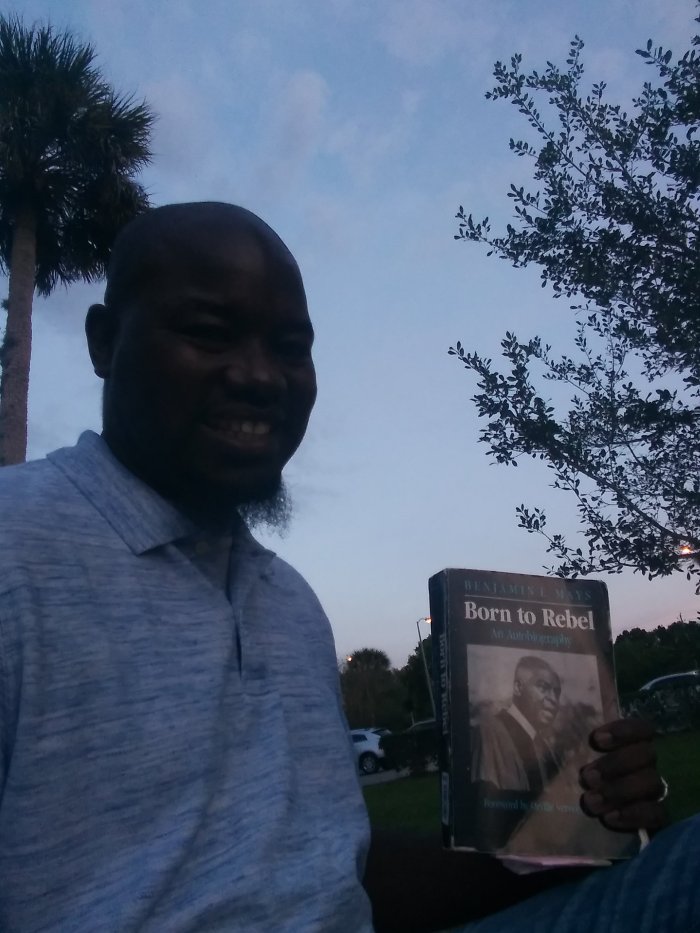
Sitting outside on the beautiful lawn of the #IRSC Vero Beach campus with my invisible friend, Dr. Benjamin E. Mays…

As I continue reading Mays’ autobiography, the paragraph below caught my attention. It is from a speech he delivered in 1926 , which he entitled “The Goal,” to young High School Black boys in South Carolina. Before I share the paragraph with you, allow me to turn your attention to Mays’ conviction about the importance to inspire and mentor black boys in our culture:

“I accepted the invitation, and I worked hard on that speech because I knew that Negro high school students from all over South Carolina would be there. I knew, too, that these Negro boys needed inspiration as surely and as sadly as I had needed it when I was a frustrated lad in Greenwood County onlu a few years before. It was a tremendously gratifying to me that when I finished speaking, those Negro boys, hungry as they had been for someone to speak to their souls, sprang spontaneously to their feet and applauded long and loud.”

I took a shot of the paragraph from the book:

A morning prayer for the City:

A morning prayer for the City:

Let us beseech the God of the City in intercessory prayer for the safety of the city and for his love and grace to reign supreme in the heart of every individual and household.

Let us welcome the Spirit of God to the city so he could move without restraint.

Let us invite the Son to rise up in every corner and public and private place in the city.

Let every heart and household in the city surrender deliberately to the will and sovereignty of the rising Son, the love of the Father, and the comfort of the consuming Spirit!

Amen!

Announcing “Haiti: Then and Now Podcast”

Announcing “Haiti: Then and Now Podcast”

I’m looking for some suggestions:

If I create an online podcast via Skype that will involve interviewing and dialoguing with Haitian and Haitianist (both in Haiti and the Haitian Diaspora) scholars, writers, leaders, thinkers, activists, politicians, educators, professionals, etc., would you be interested to listen to it and share it online with friends?

1. It will be a once-a-month podcast with a YouTube channel.

2. It will be conducted in two languages: Creole and English

3. Our conversations/The podcast will be between 30 minutes to 1 hour.

4. Who would like me to interview?

5. What topics would you like us to talk about it?

My Interview with Dr. Maggie Remy on Current Affairs and Situation in Haiti 🇭🇹

My Interview with Dr. Maggie Remy on Current Affairs and Situation in Haiti 🇭🇹

” In this interview, Dr. Maggie Remy, the host of Sak Pase Radio Show have a heart to heart discussion about The current situation in Haiti. We discuss social economic determinants of the people. Why are we still where we are today?

Corruption
Education
Sanitation
Health
The role of the Diaspora. Why are we not involved or better yet not allowed to be involved.”

https://m.facebook.com/story.php?story_fbid=2209696925758579&id=100001548791037

A 25-Year Christian History in Haiti Project in the Making…. “

“A 25-Year Christian History in Haiti Project in the Making…. ”

When I am done publishing my intellectual biographies on Jean Price-Mars (under contract) and Jean-Bertrand Aristide (under contract), I would like to take on this massive research project for the next twenty to twenty-five years of my life–if the Lord allows me to do so. I will be 68 years old when I complete this five-volume anticipated work (I will be 41 tomorrow: March 6).

1. The Story of Christianity in Haiti Vol. 1: From Slavery to the Haitian Revolution (1517-1804)

2. The Story of Christianity in Haiti Vol 2: From the Birth of Haiti to the End of the American Occupation (1804-1934)

3. The Story of Christianity in Haiti Vol 3: The Emergence of Haitian Evangelicalism and the Indigenous Church (1934-1986)

4. The Story of Christianity in Haiti Vol 4: The Post-Duvalier Church

5. The Church in Exile: A History of Haitian Protestantism in the United States Vol 5: Methods, Testimony, Practices, and (Re-) Adaptation

The State of Haitian Studies

To Those of You Who Work Outside of the Academic World: here’s a little hint to understand how the mind of academics functions and how knowledge in the academia is constructed, deconstructed, subverted, and circulated; please allow me to provide one example among others:

The least unexplored area in contemporary Haitian Studies (CHS) is Haitian (Christian) Protestantism. The most explored terrain in CHS as it relates to the Haitian experience in religion is Vodou. This disciplinary crisis is so serious and broad that one wouldn’t find a full published text in the English language on the birth and evolution of Haitian Protestant Christianity.

By contrast, in contemporary African American Studies (CAAS), Black Protestant Christianity is the most investigated religious expression. All other religious manifestations in black are peripheral and marginalized.

Christianity 101: On “Social Justice” and the “Justice of God” and the “Justice of the Gospel” in Society

Christianity 101: On “Social Justice” and the “Justice of God” and the “Justice of the Gospel” in Society

Can you please define separately both terms “social” and “justice”?

How does the concept of “social justice” relate to God’s lordship in/over “societies” (governing structures and systems in society) to effect the divine agenda of “global justice” and “total righteousness” in the world?

Moreover, how does the concept of social justice, both from a theological perspective and the practice and work of the church in society, relate to God’s eschatological (the “already-not-yet” New Testament concept/understanding framework of salvation-history) vision of redemptive emancipation (beyond the spiritual understanding of salvation) and new creation?

In recent conversations about the relationship between social justice and biblical justice, some Evangelical thinkers and pastors have linked the idea of “social justice” to Marxism and Communism. They have argued that Christians should reject the concept and not use it in their vocabulary. Rather, they suggested that Christians should use the notion of “biblical justice” to align with the intention and will of God on the matter of justice. (Yet the God of the Bible who claims to be a morally just Being also portrays himself as a fierce promoter of total and holistic justice, which may entail justice in all its facets and forms: moral, ethical, religious, social, relational, etc. )

Nonetheless, it seems to me that both “social” and “biblical” are adjectives. The first term is associated with society in general, and the second is linked to the society of the biblical world. (Social justice simply means justice in society or in the social realm.) For example, when we use the phrase the “biblical world,” it is doubtful that we are indicating that all that happened (i.e. human actions, plans, and desires) in the world in which the characters and actors of the Bible lived were sponsored or approved by God. By contrast, by deploying the phrase “the biblical world,” we are referring to a particular era or historical time frame in human history in the ancient world (of the Bible). From this perspective, when we say that something is “biblical,” it does not necessarily mean it is approved by God (I understand this is a common usage and understanding in Biblical and Theological Studies). In other words, linguistically speaking, something (i.e. a public policy or legislation to reduce poverty and crime in the city or to stop or reduce the number of abortion in this country) could be said “social” and Christ-centered or God-approved, correspondingly; social does not mean anti-Christ, anti-Christian, anti-Evangelical, or anti-biblical.

For example, the antislavery movement in the United States was a social, political, economic, and moral campaign against the institution of slavery–yet many Christians supported it; some even owned a few slaves. Many Christian abolitionists contributed to the abolition of slavery as a “social movement” or “social institution.” In this case, these Christian abolitionists were engaged in a “social justice” movement, which for many of them the enslavement of another human being or a particular racial group challenged the justice of God in society and dehumanized a group of individuals created in the Image of God. For these Christian abolitionists, the system of slavery was not “socially” just and was against the biblical definition of justice, that is “biblical justice.”

Hence, the phrase “social justice” does not always have to or should always associate with Marxist and Communist ideologies. It is also good to note that many Christian thinkers or non-Christian/secular critics use Marxism as a tool of analysis to investigate and understand the interplays of class relations and economic dynamics in society. To use a theoretical system to understand a philosophy or another system does not automatically indicate that the user of that selected system is a proponent of that school of thought, for example Marxism.

Unfortunately, many Christian thinkers who have not studied Marxism thoroughly as a critical theory or philosophical school quickly associate Marxism with being anti-Christ and anti-Christian. I must also state that Marxism as a philosophical school is not monolithic and homogeneous. There are many versions or manifestations of Marxism, just in Protestant Christianity one may find Baptist, Presbyterian, United Methodist, Church of God, Pentecostalism, Seventh Day Adventist, etc.

Furthermore, one must be very careful not to make this quick parallel or assumption; evidently, classical or orthodox Marxism is atheistic. Does that mean a Christian cannot learn anything meaningful from an atheist or an atheistic thinker? In fact, if Christians have problems with Marxism as an atheistic philosophy, they will have problems with most of the influential philosophers in modern Western philosophy or simply Christians will stop reading modern Western philosophy in general. Arguably, some of the most influential voices in the history of philosophy in Western philosophy were either atheists, agnostic, or anti-Christian. Another example pertains to the disciplines of modern Biology and Physics, most biologists and physicists today reject theistic evolution and theism, which is the popular view in modern Evangelicalism, in general. Some of these biologists (i.e. Richard Dawkins) and physicists (i.e. the late Stephen Hawkins, Neil Degrass Tyson) are radical or moderate atheists. Yet these scientists have made groundbreaking contributions to our understanding of scince, human life, and the universe. Should we simply stop reading their work or even stop using their scientific theories just because they do not embrace Christianity or endorse our theological commitment to theism?

The underlying point I’m attempting to convey here is this: it is okay for a Christian thinker or scholar to use, for example, critical theory such as Marxism, postcolonialism, post-structuralism, historical criticism, feminism, critical race theory, etc., as a tool of analysis to examine a phenomenon (Christian thinkers should not construe critical theory as just suspicious, anti-theism, or a form of modern secularism. One could use critical theory in the disciples of Biblical and Theological Studies for different purposes, just like both Old and New Testament scholars have exhausted modern literary approaches to studying the text and world of the Bibles.) By using one of the above schools of thought would not make one less of a Christian or lover of God or one would become a radical or moderate atheist. Christians ought to think rightly, responsibly, critically, and fairly and evaluate human knowledge, data, and phenomenon as active and engaged thinkers and critics in society.

Moreover, God is not a Marxist nor was Jesus a communist-Marxist Galilean preacher. Nonetheless, the Prophetic Tradition of the Hebrew Bible and the moral and ethical teachings of Jesus make a clarion call to the people of God and followers of Christ to be “a people of justice” and to embody in thought and action both moral justice and ethical justice in society and in the world.

Divine justice or righteousness not only has a moral aspect; it always leads to social obligations and responsibilities for the people of God and followers of Jesus Christ. God’s moral virtues, which are intrinsic to his nature and actions in the world, are intertwined with his idea of a justice-centered society, which always bears social obligations for the church, God’s only appointed agent in the world. The Christian understanding of spiritual salvation has tremendous implications that could and must contribute to a more equitable and just society; for example, it might entail Christian highest commitment to the Lordship of Christ and the Kingdom of God in society over Christian commitment to nationalistic ideas and political ideologies, Christian renunciation of human oppression and abuse, Christian commitment to the alleviation of human suffering in the world, Christian commitment to caring for the poor, the sick, and the needy in society, and Christian solidarity with the weak and helpless in the world, especially those whose hope is dependent on God for vindication and deliverance.

Finally, oppressive social structures and systems, which are sinful, demonic, and anti-Christ, contribute to the enslavement of the human soul in society, which is/ could be a hindrance to the effectiveness of the Gospel in people’s lives–if Christians fail to challenge them with the transformative power of the Gospel or just choose to ignore them. Followers of Jesus Christ are individuals who have renounced deliberately their own interests to embrace the interests of Christ and what he values. They have also put aside nationalistic ideologies to transform their community and society with the gospel through sacrificially serving and empowering people (especially the economically-disadvantaged populations in our country and in the world), and unconditionally loving and caring for the needy–both in deed and thought.