How long, O Lord? Living gently and revolutionarily in a hostile society and degraded-human life world

How long, O Lord?
Living gently and revolutionarily in a hostile society and degraded-human life world

One thing that is certain in the American society and contemporary global community: the life of a person is not worth a penny. We have invented different grades and scales to assess human dignity and life depending on one’s economic status, privilege, race, gender, religious affiliation, and equally on one’s geography on the world’s map. The dignity of human life has become a social construction, not a natural gift from God himself.

Various global news channels and media just reported the horrible massacre of Muslim worshipers in Christchurch, New Zealand, resulting in the annihilation of 49 individuals and the physical injury of 20 individuals. The incident occurred in two different mosques, and the victims were praying in the mosque. As it is reported, “The chief suspect, a 28-year-old Australian-born man, allegedly published a racist “manifesto” on social media before the attack, featuring conspiracy theories about Europeans being displaced, and details of two years of preparation and radicalization leading up to the shootings” (https://www.bbc.com/news/world-asia-47578798 )

I suppose that in addition to the inhumane nature and workings of economic capitalism and globalization—these two human structures lead to all sorts of problems in the world: global poverty, hunger, disease, death, underdevelopment, health hazards, lack of running water, etc.)—arguably, the two comparable threats to global peace and human flourishing in the twenty-first century global world are “violent religious extremists” and “catastrophic white supremacist ideologies.” Notice that I did not say “religious people” or “White people” are the world’s problems. In addition, I did not state that all religious people are violent extremists nor did I affirm that all white people are catastrophic and white supremacists. I am referring to two particular “worldviews” that have become some of the most pressing needs and dangerous ideologies in contemporary Western civilization and in the world today. Ideologies know no race, ethnicity, gender, identity, or geographical boundary. Both of these phenomena are structural, demonic, systemic, transcultural, and interreligious. These two deadly sins against humanity and human flourishing must die in order for cosmic peace and redemption to reign supreme.

I am not anti-white humanity or anti-religion; certainly, I am against all forms of structural ideologies and epistemologies supported by a particular racialist-based ideology or lens to interpret human dynamics in the world and global history. Correspondingly, I am against all categories of religious ideology and doctrine that exclude certain human beings—because of their race, ethnicity, religion, or geographical location in the world—from God’s abundant grace and global love for humanity. God’s gracious love knows no boundary. Divine love transcends all spheres of life, human cultures or societies, the highest form of human knowledge and achievement, and all potential human capabilities and limitations.

However, religious ideologies predicated upon the mental process or practice of extremism and fanaticism, and racist worldviews grounded on the doctrines of the supremacy of a particular race and the inferiority of other races are products of the devil, the depravity of the human heart, the crisis of human reason, and the structural organization of contemporary societies and world-systems. Yet we must remember that these twin ideologies have a past, a history, and they continue to haunt and degrade our lives and make us suffer.

(White supremacy is a form of spiritual warfare that must be fought with the armor of God and the best Christ-inspired human tactics and weapons. Changing oppressive systems and evil structures is instrinsic to the idea of Christian justice and upholding human dignity in the world. Unjust and oppressive systems and ideologies such as racism, xenophobia, and Islamphobia challenge the dignity and image of God in humanity. They’re sinful, demonic, anti-Christ, and anti-human flourishing. Isn’t it a Christian duty to denounce what’s ungodly and dishorable to God? Those in the seat of power and influence have always interpreted the Bible to carry out their personal and collective agendas, and silence the voice of the oppressed and the poor. They portray themselves as the Guardian of truth and the divine revelation. Sir, We have RECEIPTS!)

I discussed these critical human concerns and pressing needs in a little but important book called “Radical Humanism and Generous Tolerance: Soyinka on Religion and Human Solidarity” (UPA, 2017; 103 pages). How shall we then move forward? In other words, how shall we now live peacefully and in mutual understanding in this world of uncertainty? Below, I suggest ten possible ways toward this end.

Ten Basic Steps to move yourself and the world Forward toward Communal Peace, Global Shalom, and Human Flourishing:

1. The task begins with the self-examination of our conscience and personal actions to discern if we are complicit in the suffering and mistreatment of other people.
2. Be a peacemaker and an advocate of transformative justice in your family, work, community, city, church, and country—or among your friends.
3. Be a servant to people in need and serve them without reproach or grudging.
4. Always find creative ways to inspire and empower people to attain their dreams and for them to become useful and democratically-minded national and global citizens.
5. Defend the rights of the vulnerable and the poor to exist and contribute to their ability to explore their full potential in society.
6. Be an active ally to the (socially and economically) marginalized and racially-minority groups in our society or your community.
7. Do not endorse politicians and legislations that are detrimental to another group, class, or race in our society or in your state.
8. Do not endorse politicians and their foreign policies that are not human flourishing-oriented, peace and unity-based, nor those that do not lead to the improvement of nation-state diplomatic relationships and global safety, prosperity, and unity.
9. Help someone to realize the greatness of God’s love and mercy for himself or herself and for all peoples in the world.
10. Embody and promote the revolutionary ideas and liberative call of Jesus to love all people: “One command I tell you is to love one another, “A new command I give you: Love one another. As I have loved you, so you must love one another. By this everyone will know that you are my disciples, if you love one another.”

I believe the revolutionary life must entail the pursuit, practice, and doing of all these transformative interventions named above. The revolutionary life is a gentle life that redirects one’s attention from the self toward the service and well-being of the other individual and the collective. Living gently and revolutionary is not only a matter of changing one’s attitude toward wholeness. It is in fact an existential commitment that resists self-interest in order to pursue the happiness and joy of other people—, which could and must lead to radical deracination of human evils and oppression and radical transformation of societal structures and organizations, as well as modes of human interaction and rapport. With God’s active assistance and providence, we will together create another humanism, another country, another world, another society for ourselves, for our children, the next generation, and the global community. We must create a world that is based strictly on love and mutual love; that is the only hope for the survival of the human race!

My New Article on James Cone!

I’m pleased to announce that the Journal of Religion and Theology has accepted my new article for publication:

“The Meaning of James H. Cone and the Significance of Black Theology: Some Reflections on His Legacy.”

“The Coneian Turn in Christian Theology in Black” : My next project/article on Cone will explore his politico-theological ideas within the logic of Africana Critical Tradition (that is, in parallel to and connection with the intellectual activism of Du Bois, Fanon, Cesaire, Senghor, Price-Mars, Cabral, etc.) and within the grammar of what I phrase “Black Transnational Consciousness,” a concept I coined in my doctoral dissertation.

“When Literature Hurts and Texts Do Not Bring Healing”: Teaching “The Color Purple”

“When Literature Hurts and Texts Do Not Bring Healing”: Teaching “The Color Purple”

Teaching Alice Walker’s “The Color Purple” (TCP) for a second time is never an easy task for me. When I first began to teach the book last fall semester (2018), I thought that I was emotionally fit and intellectually strong to do it. The more I study and understand the violence, oppression, and abuse–sexual, economic, verbal, psychological, societal, systemic, structural, spiritual, mental, patriarchal–the women characters (i.e. Celie Nettie, Shug, Sofia, Odessa, Olivia) in the text suffer and experience, and compare the shared experiences of women to the various forms of human evil, masculine strongholds and assaults, and toxic forces haunting the lives of women in the contemporary American society, I begin to bear some of those burdens, psychologically and mentally. TCP exposes the reality of psychological fragmentation and emotional burden in the female experience and feminist consciousness; the novel is also an inescapable discourse of textual crisis.

Last fall semester, as I was teaching the novel, a male student stopped attending the course for a month because he could no longer sustain the emotional burden of the text–as he informed me privately. In the middle of class lecture, a young woman shouted, “Some of the things that happened to Celie also happened to me.” The whole class turned their gaze toward her; as a result, she muted her voice.

This spring semester, in a recent class lecture as I was attempting to establish connections and parallels (i.e. woman suffering, rape, abuse, wife-beating) between the lives of women in the novel and the testimonies of the women in the #METOO movement, two young women burst into tears and cried for almost the entire class. Two other young ladies walked out of the class. Several of them (female students) put their heads down. The class was in absolute silence for the next 10 minutes. Everyone was starring me, unable to utter a word!

At the end of our uneasy dialogue, I told the class courageously, “Unfortunately, sometimes in life we have to go through pain and suffering in order to find healing, peace, and an escape. However, it does not always have to be that way.” I will not teach Alice Walker’s “The Color Purple” in the next semester or in the academic year, 2019-2020. I am taking a mental break from TCP.

A year ago, when I told my colleague, DrDanny Hoey, that I was planning to teach Toni Morrison’s “Beloved” and Alice Walker’s “The Color Purple.” He kindly asked me, to paraphrase him, “Celucien, are you (emotionally and mentally) ready and prepared.” He advised me to hold on to the Morrison’s text, but start with Walker. I thought that I was ready to confront the force and revolutionary pen of Alice Walker’s pen.

I estimate that profound and honest textual exegesis and creative hermeneutics of a good text could potentially lead to both emotional pain and psychological healing, even holistic transformation.

Reading a novel and teaching it are two different beasts!

“Education Matters and Public Policies Against Educating Poor American Families Hurt Them and Hurt the Future of this Country”

“Education Matters and Public Policies Against Educating Poor American Families Hurt Them and Hurt the Future of this Country”

Today in the middle of class lecture as we were discussing some of the major themes (i.e. reason vs faith, education, the intellectual life) in James Baldwin’s novel, “Go Tell it on the Mountain,” I took a short pause from that to teach my students about the implications of the message of this novel to their personal and public life, and the impact of Baldwin’s ideas on the civil and political societies.

I turned to them and looked at the class intently, and declared: “Every area of our lives engages the political life; whether we want to acknowledge it or not, conscious or unconscious about it, life is about making political decisions.”

I made that statement in class so that my students could reflect critically about the value of education that is promoted in the novel by the major character John when he uses reason and his intellect to balance the seemingly tension between faith and reason. Arguably, the point I wanted to convey to this group of young men and women (the oldest one in the classroom is in her late 30s, the rest of them are between 16 to 21 yrs old) was this, in the form of a question I asked them: “Where in the world would you pay $ 100.00 per credit hr and $ 300.00 for a 3 credit hour course and graduate with a 2 or 4 yr degree without having to take a dime in student loans?”

“The fact that most of you (about 75% of our students receive financial aids and do not pay to attend #IRSC) are attending college here for free.” (I would also argue that colleges in this country should be free to all students; no one shouldn’t have to pay to go to college if your parents make less than $100,000 annually; the median salary for the middle class Americans is under $ 75,000). Further, I also stated in class, “This is a political decision you made when you pay taxes and vote people to occupy the public office. You may not realize it, but it is the true.”

It is only at #IRSC, one of the most affordable 4 yr state colleges in the nation ( I believe we are listed as # 3 in a recent survey on U.S. National Colleges), I told them that you are receiving a quality of education without getting into debt. My underlying thesis was this: “Stay in School. Get an education. Don’t be lazy. Work Hard. Stop procrastinating.Study for your classes. Have a disciplined mind. Graduate, leave #IRSC campus, and Get a Life!”

***Notably, the majority of our student population at Indian River State College come from economically-disadvantaged and poor families, where some of their parents work two jobs and a sizeable number of our students must work also to afford the basic needs of life and help their parents with the bills while going to school–taking a full load every semester.

As a result, we middle class American families and American educators should get angry about the recent proposal from the Trump administration against educating the poor and underserved American families and population:

“The Trump administration is looking to decrease the Education Department’s funding by $7.1 billion compared to what it was given last year, as part of next year’s proposed budget.The budget proposal suggests eliminating 29 programs, including after-school and summer programs for students in high-poverty areas, among other things.”

Click on the link below for more information:

https://abcn.ws/2TJECTz

What will poor American families do? How will the economically-disavantaged students and families survive when the government is going to cut assistance for education?

If a country is not investing in educating its citizens, especially the economically-disavantaged group, it is in fact heightening the already existing inequality gap between the poor and the rich. This country is making its way to further economic decline and moral bankruptcy.

“Molding their Hearts: Mentoring Black Boys to become Men of Dignity and Civil Servants”

“Molding their Hearts: Mentoring Black Boys to become Men of Dignity and Civil Servants”

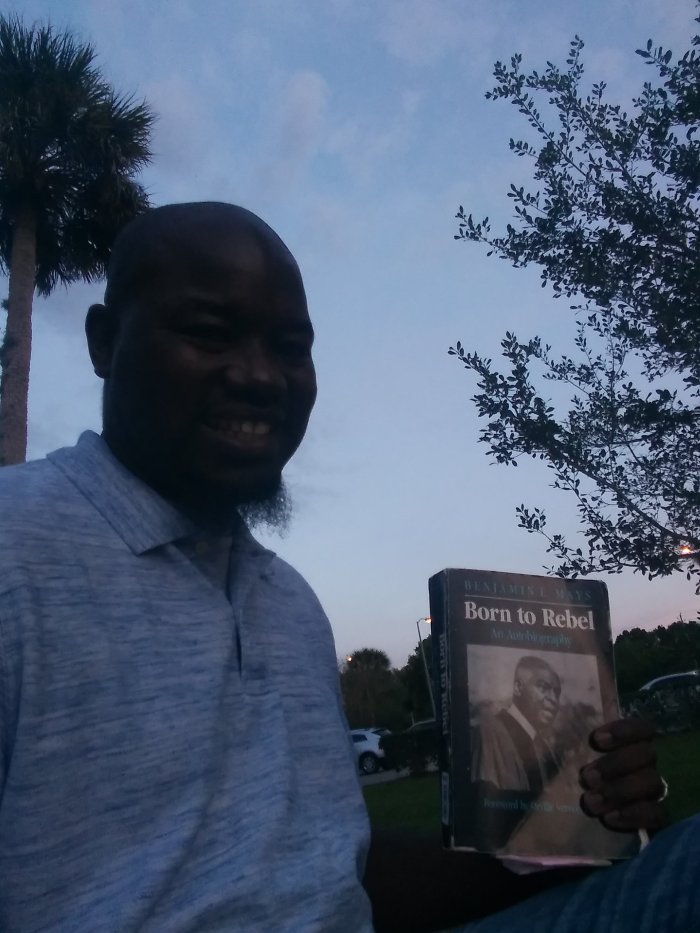
Sitting outside on the beautiful lawn of the #IRSC Vero Beach campus with my invisible friend, Dr. Benjamin E. Mays…

As I continue reading Mays’ autobiography, the paragraph below caught my attention. It is from a speech he delivered in 1926 , which he entitled “The Goal,” to young High School Black boys in South Carolina. Before I share the paragraph with you, allow me to turn your attention to Mays’ conviction about the importance to inspire and mentor black boys in our culture:

“I accepted the invitation, and I worked hard on that speech because I knew that Negro high school students from all over South Carolina would be there. I knew, too, that these Negro boys needed inspiration as surely and as sadly as I had needed it when I was a frustrated lad in Greenwood County onlu a few years before. It was a tremendously gratifying to me that when I finished speaking, those Negro boys, hungry as they had been for someone to speak to their souls, sprang spontaneously to their feet and applauded long and loud.”

I took a shot of the paragraph from the book:

A morning prayer for the City:

A morning prayer for the City:

Let us beseech the God of the City in intercessory prayer for the safety of the city and for his love and grace to reign supreme in the heart of every individual and household.

Let us welcome the Spirit of God to the city so he could move without restraint.

Let us invite the Son to rise up in every corner and public and private place in the city.

Let every heart and household in the city surrender deliberately to the will and sovereignty of the rising Son, the love of the Father, and the comfort of the consuming Spirit!

Amen!

Announcing “Haiti: Then and Now Podcast”

Announcing “Haiti: Then and Now Podcast”

I’m looking for some suggestions:

If I create an online podcast via Skype that will involve interviewing and dialoguing with Haitian and Haitianist (both in Haiti and the Haitian Diaspora) scholars, writers, leaders, thinkers, activists, politicians, educators, professionals, etc., would you be interested to listen to it and share it online with friends?

1. It will be a once-a-month podcast with a YouTube channel.

2. It will be conducted in two languages: Creole and English

3. Our conversations/The podcast will be between 30 minutes to 1 hour.

4. Who would like me to interview?

5. What topics would you like us to talk about it?

My Interview with Dr. Maggie Remy on Current Affairs and Situation in Haiti 🇭🇹

My Interview with Dr. Maggie Remy on Current Affairs and Situation in Haiti 🇭🇹

” In this interview, Dr. Maggie Remy, the host of Sak Pase Radio Show have a heart to heart discussion about The current situation in Haiti. We discuss social economic determinants of the people. Why are we still where we are today?

Corruption
Education
Sanitation
Health
The role of the Diaspora. Why are we not involved or better yet not allowed to be involved.”

https://m.facebook.com/story.php?story_fbid=2209696925758579&id=100001548791037

A 25-Year Christian History in Haiti Project in the Making…. “

“A 25-Year Christian History in Haiti Project in the Making…. ”

When I am done publishing my intellectual biographies on Jean Price-Mars (under contract) and Jean-Bertrand Aristide (under contract), I would like to take on this massive research project for the next twenty to twenty-five years of my life–if the Lord allows me to do so. I will be 68 years old when I complete this five-volume anticipated work (I will be 41 tomorrow: March 6).

1. The Story of Christianity in Haiti Vol. 1: From Slavery to the Haitian Revolution (1517-1804)

2. The Story of Christianity in Haiti Vol 2: From the Birth of Haiti to the End of the American Occupation (1804-1934)

3. The Story of Christianity in Haiti Vol 3: The Emergence of Haitian Evangelicalism and the Indigenous Church (1934-1986)

4. The Story of Christianity in Haiti Vol 4: The Post-Duvalier Church

5. The Church in Exile: A History of Haitian Protestantism in the United States Vol 5: Methods, Testimony, Practices, and (Re-) Adaptation