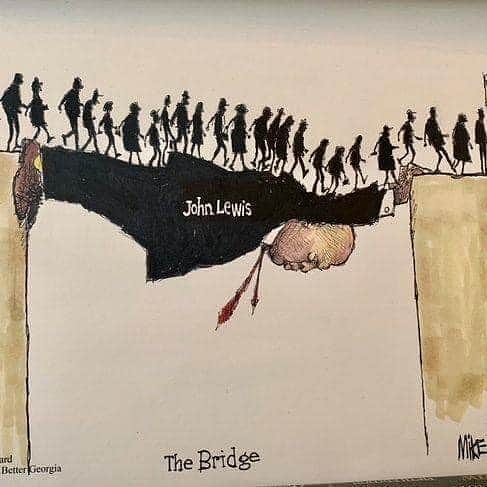
The Bridge: In Praise of Mr. John Lewis and Mr. C. T. Vivian!

The Bridge: In Praise of Mr. John Lewis and Mr. C. T. Vivian!

Sometimes, Black immigrants in the United States take for granted the opportunities, freedoms, and rights they have inherited just because of the resistance and courage of a few great men like Civil Rights leaders John Lewis and C. T. Vivian. We honor both of you today.

As a black man who was not born in the United States, if I can continue to breathe in this country, I owe it to brave African American men and women who have literally sacrificed their lives, shed their blood, and endured humiliation and dehumanization to make it possible for me and my children, and other blacks living in this country.

Thank you, Mr. Lewis!
Thank you, Mr. Vivian!

Your labor is not and will not be in vain. We will continue the struggle for human rights and life, justice and peace, human flourishing, and to create another and better country for all in these United States of America.

***

The words of our departed ancest

“Love is the willingness to sacrifice, to be beaten, to go to jail, to be killed for the betterment of society rather than live out your life in silence. The Civil Rights Movement, above all, was a work of love. Yet, even fifty years later, it is rare to find anyone who would use the word love to describe what we did. We were consciously aware that unity was our ultimate goal, and if that was truly our aim, we had come to grips with the fact that after all the warring was done, reconciliation, love, and forgiveness would have the final say. Our protests were our way of standing in the truth to reach our errant brothers and sisters and encourage them to see the abiding truth that was there before the foundation of the world and would last beyond our existence—we are one people, one family. I like to use the analogy of one house to describe our kinship to all humankind. We all live together in the same house—in different rooms, perhaps, but under the same roof and within the same walls. If one section of our house begins to rot—a basement, a back room, a closed-off closet—the entire structure is in danger of collapsing. It is only by recognizing our unity that we can prevail.”

John Lewis, Across That Bridge (pp. 179-180)

“Multicultural Churches and the Rest of Us”

“Multicultural Churches and the Rest of Us”

Let’s talk for a few minutes about Multicultural Congregations or Churches in the United States! I will ask four questions. I would like us to have a conversation. Everyone is invited to participate in this conversation–both Christians and non-Christians, believers and unbelievers.

  1. If you’re currently attending a multicultural congregation, is the lead or senior pastor White or is the pastor, Black, Asian, Hispanic, Native American, etc.?
  2. It seems to me and in most cases (I could be wrong here) that non-white Christians have no problem being led by a white senior pastor. By contrast, it appears to be a problem for white Christians to sit under the authority and leadership of a Black, Asian, or Hispanic senior pastor. Am I making a false assumption here? Are there valid and biblical reasons why there’s such a gap and unbalance relating to power, authority, and pastoral ministry in multicultural congregations?
  3. How can biblical scholars, Christian thinkers and writers, and theologians, as well as theological institutions and seminaries help shift the power dynamic in multicultural congregations?
  4. Do white Christians truly have a problem being taught, following the lead, sitting under the authority of a senior pastor who is not white?
  5. In what ways are multicultural congregations contributing to improve race relations in society and churches? Or are they also maintaining white supremacy and dominion, as it is present in various circles, institutions, systems, and communities outside the church?

Reading again through Saint Augustine’s “Confessions”: Days 1- 3

Reading again through Saint Augustine’s “Confessions”: Day 3 (Nothing in God Dies!)

“My infancy is long since dead, yet I am still alive. But you, Lord, live for ever and nothing in you dies, because you have existed from before the very beginning of the ages, before anything that could be said to go before, and you are God and Lord of all you have created. In you are the first causes of all things not eternal, the unchangeable origins of all things that suffer change, the everlasting reason of all things that are subject to the passage of time and have no reason in themselves. Have pity, then, on me, O God, for it is pity that I need. Answer my prayer and tell me whether my infancy followed upon some other stage of life that died before it. Was it the stage of life that I spent in my mother’s womb? For I have learnt a little about that too, and I have myself seen women who were pregnant. But what came before that, O God my Delight? Was I anywhere? Was I anybody? These are questions I must put to you, for I have no one else to answer them. Neither my father nor my mother could tell me, nor could I find out from the experience of other people or from my own memory. Do my questions provoke you to smile at time and bid me simply to acknowledge you and praise you for what I do know?”

Reading again through Saint Augustine’s “Confessions”: Day 2 (God, the Most Beautiful One and the Most Present One)

“You are the most hidden from us and yet the most present amongst us, the most beautiful and yet the most strong, ever enduring and yet we cannot comprehend you. You are unchangeable and yet you change all things. You are never new, never old, and yet all things have new life from you. You are the unseen power that brings decline upon the proud. You are ever active, yet always at rest. You gather all things to yourself, though you suffer no need. You support, you fill, and you protect all things. You create them, nourish them, and bring them to perfection. You seek to make them your own, though you lack for nothing. You love your creatures, but with a gentle love. You treasure them, but without apprehension. You grieve for wrong, but suffer no pain. You can be angry and yet serene. Your works are varied, but your purpose is one and the same. You welcome all who come to you, though you never lost them. You are never in need yet are glad to gain, never covetous yet you exact a return for your gifts…Can any man say enough when he speaks of you? Yet woe betide those who are silent about you! For even those who are most gifted with speech cannot find words to describe you.”

Reading again through Saint Augustine’s “Confessions”: Day 1 (You Made Us for Thyself: We Rest in Thee)

“The thought of you stirs him so deeply that he cannot be content unless he praises you, because you made us for yourself and our hearts find no peace until they rest in you.

Grant me, Lord, to know and understand whether a man is first to pray to you for help or to praise you, and whether he must know you before he can call you to his aid. If he does not know you, how can he pray to you? For he may call for some other help, mistaking it for yours.

or are men to pray to you and learn to know you though their prayers?”

“An Open Letter to Dr. Al Mohler and The Southern Baptist Theological Seminary Board of Trustees Regarding Honoring the Founding Slaveholders” by Pastor William Dwight McKissic Sr.

From Pastor William Dwight McKissic Sr.

“An Open Letter to Dr. Al Mohler and The Southern Baptist Theological Seminary Board of Trustees Regarding Honoring the Founding Slaveholders

Dr. Albert Mohler
Southern Baptist Theological Seminary
2825 Lexington Rd.
Louisville, KY 40206
Southern Baptist Theological Seminary Board of Trustees
Dear Dr. Mohler and the Board of Trustees,

Greetings in the Name of our Triune God, “in whom we live, move and have our very being” (Acts 17:28).

The impact you have made on the SBC and the nation will be felt for generations to come (Psalm 145:4).

The purpose of this correspondence is to humbly and respectfully request that the President and Board of Trustees at SBTS remove from SBTS campus, any memorabilia of the founders: James Pettigru Boyce, John Broadus, Basil Manly, and William Williams.

Why? The founders should be acknowledged and appreciated for their role in the establishment and development of SBTS. However, it is biblically inappropriate to celebrate them though, due to the following reason(s): Because of the patriarchy, prejudice, and the promotion of “putrid exegesis,” practiced and preached by the founders of Southern Baptist Theological Seminary, their names need to be removed from the Seminary as memorabilia; this includes the names of Boyce College, Broadus Chapel, and any other places where the names of the founders are displayed, including coffee mugs.

The founders stated motivations to relocate SBTS from Greenville, South Carolina, to Louisville, Kentucky, in 1877 was to escape the presence of freed slaves in Greenville, which they viewed as an “incubus and plague.” They expressed their desire to relocate the Seminary “in a White Man’s country.” Pastor Steve Bezner, who holds a PH.D. in history, recently tweeted: “Boyce helped found the school because the SBC was founded on a pro-slavery hermeneutic and needed a seminary which would support that hermeneutic.” Those scathing words alone merit revisiting this matter.

The founders should be acknowledged and appreciated for their role in the establishment of and development of SBTS. However, it is simply inappropriate and unbiblical to hallow and honor these men in a prominent and celebratory manner.

By allowing the names of the founders to continue to be plastered on walls and memorialized publicly as men of high moral character—you are in effect upholding their legacy of being theological and practical proponents and defenders of White Supremacy and Black inferiority. Furthermore, you are stuffing it down
the throats of those of us who find their actions incompatible with their faith and Baptist orthodoxy. As ministers of reconciliation, we can and ought to do better than this (II. Corinthians 5:18-20). When you build a monument or highlight names of people in significant places, you are telling people, “they did good.” When you build a monument to evildoers, you are telling people, “These evildoers did good!”

The Bible says, “Woe to those who call evil good, and good evil” (Isaiah 5:20). Honoring slaveholders by naming a college, chapel, library, and attaching their names on other high-profile places on campus is honoring them. By having done so, you have effectively called “evil good and good evil.” To defend and honor slaveholders is to defend and honor slavery.

It is a slap in the face of God’s people, and an affront to the Kingdom of God to keep saying slaveholders were theologically right but morally wrong. You cannot divorce theology and morality.

Currently, the BFM2K is the standard for doctrinal orthodoxy in the culture and life of the SBC. The founders of SBTS could not and would not meet the qualifications of being classified as orthodox, because they could not affirm the BFM2K, Section III, “Man.”

The first three sentences in this section read, “Man is the special creation of God, made in His own image. He created them male and female as the crowning work of His creation. The gift of gender is thus part of the goodness of God’s creation.”

The final sentence in Section III, “Man,” reads: “The sacredness of human personality is evident in that God created man in His own image, and in that Christ died for man; therefore, every person of every race possesses full dignity and is worthy of respect and Christian love.”

Boyce, Broadus, Manly, and Williams did not believe that “every person of every race possesses full dignity and is worthy of respect and Christian love.” These men also opposed the suffrage movement and women voting as messengers in SBC annual sessions. These two positions were evidence of misogyny and patriarchy, which is counter-culture to the spirit and the letter of the BFM2K, Section III, regarding “Man.”

Therefore, based on SBC’s doctrinal statement, these men cannot be classified as orthodox. To label these men as “orthodox” radically redefine the historic meaning and usage of the term.

Defending their beliefs and behaviors by suggesting that they were mere men of their times, simply do not justify their heterodoxy or practices. The Quakers, Wilberforce, Spurgeon, James Madison Pendleton, and the Sandy Creek Baptists, all were spiritual leaders during the era of slavery, but they chose to honor Scripture and the fact that man was made—male and female—in the image of God—the Imago Dei.

Throughout biblical and cultural history, God has often chosen to hit straight licks, with crooked sticks, to accomplish His will. That statement would fit all of us to a certain extent, certainly me. Men and women who engaged in a multitude of sins are listed on the Hall of Faith (Hebrews 11). I am grateful that God has more grace than we have sin (Romans 5:20). All of the names in Hebrew 11 were repentant sinners. The Founders of SBTS either left no record of their repentance or in the case of Broadus, later in life, there is a
record of him having changed his tune on practicing slavery, but I am yet to read where he changed his tune regarding his beliefs about the inferiority of the Negro.

When did the founders of SBTS face accountability for their racial and gender sins? They did not! When did the founders repent of their racial and gender sins? They did not!

I am aware that President Mohler and SBTS faculty have released a 71-page, well-researched document, in recent years. This document acknowledges the Seminary’s complicity in participating and contributing greatly to the diabolical institution of American chattel slavery—which, by the way, was radically different than biblical slavery. One was much more brutal and degrading than the other.

I applaud and appreciate SBTS for releasing this brutally honest document on SBTS slavery report. However, acknowledging their heinous sins, while leaving their celebratory memorabilia intact is shortsighted and incongruent. “If a person kidnap, steal and sell your child, where do you want to place the statues [memorabilia] of that person?” Absolutely nowhere! (Rev. Joel Bowman’s quote) Yet, that is exactly what SBTS has done.

We would all agree that the four founders of Southern Seminary could not imagine or fathom, that a day would come, that sons and daughters of their slaves would be admitted as students and serve on the faculty. They did such a good job of instilling the sin of White Supremacy and Black inferiority into the fabric, theology, policies, and image of the school until it was almost 100 years later before a Black student was admitted to SBTS. Is it really fair to ask this generation to honor these men in light of their heterodoxy and immoral lifestyles? If the founders had been drunkards and adulterers, rather than being men stealers and kidnappers, would you honor them? No! Why then are you honoring them? Is it because you don’t see the sin of slaveholding as wicked as drunkenness or adultery?

If there is one major takeaway to recent protests of police brutality and systemic racism, it is—this generation is not going to tolerate, accommodate, or defend the racial hypocrisy and sins of the forefathers. Black students and faculty currently have to walk the halls of SBTS always remembering and being asked to appreciate the captives of their ancestors. That’s a tall ask. Again, future generations will not tolerate what previous generations have accepted. Take note of the departure of Pastor John Onwuchekwa and the Cornerstone Church, Atlanta, from the SBC, if you don’t believe me.
One pushback to my request may be: shouldn’t we extend grace, forgiveness, forbearance, etc., toward the founders? Absolutely! Beyond a shadow of a doubt; and I do. But I can forgive you, and be gracious toward you, without hanging your pictures and memorializing your name in a celebratory fashion around my home.

You are honoring men who never repented of their rebellion and treasonous acts against the United States by serving in and supporting the confederacy. Why then honor them?

The founders were felons while engaged with the Confederacy. Why then honor them?

You are honoring men, who never recanted or repented for teaching and modeling White Supremacy. Why then honor them?

You are honoring men whom according to Dr. Mohler, engaged in “putrid exegesis” of the Scripture in order to justify the enslavement of descendants of Africa. Why then honor them?

You are honoring men who would not have allowed T. Vaughn Walker, Curtis Woods, or Jarvis Williams to have taught at SBTS. Why then honor them?

You are honoring men who would not have allowed Martin Luther King, Charlie Dates, or HB Charles to have preached in chapel at SBTS. Why then honor them?

You are honoring men who would not have allowed your wives to cast a vote for President Mohler’s choice for President, Donald J. Trump. Why then honor them?

You are honoring men, who some were praised for being benevolent slaveholders. That is tantamount to honoring a person for being a benevolent kidnapper. Who would do that? No one, in their right mind. Why then honor them?

The founders were also child abusers. It is impossible to be slaveholders and not simultaneously be child abusers. Why honor them?

You are honoring men, who dishonored Black people and women of all colors. Black people and women had no say so in the decision to honor them. Why honor men who were elected to be honored by other men who essentially found no fault with their beliefs and behaviors?

To say that it is permissible to honor the founding slaveholders of SBTS because they were not primarily known as slaveholders is simply an inaccurate statement. The slaves knew them exclusively as slavemasters. Shouldn’t they count? The slaves did not call the founders “Professor”; they called them “Massa.” Do you really want to continue honoring them? And one can’t study the history of the founders, without soon discovering that they were slaveholders and their wealth derived from slave labor helped to subsidize SBTS, mightily. To ignore the reality of the slaves’ relationship to the founders is to abuse them posthumously. To downgrade the prominence of the founders being well known as slaveholders is being dishonest.

Do you want to continue the legacy and sins that were passed down to you, by passing over this God-given, perfect moment to “remove the stain of racism” from SBTS campus? Why continue to honor them?

Being slaveholders was very much their identity. They were also known as being providers of a theological license to the church and larger society to justify slaveholding. Why then honor them?

Christ should be honored above culture. This is your opportunity to redeem SBTS’ slavery legacy, for the Kingdom of God.

Please don’t let this moment pass. Please make the right decision for the health of the school and for future generations to not have to wrestle with the question: Why is our college and seminary buildings named after “putrid exegetes,” White Supremacist and misogynist, and men who were not orthodox according to the BFM2K and the Bible?

I am formally requesting that Dr. Mohler and the SBTS Board of Trustees, prayerfully and deliberately take up this matter in the 2020 Fall Trustee meeting, and publicly report their findings. Future generations will honor you and hold your great legacy even higher, if you will make a wise decision, in the best interest of the SBC, SBTS and the nation’s health—that so desperately needs racial healing. Dr. Mohler, to paraphrase President Ronald Reagan, “Tear Down Those Names.”

For His Kingdom,
Wm. Dwight McKissic, Sr.”

**** The Southern Baptist Convention (#SBCvoices, #SBCExecComm) is very blessed to have such a godly man and leader like Pastor  William Dwight McKissic Sr. (one of my Christian heroes) who always appeals to Scripture and sound reason to call SBC Christians and the Denomination to greater righteousness, equity, racial justice, and gender inclusion. What a man of conviction!

We will keep insisting until President Albert Mohler, the SBTS Board of Trustees, and the SBC Board of Trustees “take down those names”! Please click on the link below to read a previous letter/article on the same subject:

https://drcelucienjoseph.com/2020/06/20/the-problem-of-memory-of-slavery-and-racism-at-southern-seminary-an-urgent-call-to-remove-the-four-founders-slave-owners-from-the-seminarys-current-memory/
10 Things Blacks and African American People Want in this Country: History and Ancestral (African) Identity:

10 Things Blacks and African American People Want in this Country: History and Ancestral (African) Identity:

  1. Blacks and African American people do not want to hear from White people that slavery and colonization belong to past history. Therefore, let’s not talk about them today. Black people are still shouting today that slavery and colonization have robbed their ancestors of their dignity, humanity, and economic resources. Somewhat, all of us are connected to our ancestors and their heritage.
  2. They believe that chattel and economic slavery and colonization have contributed enormously to their contemporary economic conditions, sufferings, and their ongoing struggle for freedom, economic justice, and rights in the United States and elsewhere in the Western world. They’re not asking for self pitty, but to be understood and to help escape this devastating predicament.
  3. They do not want to hear from Christians and Evangelicals that their ancestral (African) traditions such as African traditional spirituality and religion do not matter and are inferior to Christianity or other religions in the world (i.e. Islam, Judaism, Hinduism, Buddhism)
  4. They do not want to hear from Evangelical Christians that their only choice of religion is Christianity.
  5. They want White people to show that they’re really concerned about black lives and well-being, not just through mere words, but also through their actions.
  6. They want the American government and agents of the State to treat them like human beings, American citizens, and regard them as a people with dignity and a future.
  7. They want the American government and agents of the State to stop showing favoritism and preference to White Citizens. That is what they mean by equality and equal citizenship.
  8. They want to live in peace, work in peace, and enjoy friendship and their families in peace. They just want shalom and unity, and be able to relax in this country.
  9. They want the American government and White people to acknowledge their equal contributions to the American nation and not to erase their history and achievements in this country.
  10. Blacks and African American people want the Police system, the Judicial system, and Prison system to be for them, and not against them. They want equal treatment from these systems as it is for white citizens and non-white citizens in this country.

*** This post or these ten points are also based on a survey that I conducted back in June this year on various social media platforms; here is the original question:

“What are some common (good and plausible) reasons why some Black people (both in the past and the present) reject/rejected Christianity?”

The question below was the follow-up question:

What are some areas in (American) Christianity and christian practices and beliefs (in America) that are outdated and need to be changed, modified, and altogether eliminated so that (American) Christianity could be relevant in contemporary society and of practical value and worth to everyone, especially the racialized and marginalized populations, and the economically-disadvantaged groups?

“Let us dance”(for a city girl who bids goodbye to urban love)

“Let us dance”
(for a city girl who bids goodbye to urban love)

Let us dance
dance to release the burden of loneliness,
to bring friends together,
with strangers, you will make the city as one.
Dance to destroy false joys in the city.
Bad hope will escape urban love, if you dance.
Hope to the dead, if you shall dance.
Dance to bring life, to those who can’t breathe.
To say no anger within, you will dance;
dance for a new season.

Let us dance
dance as if this is your last move in the city;
the final step that will bring a new urban love,
to revive all who do not want to dance.
Dance to create new forms of life in the city;
to say no to pain;
to bring down fresh rain.
Your dance will make urban love beautiful and just.

Let us dance
by dancing, you will shine again,
climbing to the heavenly sky;
touching the highest star in the city;
Dance to marry the boy you love,
to sex in urban joy as one,
together a new offspring will create.
one that will not die in the city.
Dance to bring peace in desolate places;
urban love will build strong.

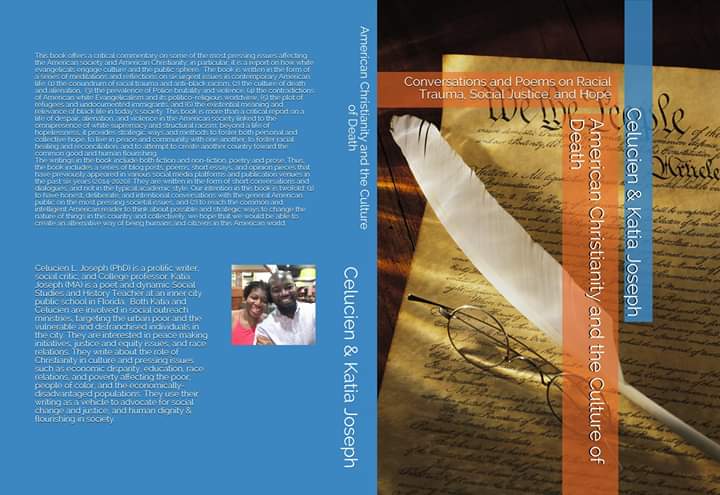
Give-Away Copies of My New Book: “American Christianity and the Culture of Death” (2020)

Give-Away Copies!

I am giving away 15 copies of the PDF version of my new book:

“American Christianity and the Culture of Death: Conversations and Poems on Racial Trauma, Social Justice, and Hope” (2020). 268 pages

If you would like to receive a copy, inbox me or send me an email @ drcelucienjoseph@gmail.com

*** There are two basic rules to receive a free copy of the book:

1) You cannot share the PDF copy with a friend!

2) You have to make your request today (June 27)

Happy Reading!

Excerpts from my new book: “American Christianity and the Culture of Death: Conversations and Poems on Racial Trauma, Social Justice, and Hope” (2020)

Excerpts from our new book: “American Christianity and the Culture of Death: Conversations and Poems on Racial Trauma, Social Justice, and Hope” (2020)

***Now available on amazon in the Kindle edition (e-book)!

“Another Country?

There is a sense to say that American Christianity, especially the white evangelical Christian expression has produced a culture of death in the American society. Arguably, the environment some white evangelicals continue to create in the American culture promotes a life of alienation and hostility for non-evangelical Christians and Christians of color. It is religious alienation and political hostility if an individual or a group is not in the evangelical camp. The political culture produced by white American evangelicals is very antagonistic to those who do not embrace the Republican party, the Conservative agenda, “God’s preferential party,” as the say, or even the “Family values” party, they believe.

In the same line of thought, White evangelicals sustain a culture of death whose aspects include existential, social, religious, economic, political, cultural, and ideological. Because some White evangelicals, for the most part, continue to tolerate the unhealthy ideologies of white supremacy and the dangerous ideas of white Christian supremacist theology, death in the culture is inevitable. Evidently, it is a matter of great urgency for black people and people of color. Whenever white evangelicals choose to remain silent on pressing moral issues such as police violence and brutality toward blacks and people of color, the culture they produce is death. When white evangelicals decide not to confront white supremacy and racial injustice, the environment they promote is death.
Finally, when white evangelical Christians fail to act on their moral duty to challenge the racial biases of the Judicial system, the Prison system, and the Police system that are responsible for the mass incarceration of blacks and people of color in this country, they contribute to racial trauma, black tragedy, and even black death. This is how the culture of death and alienation continue to be present in society.

The American church lost the battle when American Christians refused to stand on the right side of slavery. The evangelical Church failed when evangelicals participated in racial segregation and refused to integrate churches, seminaries, and public places. The Christian church in America lost the battle when the people of God refused to stand on the right side of the Civil Rights moment. All of these failures and sinful actions of the American Christianity and evangelical churches have fostered a culture of death and hostility in this nation. White Evangelicals have failed refugees, immigrants, and people of color in history in many accounts and in my times whenever they took sides of the powerful and abandoned the most vulnerable groups in society. They fail them on moral grounds and when they refuse to be an ally to African Americans and people of color on moral issues affecting their safety and lives in this country.

This book offers a critical commentary on some of the most pressing issues affecting the American society and American Christianity; in particular, it is a report on how white evangelicals engage culture and the public sphere. The book is written in the form of a series of meditations and reflections on six urgent matters in contemporary American life: (1) the conundrum of racial trauma and anti-black racism, (2) the culture of death and alienation, (3) the prevalence of Police brutality and violence, (4) the contradictions of American white Evangelicalism and its despairing politico-religious ideologies, (5) the plot of refugees and undocumented immigrants, and (6) the existential meaning and relevance of Black life in today’s society. This book is more than a critical report on a life of despair, alienation, and violence in the American society linked to the omnipresence of white supremacy and structural racism; beyond a life of hopelessness, it provides strategic ways and methods for the American people and Christians to foster both personal and collective hope, and to live in peace and in community with one another. It is also intended to foster racial healing and reconciliation. This text is an attempt to reimagine another country and an alternative societal life toward the common good and human flourishing.

The language and form in the book include both fiction and non-fiction, poetry and prose. Thus, the book incorporates a series of blog posts, poems, short essays, and opinion pieces that have previously appeared in various social media platforms and publication venues in the past six years (2014-2020). They are written in the form of short conversations and dialogues, and not in the typical academic style. Our intention in this book is twofold: (1) to engage in honest, deliberate, and courageous conversations with the general American public on the most pressing issues of our time, and (2) to reach the common and intelligent American reader to think about future possibilities and some strategic ways to change the nature of things in this country. Collectively, we hope that we would be able to create an alternative way of being human and citizen in this American world.

The fictional aspect of the book contains a series of poems, written mostly in the year 2020 and in moments of national rage and discontent, street protesting, street rioting—considering the recent tragic deaths of Ahmaud Arbery, George Floyd, Breonna Taylor, Rayshard Brooks, and a host of black and brown victims at the hands of American Police and white supremacists. These poems reimagine black and brown lives in a way that they tell complex and difficult stories about the uneasy experience of black people and people of color in the American society. These are stories of lament, poetry of despair and violence, poetry of death and alienation, poetry of black rage and protest, and poetic stories of hope and new creation. The first six poems in Part III (“Dead Bones Rise Up! Poetry of Pain, Suffering, and Revolution”) of the book are written by Katia Joseph. These energetic poems reflect Katia’s significant contribution in the book; through her poetic voice, she deploys the language of poetry to protest, demand justice and equality, to humanize America, and to challenge America to live up to its democratic ideals and promises to black and brown people. “Freedom,” an important poem, is written by Terrence Joseph. Through this poem, Terrence puts accent on the practice and significance of freedom for people of color. The remaining poems and the prose division of the book are written exclusively by Celucien.

Part I of the book engages the world of American Christianity; special attention is given to the dangerous ideologies and practices of white evangelicals. Correspondingly, Part II is concerned about social justice issues; hence, it can be construed as a critique on the American society and culture. The significance and influence of the Black Lives Matters movement in the American society is important enough not to ignore in this conversation; its rapport to the role of religion in society and to the cherished ideals preserved in America’s lofty Constitution and the Bills of Right is worth considering. These foundational documents can still inspire hope in society and empower us as Americans and as a people toward greatness and success. Because these historic documents somewhat and partially symbolize the conscience of this nation, we believe that we can always appeal to them to find direction to bring a cure to our contemporary woes and to create another country for the future generation.

For such a time as this, one thing that is true about the Black Lives Matter movement is this: it has now become a global, intercultural, and interracial BUZZ. People around the world can identify injustice when they see it; they can also identify hatred and bigotry when they see it happen, even to strangers. The world is tired about how America treats its Black citizens and its most vulnerable populations. People are also tired about the silence of evangelical leaders and churches on these moral concerns. The question before us as a nation and people is this: how are we going to move forward? how are going to cure the American soul that has been wounded since the foundation of this Republic. We’ve had an awful beginning. Our foundation is not a glorious one. We have written the loftiest Constitution in the world. Our Bill of Rights is another groundbreaking document in the modern world. These important documents must help us to foster and sustain hope, justice, rights, peace, and freedom for all Americans. We must embody their ideals in practical life so we can live in peace and harmony with each other. No other nation and no other people can do it for us. We are the masters of our own destiny, and the cure to our own wound.
This American nation began in the shed blood of the most vulnerable groups and the racially-outcast populations. The Black problem is never a racial issue; it is more than that. The Black problem is inherently an American issue that we as a people must engage and end, even now. (What black people in this country are striving for is equality, not revenge.) White Evangelical Christianity has compromised its ethics, morality, and conviction for the sake of power and influence. Right-wing evangelicals want to dominate, control the culture, and be a reference point in all things political and cultural. Correspondingly, white evangelical Christianity has been silenced on national issues of racial injustice and police brutality and in part, white evangelicals are morally responsible for the conundrum of Black and people of color in the United States. In their writings, both James Cone and James Baldwin linked the problem of white dominion in society with the compromise of White Christianity. American Evangelicalism not only continues to support white supremacy and anti-black racism in society; traditionally, white evangelical Christians have been instrumental in maintaining whiteness as power and dominion, white supremacy as a system, and theology’s racial identity. In many of his politico-theological writings Cone, for example, has challenged an entire (white) theological system and (white) Christian ethical framework that do not live up to the biblical standard of righteousness and justice. He refuted white American theology because of its silence on black pain & suffering, and black death. He debunked white theological vision of God, humanity, & the world because it is built structurally on the strict doctrine of white supremacy and white racial dominion. Cone understood that (theological) ideas have consequence, and that Black and Brown people in America have become victims of those consequential ideas. Yet he pressed that that Christian actions bear more consequences in this life and the life to come.
In the same vein, in his body of work, Baldwin called for the destruction of white supremacy that holds the black and brown body captive, and he also urged America to abandon the false Christianity that sustains the power and dominion of whiteness. Baldwin’s clarion call for the death of white dominion in America is akin to Cone’s urgent message to reject white American Christianity and theology. Baldwin’s vision of America’s redemption is grounded on an alternative world that begins with a fresh vision of American history and identity, and one that will reassess the dignity and worth of America’s black and brown citizens— without forgetting America’s past.

In addition, both thinkers were aware that America’s dominant religion, white Christianity, and the internal force and system, white supremacy and dominion, that created a subhuman category and a marginalized citizenship in the American society needed to die for the total emancipation of this great nation. In other words, white dominion, supported by the narratives and perceptions of white Christianity, is a theological heresy. James Cone and James Baldwin envisioned an alternative American narrative that is anti-white dominion and a new American saga that desecrates all the sacred places and functions whiteness embodies in the American society, as well as all the geopolitical zones and anti-black and brown narratives race sanctifies, concurrently.
This book is written in the spirit of James Baldwin and James Cone; it follows their lead in these complex and difficult matters it addresses so urgently. Yet our moral responsibility is to love one another and to express the deep dimension of love in public in the way of Jesus. We must learn how to love other individuals our systems, laws, and even our hearts do not allow us to do so. Love here is a command; can we command love? Yes, absolutely! Can you command a feeling? Love is more than a feeling; it is a sacred obligation. Love is the moral responsibility that we must practice and embody every day in this society if we want to recreate this society and move forward as a nation.

As a people, we must begin again. If we have to start off from scratch and with a blank piece of paper, it will even be worth it to use a new ink to write a new American history in the twenty-first century. As a group, we must create another country for the common good, human flourishing, our children, and the future generation. Future possibility is “the possibility” we must now embrace toward a new creation and national renewal. We must build “a new nation” and “begin again” to save the wounded soul of America— only if we want to redeem ourselves and create a society characterized by justice, love, and peace, in which everyone is armed with the appropriate tools and resources to flourish and enjoy existence, rights, and freedom.”

“The Trees That March”

“The Trees That March”

Fight until your weary voice send sounds of roaring waves,
to the highest of the stars,
like a mad soldier in the harsh rain,
you will bring forth a new season,
to exchange the sign of the moon for the sign of peace.
In stormy seasons, don’t you stop the fight.

Fight until the trees are shaken,
for the forest to embrace you,
the leaves bow down for justice,
new roots spring forth to broadcast the good news.
Let the islands hurry to march with you, for a new season of joy,
new branches rising up for a new day.

Fight with the rigor of the Palm tree,
to cover the people in sorrow under your wings,
to shine like the rising sun.
Let your poetry of resistance destroy the old tree,
trees of pain,
trees of tears,
trees of death,
to create a new nation that will last,
a new generation that is yet to be born.

Fight with the strength of the eagle,
to drive away human ego,
to reconcile children of God,
to live in the same village as one,
until we win the trophy of love.

“The Problem of Memory of Slavery and Racism at Southern Seminary: An Urgent Call to Remove the Four Founders-Slave Owners from the Seminary’s Current Memory”

“The Problem of Memory of Slavery and Racism at Southern Seminary: An Urgent Call to Remove the Four Founders-Slave Owners from the Seminary’s Current Memory”

For such a time as this, the Southern Baptist Convention, America’s largest Protestant denomination, should be on the right side of history. In 2017, African American scholars and professors Jarvis J. Williams and Kevin M. Jones edited an important book called “Removing the Stain of Racism from the Southern Baptist Convention.” The basic objective of the book was to revisit the history and legacy of slavery and racism in the Southern Baptist Convention, as well as to propose new solutions to heal the wounded soul of the Convention. In fact, the SBC was founded in 1845 because of a split over the issue of slavery.

Historically, the SBC had not only endorsed slavery as an institution; as a Christian organization, it condemned the abolitionist movement nationwide and supported and practiced racial segregation in its churches, seminaries, and institutions. Contributors of the book such as R. Albert Mohler, President of The Southern Baptist Theological Seminary; Daniel Akin, President of Southeastern Baptist Theological Seminary; Matthew Hall, Provost and Senior Vice President for Academic Administration of The Southern Baptist Theological Seminary; Curtis A. Woods, Assistant Professor of Applied Theology and Biblical Spirituality at The Southern Baptist Theological Seminary; Walter R. Strickland II II, Assistant Professor of Systematic and Contextual Theology and Associate Vice President for Diversity at Southeastern Baptist Theological Seminary; W. William Dwight McKissic, Senior Pastor of Cornerstone Baptist Church in Arlington, Texas, and others have affirmed the difficulty of the Convention to confront its racial history and make peace with its historical memory grounded on the heresy of white superiority and inferiority of Blacks and African Americans. They also observed that as a denomination, the SBC continues to struggle to remove stains of racial prejudice in its institutions and create a positive image for itself.

For example, in the same book, President Mohler affirmed that “We cannot tell the story of the Southern Baptist Convention without starting with slavery. In fact, the SBC was not only founded by slaveholders; it was founded by men who held to an ideology of racial superiority and who bathed that ideology in scandalous theological argument.” In the opening sentence of his chapter, Hall confirmed that “Southern Baptists are more haunted by the ghosts of white supremacy and racism than most denominations. While the specter of racialized injustice and evil left no corner of American religious life untouched, our family of churches has had a particularly sordid and tragic part to play in this story.” President Akin suggested various virtues and qualities that are necessary if the SBC institutions, seminaries, and churches are going to make any substantial progress toward racial justice and to deal with its racial crisis:

“[O]vercoming racism requires humility and sacrifice of the majority race, virtues that do not come easily. You see, welcoming you into my community on my terns is one thing. But to surrender my preferences so that you can feel at home in what is now our community is something more. But let me go further. Even more humility and sacrifice are needed for me to invite you to the table of leadership and to welcome you to sit at the head of the table. Until we can arrive at this God-ordained destination, our convention of churches will struggle to receive the full blessing of God and attain credibility with a cynical and skeptical culture that already questions the authenticity of our faith.”

Within the same line of thought, I am proposing that in these urgent moments of crisis the Southern Baptist Convention has a golden opportunity to eradicate vestiges of racism and white supremacy embodied in Confederate-related items from its campuses and institutions, and to create a committee to review buildings, facilities, and halls that still bear the names of Confederate members, white supremacists, segregationists, and slave owners, such as the four founders of the Southern Baptist Theological Seminary: James P. Boyce, John Broadus, Basil Manly Jr., and William Williams.

Toward this goal, the SBC will make use of this terrific occasion to reinvent itself in the public sphere and to repair its damages as a Christian denomination. This endeavor will move the Convention one step forward toward good practices of racial justice and reconciliation; this constructive effort will also help heal the racial trauma and terror that have for many years affected Blacks and African Americans. This is also a project of both intellectual and spiritual reassessment, and deconstruction and reconstruction. I am suggesting that this important work must begin with the Convention’s flagship institution: The Southern Baptist Theological Seminary.

In the year 2017, President Albert Mohler had appointed a committee of six individuals to prepare a report on the legacy of slavery and racism in the history of the Southern Baptist Theological Seminary. The members of the committee have concluded that the four founders of Southern Seminary, as named above, were active slave owners, ardent white supremacists, and energetically fought against the emancipation of the enslaved population in the United States. In the preface to the report, President Mohler made this honest declaration:

We cannot escape the fact that the honest lament of the SBC should have been accompanied by the honest lament of her first school, first seminary, and first institution. We knew ourselves to be fully included in the spirit and substance of that resolution in 1995, but the moral burden of history requires a more direct and far more candid acknowledgment of the legacy of this school in the horrifying realities of American slavery, Jim Crow segregation, racism, and even the avowal of white racial supremacy. The fact that these horrors of history are shared with the region, the nation, and with so many prominent institutions does not excuse our failure to expose our own history, our own story, our own cherished heroes, to an honest accounting—to ourselves and to the watching world.

Below, I share five major conclusions from the report (The name of the report was “Report on Slavery and Racism in the History of the Southern Baptist Theological Seminary.” The complete document can be accessed on the website of the Seminary.) that substantiate my underlining thesis:

  1. “The seminary’s founding faculty all held slaves. James P. Boyce, John A. Broadus, Basil Manly Jr., and William Williams together owned more than fifty persons. They invested capital in slaves who could earn for their owners an annual cash return on their investment.”
  2. “The seminary’s early faculty and trustees defended the righteousness of slaveholding. The semi-nary faculty supported the righteousness of slaveholding and opposed efforts to limit the institution. A number of the seminary’s prominent trustees advanced public defenses of slavery. Despite his early opposition to slavery as a young man, Basil Manly Sr. eventually became one of its most ardent apologists.”
  3. “Upon Abraham Lincoln’s election, the seminary faculty sought to preserve slavery. They believed that Lincoln’s election threatened the extinction of slavery. Boyce believed that sudden secession would be disastrous, and that negotiation with the Republicans would produce guarantees of protection for slavery. Manly and Williams seemed to view secession as the only hope for preserving slavery. Additionally, trustees such as Benjamin Pressley had made arguments for secession as early as 1851, claiming that defending slavery was of such vital priority that southern states should be prepared to leave the Union.”
  4. “The seminary supported the Confederacy’s cause to preserve slavery. Faculty, trustees, and students joined the effort to defend the independence of the Confederacy. Boyce served in the army at the start and at the end of the war and served in the South Carolina legislature for the entire war. At the 1863 meeting of the Southern Baptist Convention, Broadus drafted and presented resolutions pledging Southern Baptist support for the Confederacy. Broadus and Manly wrote and published literature calling soldiers to believe in Christ and follow him faithfully. Broadus preached the gospel among the soldiers. Students, as well as future faculty members, fought and served as chaplains. All sought God’s blessing for Confederate victory and independence.”
  5. “In the nineteenth and early twentieth centuries, the seminary faculty appealed to science to support their belief in white superiority. The faculty believed that science had demonstrated black inferiority. They were convinced of the superiority of white civilization and that this justified racial inequality. They did so with full confidence that their views were the conclusions of empirical observation undergirded by leading scientific authorities. Writing in 1882, Broadus advanced this sort of thinking, concluding that supposed black moral inferiority was connected to biological inferiority. For his part, Mullins put the matter starkly: ‘It is immoral and wrong to demand that negro civilization should be placed on par with white. This is fundamentally the issue.’ In his estimation, black political participation was the primary culprit in the “race problem.’ Charles Gardner concluded that science had established the inferiority of blacks, appealing to pseudo-scientific studies that concluded that whites were the products of more advanced evolutionary processes: ‘The negro should in some way be brought to the frank recognition of his racial inferiority.’”

To bring this important matter in the context of the ongoing events in our country, since the tragic death of George Floyd at the hands of Minneapolis, across the country and the world, protestors and state leaders have asked to reexamine America’s racist legacy, especially associated with the institution of slavery, Confederate ideology and nationalism, and Jim Crow laws/segregation. In various major urban areas and at least 22 cities such as Richmond, Virginia; Jacksonville, Florida; and Indianapolis, IN; Mobile, AL; San Francisco, CA; New London, CT; Atlanta, GA; Frankfurt, KY; Louisiana, NO; Boston, MA; Detroit, MI; and Minneapolis, Minnesota have already removed or approved the removal of Confederate monuments and statues of slave owners. For example,

• In Alabama, a bronze statue of the Confederate Navy officer Raphael Semmes, was removed from Mobile street and now relocated in the History Museum of Mobile.
• In San Francisco, California, a statue of Christopher Columbus was removed and now placed in storage.
• In Delaware, a statue of a renowned former Delaware leader who owned slaves was removed from the public place.
• In Florida, a Confederate statue that was located in a northeast Florida park for more than a century was recently removed. In downtown Jacksonville, a statue of a Confederate soldier that was located next to the City Hall was also removed.
• In the Kentucky Capitol (Frankfurt), protestors have ordered the governor to take down the statue of Jefferson Davis. Granted their request, the renowned statue will be soon removed.

Beyond the United States, in the city of Bristol, British protesters toppled and then dragged into the river the famous statue of Edward Colston, a notorious 17th-century slave trafficker of Africans. The British people also demanded the removal of the statute of white supremacist and imperialist of Cecil Rhodes. Protesters in Ireland have called to remove a statue of Oliver Cromwell from outside the Houses of Parliament in London. The statue of the celebrated slave trader and colonizer Christopher Columbus was removed in Trinidad and scheduled to be placed in the National Museum or the National Archives. Other protestors have demanded the removal of the statue of the American slave owner Thomas Jefferson in multicultural Paris, France. The presence of these statues and memorials in the public space continue to remind us of the cruelty of slavery and colonialism, as well as the history of suffering and subjection of enslaved African population in the Americas. Black people and people of color in the American society continue to suffer the legacy of slavery, racial trauma, and racial segregation.

In addition to the multiple reasons stated above, the most pressing cause I am requesting the removal of the names of the four founders from Southern seminary’s halls, library, undergraduate college, chapel, and elsewhere on campus is that they do not belong to today’s multiethnic, multiracial, and multicultural Southern Baptist Convention and SBTS. The names of these four gentlemen bring too much pain and suffering to African Americans, Black Christians, SBTS Black seminarians and alumni, and the numerous African American and ethnic churches affiliated with the SBC. Also, their names on the Seminary’s halls, library, chapel, and undergraduate college remind us of the long-held tradition of suppressing the freedoms and rights of Blacks and people of color in this country and in the Convention, concurrently. To continue to honor these figures at Southern Seminary and the SBC is to express racial insensibility and to undermine the dignity and humanity of Blacks and African American people, and people of color. In the same line of reasoning, to maintain these four names in the Seminary’s current memory and archive is to overlook the rich legacy of blacks and people of color in their struggle for racial justice, equality, integration, human rights, and freedom in the American society. Below, I name the six tangible items, memorials, and symbols that need to be renamed at Southern Seminary:

  1. Boyce College: Boyce College is the undergraduate branch of the Southern Baptist Theological Seminary; it bears the name of the slave owner, white supremacist, and Confederate preacher James P. Boyce. James P. Boyce was the first President of Southern Seminary, from 1859-1888.
  2. James P. Boyce Centennial Library: The main library of Southern Seminary also bears the name of James P. Boyce.
  3. Manly Hall: Basil Manly, Jr., served as professor of Old Testament at Southern seminary from 1859-1871, and 1879-1892, respectively. Manly Hall at the Seminary honors his racist legacy as a slave master.
  4. Broadus Chapel: The main chapel at Southern is named after John A. Broadus. Broadus was the second president of Southern Seminary, serving from 1889-1895. He was a fierce defender of the institution of slavery and white supremacy.
  5. Mullins Hall: The designation Mullins Hall refers both to the entire student housing complex and to some individual units in it. Edgar Young Mullins served as Southern’s fourth president, from 1899-1928. Mullins Hall celebrates his mixed legacy as a white supremacist, a Baptist preacheand a champion of racial segregation.
  6. Williams Halls: The designation Williams Hall refers to Dean and Administration offices, Faculty offices, and some Dorm housing. William Williams served as Professor of Church history at Southern Seminary, from, 1859-1877. Williams Halls celebrates the mixed legacy of a slave master and white supremacist.

In conclusion, I hope the Southern Baptist Convention and the Southern Baptist Theological Seminary correspondingly will be committed to completely removing the four finders’ names, items, and symbols that memorialize their racist history and racial practices. By removing their names, the Southern Baptist Theological Seminary and the Southern Baptist Convention would show to the American public and Black Christians that their commitment to racial healing and reconciliation is not a matter of lip-service; rather, it is matter of practice and upholding human dignity and worth as Christian organizations. To continue to memorialize these four individuals (James P. Boyce, John Broadus, Basil Manly Jr., William Williams) is to bring dishonor to the gospel and to bring shame to the Church of Jesus Christ. This is a matter of great urgency; it is also a matter of great significance for the future and public witness of the Seminary and the Convention, correspondingly.

Bibliographic References

The Southern Baptist Theological Seminary, “Report on Slavery and
Racism in the History of the Southern Baptist Theological Seminary,”
https://www.sbts.edu/southern-project/. the complete document can be
accessed on the website of the Seminary.

Los Angeles Times Staff and Wire Reports, “Where have statues of
Confederates, and other historical figures, been removed?” Los Angeles
Times, June 19, 2020,
https://www.latimes.com/world-nation/story/2020-06-16/confederate-statues-removed;
Ivan Pereira,” Here’s where Confederate statues and memorials have
been removed in the US,” ABC News, June 19, 2020,
https://abcnews.go.com/US/confederate-statues-memorials-removed-us/story?id=71200382

Bonnie Berkowitz and Adrian Blanco, “Confederate monuments are
falling, but hundreds still stand. Here’s where,” The Washington Post,
June 20, 2020,
https://www.washingtonpost.com/graphics/2020/national/confederate-monuments/

Marlene L. Daut, “Tear Down that Statue, Mr. Macron!” History News
Network, June 14, 2020, https://historynewsnetwork.org/article/175963

The Southern Baptist Theological Seminary, “The History of the SBTS,”
https://archives.sbts.edu/the-history-of-the-sbts/

Southern Baptist Historical Library and Archives: Biographies,
https://www.sbhla.org/bio_eymullins.htm