“Haitian Studies in the Twenty-first Century”

“Haitian Studies in the Twenty-first Century”

While we should never neglect the substantial contribution of the Haitian Revolution and Vodou Studies—as these two subject areas of knowledge are foundational in the constitution of Haitian scholarship in the English language–in the construction of a distinctively Haitian epistemology, and what Dr. Paul Camy Mocombe has phrased “Haitian Idealism,” contemporary Haitian Studies in the twenty-first century must move beyond the scholarly research on the Haitian Revolution and Vodou to explore other significant fields of knowledge in which Haitian scholars and writers have explained the Haitian experience in both modernity and post-modernity and correspondingly contributed to human understanding and flourishing in the world.

My New Article on James H. Cone!

My very long and detailed article on James Cone was published back in December 2018. I was not aware of it. I just found out today.

“James H. Cone: The Vocation of Christian Theology and the Christian Church Today,” Africology: The Journal of Pan African Studies, vol.12, no.7, December 2018. pp. 8-58.

***Do look forward for two more articles I wrote on James Cone. One will be soon published; the other is currently under review.

Click to access 12.7-2-CLJoseph%20(1).pdf

Happy reading and let me what you think!

“The Call and Courage to Love When It Hurts”

“The Call and Courage to Love When It Hurts”

In the Gospels and Epistles, love is a command, an attitude, and a lifestyle that is distinctively marked the daily interactions and relationships of Jesus’s followers. In fact, in Christianity, love has a nature and an identity, and arguably is a person, as the Bible boldly declares, “God is love.” Love as a divine virtue and moral and ethical virtue comes with many challenges, defeats, and dissappointments. In spite of the complexity to love difficult people, as love is not a natural human virtue, love is the very essence of the Christian faith and the cross of Christ. Jesus commands his disciples to love their enemies and pray to those who persecute them. Apostle Paul states to do everything in love. The Hebrew Prophets compel us to pursue love, mercy and compassion as these threefold divine attribute summarize the greatness of God and God’s loving actions in the world and gracious interactions with human beings. Hence, God’s creation ought to imitate its Creator by being like Him. Those who love unconditionally and pursue love relentlessly are lke God and his natural children.

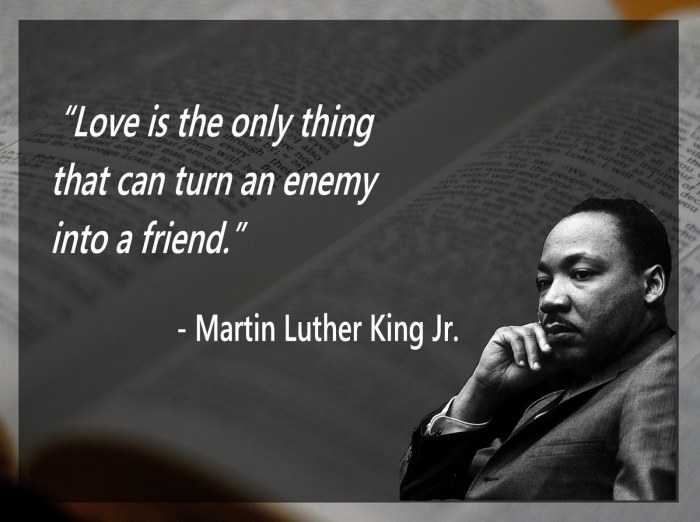
Tomorrow morning (Sunday, January 13) at Jesus Center, I will be sharing a few words about the biblical notion of love as a christian virtue and moral order for Jesus’s disciples. The call to love, even one’s enemies and rivals, is the way of Christ and is the most fulfilling way to imitate God and to become like Jesus.

I look forward to engaging you in this vital and practical conversation at 10:00 am, the time of our corporate worship at Jesus Center. You’re welcome to bring a friend with you.

Love has a name; its name is Jesus.

“Jacques-Jules Bonnaud, the First Haitian Jesuit in Colonial Saint-Domingue-Haiti”

“Jacques-Jules Bonnaud, the First Haitian Jesuit in Colonial Saint-Domingue-Haiti”

As I continue to work on Haiti’s colonial religious history, I discovered an interesting Haiti’s religious gem of colonial legacy: Jacques-Jules Bonnaud, the first Haitian Jesuit.

Father Bonnaud was born in Cap-Francais/Cap-Haitian/Okap in October 27, 1740–only three years before Toussaint Louverture was born in May 20, 1743/Bréda, Cap-Francais– to a French Father and an African mother; hence, he was a mulatto child.

As it was customary in Saint-Dominguan interracial relationships, at an early age, his parents sent the young Jacques-Jules to study in France. He attended La Flèche, a Jesuit High School, associated with the Compagnie de Jésus. In December 20, 1758–the same year Jean-Jacques Dessalines was born in Africa–, he entered the Jesuit order in Paris (des Jésuites de la Province de Paris) as a young seminarian; he was fifteen years old at the time.

The Jesuit Order appointed him as Professor at the Collège de Quimper in Bretagne (Brittany), France’s north-westernmost region. He taught there for two years until the King’s order to close the Compagnie de Jésus in 1762–the same year Britain entered the Seven Years’ War (1756-1763) against Spain and Naples. It was also in April in 1762 that Louis XV passed a decree for all black and mixed-race (mulatto) Frenchmen residing in France to register in the local municipal and with the offices of the Admiralty Court. On the government’s form, blacks and mulattoes had to declare their age, full name, religion, and reveal the purpose they were living in France. They were also to inform the government their place of birth and the name of the ship that transported them to France.

Jacques-Jules Bonnaud was ordained as Priest at the Grande Séminaire de l’archidiocèse de Paris. Due to unfortunate circumstances associating with the French Revolution, he was assassinated in 1792 at the Séminaire des Carmes in Paris. In 1926, the eleventh year of the American military occupation in Haiti (1915-1934), Pope Pius XI beatified Father Jacques-Jules Bonnaud rendering him the first Haitian Catholic Saint. Nonetheless, St. Martin de Porres is the first Black Saint in the Americas.

Arguably, Father Jacques-Jules Bonnaud, the first Haitian Jesuit, was a victim and martyr of the French Revolution.

***Consulted Sources:

Kawas Francois, “Sources Documenaires de l’Histoire des Jésuites en Haiti auc XVIIIe et XXe Siècles” (2006).

Henri Fouqueray, “Un Groupe de Martyrs de Septembre 1792” (1926)

José Luis Saez, “Un Màrtir Broto del Cabo, Santo Domingo” (1978).

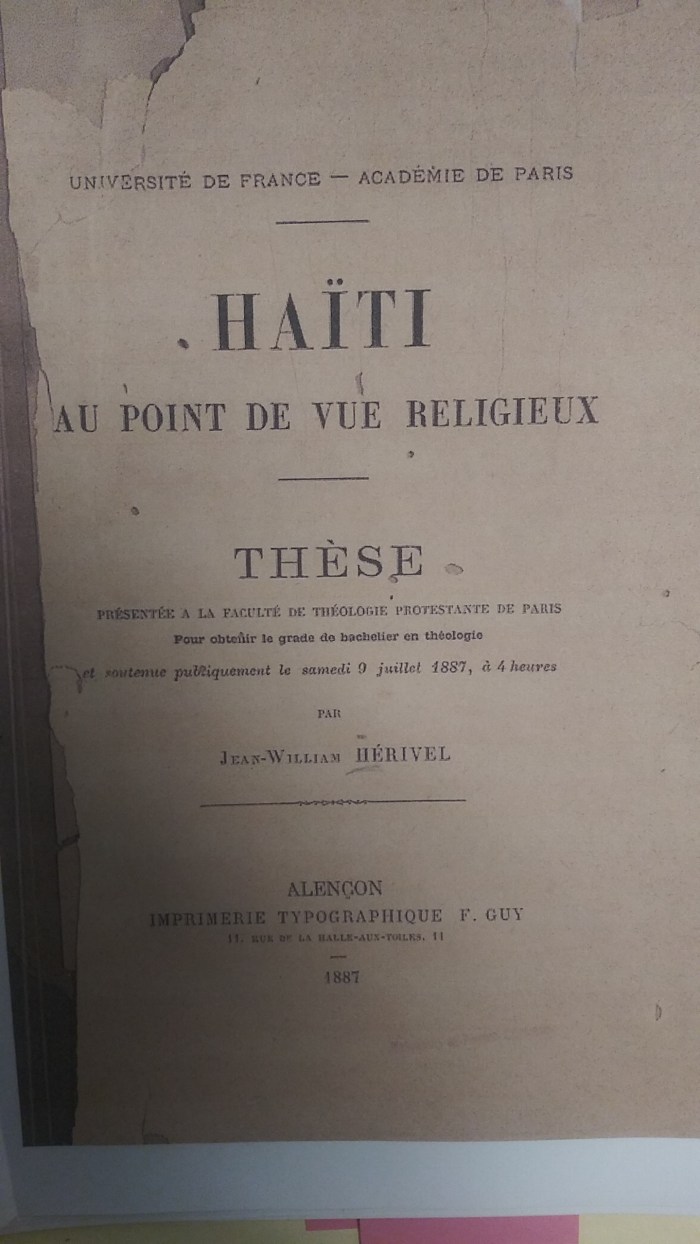
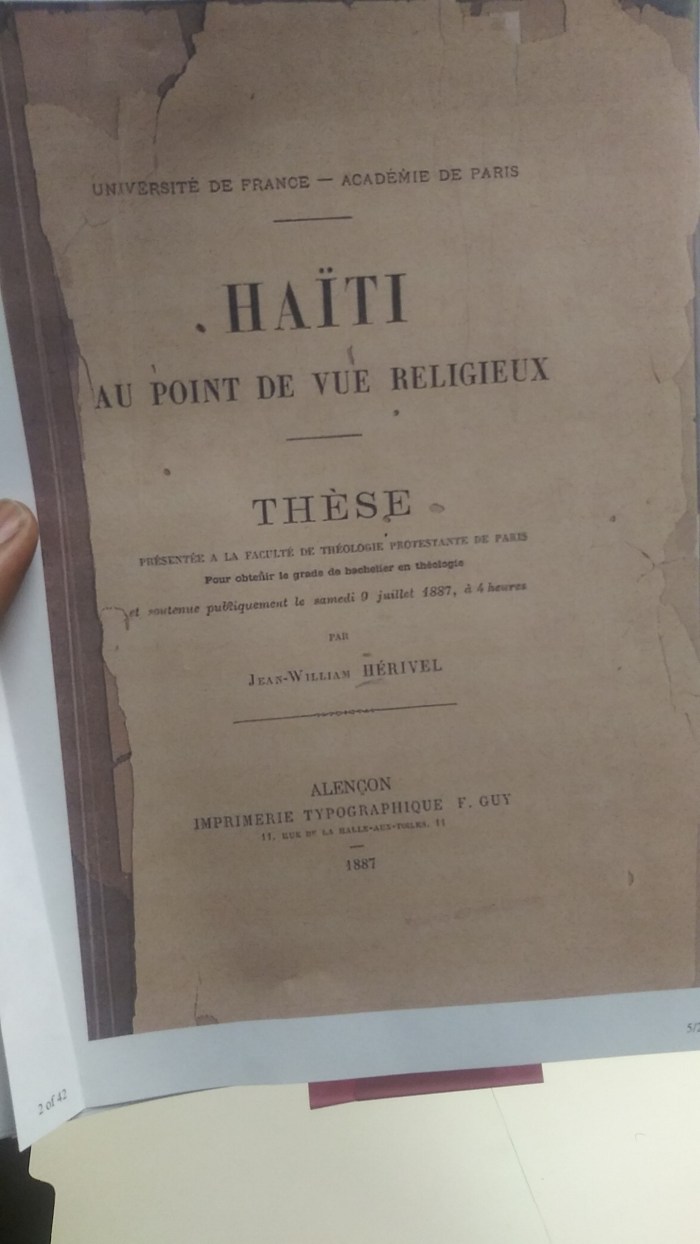
Jean-William Hérivel, First Haitian to receive a degree in Theology from Université de France in 1887!

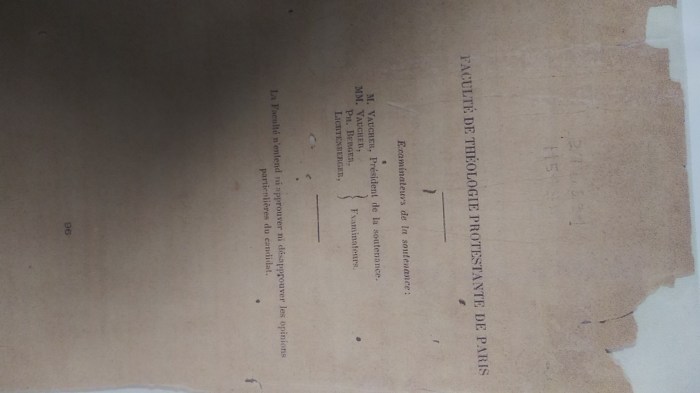
Jean-William Hérivel may have been the first Haitian to study Christian Theology at the Université de France–Académie de Paris (Facultè de théologie protestante de Paris). In July 9, 1887, at 4:00 pm–two years after Joseph Anténor Firmin, the first Black anthropologist, published in Paris and in 1885 “De l’égalité des Races Humaines (Anthropologie Positive)–Mr. Hérivel defended his thesis and was awarded a Bachelier en théologie (B.A., Theology).

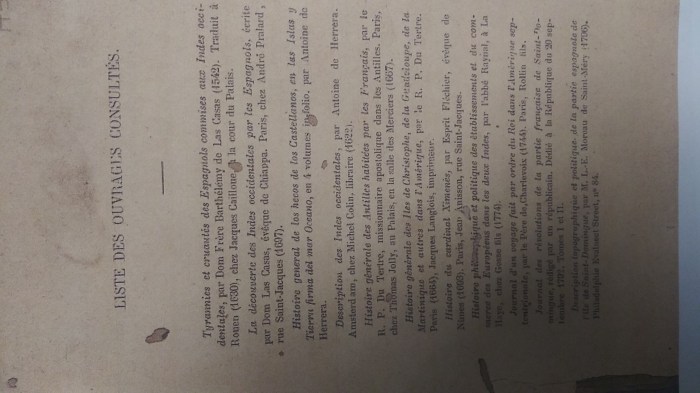
Hérivel’s thesis, “Haiti: Au Point de Vue Religieux” (Haiti: A Religious Perspective) was published the same year in the prestigious “Alencon: Imprimerie Typographique F. Guy. The thesis is about 41 pages; French theologian Ed. Vaugher served as the supervisor of the thesis, and F. Lightenberger was the Dean of the School.

I have a hardcopy of this important work in my home library. Here are a few pictures from the text:

“Haitian History by Haitians: 25 Major Haitian Historians to Read to Really Understand Haiti’s National History and the Haitian Revolution”

“Haitian History by Haitians: 25 Major Haitian Historians to Read to Really Understand Haiti’s National History and the Haitian Revolution”

Let me begin by saying a Happy and Blessed New Year 2019 to all students of Haitian history. I have not intended the recommended list below to be an exhaustive list on the subject matter, but I have selected the most important (classic) works written by Haitian historians in the French language on Haiti’s national history and the Haitian Revolution. My recommendation is limited to twenty-five eminent classic historians. My audience is Haitianists and those have an interest (or are developing an interest) in Haitian studies and Haitian revolutionary scholarship. If the interested reader, historian, or scholar wants to have an exciting adventure about Haiti, why not begin this exploration with Haitian historians themselves to learn about their own perspective about their own history.

1. Valentin Pompée de Vastey, Le système colonial devoile (1814); Notes à M. le Baron de V. P. Malouet … en réfutation du 4ème volume de son ouvrage intitulé: Collection de mémoires sur les colonies, et particulièrement sur Saint-Domingue (1814); Essai sur les causes de la révolution et des guerres civiles en Haïti (1819) / Essai sur les causes de la révolution et des guerres civiles de Hayti (1823/1969).
2. Joseph Saint-Rémy, Vie de Toussaint L’Ouverture (1850); Mémoires du général Toussaint L’Ouverture (1853); Pétion et Haïti, étude monographique et historique. 5 vols. (1854-1857).
3. Thomas Madiou, Histoire d’Haïti. 1847-1848. 8 vol. Révisé et édité (1989-1991).
4. Céligny Ardouin, Essais sur l’histoire d’Haïti (1865).
5. Beaubrun Ardouin, Études sur l’histoire d’Haïti (1853-1860). Edité par François Dalencour. 11 vols.
6. Emile Nau, Histoire des caciques d’Haïti. 2 vols. (1854).
7. Louis-Joseph Janvier, La République d’Haïti et ses Visiteurs (1883); L’Egalité des Courses (1884); Haïti aux Haïtiens (1884); Les Constitutions d’Haïti (1886); Les Jacobins noirs (1949).
8. Alfred Auguste Nemours, Histoire de la captivité et de la mort de Toussaint-Louverture: notre pelerinage à fort de joux (1929); Histoire militaire de guerre d’indépendance de Saint-Domingue (1925); Les Borno dans l’histoire d’Haïti (1926); Les premiers citoyens et les premiers députés noirs et de couleur: la loi du 4 avril 1792, ses précédents, sa première demande à Saint-Domingue, d’après les documents inédits de l’époque, suivi de: Le Cap Français en 1792, à l’arrivée de Sonthonax, d’après les documents inédits de l’époque (1941); La Charte des Nations Unies: Comparaison de la Charte avec les propositions de Dumbarton Oaks, l’alliance de la Société des Nations, les conventions de la Haye, les propositions et doctrines interaméricaines (1945).
9. Horace Pauleus Sannon, Histoire de Toussaint-Louverture. 3 vol. (1920-1933); Haïti et le régime parlementaire (np); Un journaliste sous Boyer (1898).
10. Henock Trouillot, Historiographie d’Haïti (1953); Les origines sociales de la littérature haitienne (1962); Dessalines ou la tragédie post-coloniale (1966); Introduction à une histoire du vaudou (1970); Introduction à une histoire du vaudou (1983).
11. Ernst Trouillot, Demesvar Delorme, le journaliste, le diplomate (1958); Perspectives d’histoire de Saint Domingue et d’Haïti (1961); Code du travail François Duvalier (1980).
12. Jean Fouchard, Les marrons du syllabaire (1953); Plaisirs de Saint-Domingue: Regards sur le temps passé (1955); Langue et littérature des aborigènes d’Ayiti (1972); Les marrons haïtiens: liberté ou mort. Traduit par A. Faulkner (1981).
13. François Dalencour, Précis méthodique d’histoire d’Haïti: Cinq siècles d’histoire – 1942-1930 (1935); Fondation de la République d’Haïti par Alexandre Pétion (1944
14. Dantes Bellegarde, La résistance haitienne (l’occupation américaine d’Haïti) (1937); récit d’histoire contemporaine Écrivains haïtiens: notices biographiques et pages choisies (1947); Histoire du peuple haïtien (1492-1952) (1953).
15. Gérard Mentor Laurent, Six études sur Jean Jacques Dessalines (1950); Toussaint Louverture a travers sa correspondance (1953); Documentation historique pour nos étudiants (1960); Quands les chaines volents en eclats (1979).
16. Georges Corvington, Port-au-Prince au cours des assauts de la révolution (1972).
17. Edner Brutus, Révolution dans Saint-Domingue. 2 vols. (1973).
18. Adolphe Cabon, Histoire d’Haïti. 5 vols. (n.p).
19. Gergard Barthemy, Le pays en dehors: essai sur l’univers rural haitien (1989); Dans la splendeur d’après-midi d’histoire (1996); Créoles-Bosales: conflit en Haïti (2000).
20. Roger Dorsainvil, De Fatras Bâton à Toussaint Louverture (1983).
21. Leslie F. Manigat, Une date littéraire, un événement pédagogique – Essai, Port-au-Prince (1962); L’Amérique latine au XXe siècle: 1889-1929 (1991); Réflexions sur le rétablissement des relations diplomatiques entre Cuba et Haïti (1996).
22. Roger Gaillard, Les cent jours de Rosalvo Bobo (1973); Charlemagne Péralte le Caco (1982); La Guérilla de Batraville (1983).
23. Catts Pressoir, Eléments de géologie d’Haïti (1943); Le protestantisme haïtien (1945); … L’Enseignement de l’histoire en Haïti (1950).
24. Catts Pressoir, Eléments de géologie d’Haiti (1943); Le protestantisme haïtien (1945); …L’Enseignement de l’histoire en Haïti (1950); Haiti: monuments historiques et archeologiques (1952).
25. Timoléon C. Brutus, L’homme d’Airain, étude monographique sur Jean-Jacques Dessalines, fondateur de la nation haïtienne. Histoire de la vie d’un esclave devenu empereur jusqu’à sa mort, le 17 octobre 1806 (1946-7). 2 vols; Revolution de Saint-Domingue. 2 vols. (1973); Les plantes et les légumes d’Haïti qui guérissent: mille et une recettes pratiques (1989). 2 vols.

****The 26-writer bonus: Damase Pierre-Louis, Le President Borno et la Liberation du territoire (1924); Les mensonges de notre democratie (1933); Pouvoir et Politique (1934).

Now, you have no reason to complain that I have not given you any present for the New Year, 2019. Happy reading and research! 🙂

“Welcoming the New Year with New Books”

“Welcoming the New Year with New Books”

To celebrate the coming of the new year 2019 toward self-care and intellectual formation, I am pleased to welcome five new books in my home library:

1. “The Expanding Blaze: How the American Revolution Ignited the World, 1775-1848” by Jonathan Israel

2. “Spirit in the Dark: A Religious History of Racial Aesthetics” by Josef Sorett

3. “Passionately Human, No Less Divine: Religion and Culture in Black Chicago, 1915-1952” by Wallace Best

4. “New World A-Coming: Black Religion and Racial Identity during the Great Migration” by Judith Weisenfeld

5. “Now My Eyes Have Seen You: Images of Creation and Evil in the Book of Job” by Robert Fyall

*** The above books, although some of them were published three to four years ago, were in amazon’s wish list; I waited when the price was substantially reduced to order them. This is my technique or method to buy new books, which I have been practicing since I was an undergrad student. 🙂

“A Return to Toussaint’s engagement with faith”

Two years ago, I wrote a 56 page draft on the religious belief of Haiti’s founding father Toussaint Louverture, wherein I reread selected primary texts written by Toussaint himself, in which he discussed his religious sensibility and attitude through his own autobiography, the legal texts he ordered as Governor of Saint-Domingue to be instituted, and the various correspondences and letters he penned to British and French political leaders in the second half of the nineteenth century—within the historical trajectories of Enlightenment’s reason and modernity, the promotion of “civil religion,” an ensuing conclusion of the triumph of rationality by European philosophers and men of letters and a useful blend influential political leaders in the Americas such as Toussaint Louverture, George Washington, Thomas Jefferson, Abraham Lincoln, Jose Marti, and Simon Bolivar found it (civil religion) meaningful in the construction of nation-states and in legislating new laws to regulate citizens’ morality and ethical decisions and their interactions in the corresponding newly founded society and culture in the Americas.

In the year 2019, shall the good Lord continue to grace my life with physical strength and intellectual energy, I will revisit the above article and explore what Haitianists, both Haitian-born and non-Haitian scholars, have written about Toussaint’s faith. The chosen methodology is to evaluate (1) Toussaint’s faith in the context of Vodou scholarship, (2) Toussaint’s faith in the context of Haitian Catholicism, and (3) I will assess the historiography of Haitian religious scholarship in light of Toussaint’s own (religious) voice and “expressed religious piety and secular faith” through his written texts.

For me to write about Toussaint’s faith is to embark on an intellectual journey that will involve (1) the process of challenging and deconstructing “incorporated ideologies” into Haitian religious history and Haiti’s national history; (2) it is also an attempt to construct a more accurate narrative of Haiti’s founders (and the Haitian people’s) ambivalent experience with religion and faith; and finally, (3) this article is also a process to revisit and reconstruct the rapport between nationality, identity, and religious affiliation in Haiti’s national and intellectual history.

Call for Papers: Africology: Journal of Pan African Studies (AJPAS): Special Issue on James H. Cone

Repost and Extended Deadline: January 27, 2019

“On the Side of the Poor and in Solidarity with the Oppressed: The Meaning and Legacy of James H. Cone (August 5, 1936 – April 28, 2018)”

Call for Papers

Africology: Journal of Pan African Studies (AJPAS)

Special Issue on James H. Cone

Celucien L. Joseph, PhD, Guest Editor

Deadline for Final Submissions: February 8, 2019

The Africology: Journal of Pan African Studies (AJPAS), the premier academic journal on Pan-African studies and Black thought in the world, is pleased to announce the Call for Papers for a special issue on the work of the eminent theologian, activist, and Father of Black Liberation Theology James H. Cone, who left this world for a better world on April 28, 2018. The underlying theme of this special issue pertains to the clarion call by James Cone to protagonists of human rights and freedom fighters to assume their sacred duty and public role and responsibility to be on “the side of the poor and in solidarity with the oppressed;” this twin idea underscores the meaning, relevance, and legacy of James H. Cone in the age of destructive globalization, American foreign (military) intervention, and Western capitalism in the developing nations, as well as the ongoing threats and challenges of white supremacy and white terrorism in American society, and American aggressive racism toward the black and brown populations, and the hostile xenophobic attitude toward the immigrants and political refugees under this current political administration.

In his writings, Cone articulated a Black politico-theology of liberation in the historical trajectories of the Civil Rights Movement and Black Power in the 1960s and within the tragic narrative of the Black experience and Black suffering in the United States. He conceptualized his theological ideas and moral demands as a corrective rejoinder to the triumph of white supremacy in the American society, white violence against Black citizens, and the silence of White American churches and theologians to promote brotherhood and safeguard the humanity and dignity of Black people against Police Brutality, dehumanization, and racial oppression and terror. In an article entitled, “Black Theology and the Black Church: Where Do We Go from Here?” (2004), Cone articulated the Black theological discourse as a “radical response from the underside of American religious history to the mainstream of white Christianity.” For Cone, Black Liberation Theology is an urgent call to white American Christians and churches to exercise radical transformation of thought, behavior, and actions toward the oppressed and the poor. The goal of Black Liberation Theology is to fight against all forms of human oppression and assault, and all evil forces of alienation and destruction against the underrepresented and marginalized populations—toward their full emancipation, human flourishing, and the realization of their human potential as Imago Die. Correspondingly, in his second and seminal work, A Black Theology of Liberation (1970), Cone argued that Christian “theology cannot be separated from the community it represents. It assumes that truth has been given to the community at the moment of its birth. Its task is to analyze the implications of that truth, in order to make sure that the community remains committed to that which defines its existence.”

Consequently, the five-fold objective of this special issue is (1) to highlight the politico-theological ideas and ethical demands of James H. Cone for the advancement of human rights, life, and freedom of the marginalized populations and races, and the economically-disadvantaged groups in the United States and in the world; (2) to underline the intellectual contributions of Cone’s writings to the advancement of knowledge and understanding in the academic disciplines of Christian theology and ethics, African American Theology and Biblical Hermeneutics, Postcolonial Theologies and Biblical Hermeneutics, and Black and Pan-African Studies, and their cognate areas; (3) to use Cone’s writings and thought as a form of intellectual criticism to and moral outrage against the American Empire and Western Capitalism in the world, (4) to revisit Cone’s intellectual legacy as a critique and series of jeremiads about the failure and silence of the American society and American Christianity in the mistreatment, suffering, alienation, and death of the black and brown populations; and finally, (5) to accentuate the intellectual impact of Cone’s writings and ideas on Black and African American theologians and Biblical scholars, Womanist theorists and ethicists, and Womanist Biblical scholars and theologians, and Postcolonial African thinkers, theologians, and leaders in the developing nations.

We welcome articles, both in English and French, within these five broad categories, that articulate fresh and innovative readings and interpretations of Cone’s ideas and writings. Interested participants should submit a 250-word abstract along with a 2-page cv by Friday, December 28, 2019, to Dr. Joseph, Guest Editor of the Special Issue on James H. Cone, at celucienjoseph@gmail.com. The deadline to submit the final article or completed manuscript is Friday, February 8, 2019.

About the Guest Editor: Celucien L. Joseph (PhD, University of Texas; PhD, University of Pretoria) is an intellectual historian and Christian theologian. Currently, he serves as an associate professor of English at Indian River State College. He published seven academic books and more than two dozen peer-reviewed articles on the intersections of literature, history, religion, race, and history of ideas; his recent book is entitled Between Two Worlds: Jean Price-Mars, Haiti, and Africa (Lexington Books, 2018) His academic research and teaching interests include Black Religion, Black Liberation Theology, Black Theological Ethics and Anthropology, African American Intellectual History, Black Internationalism, and Comparative History and Literature of the Black and African Diaspora (both Francophone and Anglophone). He is currently working on two books: the first is a a volume on Jean-Bertrand Aristide, former President of Haiti and Catholic-Priest Liberation Theology entitled Aristide: A Theological and Political Introduction to His Life and Thought (forthcoming in 2019, Fortress Press), and the second is on the Haitian Pan-Africanist and Haiti’s reigning intellectual in the twentieth-century Jean Price-Mars, entitled Jean Price-Mars: An Intellectual and Religious Biography (Wipf and Stock Publishers, 2019).

Dr. Joseph currently serves on the editorial of Africology: Journal of Pan African. He served as the Guest Editor to the AJPAS special issue on Wole Soyinka entitled “Rethinking Wole Soyinka: 80 Years of Protracted Engagement” (2015). He reviews manuscripts for various journals and has presented papers at conferences, both nationally and internationally.

Contact Info:
Interested participants should submit a 250-word abstract along with a 2-page cv by Friday, December 28, 2019 (the deadline is now extended to January 27, 2019), to Dr. Joseph, Guest Editor of the Special Issue on James H. Cone, at celucienjoseph@gmail.com. The deadline to submit the final article or completed manuscript is February 27, 2019.

About the Guest Editor: Celucien L. Joseph (PhD, University of Texas; PhD, University of Pretoria) is an intellectual historian, literary scholar, and Christian theologian. Currently, he serves as an associate professor of English at Indian River State College. He published seven academic books and more than two dozen peer-reviewed articles on the intersections of literature, history, religion, race, and history of ideas; his recent book is entitled Between Two Worlds: Jean Price-Mars, Haiti, and Africa (Lexington Books, 2018) His academic research and teaching interests include Black Religion, Black Liberation Theology, Black Theological Ethics and Anthropology, African American Intellectual History, Black Internationalism, and Comparative History and Literature of the Black and African Diaspora (both Francophone and Anglophone). He is currently working on two books: the first is a a volume on Jean-Bertrand Aristide, former President of Haiti and Catholic-Priest Liberation Theology entitled Aristide: A Theological and Political Introduction to His Life and Thought (forthcoming in 2019, Fortress Press), and the second is on the Haitian Pan-Africanist and Haiti’s reigning intellectual in the twentieth-century Jean Price-Mars, entitled Jean Price-Mars: An Intellectual and Religious Biography (Wipf and Stock Publishers, 2019).

Dr. Joseph currently serves on the editorial of Africology: Journal of Pan African. He served as the Guest Editor to the AJPAS special issue on Wole Soyinka entitled “Rethinking Wole Soyinka: 80 Years of Protracted Engagement” (2015). He reviews manuscripts for various journals and has presented papers at conferences, both nationally and internationally.

New Article on Jame H. Cone Submitted to Journal!

I just submitted another article on James H. Cone to one of my favorite journals on Black religion and theology. I hope it will pass the rigorous test of the peer review process 🙂

For the year 2018, I wrote three detailed articles on James Cone exploring different, but interconnecting themes in his theology. (Both of them were supposed to come out in December. I am not sure why both journals are delaying the publication of their next issue. Well, I am not in a hurry. I suppose that both articles will now be published in 2019, not 2018 as the editors have previously informed me.) From my perspective, the two cardinal and inseparable themes in Cone’s theological corpus is arguably his articulation of a robust theological anthropology and a revolutionary doctrine of God; both theological formulations have departed from the traditional Western-European theological methodology and theological diction. This alternative way of doing theology in/from the margins and establishing the rapport between theology and anthropology has now become an intellectual tradition in modern contextual and constructive theologies, both in the developing and developed worlds and among the religious thinkers that promote them.

While Cone has invested a lot of intellectual energy in developing with greater theological precision and clarity a comprehensive discourse on (black) theological anthropology, his doctrine of God is the bedrock that sustains Cone’s theological understanding of humanity and all of his theological subsets. I believe his theological anthropology is more expressive than any other theological topics he wrote about.

To express it concisely, Cone articulated a God who has revealed himself in Jesus Christ with the intended purpose to free the oppressed (i.e. black people) and deliver the poor from their oppressors and abusers. In Cone’s theological logic, God makes use of his transcendence and power to humanize and recreate the fragmented lives of the world’s poor and the economically-disadvantaged populations in the world. God’s revelation means good news to the vulnerable and freedom, life, and recreation to those who hope solely in Him–not in the powers and systems of this world–and concurrently to those (the miserable) whom God has chosen to grant justice and show his loving-kindness–by demolishing the powers, systems, structures, and forces of this world that alter their existence and dehumanize the Imago Dei in them.