Life Before and After Birth

The affirmation of the sanctity of the life of the unborn should not be equated with the preservation and protection of that life when he or she is born. A rigorous humanistic and Christian philosophy of the dignity of human life, both unborn and born, must entail the active caring and sustaining of the human life, both before and after birth.

If we can create laws and public policies to safeguard the life of the unborn, correspondingly, we should create legislations to improve human life in general and allow it to flourish and grow socially, intellectually, relationally, and economically; likewise, we should be diligent and proactive to make laws to challenge the negative forces and infrastructures (i.e. cultural, political, economic, ideological) in our culture that dehumanize certain lives and demonize human dignity in our society.

Yes, W. E. B. Du Bois’s father, Alfred Du Bois, was born in Haiti and was a Haitian mulatto!

Yes, W. E. B. Du Bois’s father, Alfred Du Bois, was born in Haiti and was a Haitian mulatto!

Du Bois, in his third autobiography, discusses that his grandfather attended the Trinity Parish of the Episcopal church, and that he was one of the “few colored communicants” (“The Autobiography of W.E.B. DuBois,” pp. 67, 65-68); Du Bois’s great grandfather, Dr. James Du Bois, was a physician in Poughkeepsie. He was born in 1750. Du Bois wrote, “Whether, as is probable, he took a slave as a concubine, or married a free Negro man–in either case two sons were born, my grandfather Alexander in 1803 and a younger brother, John” (p. 65). By consequence, Alexander Du Bois, W.E.B. Du Bois’s grandfather was a mulatto, a man of a mixed raced: from a French man (James Du Bois) and an African woman. After their African mother died in Saint-Domingue-Haiti, Du Bois’s great grandather (Dr. James Du Bois, who died in 1820) moved with both of his sons to New York, in 1810. Du Bois wrote, “Both were white enough to ‘pass,” and their father entered them in the private Cheshire School in Connecticut” (p. 65). In other words, both John and Alexander were members of the Saint-Dominguan gens de couleur class, that is, they were mulattoes, men of two mixed races: White and African. Du Bois also remarked, “Just what happened to John, I do not know. Probably he continued as white, and his descendants, if any, know nothing of their colored ancestry” (p. 66).

Du Bois’s grandfather (Alexander) went back to Haiti around 1820s; he married a woman there, most likely a mixed woman or black woman. He and his wife gave birth to a son, Alfred Du Bois (W.E.B. Du Bois’s father) in 1825. In the next sentence, Du Bois tells us that His father “may have married into the family of Elie Du Bois, the great Haitian educator” (p.66). Du Boi’s grandfather left Haiti in 1830 with his son, Alfred, for New Haven. Alfred was only five years old. Moreover, In Du Bois’ second autobiography, “Dusk of Dawn,” which he published in 1940 (“The Souls of Black Folk,” as being his first autobiography was published in 1901; “The Autobiography of W.E. B. Du Bois,” his third autobiography, which he published in 1968), asserted, “My father, a light mulatto, died in my infancy so that I do not remember him” (p. 12).

Finally, in an article from an online archive about Du Bois’s mother, Mary Silvina Burghardt, associated with the University of Massachusetts’ research library, the writer discusses the mother’s family and her mulatto-husband Alfred Bu Bois in this way: “According to family tradition, Adelbert’s father was Mary Silvina’s first cousin, John Burghardt, but Adelbert himself later claimed that his father was Charles Craig. Either way the fact that he was illegitimate tarnished Mary’s reputation and probably limited her future choices. Certainly by the time she met Alfred Du Bois—light skinned with Franco-Haitian ancestry, an appealing and exotic combination—she was ready to marry with the hope of improving her station in life” (http://scua.library.umass.edu/duboisopedia/doku.php…). The point is this: Alfred Du Bois, W.E.B. Du Bois’s father, was a Haitian man and mulatto!!!

“Let Your Passion Be Single” by John Piper

The link below will take you to the sermon that I heard some 19 years ago; it changed my life forever and radically transformed my understanding of the God of the Bible (doctrine of God) and my theological anthropology. I was then 20 years old, young, and an undergraduate student. I have listened to this sermon one hundred times; hence, it is my pleasure to invite you to listen to it.

“Let Your Passion Be Single” by John Piper

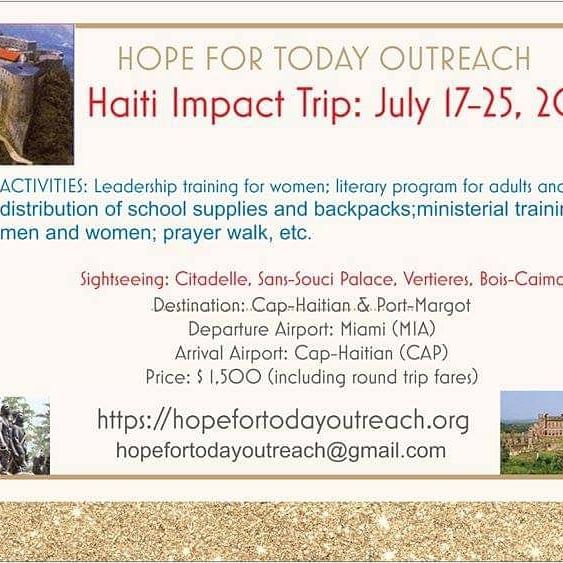
About Haiti Impact Trip: July 17-25, 2019

About Haiti Impact Trip: July 17-25, 2019

DONATIONS NEEDED FOR THE TRIP!

We would like you to join us this year in this exciting trip and hope you will consider donating supplies and resources toward the HAITI IMPACT TRIP. Here is the list of the items we are collecting:

Backpacks
Notebooks & Binders/Composition noteooks
Pencils, pens, color crayons, erasers, glue sticks, rulers, pencil sharpeners, etc.
Socks–any size for elementary to high school students.

*Our goal this year is to provide school supplies to 250 Haitian Children. We are currently accepting donations, and the deadline to provide any of the items listed above is Saturday, April 20, 2019. We will ship the items to Haiti in the first week of May to get there on time.

We can be reached in a number of ways:

By Mail

Hope for Today Outreach (HTO)
P.O. Box 7353
Port Saint Lucie, FL 34985

By Phone: 772-985-0696
By Email: hopefortodayoutreach@gmail.com
Visit our website: https://hopefortodayoutreach.org/

Mesi ampil/Thank you very much!

Hope for Today Outreach Team

“Ten Theses about God’s Providence and American Politics”

“Ten Theses about God’s Providence and American Politics”

Generally, American Christians and especially American Evangelicals have held for so long a distorted view on God’s providence and its interplays in American politics and foreign policy. My goal in this brief post is for the Christian community in the United States to foster a healthier and biblically informed position on divine providence, and that their political decisions and moral and economic choices to be faithful to biblical principles and values and the teachings and virtues of Christ on these pressing issues of our time. Below, I articulate ten theses associating with the doctrine of divine providence and the works and interventions of God in American politics and governance:

1. The political choices and politically driven moral choices of the Evangelical Right and Christian Conservatives should not be equated with God’s decisive will (or divine determinism) for the American people and the future of the American nation. The United States is a democratic nation and a secular state that established the freedom of choice and the freedom of rights for its citizens regardless of their religious affiliation and ideological worldviews.

2. Although the God of the Bible is a political God, he is not a political monster, nor has he granted one (specific) nation (i.e. United States of America) the right of political hegemony and domination over the most vulnerable people of the world and the weaker nations.

3. In various stories in the Bible, the God of Scriptures always portrays himself as the Sovereign King of the nations who is against and punishes the strong nations that oppress and conquer the weak nations.

4. Sometimes, the political God would appoint a wicked leader to judge a wicked nation. When God allows an immoral leader and a political monster access to political power and governance, it is almost and always with the intent to lead this nation to structural decline including political deterioration, cultural degeneration, economic relapse, and moral downfall—if the people do not repent from their evil ways.

5. When a nation becomes politically powerful and economically stable, it is not an indicator of divine favor or God’s preferential option for that nation. As we learn in ancient history and the history of empires, powerful nations and empires amassed wealth and resources and boost their economic strength through various means such as conquest, economic exploitation of workers, forced labor, and the weakening of the conquered nation (s). Therefore, there is no biblical warrant that the Christianization of a nation and a people guarantees economic success and political stability.

6. The belief that some nations are economically poor and others are economically rich because of their affiliation with a particular religious tradition (i.e. Christianity) or their failure to embrace Christianity—in the case of the poor nations—does not align with the science of (contemporary) economics, the ethics of good leadership and moral governance, and modern technological advancements. This is a grave misunderstanding of the nature and workings of theocratic government and secular government. Nonetheless, by any means, this thesis denies God’s sovereign choice to bless and prosper a nation and a people.

7. Therefore, it is not theologically justifiable and biblically sound to link the form of government that existed in biblical times with modern (American) politics and government.

8. On the other hand, a nation whose laws and public policies are grounded on Christ-centered moral virtues, ethical principles, righteous governance, and economic justice, and if the same nation implements these laws into the workings of its civil and political societies, inevitably, this nation will experience holistic growth and prosperity and its citizens will flourish.

9. The common belief that American patriotism has its roots in biblical Zionism is politically and theologically misleading, and correspondingly that American exceptionalism is associated with Jewish exceptionalism by the virtue of God’s election of the Jewish people to be his people is not theologically sustainable and warranted.

10. The common ideology that a thick American nationalism and exceptionalism carried out more often through America’s (unjust) wars, foreign invasions, and interferences in foreign politics will not ensure permanent national defense and sustaining peace, holistically unify the American people, and prevent external attacks. Such ideology is anti-God, anti-Christian ethics, and morally bankrupt.
“Benjamin Mays on Racial Privileges, Social Justice, and Social Ostracism”

“Benjamin Mays on Racial Privileges, Social Justice, and Social Ostracism”

My research on Mays and his theology of racial reconciliation and unity continues…

In “The Negro’s Church,” published in 1933, Benjamin Elijah Mays provides some reasons that prevent some individuals not to be on the side of justice and on the side of the poor; in other words, they are reluctant to be on the side of God and are afraid of experiencing social alienation from their group and losing their economic privileges in society:

“There is some virtue in being identified with the under-privileged. It is usually more likely that the man farthest down will advocate complete justice for all than that the man farthest up will. It is hardly possible for the most privileged to be as sensitive to the injustices, the restrictions and the limitations imposed upon the weak as it is for the weak themselves; or for him to feel these wrongs with the same degree of intensity as they are felt by the under-privileged. They who sit in the seat of the mighty, or those who are racially identified with the ruling class, are more likely to feel that they have too much to lose if they begin to champion too ardently the cause of the man farthest down. It is more difficult for them even to see the wrong. The danger is that they view the evil from lofty heights, if at all. They fear economic insecurity and social ostracism, which may come to them if they identify themselves too openly with the oppressed group.”

Newly Acquired Antique Books!

About a month ago, my “retired neighbor,” who is from Columbia, called me to come to his garage. (He lives about two houses down from my house. He is a very generous elderly man who always donates supplies for the people of Haiti.) He needed some help cleaning up his garage; so, I walked to his house to help him; in fact, because of his amazing kindness, I told him don’t worry about the garage I will clean it for you. I got exhausted when I was through 🙂

There were about two shelves stocked with books in the garage, from across the disciplines. He said to me, “Lou:Take all the books from the garage even those you don’t need and won’t use.” 🙂

Here’s a list of the antique books I found in his garage; there are more books in boxes that I need to sort through:

1. History Book: “The Ancient History of the Eyptians, Assyrians, Babylonians, Medes and Persians, Macedonians and Grecians” by Charles Rollin, Translated from the French in Two Volumes, published in 1823 in Boston by Samuel Walker

2. French Bible:”La Sainte Bible,” published in 1843 in London by La Société Biblique Britanique et Etrangére

3. Physics Book: “Physics with Applications” by Henry S. Carhart and Horatio N. Chute, published in 1917 in Boston by Allyn and Bacon

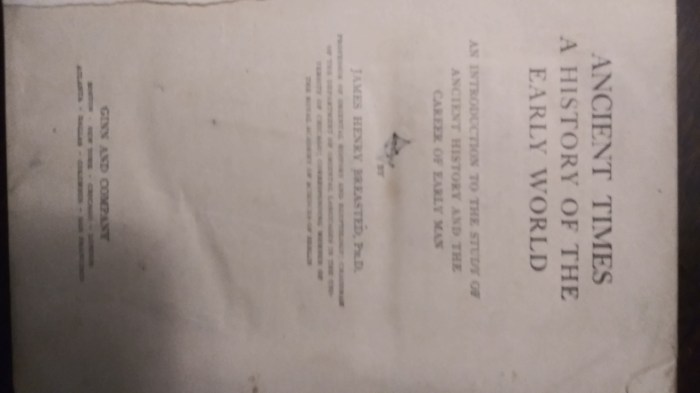
4. History Book: “Ancient Times: A History of the Early World: An Introduction to the Study of Ancient History and the Career of Early Man” by James Henry Breasted, published in 1914 in Boston by Ginn and Company

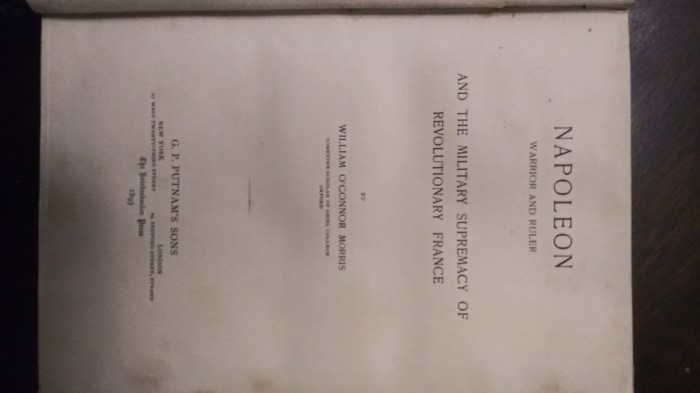
5. History Book: “Napoleon: Warrior and Ruler, and the Military Supremacy of Revolutionary France,” by William O’Connor, published in 1893 in New York by G.P. Putnam’s Sons

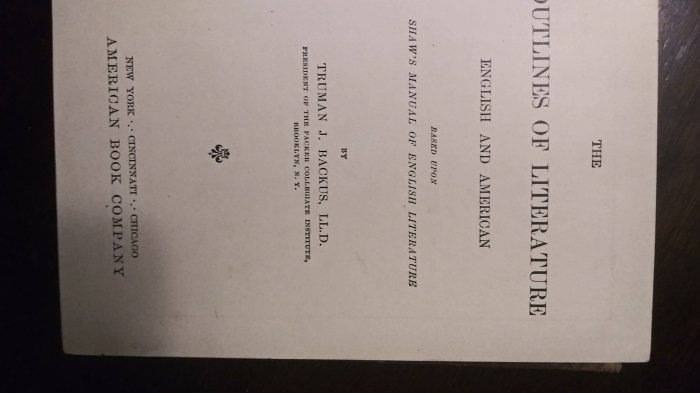
6. Literature Book: “The Outlines of Literature: Engliah and American. Based Upon Shaw’s “Manual of English Literature” by Truman J. Backus, published in 1897 in New York by American Book Company

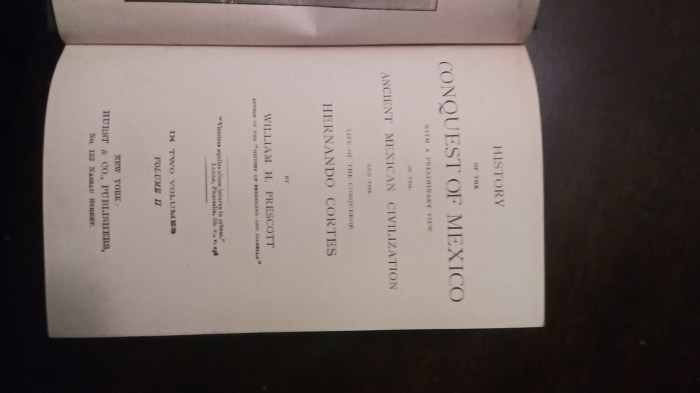
7. History Book: “History of the Conquest of Mexico with a Preliminary View of the Ancient Mexican Civilization and the Life of the Conqueror Hernando Cortes,” in Two Volumes by William H. Prescott, published in 1843 in New York by Hurst & Co., Publishers

*** The second page of the book include a sketch of Montezuma II, Emperor of Mexico

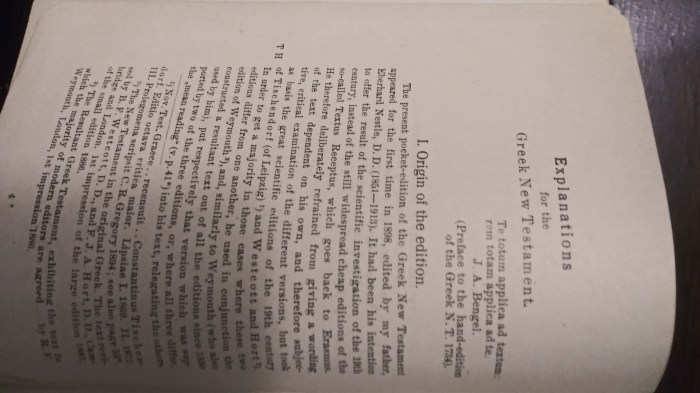
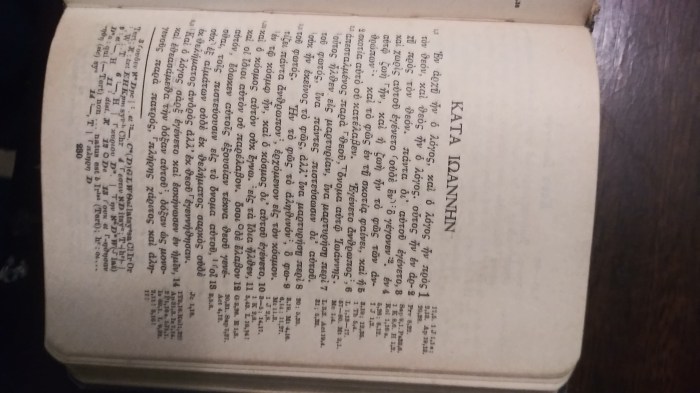
8. Greek Bible: “Greek New Testament,” Edited with Critical Apparatus by Dr. Eberhard Nestle and Newly Revised Dr. Erwin Nestle. Sixteenth Edition. Published in 1935

*** This Greek New Testament contains the Preface (“Explanations for the Greek New Testament”) to the hand-written of the Greek N.T. published in 1734.

Paper Proposal for the SBL/AAR Joint Conference (California; November, 2019)

This week, I have to finalize three paper proposals for the SBL/AAR joint conference in California (November 2019). My first paper will be on the meaning of James H. Cone in American theological and ethical tradition; this is based on two recent articles I published on Cone. My second paper will be on Wole Soyinka’s interpretation of African Traditional Religions. This is based on a book I published two years ago entitled “Radical Humanism and Generous Tolerance: Soyinka on Religion and Human Solidarity” (Hamilton Books, 2017). My third paper is a comparative analysis of the political theology of four Caribbean theologians on the intersections of theology, anthropology, decolonization, and human rights issues: Jean-Bertrand Aristide (Haiti), Idris Hamid (Trinidad), Noel Leo Erskine (Jamaica), Kortright Davis (Antigua and Barbuda). This presentation will be based on an article I published last year on the same subject matter with “Black Theology:An International Journal.”

If I submit three proposals, at least (I hope)one of them will be approved for presentation. 🙂

My Ideal Presidential Candidate for the 2020 Presidential Election in Plain and Simple Language:

My Ideal Presidential Candidate for the 2020 Presidential Election in Plain and Simple Language:

When it comes to voting and politics, I’m concerned primarily about these seven major issues I am looking for in a presidential candidate:

1) the candidate’s political and economic views:are they in favor of the poor and the economically-underrepresented population in our society? will they uplift and empower the poor and middle class in our country? will the candidate promote better economic opportunities and programs for the poor and middle class Americans and create laws to improve the economic gap between the poor and the rich?;

2) political affiliation: will the candidate’s policies support the bourgeoisie class and the blood-sucking capitalist institutions in our society while neglecting the well-being of the oppressed black and brown communities in the nation, and the under-served poor white people;

3) the candidate’s holistic vision for the country: will his or her political ideologies and actions contribute to human flourishing, strengthening our broken educational system (especially schools in poor white, black, and brown communities), strengthening the country’s infrastructures and economic deficit, etc; will the candidate uphold the rights and freedom of the American people and the undocumented immigrant population regardless of their sexuality, gender, race, disability, class, education, religion, and country of origin.

4) the candidate’s foreign policies: will he or she be another American president who will patrol the so-called third world countries and advance American imperialism executed through unjust wars, the economic exploitation of the developing world, and America’s hegemony in the world?;

5) the candidate’s moral leadership and life: I believe the American people and our children would like to emulate a president who embodies moral virtues and moral leadership such as goodness, hospitality, fairness, equality, equity, justice, commitment to one’s family and children, generosity, civility, citizenship, inclusive patriotism, generous tolerance, etc.

6) the candidate’s view of human life and human dignity: will the candidate protect the life of the unborn and do justice to the voiceless? will the candidate promote the rights of life of the unborn? will the candidate create policies to ensure the preservation of the life of those who are being incarcerated and placing behind bars? what will the candidate do to stop the mass incarceration crisis in our country?

7) the candidate’s viewpoint on race: will the presidential candidate work toward fostering better race relations in this country? will he combat against and eliminate racially-biased laws and public policies that disfranchise the black and brown populations in this country? will his or her policies advance racial fairness and economic equity for all Americans. Will his or he policies contribute to the healing of our racial wounds and animosity between people of different races and ethnicities in our society?

Briefly, that is my ideal presidential candidate for 2020.