Pray for All People

“Pray for ALL People and the Common Good of ALL Nations”


How Should Christians and the People of God Respond to the Modern Crisis between the Nation of Israel and Palestine?

When the Bible commands the people of God to pray for the peace of Jerusalem (Psalm 122:6), it does not forbid God’s people to pray for the peace of Palestine nor to exclude other nations and peoples in Christian prayers, concurrently. In fact, Scripture strongly encourages Christians and the people of God to utter intercessory prayers for all peoples and all nations, respectively. As it is stated in Scripture, “First of all, then, I urge that supplications, prayers, intercessions, and thanksgivings be made for all people, 2 for kings and all who are in high positions, that we may lead a peaceful and quiet life, godly and dignified in every way” (1 Tim. 2:1-7). In this sense, the Christian prayer is universal, inclusive, and non-discriminatory; its driven motive is peace-building and the promotion of human dignity and worth. In this passage, prayer is depicted as a weapon of peace and stability, construction and deconstruction.

Correspondingly, the Christian prayer has an ethico-political purpose: the political peace and stability of the nation-states, and the common good and welfare of all people. Yet one should remember that prayer is about negotiation with the Divine/God the same way peace-making or peace-building requires the process of democratic intent and the deliberate negotiation between political leaders and national and international citizens of the world. In other words, God does not grant national peace apart from human negotiation. National peace is also the work of the nations and their leaders. God, the leaders, and the people they guide work hand in hand and in unqualified solidarity to foster peace, a politics of relationality, and an ethic of mutual respect.

The people of God do not just pray exclusively for the people they love, such as their friends, co-workers, and family members; it is the contrary. Jesus, in the Sermon on the Mount, instructs his followers and the people of God to be kind and generous through intercessory prayers for the welfare of their enemies and the common good for the people who do not like them. As it is observed in this important passage, “44 But I tell you, love your enemies and pray for those who persecute you, 45 that you may be children of your Father in heaven. He causes his sun to rise on the evil and the good, and sends rain on the righteous and the unrighteous” (Matthew 5:44-45). Accordingly, the centrality of Christian prayer is to make the Christian an engaged human being and a participatory citizen in human affairs and the divine project in the world. It can also be stated that the purpose of Christian prayer is to make the Christian a more reflective individual who does not overlook the weight of violence in his or her community and the burden of evil in contemporary times. This passage also suggests that prayer has a humanitarian and humanistic value; it is simply about imitation, that is, being and acting like God through his kind intentions and unmeasured goodness toward all people and nations.

In the spirit of Psalm 122:6, to wish divine shalom upon a country or a nation should not be equated with the license to ignore a country’s wrongdoings and its habit of violence and violation of human rights, as it is the case between the nation of Israel and the nation of Palestine. The call to intercessory prayers for the peace of Jerusalem is also a clarion call to hold the nation of Israel accountable for its deliberate mistreatment of the nation and people of Palestine, as God despises all manners of injustice and all forms of exploitation toward his image bearers. God gives justice and grace to the oppressed and the marginalized of the world (“The Lord is a refuge for the oppressed, a stronghold in times of trouble”: Psalm 9:9; “The Spirit of the Lord is on me, because he has anointed me to proclaim good news to the poor. He has sent me to proclaim freedom for the prisoners and recovery of sight for the blind, to set the oppressed free, to proclaim the year of the Lord’s favor”: Luke 4:18-19). God punished the nations of Sodom and Gomorrah for their wickedness and violence (Genesis 18:20-33), and he judged the nation of Assyria for its arrogance and practice of violence (Isaiah 10:12, 5-19), and the nation of Babylon for its guilt, vengeance, and unjust diplomatic dealings with the neighboring nations (Jeremiah 56:6-56). The God who acts, sees, intervenes, and liberates always does so through personal, collective, and intercessory prayers.

Prayer is a divine gift for all people, and God has designed prayers to be a universal blessing for all nations and all peoples of the earth. To pray for Jerusalem is not a command to Christians and the people of God to support blindly the nation of Israel in all its undertakings toward its neighboring nation: Palestine. Christians and the people of God should not use the gift of prayer to promote nationalism, Zionism, anti-Semitism, and anti-Palestinian racism and xenophobia. Prayer as a universal and inclusive gift transcends all forms of human hatred, hostility, and violence. Intercessory prayers should be launched, in its weaponry sense, to fight injustice, human rights violation, genocide, and unnecessary death.

The art of Christian prayer invites human accountability, openness, and honesty (“For I know my transgressions, and my sin is always before me”: Ps. 51:3). It also includes the process of personal and collective confession and mourning (“Deliver me from the guilt of bloodshed, O God, you who are God my Savior… a broken spirit; a broken and contrite heart you, God, will not despise”: Ps. 51:14; “Lord, the great and awesome God, who keeps his covenant of love with those who love him and keep his commandments, 5 we have sinned and done wrong. We have been wicked and have rebelled; we have turned away from your commands and laws. 6 We have not listened to your servants the prophets, who spoke in your name to our kings, our princes and our ancestors, and to all the people of the land”: Daniel 9:4-6). As it is inferred in these passages, God is against all forms of human and state violence and injustice—even those committed by the people of God and Christians. Nonetheless, he uplifts the nations and the peoples who are committed peacemakers and peace-builders (Matthew 5:9), and those who pray purposefully for the good health and welfare of their friends and their enemies, with the same passion and zeal.

Finally, we should remember that Christian prayer is a political act since it includes the political leaders of the nations, involves the kingdoms of this world, and is concerned with the political activities and interventions of the nations, respectively. Prayer is also a spiritual activity since humans address it directly to God, a divine Spirit/Being, and it is a divine design to improve one’s spiritual journey and intimacy with God. Prayer as a form of theological engagement draws us near the Divine and his Spirit; as a theological expression and disclosure, prayer gives us access to the deep things of God (i.e. his projects and plans for his people and the nations) and to the depth of his Being and essence. From this perspective, prayer is a form of human radicalness and divine openness. The prayer that aims at fostering peace, national unity, and political accord between nations and peoples is the one that God honors. Let us continue to offer candid and revolutionary intercessory prayers for the preservation of peace and tranquility, human rights and dignity, and the freedom and political freedom of the Palestinian people and of all exploited people and all subjugated nations of the world.
Une Belle Chose: A Mother’s Day Poem


“Une belle chose”

La gentillesse est tout ce que tu fais
Tes enfants t’appellent maman éternelle
Ton chemin est paix et vie
Si nous avons besoin de réconfort, c’est en toi que nous nous reposons
Si jamais nous prenons des chemins différents, tes paroles jaillissent en flammes pour nous réunir

La gentillesse est tout ce que tu fais
Tu donnes de l’eau quand le ciel oublie d’envoyer la pluie
Quand le soleil se repose, ton énergie redirige la vie dans le cosmos
Quand la lune dort, tu veilles sur le monde en sécurité
Ta lumière en haut guide le chemin des étoiles

La gentillesse est tout ce que tu fais
Nous courons vers toi pour échapper à la peur
Tu tiens nos mains fermement, nous ne trébucherons pas
Nous croyons en la foi car tu nous fais rêver
Que la prochaine génération fleurisse dans ta fleur éternelle

In English

“A Beautiful Thing”

Kindness is all you do
Your children call you mom-ever-lasting
Your way is peace and life
If we ever need comfort, in you we rest
If we ever part ways, your words burst in flame to unite

Kindness is all you do
You give water when heaven forgets to send rain
When the sun rests, your energy redirects life in the cosmos
When the moon sleeps, you watch over the world in safety
Your light on high guides the way of the stars

Kindness is all you do
We run to you to escape fear
You hold our hands tight, we will not stumble
We believe in faith because you make us dream
May the next generation blossom in your eternal flower

“10 Tips to Guide Life’s Choices in the Present and Future”

“10 Tips to Guide Life’s Choices in the Present and Future”

  1. We are afraid of strangers because we do not affirm our common humanity.
  2. We fear death because we are afraid of the unknown.
  3. We are isolated from other people because of self-preservation.
  4. We do not love because we are not fully healed.
  5. Compassion is the face of love.
  6. Empathy is the affirmation of our common vulnerability as human beings.
  7. The presence of the future is the realization of dreams in the moment.
  8. The meaning of life is the formation and shaping of one’s character.
  9. The search for power and desire to dominate is not an art form; it will lead to destruction.
  10. The training of the soul is the beginning of a happy life.

“Price-Mars’ Reflections on the Du Bois-Washington Debate”

“Price-Mars’ Reflections on the Du Bois-Washington Debate”

For my intellectual biography on the greatest Haitian intellectual and my dead mentor Jean Price-Mars (1876-1969), I am writing this cool chapter on Price-Mars and Black America. Interestingly, Price-Mars was friends with both W.E. B. Du Bois and Booker T. Washington. (You should read correspondence between Du Bois and Price-Mars and see how they expressed brotherly affection for each other.) Price-Mars first met Booker T. in France in 1903 while he was still a medical student at the University of Paris/”La Sorbonne” (1899-1903)–the leading research university in France.

Price-Mars saw Booker T. again in 1904 while he was in his diplomatic post in the United States and serving as Government Commissioner for the Universal Exposition in St. Louis, Missouri in that year. When he visited the Tuskegee Institute or the “Tuskegee Machine,” he stayed with Booker T. for a few days and was amazed by his leadership, friendship, hospitality, and his commitment to improve the plot of Black Americans via the Institute.

Interestingly, as one who was promoting a similar version of the Duboisian “Talented Tenth” in the early years of 1900 in Haiti and pushing for the moral leadership and responsibility, and the intellectual guidance and mentorship of the Haitian intelligentsia and the ruling class (“the élite”) in society, Price-Mars integrated Washington’s agricultural theories and social philosophy and the Duboisian Talented Tenth theory into the Haitian society in order to improve the conditions of the Haitian people and reform the country’s educational system.

Here I am trying to write this chapter, trying to figure out how the famed Haitian scholar (the “Uncle” of the Black world) and Pan-African polemist was able to reconcile both opposing methods and philosophies, and the leadership approaches and educational theories of two of the most respected leaders in Black America: W.E.B. Du Bois and Booker T. Washington in the early years of the twentieth-century. Pray for me 😊🙏

“What You Should know about God, Vodou, and the Ideological-Religious Interpretation of the Haitian Revolution”

“What You Should know about God, Vodou, and the Ideological-Religious Interpretation of the Haitian Revolution”

Nineteenth-Century Haitian (both the Patriotic and Romantic Literacy Movements) poets never attributed the success of the Haitian Revolution to the redemptive aspect of the Vodou religion and its Lwa/Spirits. Rather, they interpreted the Haitian Revolution as divine vindication on the institution of slavery and slave-holding societies in the Americas.

With poetic liberty and forceful rhetoric, both Romantic and Patriotic poets brilliantly argued that the triumph of the Haitian Revolution was an act of the divine will and the result of divine providence. They contended that it was the Judeo-Christian Christian God who liberated the enslaved African population at Saint-Domingue out of slavery and European colonialism.

In the same line of thought, nineteenth-century African American missionaries to Haiti took the same position that it was God who rescued the African slaves at Saint-Domingue from slavery. In their missionary endeavors in Haiti’s urban and rural areas, they propagated this message as the good news of God to the “Haytian” people. This was their basis for their evangelicalistic and missionary fervor. (In passing, it should be noted that it was not only White American and European Protestant Christian missionaries who invested in the work of Christian mission and evangelization in the early years of the Republic of Haiti. As early as 1819, African American missionaries invested in the theological education and spiritual formation of Haitian pastors, ministers, and the Haitian people. African American missionaries built the first Protestant Christian church in Haiti and started the first Episcopalian denomination in Haiti. Some of them died in the work of christian mission. Yet their sacrifice was not in vain. These Black Christian missionaries were also motivated by the messianic message of Pan-African Bibiblical Ethiopianism. )

The idea that Vodou was responsible for the success of the Haitian Revolution is a new discourse in Haitian literary and intellectual traditions that began with the publication of Jean Price-Mars’ epoch- making book “Ainsi parla l’Oncle” (“Thus Spoke the Uncle”), published in 1928. It was the substantial impact of the message of the book that gave birth to the Haitian indigenist movement and the reinterpretation of the success of the Haitian Revolution through the Vodou religion.

“When God is Silent, the Lwa Disappear, and Haitians Suffer”

“When God is Silent, the Lwa Disappear, and Haitians Suffer”

All Haitians in the Diaspora live in exile, and life in exile is a life of (re-)memory and alienation that creates both mental trauma and physical distance in respect to their native land.

Haitians outside of Haiti long to visit home, and they’re afraid of being kidnapped, tortured, and even murdered in the streets of Port-au-Prince.

The violence that is now associated with the Capital city of Haiti and other parts in the country has created a generation of Haitian youths who believe the only way to live as humans is to escape and find peace in a more promising country.

The segment in the Haitian population that is more affected by the frequency of gun shots and the fear of physical death is Haitian school children.

Life in Haiti has become more vulnerable and the preservation of human life has become more urgent than the generation past.

What does it mean to be poor and powerless in your country of birth?

What does it mean to live in a life characterized by every day trauma, political crisis, gang violence, and fear?

What does it mean when life has no meaning after you’ve tried all you could do to make it meaningful and productive in your birthplace?

What does it mean to be dispossessed, displaced, and socially-alienated in your homeland?

What does it mean to grow up in a country whose future is unknown, vulnerable, and fearful?

“Between African and African American Studies and Me”

“Between African and African American Studies and Me”

Many people didn’t know that before I started writing books about Haiti, African and African American literatures and African and African American intellectual thoughts were my areas of focus. In fact, the topic of my PhD dissertation was on Négritude and Harlem Renaissance. I even published a book on Africa’s greatest living playwright and literary giant: Wole Soyinka (See my book “Radical Humanism and Generous Tolerance: Soyinka on Religion and Human Solidarity,” 2016) and taught a class on the work of Africa’s greatest novelist Chinua Achebe.

Further, I served as the guest editor for the Journal of Pan African Studies for a special issue on Wole Soyinka (Vol. 8, Number 5, September 2015). My second book was about Frederick Douglass and Langston Hughes and their ideas about the meaning of Haiti and the Haitian Revolution in the world (See my book, “Haitian Modernity and Liberative Interruptions,” 2013).

In 2020, I decided to return to African American religious thought and published a book (“Theologizing in Black: On Africana Theological Ethics and Anthropology”) in which I studied the theological ideas of James H. Cone and Benjamin E. Mays.  If the good Lord grants me enough grace, I would like to write a book on the religious ideas of Chinua Achebe based on his novels, and an intellectual biography on James H. Cone. Before I do so, I owe Haitian scholars and studies two more books that I must finish by summer 2025. 😊

“Christianity and the Predicament of Black and Haitian People”

“Christianity and the Predicament of Black and Haitian People”

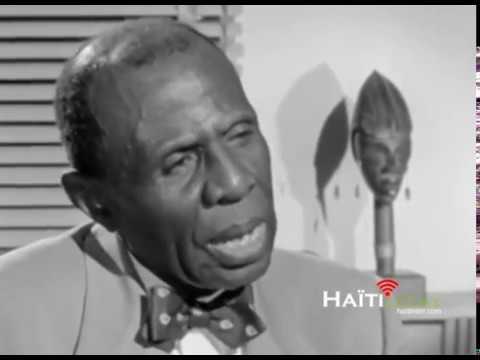
This famous Haitian theologian and public intellectual in the video (Click on the link below to watch) states that “Si vous êtes noir vous vous définissiez come chrétien, c’est une insulte à vos ancêtres.” In English, it means, “If you are black you define yourself as a Christian, it is an insult to your ancestors.” The ideology behind this statement is that Christianity is associated with slavery; blackness is against Christianity; and that Black people should embrace the spirituality of their ancestors, which the speaker calls “Vodou.” Based on the speaker’s reasoning,

1. A Jew should not associate with a German because Hitler and his German terrorists murdered about 6 million Jews, some of whom were that person’s (Jewish) ancestors?

2. A black man should not marry a white woman because the ancestors of the white woman enslaved the ancestors of the black person?

3. An Igbo should not marry a Yoruba because the Igbos murdered the ancestors of the Igbo people?

Sometimes, I just don’t understand the argument some people make to restrict people’s religious freedom and affiliation. 🧐 🧐 🧐


https://www.facebook.com/reel/233754552497327?s=yWDuG2&fs=e&mibextid=Nif5oz


Arguably, this is an error of philosophical or logical fallacy. First of all, we are dealing with two different categories: religion and ethnicity/race. There’s not and should not be a necessary association between the two. For example, as a black person, I have the freedom or choice to embrace Christianity, Islam, Vodou, Hinduism, etc. As a person of African descent, I also have the freedom not to affiliate with any religion or religious tradition. As a black human being, I still have the freedom to reject theism and embrace atheism. In other words, my racial category or identity does not determine my religious identity or association. The freedom of choice is not dependent upon one’s race and ancestral identity.

In the time of slavery, some slave masters and certain Christians used Christianity to support the enslavement of African people in slave societies in the Americas. Christianity was used as an instrument to exploit, abuse, and dehumanize the African population. However, it is a logical fallacy to equate Christianity with slavery. This is a false equivalence. While many enslaved Africans were forced to receive Christianity and Christian baptism, many slaves converted to Christianity voluntarily and without any coercion. Some of the slaves who willingly embraced Christianity as their new faith were born in the American continent; others who came to the Americas were already practicing Christians in Africa.

While the deliberate exploitation of Christianity as a tool may have contributed to the predicament of some black people in the world, Christianity is not responsible for the plot of Black people in the world. Human suffering, not just black suffering, has various sources and causes.

Those who call themselves leaders and intellectuals in black communities should put a break to the victimization narrative. This rhetorical discourse has not been working effectively in Black communities and it has not changed people’s living conditions.
I remain optimistic that there are other constructive ways and methods black leaders and intellectuals could deploy to empower the people, inspire young people to be responsible citizens and committed to a cause, and to teach them to be agents of transformation in their respective communities.

“Between the Shores of Our Souls”: A New Poem

It’s been a few months since I composed a poem. I’ve worked on this new piece for two weeks, a poem I simply called “Between the Shores of Our Souls.” I hope you like it.

“Between the Shores of Our Souls”

I’ll hide your soul deep in me,
above the height of ocean frontiers
Like a tender wind between the sacred space of the moon and the sun
Growing feathers in my silent wings,
just to kiss the palm of your restless hands
I’ve measured my life with the ruler of your charm,
counted it worthy to mean something to you

I’ll be your order during the night and daylight
Offering you rain where the land is dried,
flowers and fresh leaves where spring does not blossom
To be the light of your forbidden steps
To make you smile in a loveless land
Your love urgent grows in memory last

I’ll be your promise of beauty and fantasy
Drying your tears with my silent words in rhyme
Washing your clothes with my gentle hands
To lift you to the top when hope wanders in despair
To sing the tune of an October love with broken words
I’ll sacrifice my dreams so you can dream about the rain and a new melody