An Invitation to the Kick off of the IRSC NEA Big Read: “Brother, I’m Dying” by Edwidge Danticat
If you live in the Treasure Coast area in Florida, you are cordially invited to the #IRSC NEA Big Read to examine the writings of the award winning novelist Edwidge Danticat
Event: Kick off of the NEA Big Read:
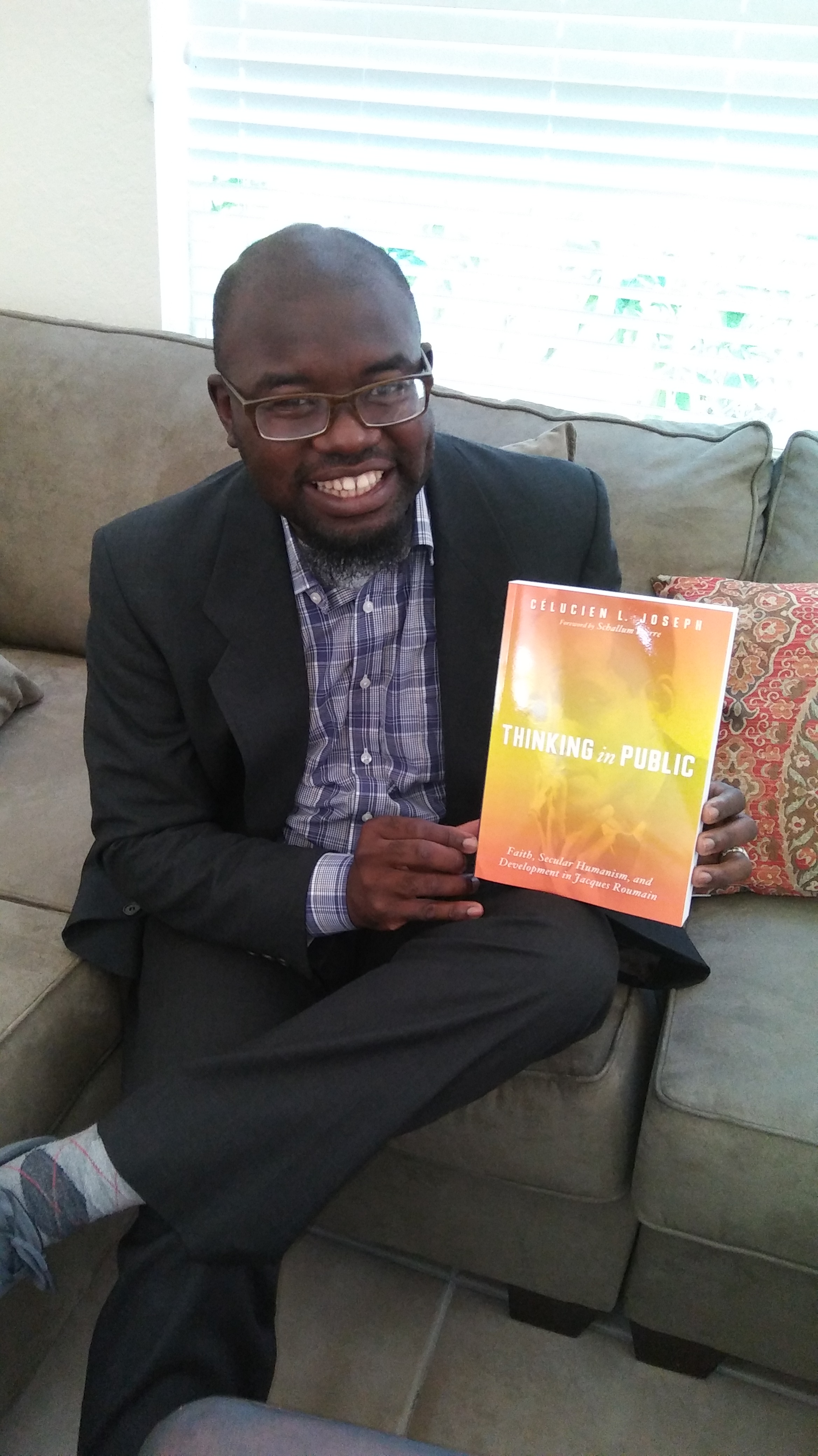
Faculty-Driven Panel Discussion on Edwidge Danticat’s book, “Brother, I’m Dying.” Dr. Celucien L. Joseph (“Docteur Lou”), Professor of English at Indian River State College and Co-Advisor to the Haitian Cultural Club at IRSC, will provide an overview of the book.
Where: Indian River State College
(Main Campus in Fort Pierce, Florida)
When: Wednesday, February 1, 2017
Time: 2:30 PM- 3:30 PM
Room #: N 135
*The Faculty-driven panel will provide an introduction to “Brother, I’m Dying” by Edwidge Danticat and a lively discussion on the importance of telling your own stories through creative means and empathizing with the stories of others. Student and community members will also sit on the panel and provide the opportunity for further discussion.
** The first 50 attendees will also receive a free copy of “Brother, I’m Dying.”

President Trump’s Ban on Muslim Refugees in the United States and the Evangelical Response
The major crises of American Evangelicalism in the twenty-first century in regard to the American-Islamic relations can be summarized succinctly in three ways: (1) the Evangelical turn to political idolatry, (2) the crisis of (Evangelical) conscience, and (3) Evangelical resistance to express genuine biblical empathy and generous caring hospitality toward those who are suffering and oppressed. These three important factors are vital to get a better understanding of the Evangelical response to President Trump’s Ban on Muslim Refugees. How have American Evangelicals reacted to this this executive order? Below, we have identified three ways that articulate the attitude of American Evangelicals toward possible Muslim Refugees in the United States and their response to President Trump’s recent executive order of The Ban.
- Evangelicals for The Ban (Political American Evangelicalism): This group of American evangelicals is obsessed with political power and dominance. They believe in the expansion of the kingdom of God through active engagement in politics, and therefore cultural and political hegemony is a necessary means to achieve this Evangelical objective. Because Islam is the second largest and growing religion in the world, it is therefore perceived as a threat to the growth and expansion of Christianity in the world, especially in American and Western societies. This group also fears the possible loss of religious and political power, the inevitable long-range impact of Islam in the American society, and correspondingly, the wide range of effects of Islamic ideals on American ideals and American way of life. In other words, the rapid spread of Islam and Islamic culture in American and Western societies and beyond has become a crucial alarming moment for the evangelicals belonging to this category. This Evangelical group supports President Trump’s Ban on Muslim Refugees in the United States because the members of this group categorically equate these potential Muslims refugees as prospective Muslim terrorist groups who will harm America and alter the American way of life through their religion, cultural traditions and practices, and language.
- Evangelicals for Muslim Evangelization: This group of American Evangelicals categorically rejects President Trump’s Ban on Muslim Refugees in the United States. They interpret Trump’s executive order as a precarious threat to Christian evangelization to Muslims and as a disastrous hindrance to Christian mission in Muslim countries. This group of American Evangelicals holds that Muslims are heathens who need to be saved from their devilish religion and detrimental Islamic civilization. The evangelistic zeal of this group is not prompted by the biblical imperative to love the stranger and the non-Christian or is it motivated by the scriptural mandate to exercise sincere empathy and caring hospitality toward the Muslims; rather, their evangelistic outreach is without the challenging demands of the cross of Christ and devoid of the rigorous ethical teachings and practices of the Gospel.
- Evangelicals for Muslim Friendship: This group of American Evangelicals interprets President Trump’s Ban on Muslim Refugees in the United States as unwarranted,unconstitutional, discriminatory, and as a human rights violation. While their support of Muslim refugees to immigrate to the United States, they still desire to maintain the hegemony of religion (Christianity) in the public sphere and strongly encourage Muslim assimilation into Western values and American way of life. This group of individuals do not see potential Muslim Refugees as a possible menace to American democracy and progress nor do they place all Muslims in the same basket—such as radical religious zealots under the influence of radical Islam; however, they do fear that the ensuing full integration of Islam and Islamic culture in the American life and experience will eventually lead to the fragmentation of Christianity and Christian values in the American society.
La Pensée du Jour: Cling to Christ!
La Pensée du Jour: Following Jesus
Do not follow Jesus at a distance; walk near him and never let go. Cling to Christ!
*What I wrote above should not be taken literally. It is a rhetoric of christian spirituality and devoted or genuine discipleship. Nonetheless, being a follower or disciple of Christ entails living a radically transformative life that woes people to Jesus to do the same. Following Jesus in this violent and uncertain world is an alternative living that also involves a high level of active self-denial, sacrifice, serving and loving people unconditionally, and treating them with respect and dignity.
La Pensée du Jour: Jesus and Evangelization
Effective evangelization begins with fervent prayer for the lost. We have to tell our friends about Jesus. Jesus only!
A Morning Prayer:
Defining Alternative Facts!
American Evangelicals, Abortion, and Life after Birth
It is not enough to be just a pro-life advocate group in the twenty-first century American culture. Unfortunately, in the American society, American evangelicals are known to be a group that identifies itself with the political values of the Republican Party, which is often equated with “family values,” and summarizes as those who fight for life. To put it differently, many critics have argued that the overarching tenet of American evangelicalism in respect to social issues lies in its aggressive campaign for the protection of the life of the unborn. On the other hand, American evangelicals have failed miserably to engage contemporary culture and the pressing human needs of the moment critically, reasonably, ethically, and responsibly. It is doubtful to me that secular (non-theistic) humanism has adequate resources to deal effectively with the problem of pain and human suffering in modern times. Nonetheless, we must hope for the possibility of radical transformation in our culture and reflect critically about this pivotal issue: given the collective wound we are experiencing as a people and nation, can Evangelical Christianity save contemporary American society?
Arguably, American evangelicals have neglected life after birth, and undermined the structural demons and social sins that entangle a large number of the American population—especially the poor, underrepresented families, and various minority groups in the American society. American evangelicals need to be more comprehensive about what they consider as moral issues and pressing ethical demands. In such a time as this as we are transitioning into a new political era and leadership, we are optimistic and pray earnestly that American evangelicals would use their energy, influence, and finances to fight against other forms of human oppression, social evil, and structural injustices the same way they have traditionally deployed these same resources to campaign against the unethical and devastated human action we call abortion.
This twenty-first century is a critical time in American history for American evangelicalism to rethink in a revolutionary sense about its ethical framework/system and reconsider itself both as a religious movement and liberation movement that also values life after birth, and prizes equally the demand for justice, peace, dignity, respect, love, unity, reconciliation, and democracy for all. American Evangelical contemporary ethical system is not “thick” and rigorous enough to confront the pressing human needs of contemporary American society and the radical transformation of the human condition and nature in these urgent times. The peril of the Evangelical mind is inevitably its unreadiness to face critically and responsibly the changing American culture. In the same line of thought, the danger of Evangelical theology is its inadequacy to be relevant to the culture and values of the “millennial” generation.
We are convinced that Christians of all denominational identity or category and ideological persuasion should also oppose racism, poverty, war, imperialism, injustice, oppression, labor exploitation, segregation, and any form of sin and evil that dehumanizes people and challenges the image of God in man and woman. Any neglect of any of this pressing need would render Christianity disengaged with contemporary culture, and the life-experiences and lived-worlds of individuals. The soul of the American people is already deeply wounded and tattooed by a painful history of alienation and fear. In contemporary American society, Evangelical theological ethics need to be more comprehensive and Christ-exalting and God-honoring!
As Prophet Micah reminds us, “He has told you, O man, what is good; and what does the Lord require of you but to do justice, and to love kindness, and to walk humbly with your God?” (Micah 6:8). Followers of Jesus Christ need to be pro-life from conception to adulthood. They ought to believe, teach, and live the message of the Gospel by caring for and defending the rights of the most vulnerable: children, women, the undocumented immigrant, the poor, the orphan, and underprivileged families.
President Trump’s Inaugural Address and the death of America’s God
of The Washington Post dubbed President Trump’s inaugural speech “A most dreadful inaugural address,” which also bears the title of his opinion piece. He also makes this important observation about President’s Trump’s inevitable encounter with this historic moment in the American experience, “Oblivious to the moment and the setting, the always remarkable Trump proved that something dystopian can be strangely exhilarating: In what should have been a civic liturgy serving national unity and confidence, he vindicated his severest critics by serving up reheated campaign rhetoric about “rusted out factories scattered like tombstones across the landscape” and an education system producing students “deprived of all knowledge.” Mr. Will’s criticism of our new President’s arrogant speech is arguably an expression of Mr. Trump’s cynicism and xenophobia. The underlying problem of the inaugural address lies in the fact that the new American President has pushed grace and national unity, and the imperative of reconciliation and friendship aside to promote a narrative of retaliation, fear, and alienation. It is a speech devoid of enduring human hope, sustaining love, effective human interdependence, and a politics of relationality.
President Trump could have delivered a more humane, sympathetic, cosmopolitan, and elegant inaugural address. But, he chose not to do so. In his speech, President Trump implied that it is going to be a war between the “civilized world” and the “non-civilized world,” the West (America) and the Other (Radical Islam?). He besought the blessing of the “American God” to lead the way.
We must reject this idol. America’s God is not the true God. He is a deity fashioned and manipulated according to the image, desires, and the sovereign will of America’s political elite class, bourgeois Christianity, and charlatan preachers and theologians.
This God must die. We must kill him!