Recently-Acquired Books

Recently-Acquired Books
 
Here’s a list of a selected books that I recently acquired on amazon in the month of April for my home library:
Books
 
1. The Crucifixion of the Warrior God: Volumes 1 & 2
Gregory A. Boyd
 
2. Judaism: Practice and Belief, 63BCE-66 CE
E. P. Sanders
 
3. Paul: The Apostle’s Life, Letters, and Thought
E. P. Sanders
 
4. Reading Backwards: Figural Christology and the Fourfold Gospel Witness
Hays, Richard B.
 
5. Anthologie de poésie haïtienne contemporaine : 73 poètes
 
6. C. S. Lewis — A Life: Eccentric Genius, Reluctant Prophet
McGrath, Alister
 
7. God or Nothing: A Conversation on Faith
Cardinal Robert Sarah
 
8. Waking Up: A Guide to Spirituality Without Religion
Harris, Sam
 
9. The Spirit Poured Out on All Flesh: Pentecostalism and the Possibility of Global Theology
Yong, Amos
 
10. Greek Religion
Burkert, Walter
 
11. Creation of the Sacred: Tracks of Biology in Early Religions
Burkert, Walter
 
12. Salvation by Allegiance Alone: Rethinking Faith, Works, and the Gospel of Jesus the King
Bates, Matthew W.
 
13. Ancient Mystery Cults (Carl Newell Jackson Lectures)
Burkert, Walter
 
14. Homo Necans: The Anthropology of Ancient Greek Sacrificial Ritual and Myth
Burkert, Walter
 
15. A People’s History of Christianity: The Other Side of the Story
Bass, Diana Butler
 
16. Handbook of Women Biblical Interpreters: A Historical and Biographical Guide
Taylor, Marion Ann
 
17. Old Testament Today: A Journey from Original Meaning to Contemporary Significance
Walton, John H.
 
18. Not in God’s Name: Confronting Religious Violence
Sacks, Jonathan
 
19. Jesus Among Secular Gods: The Countercultural Claims of Christ
Zacharias, Ravi
 
20. The Lost World of the Israelite Conquest: Covenant, Retribution, and the Fate of the Canaanites
Walton, John H.
 
21. No God but One: Allah or Jesus?: A Former Muslim Investigates the Evidence for Islam and Christianity
Qureshi, Nabeel
 
22. Seeking Allah, Finding Jesus: A Devout Muslim Encounters Christianity
Qureshi, Nabeel
 
23. To Heal a Fractured World: The Ethics of Responsibility
Sacks, Jonathan
 
24. John: The NIV Application Commentary
Gary M. Burge
 
25. Gospel of Glory: Major Themes in Johannine Theology
Bauckham, Richard
 
26. Reading John for Dear Life
Clark-Soles, Jaime
 
* This is not a complete list. I also purchased more than two dozen books from Goodwill, which are not listed here. I love to brag about my home library because I absolutely LOVE BOOKS. I believe I’m close to have 4500 books in my home library and office at work.
 
Now, you can see why I do not have any money in the Bank.
 
🙂

This is how You Should Love and Live!

This is how You Should Love and Live!

One of the most challenging matters in our life is to love our neighbor as we love ourselves. Love in this sense is a difficult action to undertake, a puzzling thing to practice as some of our neighbors are not nice individuals nor do they intentionally seek our well-being or best interest in life. What makes this matter more paradoxical and urgent is the identity of (some of) our neighbor.

The neighbor could be a poor, an immigrant, an undocumented individual, a prostitute, a murderer, a rapist, a child molester, a stranger, a racist, or someone who has mistreated you or abused someone you love.

In the biblical sense, “to love your neighbor as yourself” is a deliberate commitment, even an imperative. Can you command love? Can you command emotion since love is also an emotion?

To love one’s neighbor means to stand up for the life of one’s neighbor, and to treat him or her (even them) with kindness and justice. To love your neighbor as yourself also means not to mistreat or exploit that individual, but to empower, uplift, and build up that person, and to seek his or her best interest and welfare.

Here’s a more detailed instruction from a biblical perspective on this important matter:

“When you reap the harvest of your land, you shall not reap your field right up to its edge, neither shall you gather the gleanings after your harvest. And you shall not strip your vineyard bare, neither shall you gather the fallen grapes of your vineyard. You shall leave them for the poor and for the sojourner: I am the Lord your God….You shall not steal; you shall not deal falsely; you shall not lie to one another.You shall not swear by my name falsely, and so profane the name of your God: I am the Lord……You shall do no injustice in court. You shall not be partial to the poor or defer to the great, but in righteousness shall you judge your neighbor. You shall not go around as a slanderer among your people, and you shall not stand up against the life of your neighbor: I am the Lord.


You shall not hate your brother in your heart, but you shall reason frankly with your neighbor, lest you incur sin because of him. You shall not take vengeance or bear a grudge against the sons of your own people, but you shall love your neighbor as yourself: I am the Lord.”–Lev. 19:9-18

Admittedly, it is difficult to love intentionally someone who has caused you misfortunes in life. Can you love a rapist or someone who has raped you, your child, a family member, or your friend? Can you love a child molester? Can you love a spouse abuser? Can you love someone who has assaulted you or caused you profound pain and suffering?

It seems to me love as an imperative is not something one can cultivate on his or her own. It requires repetition and a set of practices. To love in the biblical sense requires divine intervention in one’s life and one’s intentional collaboration with God who can and will empower us to love unconditionally and unreservedly. To love in that manner  means to live meaningfully in relation to God and in relation to other people.


Love thy neighbor as thyself sometimes may not be an instantaneous act, but a journey in life that involves growth, maturity, patience, forgiveness, and reconciliation.  However, in all things, we must strive to love–intentionally, completely, and unconditionally.

CNN & Dialogue on Vodou at Legacy 1804

“Legacy of 1804 | CNN Vodou Doc | Was it a Hack Job? 🇭🇹Join a manbo, an ordained minister,  a philosopher and me for a spirited discussion about CNN’s recent documentary on Haitian vodou. 

9-9:30 👉🏽Pawol ak Mizik Opening segment: Paul Beaubrun on being a Beaubrun,  on his tour with Lauryn Hill, his latest album and his future plans

9:30 – 11👉🏽Guests for vodou discussion: GwetoDe Manbo Fabiola Abellard | Dr. Celucien Joseph,  Pastor and Academic | Dr. Paul Mocombe, author of The Vodou Ethic and the Spirit of Communism

Listen live at kiskeacity.com  or  http://www.blogtalkradio.com/pancaribbean/2017/05/06/legacy-of-1804-cnn-vodou-documentary-was-it-a-hack-job-lof1804. You can also listen live only on the phone at 714-242-6119.

#haiti #vodou #religion #spirituality #lof1804 #kiskeacity #cnn #rezaaslan #paulbeaubrun @paulbeaubrun”

Two Precious Gifts in one single day!

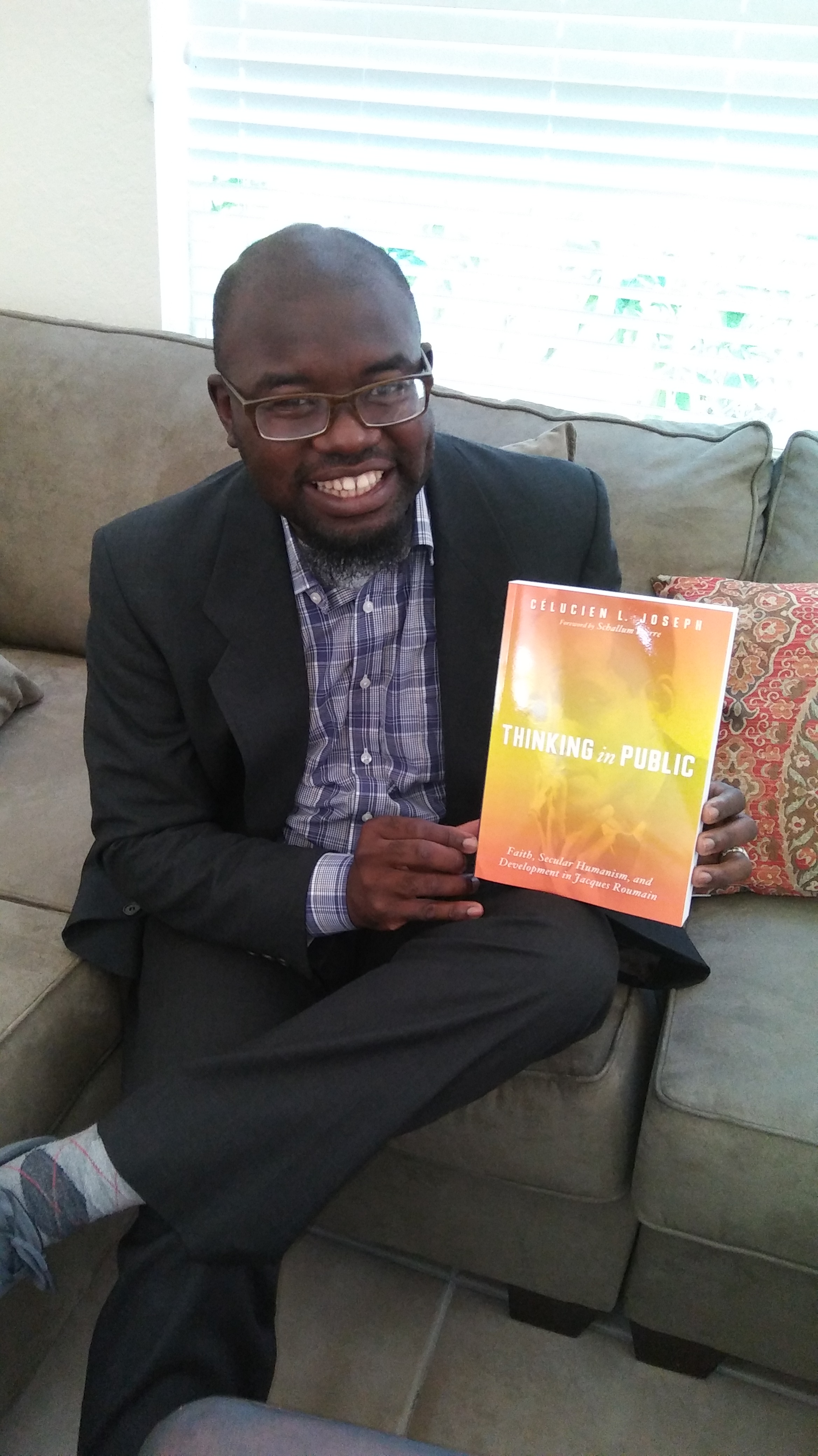
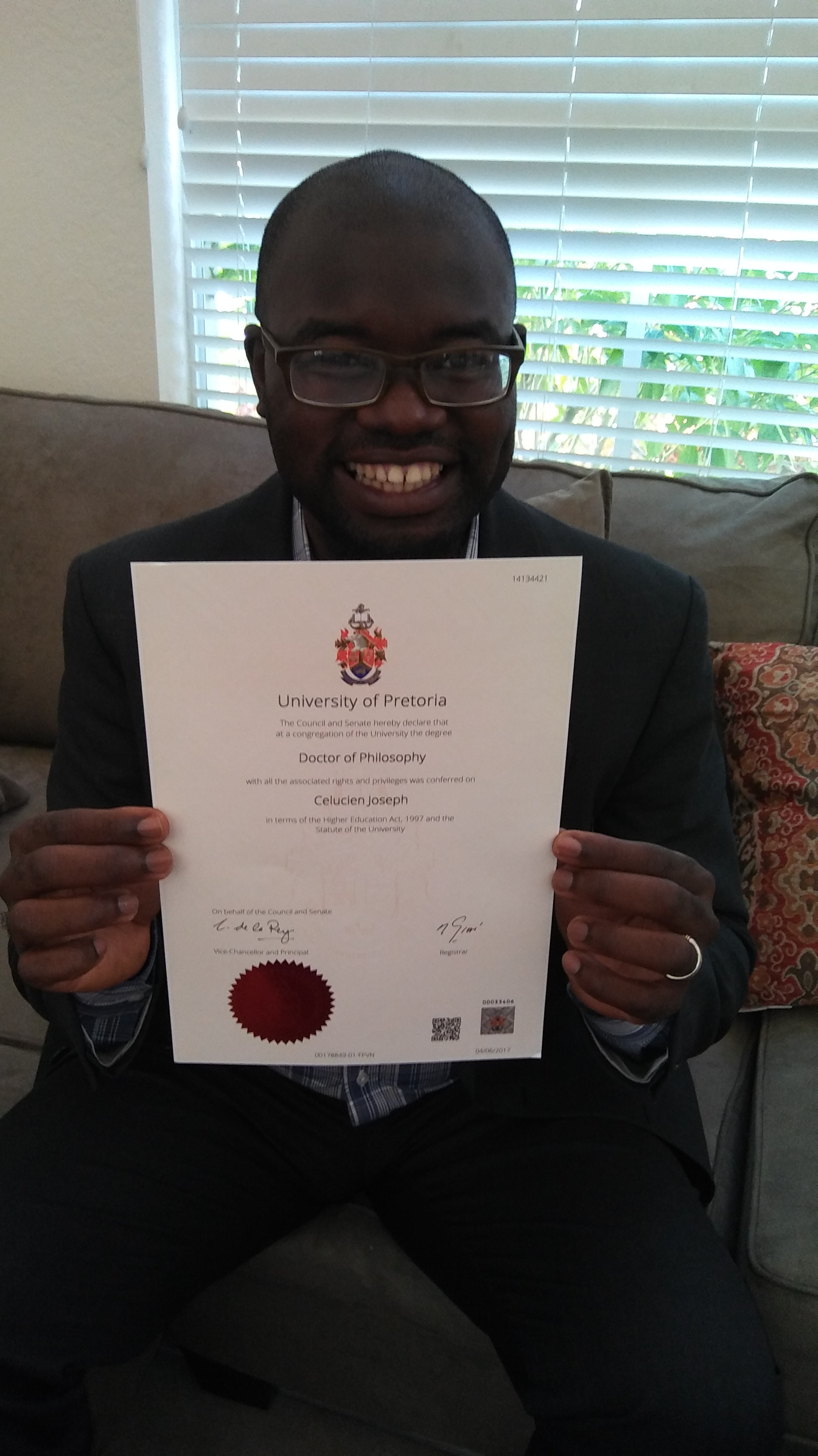
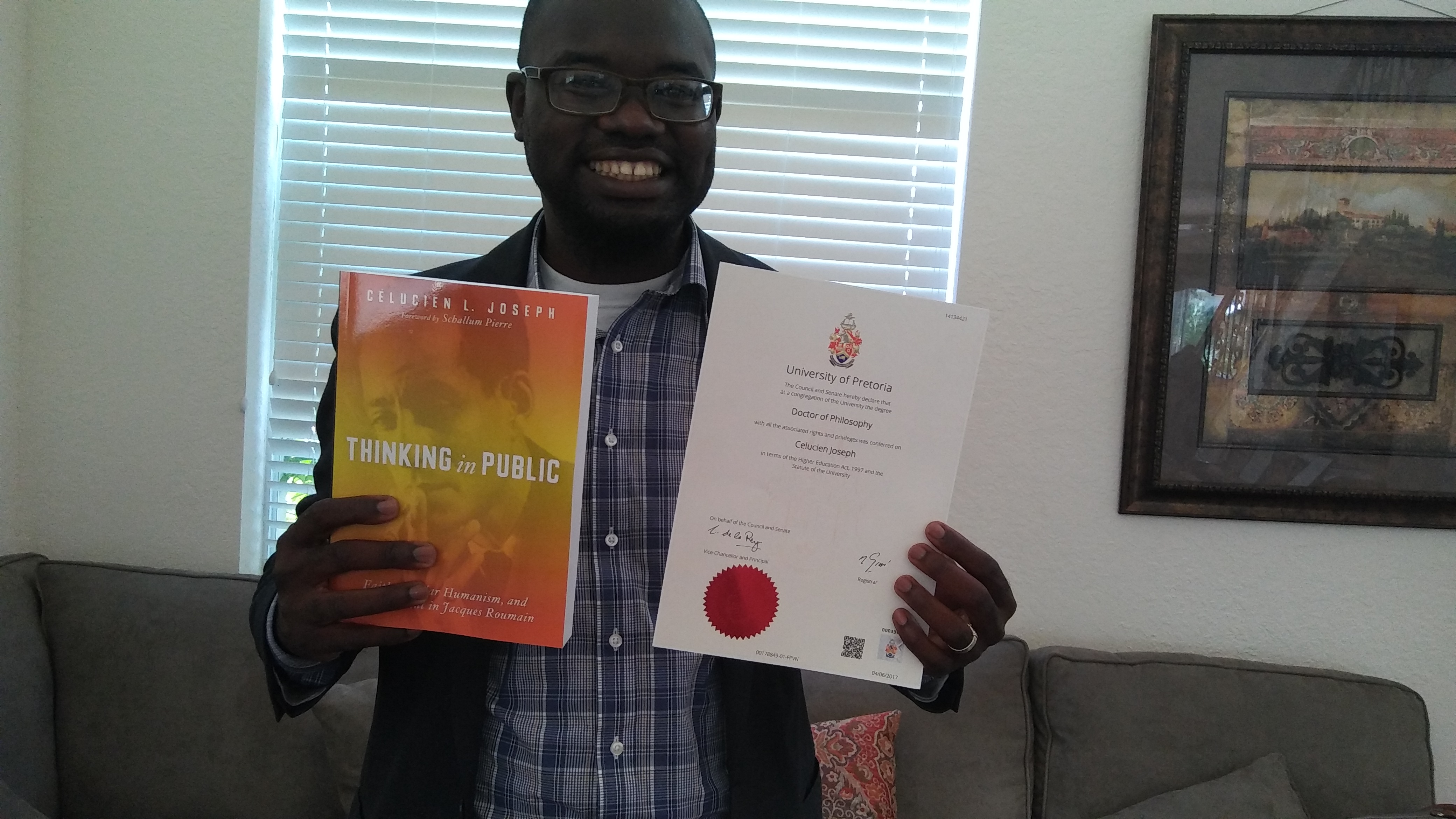
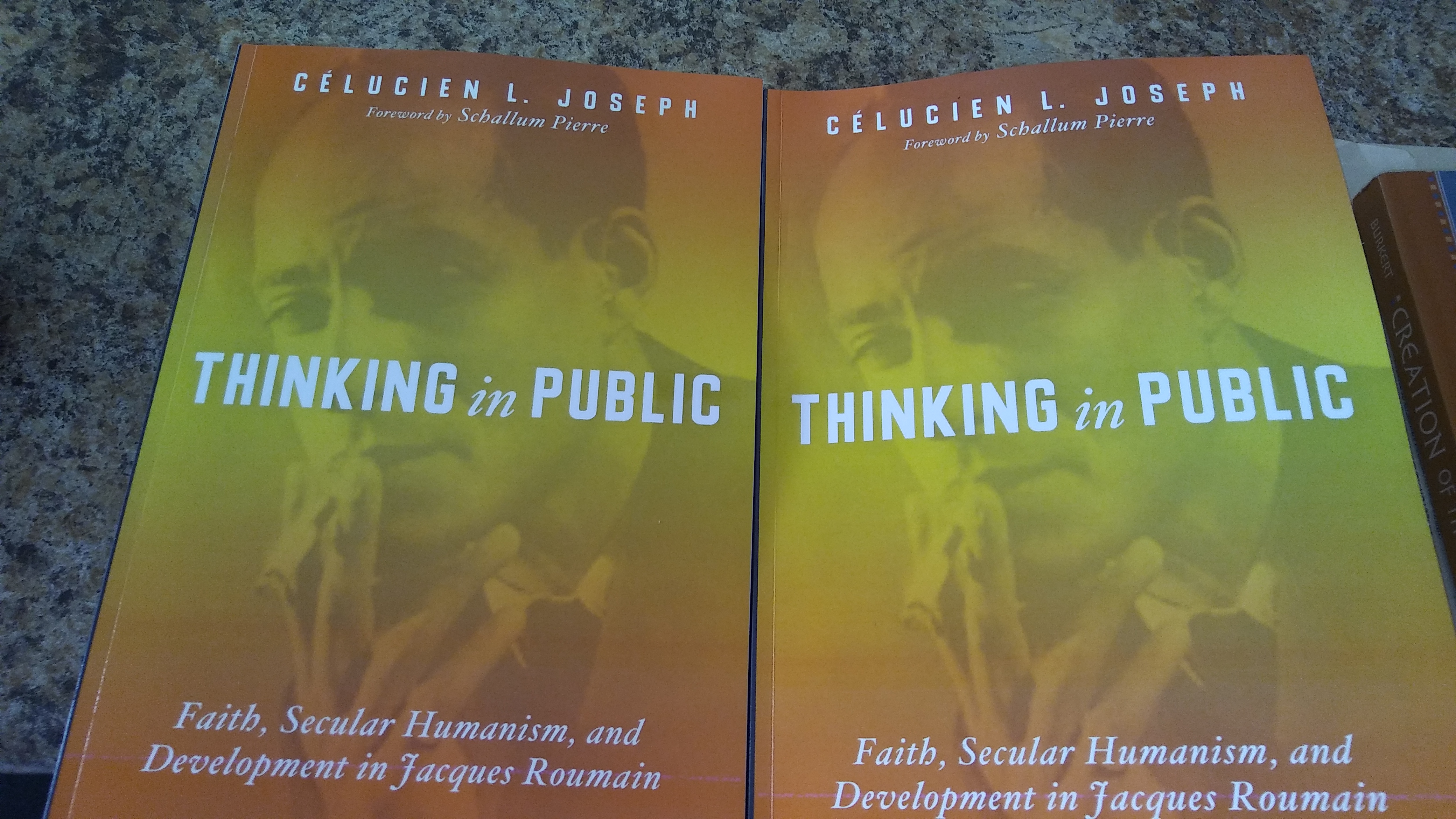
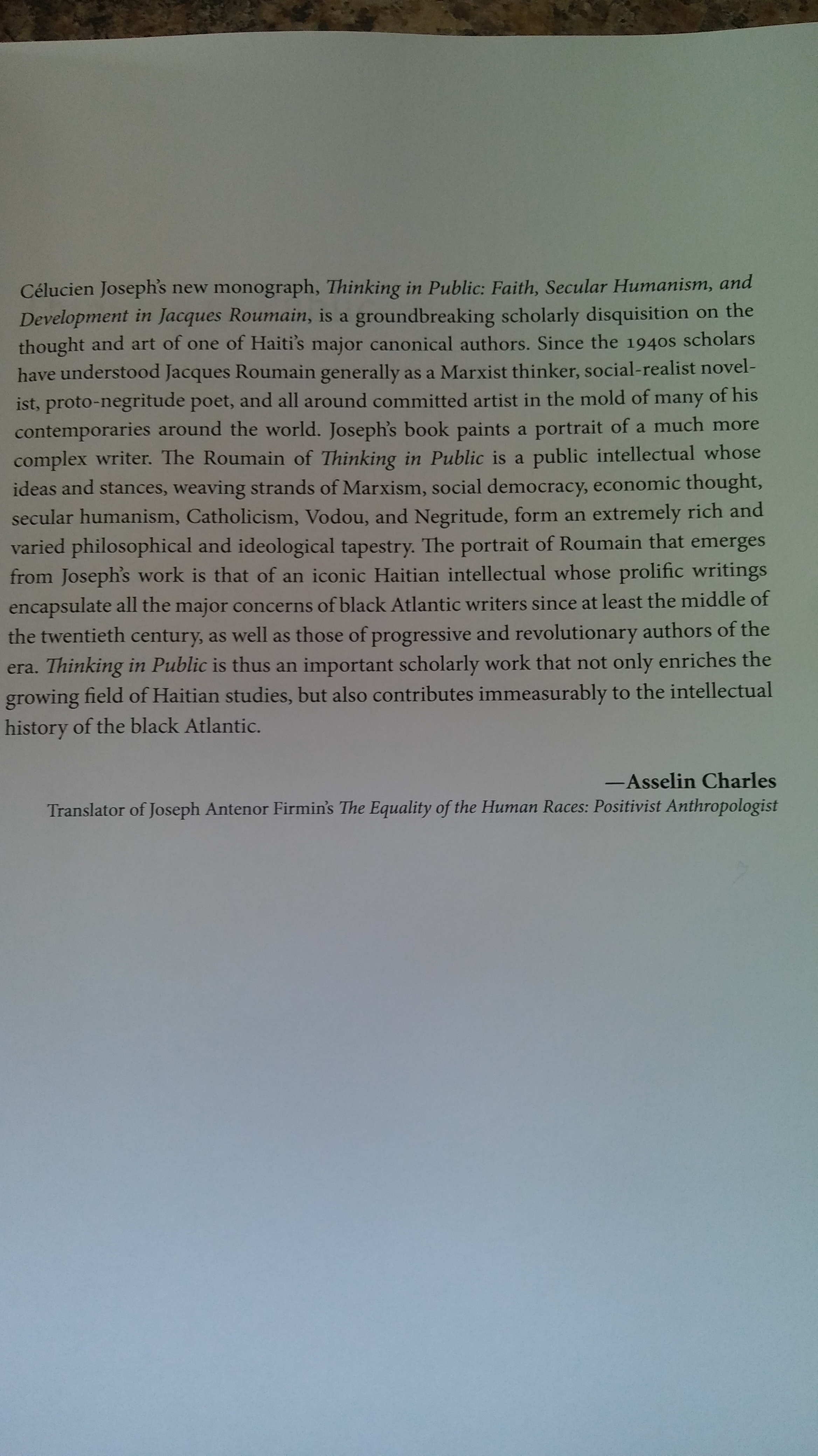
​I’m a very blessed man. Today, I received two important gifts: copies of my new book: “Thinking in Public,” and my PhD diploma for the degree in Systematic Theology and Christian Ethics from the University of Pretoria.

Unfortunately, I couldn’t attend the doctoral commencement that was held last month. I was too broke to buy the airplane ticket to Pretoria. LOL

Endorsements of Thinking in Public


By the way, The publisher just reduced the price of my new book (web special).

Help Me Choose a Novel to Teach

Help Me Choose a Novel to Teach
 
I will be teaching two literature classes in the Fall semester 2017. I’m going to assign two different novels, that is each course will not be reading the same novel. I have a pre-selected list of novels to choose from; however, I want you friends and literature people to help me choose two of the novels below. The order of the list is unimportant.
 
1. “Gilead” by Marilynne Robinson
2. “Massacre River” by René Philoctete
 
3. “General Sun, My Brother” by Jacques Stephen Alexis
 
4. “Dance on the Volcano” by Marie Vieux-Chauvet
 
5. “Hadriana in All My Dreams” by René Depestre
 
6. “Native Son” by Richard Wright
 
7. “One Hundred Years of Solitude” by Gabriel Garcia Marquez
 
8. “Americana: A Novel” by Chimamanda Ngozi Adichie
 
9. “The Bluest Eye” by Toni Morrison
 
10. “Beloved” by Toni Morrison
 
11. “Half of A Yellow Sun” by Chimamanda Ngozi Adichie
 
12. “Invisible Man” by Ralph Ellison
 
13. “The Known World” by Edward P. Jones
 
14. “Nervous Conditions” by Tsitsi Dangarembga
 
15. “Go Tell It on the Mountain” by James Baldwin
* With this novel, we will watch the documentary on James Baldwin, “I am not Your Negro,” directed by Raoul Peck

Life in a Small College Town Called Graceville!

Life in a Small College Town Called Graceville!

In the year 1999 or 2000, I was supposed to begin the Pre-medicine program with an emphasis in Biology at Florida Atlantic University (Boca Raton, Florida) as a transfer student, which meant I would have had two years left to complete my Baccalaureate in Biology at FAU. I postponed my admissions for personal reasons, which I will not discuss in this post.

As a result, I attended a small liberal arts Christian College (The Baptist College of Florida) in Graceville, Florida for my undergraduate degree. My graduation class of 2001 was very small.

When I was living there, the population of the town of Graceville was under 2600 people. We had one police officer, one gas station, one fast food restaurant (Hardee’s), and one grocery store: Piggy Wiggly. Although Graceville was a boring place to live and grow, the College environment was pleasant, and the people were quite calm and loving. I have enjoyed it, immensely. Graceville was indeed full of grace!

Here’s the Graduation Photo of my Class of 2001.
Can you see me?

College Graduation pic

In Honor of the Legacy of Jacques Roumain and In Honor of the Haitian Poor

In Honor of the Legacy of Jacques Roumain

and In Honor of the Haitian Poor

Roumain2


I will not take a dime or any royalty from the publisher (Wipf and Sock) for my new book on Jacques Roumain: “Thinking in Public: Faith, Secular Humanism, and Development in Jacques Roumain” (May 2017).


I would like to honor the legacy of Jacques Roumain in three ways: (1) by writing a book about his life and ideas, which I have already done, (2) by emphasizing the importance of his ideas and legacy for Haitian democracy and Social Uplift programs in Haiti, and (3) to give all the royalties earned from this book to improve the literacy program and build a trade school in Port-Margot, Haiti.


After Jacques Roumain moved back to Haiti from Europe, he would spend the rest of his life fighting and protesting against the forces (both internal and external powers) that exploited Haitian workers and the poor in Haiti, and by  working on behalf of Haiti’s underclass, peasants, and the economically-disadvantaged in order that their social and economic conditions could be improved, and their children could have a promising future.


*Hence, when you order my new book on Jacques Roumain, I can assure you your contribution will help accomplish the stated goals or objectives. To me, to honor the legacy of Jacques Roumain is to be sensitive to the plight of the Haitian poor, to walk in solidarity with the peasant class and the disfranchised in the Haitian society, and to serve them and invest our talents, skills and money to improve the life and future of the least among us in the Haitian society.

Jacques_Roumain3

E. P. Sanders on Paul’s views about Sex and Homosexual Activity (Part 1)

E. P. Sanders on Paul’s views about Sex and Homosexual Activity (Part 1)
 
I have always wanted how E. P. Sanders interprets the controversial passage of Romans 1: 25-7. In my reading of his new book, “Paul: Apostle’s Life, Letters and Thought” (Fortress Press, 2015), Sanders writes the following about Paul’s understanding of human sexuality and sexual relations:
 
“The most striking aspect of gentile sexual immorality was the ‘exchange’ of the ‘natural’ sexual connection between male and female for same-sex relationships (Rom. 1:25-7). ‘Natural’ sexual relations are those that could lead to conception.
 
For the modern reader, the elements of Paul’s vice lists that most require explanation are those that point to homosexual activity…If the statement in Rom. 1:26, that gentle women ‘exchange natural intercourse for unnatural,’ stood alone, this might mean that women performed anal or oral sex with men, rather than vaginal, but the following verse indicates that Paul had homosexual activity in mind:
“in the same way also the men, giving up natural intercourse with women, were consumed with passion for another” (1:27).
 
Male homosexuality is also condemned in 1 Cor. 6:9, where Paul refers to pornoi, which we have already seen can appropriately be translated “the sexual immoral,” and to malakoi and arsenokoitai, which the NRSV translates “male prostitutes and sodomites.”
 
Pornoi (“the sexually immoral”): all those people of whose sexual behavior Paul disapproves
 
Malakoi (“catamites”: males who are the passive recipients of anal intercourse
 
Arsenokoitai: males who penetrate catamites” —Sanders, “Paul,” 343-4)