“On Preaching and Transformation”

“On Preaching and Transformation”

Good and biblical preaching is relational, existential, and pastoral; a lot of people in our congregation are broken and want to know if the preacher can relate to some of their troubles and struggles. They want to see the humanity and sensitivity of their pastor and expect the pastor to relate to their pain and suffering. In other words, preaching that transforms people’s lives and stimulates individuals to change their community is incarnational, empowering, and liberative.

“Fòk Sa Change” (“This Must Change”):The Haitian-American Church in the Twenty-first Century”

“Fòk Sa Change” (“This Must Change”):The Haitian-American Church in the Twenty-first Century”

I would like to keep the conversation about the crisis of the Haitian-American Church going. I published two articles (December 2018 and January 2019) on the subject matter in “The Haitian Times.” Folks, the Haitian-American American church should aim for better results in this twenty-first century’s culture.

The Haitian-American Church in our contemporary moments is functioning as if people’s lives do not matter and that their existential troubles, except for those dubbed “spiritual,” are not urgent and real issues. Our churches fail to balance the life of the soul and the life of the mind. Correspondingly, our churches have neglected the theology of the belly while prioritizing the theology of the head. There must be a radical shift in what we confess theologically and what we practice morally and ethically. For example, poverty is a moral problem the same way that denying the deity of Jesus is a grand theological heresy in the Christian tradition. A second example is this: to ignore the suffering of a single mother of four children in our congregation while promising her we will pray for her during our Friday prayer meetings when the congregation can and in fact has the resources to reach out to her in order to alleviate her pain is a catastrophic ethical dilemma. This is not the purpose of Christian prayer.

I believe our Haitian-American congregations can do better and should play an effective role in the community they’re located. We need to eastablish healthy churches that will actively engage the community, foster a high level of conscientization among the people in the community, collaborate with city’s officials for public good, and actively serve the poor and those in need in the city–it’s also the reponsibility of the church to connect and point people to Jesus, and to spread the love and glory of God in the public sphere and in the civil society.

Nonetheless, the root of the crisis of the Haitian-American Church primarily lies in the miseducation of the Haitian-American Clergy. The root of the weaknesses of the Haitian-American Church is also associated with the bankruptcy of the Haitian-American leadership. A third source of the crisis of the Haitian-American Church is linked to deep ethical and moral problems of the Haitian-American Clergy.

I’m currently working on two op-eds on the subject of “The Miseducation of the Haitian-American Church”–as long as “The Haitian Times” continues to afford me the opportunity to publish my work for the good and welfare of our community.

“The Commitment to Love and How to Enhance Your Love for Your Enemy”

“The Commitment to Love and How to Enhance Your Love for Your Enemy”

Love has no enemy, nor does it know any opposition and adversary. The writers of the Bible boldly proclaim that “God is love.” The amazing power of the divine love includes these most coveted adjectives: (God’s love is) beautiful, kind, uncontrollable, boundless, active, redemptive, universal, sacrificial, self-giving, and transcultural. God loves all people regardless of their location in the world and their experience in life; God is always pursuing every individual because he wants to shower each one of us with love, kindness, grace, and affection!

As a result, God commands love to be a catalyst of the human experience and defining characteristic of his creation. From God’s perspective, love is/ becomes more than a human emotion or a sensation; biblical love is a moral duty and commitment to express love boundlessly toward all people, even one’s enemy.

In addition, the most important moral duty of Jesus’s followers is to love and pursue it at all cost, that is, to imitate God’s way of love and loving, and to obey unreservedly Jesus’s ethical imperative to love, even one’s enemy. Hence, God’s creation ought to imitate its Creator by being like Him. Those who love unconditionally and pursue love relentlessly are like God; they are peacemakers like God and his natural children.

Tomorrow morning (Sunday, January 20) at Jesus Center, I will be discussing the idea of love from a biblical perspective and offer some practical ways on how to enhance your love for everyone, even for your enemy or rival. The way of love is the way of Christ and is the most fulfilling way to be human, to imitate God, and to become like Jesus.

You and your family are our special guests at Jesus Center. We can’t wait to meet you in person and fellowship with you. Our worship service starts at 10:00 am. See you tomorrow morning at Jesus Center Community Church!

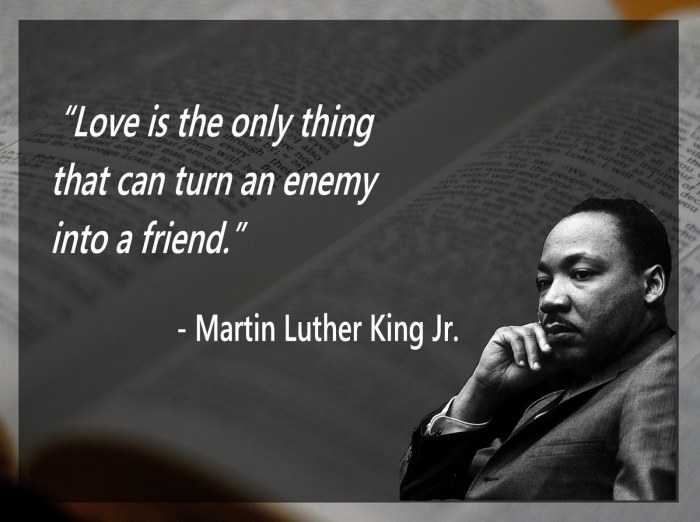
“Love is the only thing that can turn an enemy into a friend.”— Martin Luther King, Jr.

“Love is kind and endures all things.” –Paul

“A new commandment I’m giving you is to love one another.” –Jesus

” Love your enemy; pray for those who persecute you.” –Jesus


“Nine Crises and Weaknesses of the Hatian-American Church”

In December 2018, “The Haitian Times” published my article entitled “The Crisis And Failure Of The Haitian-American Church.” At the beginning of the new year (January 2019), “The Haitian Times” published the sequel to my December op-ed.

Check it out, “Nine Crises and Weaknesses of the Hatian-American Church,” and let me know what you think.

https://haitiantimes.com/2019/01/17/9-crises-and-weaknesses-of-the-haitian-american-church/

Bonne lecture!

“Haitian Studies in the Twenty-first Century”

“Haitian Studies in the Twenty-first Century”

While we should never neglect the substantial contribution of the Haitian Revolution and Vodou Studies—as these two subject areas of knowledge are foundational in the constitution of Haitian scholarship in the English language–in the construction of a distinctively Haitian epistemology, and what Dr. Paul Camy Mocombe has phrased “Haitian Idealism,” contemporary Haitian Studies in the twenty-first century must move beyond the scholarly research on the Haitian Revolution and Vodou to explore other significant fields of knowledge in which Haitian scholars and writers have explained the Haitian experience in both modernity and post-modernity and correspondingly contributed to human understanding and flourishing in the world.

My New Article on James H. Cone!

My very long and detailed article on James Cone was published back in December 2018. I was not aware of it. I just found out today.

“James H. Cone: The Vocation of Christian Theology and the Christian Church Today,” Africology: The Journal of Pan African Studies, vol.12, no.7, December 2018. pp. 8-58.

***Do look forward for two more articles I wrote on James Cone. One will be soon published; the other is currently under review.

Click to access 12.7-2-CLJoseph%20(1).pdf

Happy reading and let me what you think!

“The Call and Courage to Love When It Hurts”

“The Call and Courage to Love When It Hurts”

In the Gospels and Epistles, love is a command, an attitude, and a lifestyle that is distinctively marked the daily interactions and relationships of Jesus’s followers. In fact, in Christianity, love has a nature and an identity, and arguably is a person, as the Bible boldly declares, “God is love.” Love as a divine virtue and moral and ethical virtue comes with many challenges, defeats, and dissappointments. In spite of the complexity to love difficult people, as love is not a natural human virtue, love is the very essence of the Christian faith and the cross of Christ. Jesus commands his disciples to love their enemies and pray to those who persecute them. Apostle Paul states to do everything in love. The Hebrew Prophets compel us to pursue love, mercy and compassion as these threefold divine attribute summarize the greatness of God and God’s loving actions in the world and gracious interactions with human beings. Hence, God’s creation ought to imitate its Creator by being like Him. Those who love unconditionally and pursue love relentlessly are lke God and his natural children.

Tomorrow morning (Sunday, January 13) at Jesus Center, I will be sharing a few words about the biblical notion of love as a christian virtue and moral order for Jesus’s disciples. The call to love, even one’s enemies and rivals, is the way of Christ and is the most fulfilling way to imitate God and to become like Jesus.

I look forward to engaging you in this vital and practical conversation at 10:00 am, the time of our corporate worship at Jesus Center. You’re welcome to bring a friend with you.

Love has a name; its name is Jesus.

“Jacques-Jules Bonnaud, the First Haitian Jesuit in Colonial Saint-Domingue-Haiti”

“Jacques-Jules Bonnaud, the First Haitian Jesuit in Colonial Saint-Domingue-Haiti”

As I continue to work on Haiti’s colonial religious history, I discovered an interesting Haiti’s religious gem of colonial legacy: Jacques-Jules Bonnaud, the first Haitian Jesuit.

Father Bonnaud was born in Cap-Francais/Cap-Haitian/Okap in October 27, 1740–only three years before Toussaint Louverture was born in May 20, 1743/Bréda, Cap-Francais– to a French Father and an African mother; hence, he was a mulatto child.

As it was customary in Saint-Dominguan interracial relationships, at an early age, his parents sent the young Jacques-Jules to study in France. He attended La Flèche, a Jesuit High School, associated with the Compagnie de Jésus. In December 20, 1758–the same year Jean-Jacques Dessalines was born in Africa–, he entered the Jesuit order in Paris (des Jésuites de la Province de Paris) as a young seminarian; he was fifteen years old at the time.

The Jesuit Order appointed him as Professor at the Collège de Quimper in Bretagne (Brittany), France’s north-westernmost region. He taught there for two years until the King’s order to close the Compagnie de Jésus in 1762–the same year Britain entered the Seven Years’ War (1756-1763) against Spain and Naples. It was also in April in 1762 that Louis XV passed a decree for all black and mixed-race (mulatto) Frenchmen residing in France to register in the local municipal and with the offices of the Admiralty Court. On the government’s form, blacks and mulattoes had to declare their age, full name, religion, and reveal the purpose they were living in France. They were also to inform the government their place of birth and the name of the ship that transported them to France.

Jacques-Jules Bonnaud was ordained as Priest at the Grande Séminaire de l’archidiocèse de Paris. Due to unfortunate circumstances associating with the French Revolution, he was assassinated in 1792 at the Séminaire des Carmes in Paris. In 1926, the eleventh year of the American military occupation in Haiti (1915-1934), Pope Pius XI beatified Father Jacques-Jules Bonnaud rendering him the first Haitian Catholic Saint. Nonetheless, St. Martin de Porres is the first Black Saint in the Americas.

Arguably, Father Jacques-Jules Bonnaud, the first Haitian Jesuit, was a victim and martyr of the French Revolution.

***Consulted Sources:

Kawas Francois, “Sources Documenaires de l’Histoire des Jésuites en Haiti auc XVIIIe et XXe Siècles” (2006).

Henri Fouqueray, “Un Groupe de Martyrs de Septembre 1792” (1926)

José Luis Saez, “Un Màrtir Broto del Cabo, Santo Domingo” (1978).

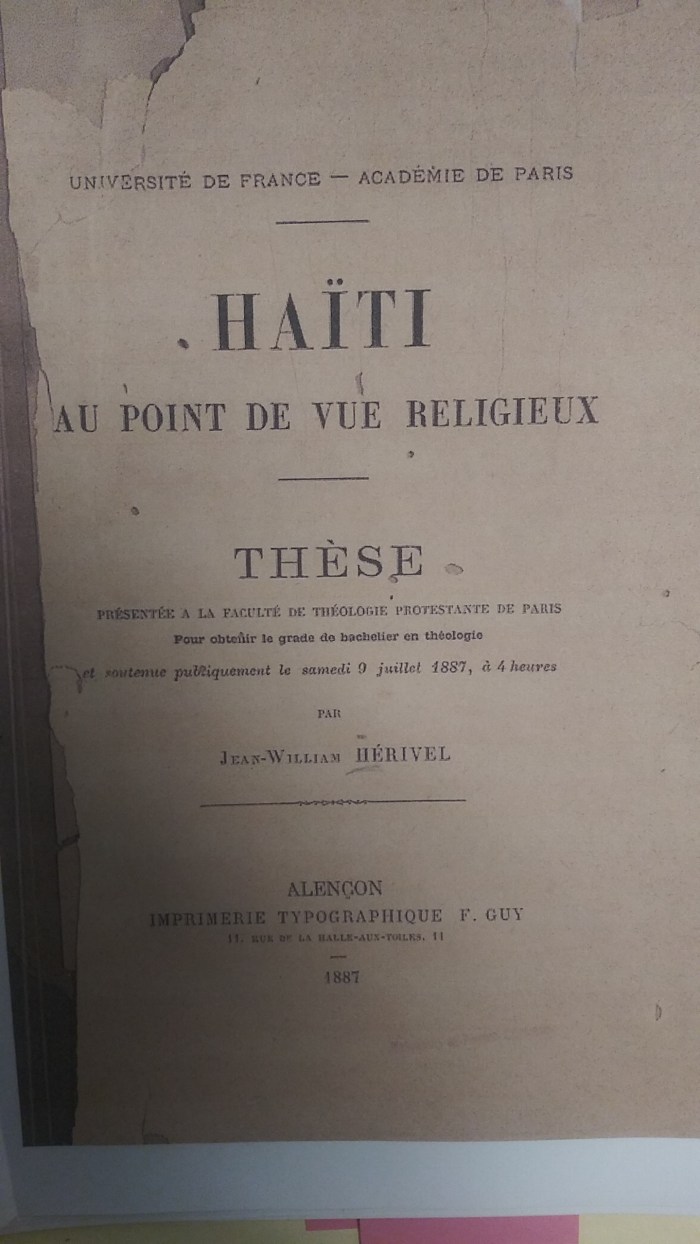
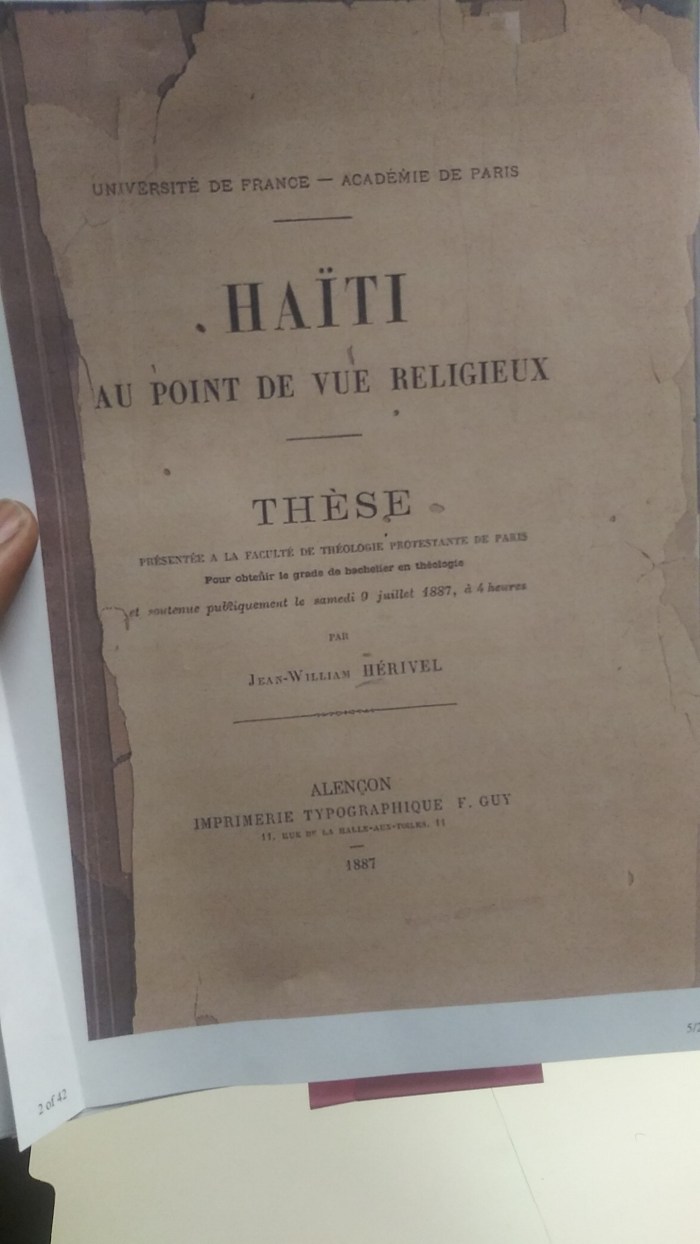
Jean-William Hérivel, First Haitian to receive a degree in Theology from Université de France in 1887!

Jean-William Hérivel may have been the first Haitian to study Christian Theology at the Université de France–Académie de Paris (Facultè de théologie protestante de Paris). In July 9, 1887, at 4:00 pm–two years after Joseph Anténor Firmin, the first Black anthropologist, published in Paris and in 1885 “De l’égalité des Races Humaines (Anthropologie Positive)–Mr. Hérivel defended his thesis and was awarded a Bachelier en théologie (B.A., Theology).

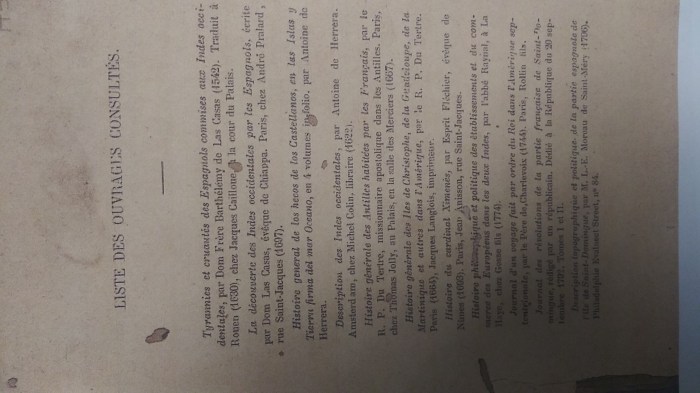
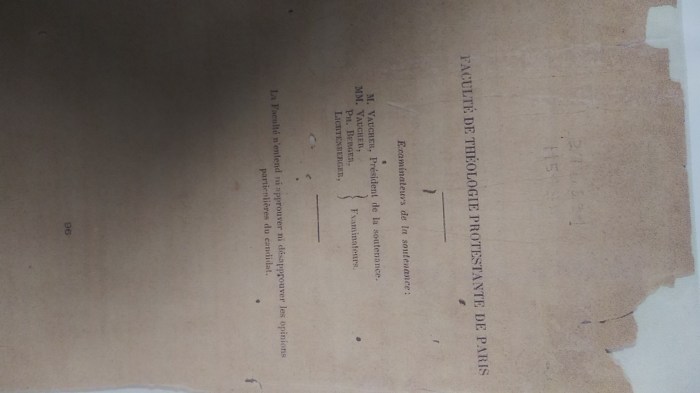
Hérivel’s thesis, “Haiti: Au Point de Vue Religieux” (Haiti: A Religious Perspective) was published the same year in the prestigious “Alencon: Imprimerie Typographique F. Guy. The thesis is about 41 pages; French theologian Ed. Vaugher served as the supervisor of the thesis, and F. Lightenberger was the Dean of the School.

I have a hardcopy of this important work in my home library. Here are a few pictures from the text: