“On Haitian History Books” or “Books on Haitian History”
This dude on Facebook wants all of his friends to take photos of all the History books they own about Haiti. At first, I was reluctant to do so because it would take me a long time to take pictures. Oh well, I like my friends, and they’re good to me.
Hence, I decided to showcase a selection. The represented History books on Haiti do not include the ones in my garage, my office library at work, and other books I loaned to friends.
They put him on an unfair trial–the greatest trial that shakes the earth;
The jury misjudged him and fabricated lies about him; the people mischaracterized and cheated him; the leaders chastised and shamed him; and they all found him guilty for a crime he did not commit–lies that are forgiven and guilt that is forgotten;
They whipped him until his body bore bruises, his soul abuses, and his heart humanity’s challenges–the body that bears the world’s pain and gives new birth;
They made him carry a cross they fashioned for his destiny–the cross of pain, of sorrow, of humanity’s hope;
They hang him on a tree to be lynched– a tree that gives passion, redemption, satisfaction, and resurrection;
They handed him over to the soldiers to be oppressed–yet he is their hope and Savior too;
While still hanging on the lynching tree, they mocked him; they insulted him; they gave him sour wine mingled with gall to drink; and they spat on his face in shame–the Savior’s saliva that brings the abusers’ sweet healing and the oppressors’ restoration;
They crucified him so he could die–the death that fuels new life and salvation too;
After he breathed his last breath in shame, he was declared dead at last–he is the breath of life and resurrection of life;
They put him in the tomb and buried him in shame–the tomb of despair and of glory too;
They sealed the tomb of shame with a rock so he will not go away–the seal of humanity’s destiny and their stone of safety.
Hold on, Sir! Hold on, Madame! Wait, boys and girls! Don’t move, children! Tarry, young people! Don’t go away, citizens of the world!
Wait until the morning hour; the new Sunday for the seal to be broken;
Some two thousand years ago, it was a Friday like this one that Jesus was put on trial before a ruthless juror, consisted of both religious leaders and politicians, that found him guilty for a crime he did not commit. As reported in the Gospels, the common people, both Jews and Gentiles, actively participated in Jesus’ unfair trial. He appeared before Pontius Pilate, the powerful political figure and state agent, who determined his fate, not his future.
Further, historians tell us that the judgment and the final verdict leading to the death penalty, burial, and annihilation of Jesus happened on a Friday– what is commonly called the “Good Friday” or “Holy Friday” in the Christian sacred/liturgical calendar. Arguably, the death of Jesus was a state-sponsored violent death and ruthless execution. The death of Jesus is a demonstration of the problem of justice in society and the bankruptcy of the legal system in the world. By implications, it invites us to think responsibly and ethically, for example, about the problem of mass incarceration of black males in the United States. Like Jesus, many of the prisoners and felons currently serving a sentence (some a “life sentence”) are wrongly accused of a crime they did not commit.
Yet while Jesus was still hanging on a cross made up of old and rugged wood, somewhat analogous and parallel to the America’s terrorized lynching tree in which many thousands of falsely-accused blacks breathed their last breath in the American society, he spoke seven powerful and beautiful words that narrate an intricate rapport between God and humanity, human vulnerability and strength, despair and hope, grace and forgiveness, inclusion and acceptance, redemption and justice, love and hospitality, etc.
On this “Good Friday,” as we continue to remember Jesus, I invite you to reflect upon the meaning and implications of the seven last sayings of Christ:
“My God, my God, why have you forsaken me? (Matthew 27:46).
The first saying of Jesus establishes the paradoxical rapport between the good and holy God and the problem of divine justice upon the bearer of sin. In Christianity, it is believed that Jesus is the bearer of everybody’s punishment from God because everyone sins; sin is a transgression against a holy and righteous God, the Creator and Redeemer of all people. When someone sins, he or she becomes an instant violator of God’s moral law and ethical virtues, and everyone falls in this category.
Hence, the saying by Jesus, while being lynched on the wooden-cross, indicates the following threefold message: (1) sin creates alienation between God and human beings, but it is never too deep to stop the divine love and grace; (2) sin creates alienation and distance between individuals in society, but it does create the possibility for reconciliation and to do life together again; and (3) sin does not have the final word and does not determine one’s future and final destiny. Rather, it is one’s personal attitude and response to the death of Christ that determines the nature of one’s relationship to God the Creator. In other words, the death of Christ calls for a decision from every individual, and this decision is personal and existential, and it also involves Jesus the Christ and Jesus the Savior of all people.
“Father, forgive them, for they do not know what they are doing” (Luke 23:34).
Forgiveness is always a human possibility and a wonderful gift of reconnection and readjustment, between God and individuals, individuals from the same clan or people from different communities.
Forgiveness is not only about human relationships and interplays; it may engage two nations or governments that were once in enmity with one another. Forgiveness fosters the possibility for global peace and mutual collaboration between the nations and leaders of the world.
Every individual has an opportunity to start life again once being forgiven and reconciled with one another. Every nation has the capacity to forge strong links of friendship and hospitality, and to perform intentional acts of kindness toward one another–once forgiveness is achieved.
Forgiveness is an active attitude and a human force that compel us to seek reconciliation and peace; it welcomes friendship and defers exclusion, and teaches us vulnerability, teamwork, and humility.
The triumph of humanity in this world does not rest upon a blossomed capitalist market nor does it entail forces of competition toward greatness and status; rather, the success of humanity in this age lies in our willingness to forgive and map out a new path together. Forgiveness changes our attitude from being a master to be a servant.
Consequently, in this saying from the lips of Jesus, Jesus extends the gift of forgiveness to his abusers, exploiters, oppressors, and even to those who have planned his death. That’s the example that marks the Christ-event on the cross, and this is how the cross speaks to humanity and to each individual. This is what it means to follow Jesus in proximity and to be a friend of God. In this way, ever person is called urgently to imitate Christ and to pursue the mind of Christ in all things.
“I tell you the truth, today you will be with me in paradise” (Luke 23:43).
The gift of paradise is not a place in another world or a metaphysical residence. It is a conferred status upon receiving divine grace and favor and having been interrupted radically by divine love and kindness. Paradise means divine presence and interpenetration, and christocentric unity and indwelling.
Paradise is an invitation to participate in Christ and to be one with him in this world and the one to come. In the third saying, Jesus the Christ begins with and thus invites one individual, who was a decisive and condemned thief by the Roman Empire and a stranger to Jesus, to be in paradise with him; that individual stands for every human being in the world and the beneficiary of every subsequent invitation offered by Jesus–inclusively to every boy and girl, man and woman, male and female, homosexual and lesbian, transgender and cisgender, and every individual fashioned in the image of God. This invitation id inclusive for it crosses class, ethnic, racial, political, ideological, and geo-political lines and borders. Yet it comes with a measure of substantial responsibility and radical transformation, what Jesus himself called “the new birth.” Everyone who is invited to Christ’s paradise must be “born again.”
“Dear Woman, here is your son!” and “Here is your mother!” When Jesus recognized His mother standing near the cross with the Apostle John, He entrusted His mother’s well-being to John’s responsibility. (John 19:26-27).
In this fourth declaration by Christ, he directly validates the dignity and humanity of women, and concurrently, he establishes the intimate bond and relationship between a mother and a son. In the same vein, “The Christ” affirms that life is a gift that generates from women; yet its ultimate origin is divine and mysterious.
Life as a gift from both God and women, correspondingly, requires the urgency to be part of a community and the pressing existential need to live and walk together in connection with one another; indiscriminate human hospitality is connected with the good life and successful human existence. Thus, Jesus could entrust the welfare of his dear mother to John’s sacred task or responsibility.
“I am thirsty” (John 19:28).
The fifth statement of “The Christ” indicates his vulnerability as a person and as an individual who can relate to human (our) suffering, pain, and sorrows. The underlying message of this statement signals that the person of Christ is relatable and relational, and that he is no stranger to time and space, and to humanity. He is severely touched by human fragility and weakness, and radically subject to human nature and the spontaneity of life.
“It is finished!” (John 19:30).
The sixth claim of “The Christ” is the most powerful human speech ever uttered to God, the Maker of heavens and earth, and the Redeemer of human beings and the cosmos. “It is finished” gives a clear indication of a (divine) commission that was now executed and fulfilled by the messenger. At this point in the conversation, Jesus once again affirms his divine appointment as the final messenger of the immortal and gracious God.
This rhetoric of affirmation and attainment is not only associated with Jesus’ redemptive task; by implication or inference, this saying is intimately linked to the divine origin and identity of “The Christ.” This is the basis for human salvation and redemption, achieved through divine love in the Son of God, who died sacrificially for the world–as biblical writers unapologetically attest.
Finally, this claim by Jesus, like his sacrificial death, has become the most transformative cosmic event in human history that ensures restoration and friendship, reconciliation and peace with God. It also paves the way and potentially guarantees the possibility for human reconciliation and peace, with one another.
“Father, into your hands I commit my spirit!” (Luke 23:46).
Because every life has its origin in God, the spirit of every person and every animate thing likewise has its source in God our Maker. To commit one’s life to God is not a decision that should be postponed for the future, or in the next life to come, or even at the point of one’s death. Commitment here means an instantaneous decision and existential responsibility. Ultimately, it affirms that our life is not our own; it belongs to God, the great steward of (human) life and existence.
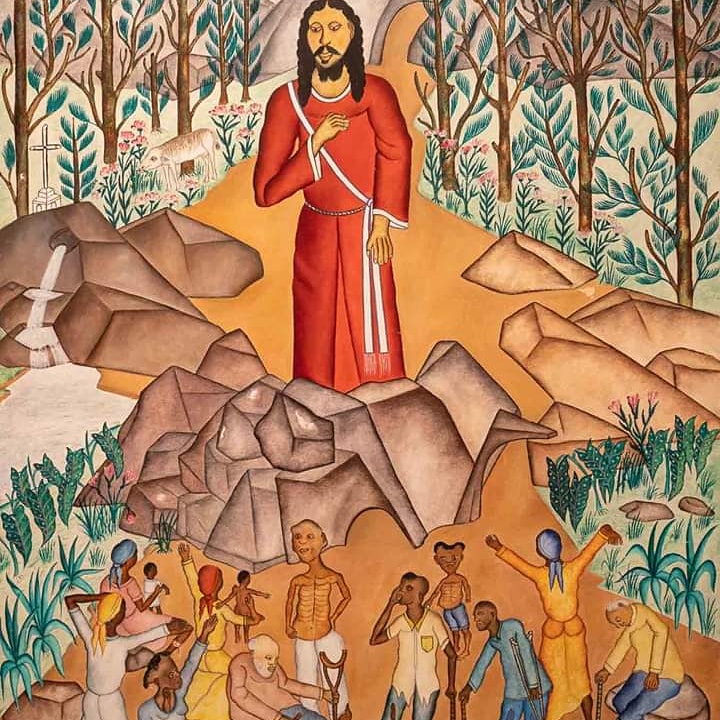
Haitian art: Benoit Rigaud, “Healing of the Sick” Source: Patrick Bellegarde-Smith
“Holy Thursday: Be a Servant to Others while Remembering Jesus’ kindness and servant leadership”
On this Holy Thursday, we are called to serve others and show kindness and compassion to the vulnerable, the needy, and the poor, especially those in our community who have been infected and affected by the devastating power of the coronavirus.
As we continue to remember Jesus and his sacrificial death during the Passion Week, Let us thus follow Christ’s example of servanthood. It was on a Thursday like this one and on his way to Calvary and glory, Jesus washed the feet of his disciples.
***Those who are serving and caring for us, our family, and our friends deliberately, intentionally, and sacrificially in this deadly time of coronavirus are agents of Christ in this broken world; they are demonstrating the spirit of servant leadership, the spirit of Christ, in a time of uncertainty, a moment of global crisis. They wash people’s feet everyday, moment by moment, and some of them wash our feet unreservedly while forgetting to wash their own until they breathe their last breath in this world toward non-existence, even death through unconditional service and selflessness.
It is the spirit of servant leadership and generous kindness embodied in the life of Christ Jesus that will transform the world; create another and better world; heal our individual and collective wounds; cure us from all of our diseases and terrors; inspire a new humanism in our country; foster revolutionary love and justice; and restore our human dignity in such a time as this one.
Hence, I invite you to mediate upon this passage below and follow the example of Jesus the Christ:
13 It was just before the Passover Festival. Jesus knew that the hour had come for him to leave this world and go to the Father. Having loved his own who were in the world, he loved them to the end.
2 The evening meal was in progress, and the devil had already prompted Judas, the son of Simon Iscariot, to betray Jesus. 3 Jesus knew that the Father had put all things under his power, and that he had come from God and was returning to God; 4 so he got up from the meal, took off his outer clothing, and wrapped a towel around his waist. 5 After that, he poured water into a basin and began to wash his disciples’ feet, drying them with the towel that was wrapped around him.
6 He came to Simon Peter, who said to him, “Lord, are you going to wash my feet?”
7 Jesus replied, “You do not realize now what I am doing, but later you will understand.”
8 “No,” said Peter, “you shall never wash my feet.”
Jesus answered, “Unless I wash you, you have no part with me.”
9 “Then, Lord,” Simon Peter replied, “not just my feet but my hands and my head as well!”
10 Jesus answered, “Those who have had a bath need only to wash their feet; their whole body is clean. And you are clean, though not every one of you.” 11 For he knew who was going to betray him, and that was why he said not every one was clean.
12 When he had finished washing their feet, he put on his clothes and returned to his place. “Do you understand what I have done for you?” he asked them. 13 “You call me ‘Teacher’ and ‘Lord,’ and rightly so, for that is what I am. 14 Now that I, your Lord and Teacher, have washed your feet, you also should wash one another’s feet. 15 I have set you an example that you should do as I have done for you. 16 Very truly I tell you, no servant is greater than his master, nor is a messenger greater than the one who sent him. 17 Now that you know these things, you will be blessed if you do them.” John 13: 1-17
“Holy Wednesday”: Behold the Lamb of God: Remembering the Kiss and the Sacrifice!
On this Holy Wednesday, we remember not only the kiss of betrayal from Judas Iscariot–one of the twelve disciples of Christ–which contributed to the eventual arrest and death of Jesus; we also remember Jesus’ attitude–active obedience, submission to the will of God, and generous forgiveness–toward his abusers, especially Judas’ ultimate decision to betray his master for 30 pieces of silver.
Psalm 41:9
“Even my close friend in whom I trusted, Who ate my bread, Has lifted up his heel against me.”
Mark 14:18-20
“As they were reclining at the table and eating, Jesus said, “Truly I say to you that one of you will betray Me–one who is eating with Me.” They began to be grieved and to say to Him one by one, “Surely not I?” And He said to them, “It is one of the twelve, one who dips with Me in the bowl.”
Mark 14:43-45
“Immediately while He was still speaking, Judas, one of the twelve, came up accompanied by a crowd with swords and clubs, who were from the chief priests and the scribes and the elders. Now he who was betraying Him had given them a signal, saying, “Whomever I kiss, He is the one; seize Him and lead Him away under guard.” After coming, Judas immediately went to Him, saying, “Rabbi!” and kissed Him.”
Luke 22:47-48
“While He was still speaking, behold, a crowd came, and the one called Judas, one of the twelve, was preceding them; and he approached Jesus to kiss Him. But Jesus said to him, “Judas, are you betraying the Son of Man with a kiss?”
John 13:21-26
“When Jesus had said this, He became troubled in spirit, and testified and said, “Truly, truly, I say to you, that one of you will betray Me.” 26 Jesus then answered, “That is the one for whom I shall dip the morsel and give it to him.” So when He had dipped the morsel, He took and gave it to Judas, the son of Simon Iscariot.”
Mark 14:10-11
“Then Judas Iscariot, who was one of the twelve, went off to the chief priests in order to betray Him to them. They were glad when they heard this, and promised to give him money. And he began seeking how to betray Him at an opportune time.”
Luke 22:3-6
“And Satan entered into Judas who was called Iscariot, belonging to the number of the twelve. And he went away and discussed with the chief priests and officers how he might betray Him to them. They were glad and agreed to give him money.”
“The Need for Haitian Biographies in English: The Top Ten”
This is a great era for Haitian studies! The body of scholarship about Haiti and its national history continues to blossom in the Anglophone world, especially in North America (i.e. the United States). In contemporary Haitian studies, there are two major sub-areas that continue to dominate the contemporary academic discourse in the English language: studies on the Haitian Revolution and research on Haitian Vodou. Both areas are valuable as they contribute substantially to our understanding of the colonial system, slavery, the French empire, and the formation of the Haitian postcolonial state, as well as revolutionary Haiti’s contribution to modernity, universal emancipation, and human rights discourse. Second, correspondingly, contemporary studies on Haitian Vodou, what many American scholars simply call, the “Haitian Religion,” is also a significant sub-area that informs us in significant ways about the interesting link and intersection of faith, culture, identity, and politics in the Haitian experience and Haiti’s civil and political societies. The Vodou religion is also important to study because it helps us to establish linkages and parallels between Haiti and continental Africa, Haitians and their African ancestors, African traditional religion and other religious traditions such as ancient Egyptian religion, Christianity, Hinduism, and Islam, etc.
Nonetheless, there exists a profound gap in contemporary Haitian studies and Africana studies to produce more “intellectual biographies” in the English language on Haiti’s major writers and thinkers. For me, this is a pressing academic necessity because Haitian studies as a promising learning field is growing rapidly in the Anglophone world. Allow me to provide two examples relating to this important concern. In 2017, I had the pleasure to publish a detailed intellectual biography on the renowned Haitian Marxist and communist public intellectual Jacques Roumain. The biography, “Thinking in Public: Faith, Secular Humanism, and Development in Jacques Roumain” was published by Pickwick Publications, an imprint of Wipf and Stock Publishers. Currently, I am working on an intellectual biography on Jean Price-Mars for Vanderbilt University Press. About two years ago, I had the immense joy to collaborate with a group of talented writers and thinkers contributing to the publication of a seminal book on Price-Mars entitled “Between Two Worlds: Jean Price-Mars, Haiti, and Africa” (Lexington Books, 2018; I served as the lead editor of the book). A year ago, two senior editors of two different prestigious universities presses approached me to submit a book proposal for an intellectual biography on the prominent Haitian thinker and anti-racist intellectual Joseph Antenor Firmin. A biography on Firmin in English would be a major intellectual achievement!
Further, I have to admit a personal weakness. I love reading intellectual biographies on great men and women who have left their marks on our lives and their rich legacies that continue to inspire and empower us—toward social transformation, the common good, and human flourishing. I also enjoy reading big books that are interdisciplinary in scope and content, and whose focus is on the subject of history of ideas.
Generally, biographies are important for various good reasons I am not even able to name here. In the same line of thought, biographies about Haiti’s major writers and intellectuals are crucial for the following five reasons I outline below:
To help us understand the world that made those thinkers and the context that shaped their life, their actions, and their legacy in the world;
To assist us in making sense about the complexity of human nature and human relations from the perspective of the so-called subalterns and the political trajectories of the developing nation-state of Haiti;
To continue to enrich our intellectual growth and curiosity, as well as to nurture the life of the mind from different sources of knowledge production, and epistemological deconstruction and construction;
To expand the field of Haitian studies and Africana studies, respectively, and to integrate and to be in conversation with other equally important sub-areas of study, which will contribute to the expansion of human knowledge and understanding; and
To invite other role models and circles of influence, that have graced the former world, in our present life so we can learn from their experience, wisdom, and actions as to improve the present human condition—contributing to the common good and human flourishing.
It is from this perspective, I would like to recommend students of Haitian studies and Haitianists to consider researching and eventually writing (intellectual) biographies in the English language on the following major Haitian writers and thinkers; I limit my recommendations to ten writers who have lived through the twentieth-century:
Joseph Auguste Anténor Firmin (1850 –1911)
Suzanne Comhaire-Sylvain (1898-1975)
Madeleine Sylvain-Bouchereau (1905-1970)
Félix-Morisseau-Leroy (1912-1988)
Marie Vieux-Chauvet (1916-1973)
Jacques-Stephen Alexis (1922-1961)
René Depestre (1926-Present)
Paulette Poujol-Oriol (1926 –2011)
Georges Castera (1936 –2020)
Franck Étienne “Frankétienne” (1936-Present)
*** Michel-Rolph Trouillot (1949-2012) needs to be among the top ten!
Let’s begin our Monday, the Holy Week, with a comforting word from Dr. Jesus Christ:
“Do Not Worry”
25 “Therefore I tell you, do not worry about your life, what you will eat or drink; or about your body, what you will wear. Is not life more than food, and the body more than clothes? 26 Look at the birds of the air; they do not sow or reap or store away in barns, and yet your heavenly Father feeds them. Are you not much more valuable than they? 27 Can any one of you by worrying add a single hour to your life?
28 “And why do you worry about clothes? See how the flowers of the field grow. They do not labor or spin. 29 Yet I tell you that not even Solomon in all his splendor was dressed like one of these. 30 If that is how God clothes the grass of the field, which is here today and tomorrow is thrown into the fire, will he not much more clothe you—you of little faith? 31 So do not worry, saying, ‘What shall we eat?’ or ‘What shall we drink?’ or ‘What shall we wear?’ 32 For the pagans run after all these things, and your heavenly Father knows that you need them. 33 But seek first his kingdom and his righteousness, and all these things will be given to you as well. 34 Therefore do not worry about tomorrow, for tomorrow will worry about itself. Each day has enough trouble of its own.”
A poem of hope and resilience for difficult times:
“A Map to the Next World” By Joy Harjo
In the last days of the fourth world I wished to make a map for those who would climb through the hole in the sky.
My only tools were the desires of humans as they emerged from the killing fields, from the bedrooms and the kitchens.
For the soul is a wanderer with many hands and feet.
The map must be of sand and can’t be read by ordinary light. It must carry fire to the next tribal town, for renewal of spirit.
In the legend are instructions on the language of the land, how it was we forgot to acknowledge the gift, as if we were not in it or of it.
Take note of the proliferation of supermarkets and malls, the altars of money. They best describe the detour from grace.
Keep track of the errors of our forgetfulness; the fog steals our children while we sleep.
Flowers of rage spring up in the depression. Monsters are born there of nuclear anger.
Trees of ashes wave good-bye to good-bye and the map appears to disappear.
We no longer know the names of the birds here, how to speak to them by their personal names.
Once we knew everything in this lush promise.
What I am telling you is real and is printed in a warning on the map. Our forgetfulness stalks us, walks the earth behind us, leaving a trail of paper diapers, needles, and wasted blood.
An imperfect map will have to do, little one.
The place of entry is the sea of your mother’s blood, your father’s small death as he longs to know himself in another.
There is no exit.
The map can be interpreted through the wall of the intestine—a spiral on the road of knowledge.
You will travel through the membrane of death, smell cooking from the encampment where our relatives make a feast of fresh deer meat and corn soup, in the Milky Way.
They have never left us; we abandoned them for science.
And when you take your next breath as we enter the fifth world there will be no X, no guidebook with words you can carry.
You will have to navigate by your mother’s voice, renew the song she is singing.
Fresh courage glimmers from planets.
And lights the map printed with the blood of history, a map you will have to know by your intention, by the language of suns.
When you emerge note the tracks of the monster slayers where they entered the cities of artificial light and killed what was killing us.
You will see red cliffs. They are the heart, contain the ladder.
A white deer will greet you when the last human climbs from the destruction.
Remember the hole of shame marking the act of abandoning our tribal grounds.
We were never perfect.
Yet, the journey we make together is perfect on this earth who was once a star and made the same mistakes as humans.
We might make them again, she said.
Crucial to finding the way is this: there is no beginning or end.
One of the central problems with Western governments lies in their failure to recognize or validate the humanity and dignity of non-Western people.
This human shortcoming has fueled European leadership, history of ideas, and foreign policies, since the foundation of Greco-Roman civilization. The desire to govern, conquer, dominate, and even ruin is not only very Western; it centers the Western perspective on global history.
May peacemaking become our resolute lifestyle and shared vocation, and may we also become a people who intentionally pursue reconciliation and harmony with other nations and people in the world!
Le us find a common way to cure the world with a global virus that is love, interdependence, compassion, and kindness.
I wrote this short post in response to this article and to spport Dr. Who’s claim:
“Coronavirus: Africa will not be testing ground for vaccine, says WHO”
Let us thus remember Jesus as King👑 and contemplate on the significance of his title for our ongoing relationships and actions as his followers, as well as the implications of his cosmic governance in the world today!
” 28 After Jesus had said this, he went on ahead, going up to Jerusalem. 29 As he approached Bethphage and Bethany at the hill called the Mount of Olives, he sent two of his disciples, saying to them, 30 “Go to the village ahead of you, and as you enter it, you will find a colt tied there, which no one has ever ridden. Untie it and bring it here. 31 If anyone asks you, ‘Why are you untying it?’ say, ‘The Lord needs it.’ ” 32 Those who were sent ahead went and found it just as he had told them. 33 As they were untying the colt, its owners asked them, “Why are you untying the colt?” 34 They replied, “The Lord needs it.” 35 They brought it to Jesus, threw their cloaks on the colt and put Jesus on it. 36 As he went along, people spread their cloaks on the road. 37 When he came near the place where the road goes down the Mount of Olives, the whole crowd of disciples began joyfully to praise God in loud voices for all the miracles they had seen: 38 “Blessed is the king who comes in the name of the Lord!”“Peace in heaven and glory in the highest!” 39 Some of the Pharisees in the crowd said to Jesus, “Teacher, rebuke your disciples!” 40 “I tell you,” he replied, “if they keep quiet, the stones will cry out.” 41 As he approached Jerusalem and saw the city, he wept over it 42 and said, “If you, even you, had only known on this day what would bring you peace—but now it is hidden from your eyes. 43 The days will come upon you when your enemies will build an embankment against you and encircle you and hem you in on every side. 44 They will dash you to the ground, you and the children within your walls. They will not leave one stone on another, because you did not recognize the time of God’s coming to you.”

 drcelucienjoseph, "Thinking and Meditating"