“A Man Between Two Worlds: An Interesting Report about My Academic Pilgrimage (Part I)”
I love books. I love the church and the people of God. I also love the academic life. I love good and challenging books, with an infinite passion and zeal. Good books and authors often take us places where we’ve never imagined we will go in our lifetime and sometimes leave mental scars with us which will mark permanently our intellectual life.
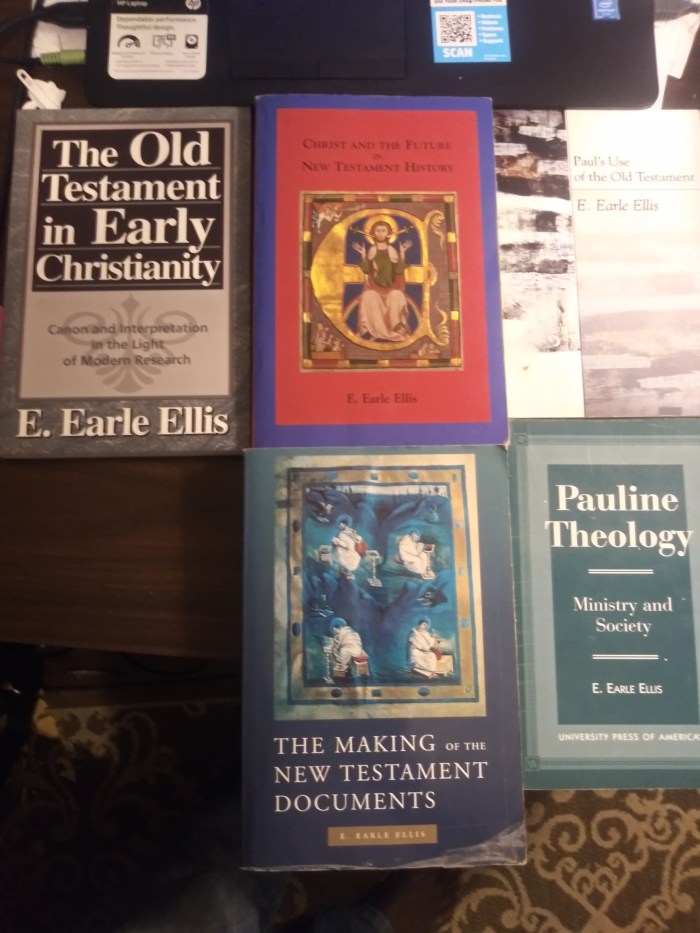
Tonight, as I was browsing through the Biblical Studies division in my home library, my eyes suddenly fell upon my former New Testament teacher’s magisterial work, “The Making of the New Testament Documents” (Brill, 2002). Immediately, my memory revisited the various ways Prof. Earle E. Ellis has influenced my intellectual life as a young scholar in the making and student majoring in New Testament (Th. M.) at Southwestern Baptist Theological Seminary (SWBTS), in the academic years 2005-2007.


In 2005, I moved with my family to Fort Worth, Texas not to pursue another graduate degree at SWBTS, but to pursue a PhD in History of Ideas at the University of Texas at Dallas (UT Dallas). The Dean of the School of Arts and Humanities from the UT Dallas called me to inform me about my acceptance to the PhD program and that the Graduate Admissions Committee was very impressed about my academic performance. He asked me how I was able to work on two Masters degrees, concurrently pursuing an Advanced Master of Divinity with concentrations in Biblical languages (Greek and Hebrew) and Theological Studies at the Southern Baptist Theological Seminary (SBTS) and an M.A. in French Language and Literature at the University of Louisville. What he did not know about my intellectual ambition was what I had no intention to reveal to him… that I was also enrolled in another M.A. degree at the University of Louisville (UofL) in Kentucky during my last academic year at The Southern Baptist Theological Seminary (SBTS). To be the first person in my family to get accepted to a PhD program was already an achievement and a mark of family proud; to become the first Haitian-American to graduate with a PhD in English Literary Studies at UT Dallas was another milestone accomplishment for my family and for many young people of Haitian descent, both in Haiti and abroad in the Haitian Diaspora.
After I spent my first year in the doctoral program, I quickly changed my major to English Literary Studies with specializations and doctoral comprehensive exams in African American Literature, African American Intellectual History, and Caribbean Culture and Literature. If I recall correctly, I switched majors because the School of Arts and Humanities at UT Dallas did not have any Professor who specialized in African History, Black History, or anyone who was working in African American History. I wanted to study the history and culture of the African Diaspora. There was no specialist in the area in the Department. Nonetheless, I was able to pursue a second focus in American Intellectual History which would have allowed me to give specific attention to African American Intellectual History; this academic area was close enough to what I wanted to do as a future scholar and researcher.
Progressively, I developed intellectual interests and academic passion for the field of Black Studies because of a particular African American professor, my very first “Black Professor” in Higher Learning education, at the University of Louisville who’ve had a tremendous and enduring impact on me. It was probably in Summer 2003 or 2004, I took a special course with him on the “Black Diaspora and Urban Education.” The course was designed for future teachers and especially for individuals who had an interest in urban education, teaching the economically-disadvantaged student population in our country. This particular class woke me up from my intellectual nap and cultural ignorance. It provided to me three major benefits: 1) the social consciousness about poor urban students and the predicament of disfranchised brown and black students, 2) critical tools of empowerment to serve and teach this group of American students—as a future writer, educator, and scholar, and finally, 3) the understanding of the Black Experience in the world, and to appreciate the significance of Black History (In class lectures, the professor used to boast about the success of the Haitian Revolution as only “successful slave revolution” in human history and the exemplary role of Toussaint Louverture, and he would often discuss about the importance of W.E.B. Du Bois and his 1903 seminal text, “The Souls of Black Folk,” in highlighting the Black experience and awakening Black consciousness in the United States, the radical movement of Marcus Garvey, Dr. Martin Luther King and his Civil Rights Movement, John Hope Franklin’s excellent text “From Slavery to Freedom” [this was one of the assigned texts in the course], and the suffering of Black people during slavery and the great emancipation from slavery that radically transformed the Black experience in the Americas), as well as the complexity of the African Diaspora and the manifold achievement of Africa in global history and universal civilization.). This particular course has assisted me in countless ways to make sense of the richness and complexity of human nature and history, the geo-politics of the nations of the world, and the evolution and progress of modern societies and Western civilization, in particular.
The year 2005 was a good year for my family; we experienced many blessings (our second boy was born; I published my first academic paper on the “Medieval Perspective on Children—through the Eyes of the Christian Church.” Unfortunately, I do not have any existing copy of this work.) from the Lord. I just graduated in 2004 with an M.A. in French Literature and Language from the University of Louisville (UofL) (As a personal habit, I do not like to tell people that I have a graduate degree in French because they will start asking me to teach them French and give me translation assignments to do. Lol). As a student learning about the major writers of France (i.e. Michel Foucault, Simone de Beauvoir, Jean Paul Sartre, Victor Hugo, Honore de Balzac, Voltaire, Montesquieu, etc.) and those of the Francophone world (i.e. the Martinican poet and politician Aimé Fernand Césaire, Senegalese poet and politician Léopold Senghor, and Léon Damas, Jean-Price Mars, Jacques Roumain, Edouard Glissant, Jean Bernadé, Patrick Chamoiseau, Raphael Confiant, Mariama Bâ, and the Pre-Negritude sisters [Paulette and Jane Nardal]) and being exposed to major Black Intellectual Traditions including Negritude, Creolité, Antillanité, noirisme, Black Internationalism, Black integrationism, Black assimilationism, Black nationalism, and European schools of thought including German idealism, Hegelianism, Marxism, socialism, communism, capitalism, utopianism, Romanticism, I’ve had great intellectual difficulties reconciling what I was learning at the conservative and Evangelical Seminary SBTS and the radical knowledge I was exposing to at the University.
Moreover, Critical Theory would change me, and I was between two worlds: the seminary sphere and the university realm. As a seminary student, it appeared to me that the life of the soul and the life of the mind, which I was both nurturing simultaneously, was in constant conflict and tension. The university supplied to me the useful secular knowledge and a complex perspective about the world as well as the tools that were missing in my seminary education; likewise, the seminary formation was supplying to me a different kind and category of knowledge that was missing in my secular education. I did to know how to balance these two worlds and these two forms of knowledge, but I have become more aware of the utility of both spheres of knowledge and education that made me who I am today. I knew that I needed both to navigate through the world of the church and the world of the academia.
Further, I was evolving intellectually by becoming more aware of this vast sea of knowledge outside of the world of theology and seminary. I was changing intellectually and spiritually, and I could not stop the movement in and around me. My greatest teachers in those formative academic years were not the theologians I have encountered in seminary classrooms nor the biblical scholars and thinkers whom I have met in textbooks (however, in various ways, my seminary professors have had some sustaining influences on me); the major influences in my life were these individuals and history of ideas that have radically shaped my consciousness, thought-process, my Christian life, and my way of being in the world in relation to God and to other people. Beyond the seminary classroom and the university walls, the life, character, supremacy, and teachings of Jesus Christ have remained the greatest forces that have changed my life and continue to inspire me as a person. The understanding and knowledge of this Christ is supreme over the cultural knowledge and history of ideas (intellectual knowledge) I have gained as a student preparing for the ministry and as a student forming for the academic world, concurrently.
At the University of Louisville, I was pursuing a double-major: an M.A. in French and M.A. in the Humanities with a concentration in Religious Studies. I have always been fascinating by the complexity of what call “religion.” I believe that religion is one of the top ten monumental achievements and original inventions in human history. My intellectual curiosity to study and to understand different religious traditions (humanity has always been in the quest to understand and know God and understand his providence in history and ways in the world) that are different than my own Christian tradition is an on-going and endless process and a rewarding and experimental journey. “Reason,” for example, in many religious traditions—be it Abrahamic or non-Abrahamic faiths or even atheistic, humanistic, and rationalistic religious-philosophical traditions such as Buddhism, Confucianism, Taoism—sometimes betray both intellectual reason and human logic. A particular religious ritual may not make any sense to the non-practitioner; however, those who practice it within their own sphere of religious reason and knowledge will come up (or invent new reasons) with countless reasons to support the practice and reason behind the ritual—even if it may seem “unreasonable,” and even “illogical” to most of us. (African-derived religions such as the Haitian Vodou, for example, has helped me to understand many complex things in the world such as the complexity of God and his nature, and the notion of divine providence in history and God’s revelation in human cultures. Yet, as a Christian theologian, I unapologetically believe that Jesus Christ is the ultimate embodiment of God’s revelation and attributes, and that He is the ultimate ground of human existence. He is also the ultimate source of human salvation and sole hope for humanity to get right with God.) Space also is an important aspect in human life in the development of spiritual maturity and in the nurturing further religious or theological consciousness. Texas would supply to me both the intellectual space and spiritual domain to grow, establish, and develop new relationships.
Consequently, my family left Kentucky to be relocated in Texas for three main reasons: 1) UT Dallas has offered me admission to its doctoral program; 2) I was offered a teaching job right after my graduation with my first M.A. degree, and 3) I wanted to leave Louisville, Kentucky for new life adventures and to explore future possibilities. Although as a family, we have experienced tremendous growth and success, I personally did not like Louisville at all. We’ve had some tough collective experiences and difficult relationships in that city, and as a seminary student, the academic atmosphere at Southern encouraged intellectual growth and fostered rigorous biblical scholarship and solid theological habits and exercises. The social dynamics and human interactions in the seminary environment, from my perspective, were not personally rewarding and uplifting; yet, in Louisville, we made good friends and cultivated enduring relationships even to this day.
Eventually, we moved to the city of Fort Worth in June or July 2005, Texas to start in August my very first and real teaching job as a French teacher, at a private Christian High School in Fort Worth (Although I have previously taught intermittently in various schools in Kentucky, I did not consider these previous experiences as “real teaching” experiences.) In Texas, life will not be the same, as it were in Kentucky. New experiences produce new challenges that often accompany by both growth and defeat. These occurrences will also transform our family dynamics.
As I was getting prepared to begin the PhD program at UT Dallas in the following year (Although I was granted acceptance for the Fall semester 2005, my wife was pregnant with our second child Joshua, I had to postpone my doctoral admission for the following year, 2006), I was enrolled in the post-M.Div., the two-year Th.M. (Master of Theology) degree, a post graduate degree, with an emphasis in New Testament Studies at Southwestern Baptist Theological Seminary (SWBTS). At SWBTS, I had the greatest privilege to meet Prof. E. (Edward) Earle Ellis (March 18, 1926 – March 2, 2010), a major Biblical scholar and one of the most influential professors who has shaped my understanding of German Biblical Scholarship and Higher Criticism in New Testament Studies. I was always amazed by his kindness, clarity and precision in teaching, and his breath of knowledge of the subject matter and cognate areas (He studied law before moving to Biblical Studies as a career path). During my time at SWBTS, I took three important classes with Prof. Ellis: “The Theology of Paul,” “The Theology of Jesus,” and the “Theology of 1 Corinthians” that will revolutionize my entire academic journey as a seminary student. My classes with Prof. Ellis were never boring and usually started at night, possibly 6:00 pm to 8:30 pm or 7:00 pm to 9:30 pm.

P

rof. Ellis, who received a PhD from the University of Edinburgh in 1955, was well-versed in Rabbinical literature and Jewish Hermeneutics. When I was a student at SWBTS, he served as Research Professor of Theology Emeritus; he was 79 years old when I took my first course with him on “The Theology of Paul” in the Fall 2005. He possessed his own distinctive pedagogical way and method not only to articulate the complexity of the Text of Scripture, but also the intended meaning to the original audience of the Bible. As any young seminarian, I was thirsty for more intellectual knowledge about the biblical data and to be more acquainted with the world of the Bible and specifically the formation of the New Testament documents. Prof. Ellis’ teachings were profound, informative, and enlightening to me, exceeding the intellectual expectations of my M.Div. years at Southern. Because of his previous training in law, he would lecture as if he were in the courtroom; first, he would list the names of biblical scholars and theologians, especially the German ones, and their associated views on the Biblical Text or issue; with great rigor and passion, he would assess each (School of) interpretation individually by presenting the weakness and vindicating his own perspective on the text and relating matter, with lucidity and precision.
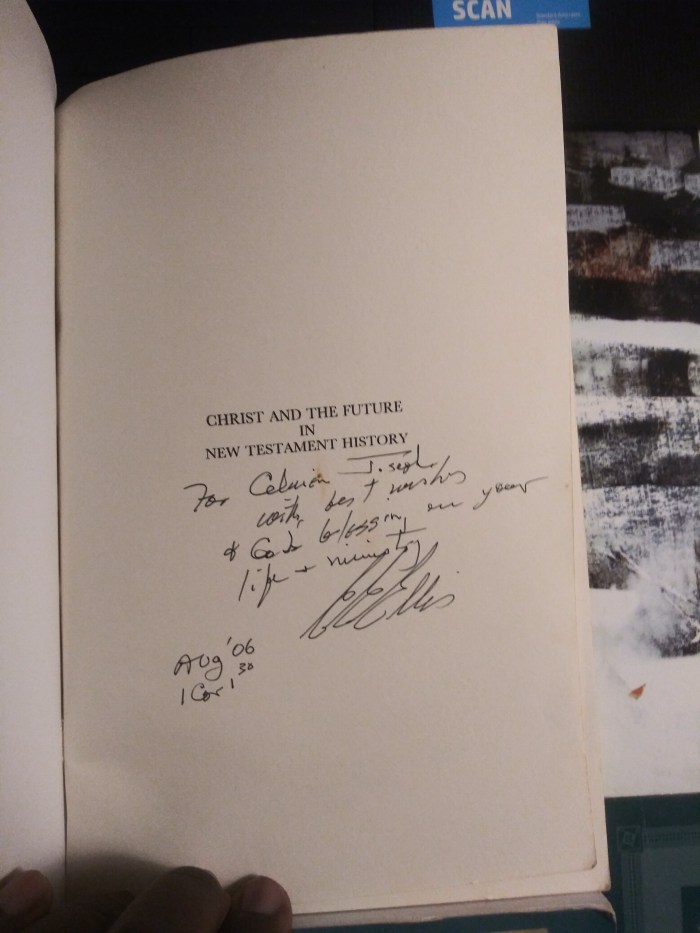
Every week in his classroom, I was discovering new data about Biblical Hermeneutics and the biblical text. Because he was student-centered, I developed the habit to talk to him after the class period was over on that day, so I could make further inquiry about Scripture, and to discuss specific matters and relating issues to the lecture of that day. I would also walk with him to his second-floor office and carry his suitcase. I remember the day when he brought to class a copy of his groundbreaking study, “The Making of the New Testament Documents,” and on a sticky note wrote the following words: “This book belongs to Celucien Joseph.” Nonetheless, this Celucien was battling with the internal conflict whether to go forward with the PhD in History of Ideas at UT Dallas or to apply to do a PhD in New Testament in the United Kingdom. I was found in two distinct worlds because I am a man of two spheres with a split-soul in the church and the academic world.