“Monopolizing Justice : When Monetary Justice and Legal Lawsuits are not ENOUGH to fix our Racial Wounds”

“Monopolizing Justice:When Monetary Justice  and Legal Lawsuits  are not ENOUGH to fix our Racial Wounds”

The practice of racial discrimination and white supremacy in the American society not only literally kill human lives; it causes severe financial injuries and burden on the U.S. economy. What is depressing is that our governments–at the Federal, State, and County level–are resistant to work out an effective plan to destroy the systems, institutions, and practices that cause such national troubles and human sufferings. Justice is not cheap and a passive force. Injustice is even more costly than the practice and idea of justice. Monetary justice will never solve the roots of our common wounds and racial predicament. If the American government and elected officials would listen to the cry of the vulnerable members of our democracy and correspondingly to the complaints of those who continue to be victims of racial trauma and prejudice, and if they would act judicially and equitably to alleviate the racial pain and unjust practices, perhaps, we would be on the right path of racial healing and (more) racial progress.

According to various reports and studies, it has now become evident to us that our economic strength, military power, and ideals of democracy, not the practice of democracy, are not adequate to fix the deep problems of racism and white supremacy in the American society. Both practices are deeply human problems that are grounded profoundly in our value system and racial habits. In other words, our richness in military and material resources cannot and will not resolve the practice of racial hatred and inequality, and discriminatory laws and inequitable public policies. (I want to be clear here that I’m  referring  to how we have   created a false vision of justice and democracy in this country. (1) We have wrongly equated democracy and justice with military power and economic progress. (2)  We have wrongly substituted justice and democracy with an incomplete practice of freedom and human rights. (3) Correspondingly, we believe that compensating victims of racial injustice and oppression will solve the dilemma of racism and white supremacy embedded in our systems and institutions, and in our practices and habits. These are great moral dilemmas and ethical crises in this country. )

Further, members of the racialized and the economically-marginalized minorities in this country have been suing the American government –Federal, State, and County–since this country’s birth for the lack of practice of our foundational democratic ideals: equality, human rights, justice, peace, freedom, happiness, etc. Evidently, lawsuits that result in monetary justice –as some people have interpreted it–as a way to rectify acts of injustice and the practices of racial oppression should not be construed as total or genuine justice. Justice is a cardinal virtue necessary for any functioning democracy and government.

Unfortunatley, we cannot run a country on democratic ideals only. This conception of democracy is not enough and adequate, and has failed many American citizens for many years. There’s a conceptual and practical distinction between the theoretical ideals embedded in our Constitution and Bills of Rights and the pracrtice and the materialization of such lofty ideals in this nation’s systems and institutions, and moral and ethical values and worldviews.

Democracy is a state of being, an existential act, and a set of practices that influence  every  aspect and department of society, and necessitate other complementary human virtues: love, tolerance,  inclusion,  embrace,  equality,  equity,  justice, etc.  Such practices and interventions would contribute to the common good and human flourishing in society and in the world.  Democracy is  also built on certain moral principles and ethical values to sustain its continual practice and longevity,  and cultural and political force in society and in the world.

Racism is not cheap. White supremacy is costly. They are major threats to our democratic system and tradition.  Both racism and white supremacy are anti-democratic practices that defer the triumph of justice in our midst and governmental systems  and institutions. Human flourishing cannot happen when racism and inequality are visible structures in society and governance. Justice is the very foundation of democracy. Without justice, our democracy will always be short of equality. To monopolize justice and love in all our doings and actions and intellectual practices and political interventions is to place democracy at the centre of human existence and political life.

Finally, as a country, we do have a choice to make things right and to champion the imperative cause of justice and equality and plural democracy in this society; here are some suggestions:

  1. We should prioritize total justice in all our legal transactions and human interactions.
  2. We should practice generous justice in all areas and departments of our plural democracy.
  3. We must reinterpret the concept of democracy as an act and way of life, not just ideals, and the right feeling toward other citizens and human beings.
  4. We must see our plural democracy and justice as concrete human, educational, intellectual, and legal practices and habits that will make us better as a nation.
  5. We should construe human rights as rights that are necessary for our practice of democracy and citizenship. Yet human rights are fundamental and natural rights that all citizens need to flourish in life and to explore their full potential as members of our democracy and members of the human race.
  6. We should reinterpret justice and equality as daily practices that add more value and dignity to our shared humanity; any force that threatens justice and human dignity could lead to the practice of dehumanization and injustice.
  7. We should continue to strive together and collaborate to destroy systems, institutions, and pracrices–judicial, intellectual, economic, cultural, ideological, political, etc.– that create alienation between this country’s racial and ethnic groups, and those that defer our racial healing and progress as human beings created in the image of God, our common Creator.

***Finally, read the report below on “The Cost of Racism” in the American society:

“Nationwide protests have cast a spotlight on racism and inequality in the United States. Now a major bank has put a price tag on how much the economy has lost as a result of discrimination against African Americans: $16 trillion.

Since 2000, U.S. gross domestic product lost that much as a result of discriminatory practices in a range of areas, including in education and access to business loans, according to a new study by Citigroup. It’s not an insignificant number: By comparison, U.S. GDP totaled $19.5 trillion last year.

And not acting to reverse discriminatory practices will continue to exact a cost. Citigroup estimates the economy would see a $5 trillion boost over the next five years if the U.S. were to tackle key areas of discrimination against African Americans.”

Click on the link to finish reading the article :
https://www.npr.org/sections/live-updates-protests-for-racial-justice/2020/09/23/916022472/cost-of-racism-u-s-economy-lost-16-trillion-because-of-discrimination-bank-says?utm_campaign=npr&utm_medium=social&utm_source=facebook.com&utm_term=nprnews

“The Bankruptcy of Justice and the Ethics of Life”

“The Bankruptcy of Justice and the Ethics of Life”

Money can’t never replace somebody’s life. Our conception of justice in this country is morally bankrupt and dehumanizing. We have created an ethical vision of life that is substantially cheap and terrifying.

True justice begins with this greatest existential question: what must we do as a community, people, and a nation to humanize and value life itself, for example, the life of the poor and the marginalized, and to ensure that all lives really matter (existential philosophy, theological ethics, sociology)?

True justice should compel us to ask another pivotal question: do I have the right of existence and the right to live in my community as a constituent member of an ethnic/racial/gender/religious group (ethics, gender studies, religion)?

True justice promotes human life at all cost by creating a non-threatening and peaceful atmosphere for the vulnerable and ensures that all members of society, especially the racialized and minoritized individuals and groups, would flourish and explore their full potential as citizens of this country (nationalism) and members of the human family (cosmopolitanism), concurrently.

True justice deals with the structures and systems in society that dehumanize life itself and undermine the worth of people as bearers of the image of God (theological anthropology, politics, government).

True justice is established on the premise that my happiness and freedom are as important as those of my neighbor, and that my future possibilities and potentials are as vital as those who live in a different community or those who belong to a different social class or racial group (political theory, economics, philosophy of race).

Justice as monetary reparation is not fully adequate and holistic. We need a better justice system in this country that is integral in all areas, aspects, and departments of human life and society. Our passion for justice is too weak. We are too easily satisfied with cheap acts of justice, which we believe to be true justice.

***I wrote this piece as a reaction to the new settlement associating with Breonna Taylor’s life and death. Click on the link to learn about it: https://www.nytimes.com/2020/09/15/us/breonna-taylor-settlement-louisville.html

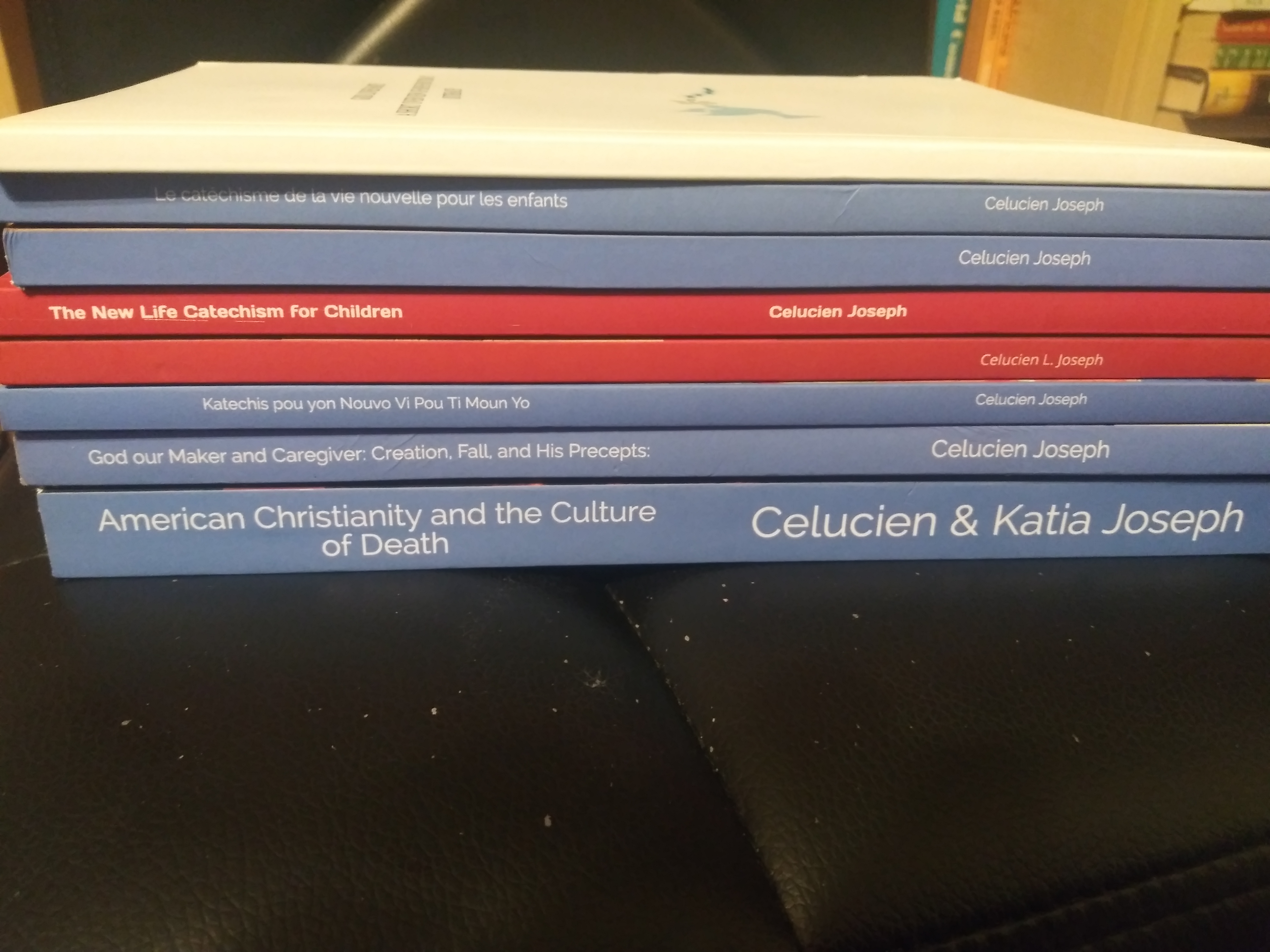
“The Joseph Family Through Books” (Part 2): Books for the People in the Church (Non-Academic Works)

“The Joseph Family Through Books” (Part 2): Books for the People in the Church (Non-Academic Works)

Since I am a church guy, I published eight non-academic books to be used in ecclesiastical communities, such as in small groups and Bible study settings toward spiritual formation and piety, both on the individual and collective level. Since I love Jesus, I write these books for people who love Jesus and also those who may not like Him; so you have no excuse not to read my books 🙂

The books below are written in three languages: English, Haitian Creole, and French.

  1. American Christianity and the Culture of Death: Conversations and Poems on Racial Trauma, Social Justice, and Hope (2020)
  2. Le catéchisme de la vie nouvelle pour les enfants: 100 questions et réponses pour nous apprendre à vivre paisiblement et relationnellement dans le monde (French Edition) (2019)
  3. The New Life Catechism for Children / Le catéchisme de la vie nouvelle pour les enfants: 100 questions et réponses pour nous apprendre à vivre paisiblement … dans le monde (Bilingual Edition: English and French) ( 2019)
  4. The New Life Catechism for Children/Katechis pou yon Nouvo Vi Pou Ti Moun Yo: 100 Kesyon ak Repons pou anseye nou kijan pou nou viv nan lapè ak bon relasyon nan mond lan (Bilingual Edition: English and Creole) (2019)
  5. Katechis pou yon Nouvo Vi Pou Ti Moun Yo: 100 Kesyon ak Repons pou anseye nou kijan pou nou viv nan lapè ak bon relasyon nan monn lan (Creole Edition) (2019)
  6. The New Life Catechism for Children: 100 Questions & Answers to teach us how to live peacefully and relationally in the world (English Edition) (2019)
  7. God our Maker and Caregiver: Creation, Fall, and His Precepts:: Book (2019)
  8. . God loves Haiti (2015)

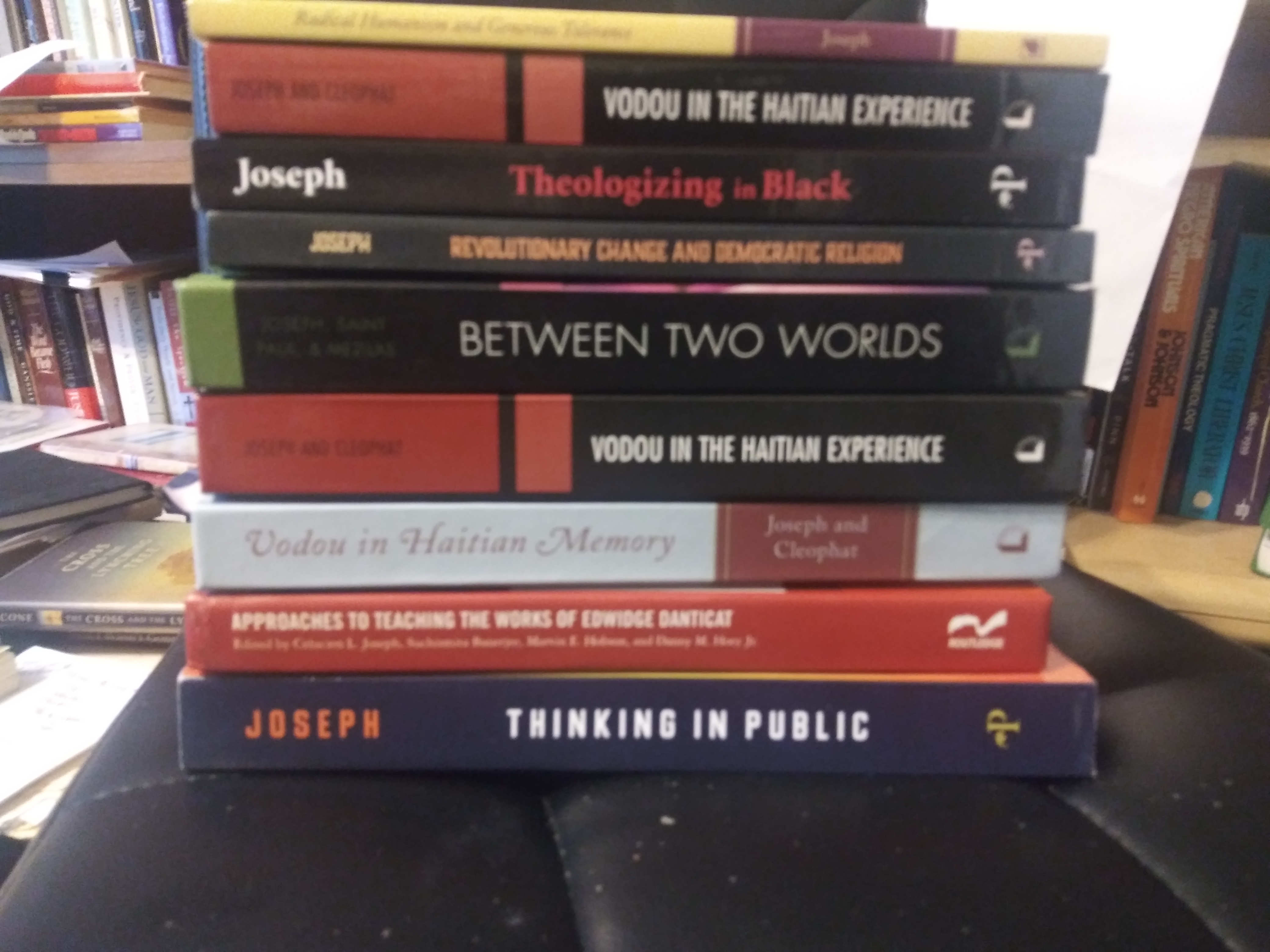
“The Joseph Family Through Books” (Part 1): Academic Works

“The Joseph Family Through Books” (Part 1): Academic Works

Here are all the academic (9) titles I’ve published over the course of eight years. I gave birth to four twin babies, that is, four books I’ve co-edited with friends, and authored five personal books. As you can tell, I’m a mother who is always pregnant; I give birth regularly to non-human babies 🙂

  1. Theologizing in Black: On Africana Theological Ethics and Anthropology (Pickwick Publications, 2020)
  2. Revolutionary Change and Democratic Religion: Christianity, Vodou, and Secularism (Pickwick Publications, 2020)
  3. Thinking in Public: Faith, Secular Humanism, and Development in Jacques Roumain (Pickwick Publications, an Imprint of Wipf and Stock Publishers 2017)
  4. Between Two Worlds: Jean Price-Mars, Haiti, and Africa (Black Diasporic Worlds: Origins and Evolutions from New World Slaving) (Lexington Books, 2018)
  5. Radical Humanism and Generous Tolerance: Soyinka on Religion and Human Solidarity (University Press of America, 2016)
  6. Vodou in the Haitian Experience: A Black Atlantic Perspective (Lexington Books, 2016)
  7. Vodou in Haitian Memory: The Idea and Representation of Vodou in Haitian Imagination (Lexington Books, 2016)
  8. Haitian Modernity and Liberative Interruptions: Discourse on Race, Religion, and Freedom (University Press of America, 2013)
  9. Approaches to Teaching the Works of Edwidge Danticat (Routledge, 2019)

**** Three of those books have received academic awards.

God and Justice

Justice is an essential attribute of God just like divine characteristics such as love, compassion, foreknowledge, holiness, omnipotence, eternality, aseity, sovereignty. These are not inseparable divine virtues. They’re intertwined and reflect both the content of the Being of God and his actions in the world.

Hence, I’m not sure if it is possible to preach the Gospel authentically and champion the ethics of Jesus in the public sphere without moving by compassion and empathy toward those suffering because of the social injustices of our political system, structural sins, and cultural ideologies.

Followers of Jesus must live and practice the Gospel (“Good news”) they believe in. They must demonstrate its power in the lives of individuals and families. The power of the Gospel is not only transformative power to salvation; the message of the Gospel is also about alleviating human suffering, caring for the needy and brokenhearted, and responding urgently to the pressing needs in our community and city.

“On Kindness, Privileges, and Change”

“On Kindness, Privileges, and Change”

It’s really not a good idea to use your privileges (i.e. financial, gender, ethnic, racial, sex, class, education, nationality) or fame to make life in this world an uneasy journey for those with less privileges or no privileges at all.

The individuals who have changed the world and human dynamics in society used their privileges (i.e. power, influence, reputation) to uplift the weak and empower the disadvantaged to dream again and hope for another world that is more promising and fulfilling.

They share a common characteristic: self-denial. They became small so others can become big. They put the needs of others above theirs. They always find creative ways to love people, and to show kindness and acts of compassion to those who are hungry and thirst for justice, peace, and righteousness. They love gently and daringly, treat others caringly, and give themselves unselfishly. These individuals, both men and women, live life in this world with an unwavering commitment and passion to make it a better place for all, especially the poor.

These individuals also use their power and privileges not to oppress, exploit, or shame the poor, the unfortunate, and those living in the margins; rather, they hold truth to the principle of human brotherhood and “I am my brother’s keeper.”

Friends: if you are a privileged individual in society or have power to effect change in your city or wherever you’re exercising these abilities, please use them for the good and welfare of the least among you and us. Trust me you won’t become a less privileged and powerful individual when you exploit your resources for the sake of making someone’s else’s life or living condition better and toward the common good, a better society, and human flourishing.

“The Early African Framers of the Christian Faith: Selected Important Works of Early African Christian Literature in the First 600 Years of Christianity”

“The Early African Framers of the Christian Faith: Selected Important Works of Early African Christian Literature in the First 600 Years of Christianity”

The Christian religion was born in the Roman Empire and consequently spread under the influence and with the support of the Roman Empire. In its inception, Christianity had multiple beginnings and moved rapidly from Palestine, Asia, Africa, and then Europe, in that sequential order. In fact, some historians talk about Christianity’s concurrent beginnings: Palestine, Asia, and Africa. In particular, what is known today as the Continent of Africa was a significant geographical location that marked the genesis of Christianity. Africa is one of the cradles of the Christian faith. In the first 600 years of Christianity, the three most important places in which Christian history left an enduring mark on human history and where the core theological beliefs and Christian dogmas were developed, nourished, and refined were in Africa; these historic places included North Africa (i.e. Carthage, Cyrenaica, Cyrene [or the Maghrib of Libya]), Egypt (i.e. Alexandria), Ethiopia (i.e. Aksum) ancient Nubia (i.e. Faras [capital city associated with the kingdom of Noba]; Old Dongola [capital city associated with the kingdom of Makurra]; and Soba [capital city associated with the kingdom of Alwa]), and modern Sudan.

In this overview on early African Christian literature, I focus on seven major African Church fathers who were among the framers of the Christian faith, history, and theology. I divide their contributions based on the geography or region and the languages in which they wrote or theologized. The first group includes African Christian leaders in the Latin World or the early African Christian thinkers who wrote in the Latin language; this reference lists the writings of three of them: Tertullian of Carthage, Cyprian of Carthage, and Augustine of Hippo. The first group of individuals were North Africans and whose names are associated with the city or the location (i.e. Carthage, Hippo) they ministered to people. Let me provide a sentence or two about each writer.

Tertullian was born in Carthage around the year 160 (ca.). He is known as the creator of Latin Christian theological language. Cyprian was born in Carthage around the year 200 (ca.) and died in the year 258. He was an influential rhetorician and his writings focus particularly on the unity of the church and ecclesiastical order and orthodoxy. Finally, Augustine is probably the most influential theologian and philosopher in the history of Christianity. He is probably the most prolific Christian writer in Christian history, at least in his era to the Middle Ages.He was born in the small town of Tagaste, Numidia in 354 in North Africa (Libya).

The second group of African Christian leaders constitutes the African framers in the Greek World or the African Christian thinkers who wrote in the Greek language; this guide lists the writings of four of them: Clement of Alexandria, Origen of Alexandria, Athanasius of Alexandria, and Cyril of Alexandria. The second group of writers were from the country of Egypt and whose names are associated with the places (i.e. Alexandria) they served as Christian leaders and theologians. In the same line of thought, let me provide a sentence or two about each thinker.

Clement was born near the middle of the second century, probably in Athens. He was an influential Alexandrian theologian and in his writings, he explored the rapport between Christian ideas and Greek philosophy. Origen was born in Alexandria the year 185 and died in Alexandria the year 373. A prolific writer, he is known as one of the greatest interpreters of the Bible and a creative theologian. Athanasius is widely known as the “Defender” of the Council of Nicaea (the Nicene Creed, ca. 328), especially orthodox Christology, and the “Father” of Christian Orthodoxy. Finally, Cyril was a significant Alexandrian writer and best known for his controversy over the Christological perspectives of Nestorius, which he rebuked in his writings. He brilliantly defended the two natures of Christ (or the dual identity of Christ) and energetically contended that Christ was both fully divine and fully human, concurrently.

Unfortunately, in this reference guide, I do list early African literature or writers who wrote in the Coptic language (spoken Egypt and Sudan, to some degree) or the Ge’ez language (i.e. Eritrea, Ethiopia). While the former is associated with the Coptic Christianity in Egypt, Nubia, and Sudan; the latter is associated with the Ethiopian Orthodox Tewahedo Church or/and Eritrean Orthodox. I do not list all the dates associated with the writings below simply because we do not know all of them; nonetheless, I list each work under its author’s name. Also, I do not reference all the works connected to the writers above or below, but only the most essential writings to enhance our understanding of early African Christian history and Africa’s enormous and sustaining contributions to global Christianity, especially its enduring mark on Western Christianity and theology.

I. Early African Christian Literature: The Latin Church Fathers

A. Tertullian of Carthage (Quintus Septimius Florens Tertullianus) (ca.160-ca.225)

· Apologeticum (Apology against the Gentiles in Defense of Christians)
· To the Heathens
· On the Prescription of Heretics or On the Rule of the Heretics (De praescriptione haereticorum)
· Against Marcion (Adversus Marcionem)
· Against Praxeas
· Against Hermogenes
· Against the Valentinians
· The Demurer Against the Heretics (De Praescriptione haereticorum)
· Prescription against the Heretics (ca.220)
· Against the Scorpion or Scorpiace
· On Prayer
· On Patience
· On Penance
· On the Crown
· On Chastity
· On Baptism
· On Modesty
· On the Pallium
· To the Martyrs
· On Spectacles
· On Monogamy
· To His Wife
· To the Nations, or To the Gentiles
· The Testimony of the Soul
· On the Flesh of Christ
· On the Resurrection of the Flesh
· On Veiling of Virgins
· On Flight in Times of Persecution

B. Cyprian of Carthage (Thascius Cacecilius Cyprianus) (ca. 200-ca. 258)

· The Idols Are Not Gods
· Testimonies to Quirinus
· To Fortunatus
· To Donatus
· To Demetrianus
· On The Unity of the Catholic Church: Against the Novationists(De Unitate Ecclesiae Catholicae)
· On the Lapsed, or On the Fallen
· On the Dress of Virgins
· The Lord’s Prayer
· On the Advantage of Patience
· On Works and Alms

C. Aurelius Augustin (ca.354- ca. 430)

· Against the Academicians
· Against Adiamantus
· Against a Letter of Mani
· Against the Skeptics (Contra Academicos) (ca. 387)
· Against Two Epistles of the Pelagians
· Against Julian the Defender of the Pelagian Heresy
· Incomplete Work against Justin
· On the Immortality of the Soul (De immortalitate anima (ca. 387)
· On Free Will (De libero arbitrio) (ca. 388)
· On Rebuke and Grace
· On True Religion (De vera religione)
· Confessions (Confessiones) (ca.397-401)
· On Christian Discipline (De disciplina Christiana) (ca. 396)
· On Christian Doctrine (de doctrina Christiana) (ca. 397)
· On the Unity of the Church
· City of God (De civitate Dei) (ca.412-426)
· On the Happy Life
· Soliloquies
· Expositions on the Psalms
· Tractates on the Gospel of John
· Questions of the Gospels
· On Baptism (ca. 400)
· On Nature and Grace (De natura et gratia)
· On The Trinity (De Trinatate) (ca. 415-420)
· On the Grace of Jesus Christ and Original Sin (ca. 418)
· On the Nature of God
· The Predestination of the Saints (ca. 428)
· The Gift of Perseverance (ca. 429)
· On the Customs of the Catholic Church and of the Manichees
· On Genesis against the Manichees
· Questions on the Heptateuch
· On the Sermon on the Mount
· Commentary on Romans
· The Mirror of Scripture
· On the Faith and the Creed
· Enchiridion
· On Faith, Hope, and Charity
· Two Books to Simplician on Various Questions
· On Punishment and the Forgiveness of Sins
· On Nature and Grace
· On Grace and Free Will

II. Early African Christian Literature: The Greek Church Fathers

A. Titus Flavius Clemens (“Clement of Alexandria”) (ca.150-ca.215)

· Exhortation to the Greeks
· Stromateis (Stromata or Miscellanies)
· The Paedaogus (The Instructor)
· Hypotyposeis
· Who Is the Richer [Person] to be Saved?

B. Origen (ca. 185-ca. 254)

· Hexapla (ca. 230)
· On First Principles (De principiis) (ca.)
· Philocalia
· Commentaries on Genesis (ca.232)
· Exhortation to Martyrdom (ca.235)
· Contra Celsum (Against Celsus) (ca. 250)
· Homilies on Genesis

C. Athanasius of Alexandria (ca.296-ca.373)

· Against the Heathen
· Speech against the Pagans and Speech on the Incarnation of the Word (ca.318)
· Treatise on the Incarnation of the World of God (De Incarnatione) (ca. 318)
· Orations against the Arians
· Apology against the Arians
· History against the Arians
· Three Speeches against the Arians (ca. 335) or Discourses Against the Arians
· Letter to Virgins (ca. 337?)
· Life of St. Antony (ca.357)
· To the Bishops of Africa (ca. 373)
· Thirty-Ninth Festal Letter (ca.367)
· Against the Manichees
· Sayings of the Fathers or the Apophthegmata of the Fathers

D. Cyril of Alexandria

· Christ the Educator
· On the Worship of God in Spirit and in Truth
· Excerpts from Theodotu
· Consubstantial Trinity
· Against Julian
· Against the Blasphemies of Nestorius
· Commentary on John/Commentary on St. John
· Commentary on Matthew
· Glaphyra (“beautiful things)
· Commentary on the Twelve Prophets
· Explanation of the Twelve Chapters
· Christ Is One

***I hope this reference guide will help the reader to have a better understanding of the enormous contributions of Africa in the birth and growth of global Christianity, especially Western Christianity, in its first 600 years. I also trust that this piece will help correct some misunderstandings about the relationship between Africa and early Christian history.

Big Progress on Book Project: “Theological Education and Christian Scholarship for Human Flourishing”

I began the initial research for this book five years ago. Hence, I’ve been actively working on this manuscript in the past five years. I’m pleased to announce that I am currently finalizing the last two chapters. As an educator who believes our participatory democracy must be strengthened through an inclusive and multicultural education, this book is very dear to my heart and my philosophy of theological education, civic engagement, and human flourishing.

I’ve been struggling to find an answer to some of the pressing issues I discussed in this book since my early days in seminary (It has been exactly 18 years now; my first year of seminary was in August (fall semester), 2002).

Oh the great and merciful God, grant me enough grace and clarity of thought to finalize Chapters 6 and 7.

“Why I love the Church and the location where the Church lives”

“Why I love the Church and the location where the Church lives”

I love the Church. It’s not perfect, but is a work in progress, an ongoing creation of God. I’m fortunate to be a participant of God’s redemptive narrative, through the Spirit of reluctant power, grace, and love, in the hearts and minds of little boys and little girls, men and women, the poor and the vulnerable.

I love the ghetto because the church lives there.

I love the city because it is the location of the Church and God’s chosen people.

I love the countryside and the farmland because they’re the place where the church was born and first learned how to crawl.

I love the Church of little boys and little girls for no one will see and enjoy God if she does not have the attitude of such innocent creatures.

I love the Church of the poor and the vulnerable, and of the weak and the disfranchised, because of God’s special attention to them.

I love the Church because it reminds me of the calvary of darkness, pain, and suffering, and the worth and dignity of the substitutionary and sacrificial death of my Lord and Savior: Jesus, the God-Man, who died for the safety, godliness, and beauty of the Church.

***The Church is not the city, but lives in the city. The Church is not the ghetto, but the ghetto is the location of the church, the people of God. The farmland or the countryside is not identical to the church or with the redeemed people of God; it is the milieu wherein the Spirit moves, creates, and establishes the Church. The Church is who you are in Christ and what you are becoming in God.

The church is in fact a unique location, a very special place in which the Spirit-God moves, works, and indwells. This location of God’s rest is you.

#Ilovethechurch

#thechurchiswhoyouareinChrist

#thechurchisnotaplacethechurchisyou

Rev. Dr. Celucien L. Joseph, PhD