"Exploring American thought, democracy, culture, religion, Haiti, and the Black Atlantic to better understand the past and future of the Americas and the world–toward human flourishing."
As I have watched over the years the unexpected death of many men who are in their late 40s, death as an inescapable human phenomenon has become more real to me—in the most existential sense. It’s closer to all of us more than we could imagine or would want to believe. The reality of death is the human reality.
Good People: This is not a matter of being afraid of death or being afraid of dying. Death as a powerful force claims our individual existence— whether we’re ready or not. The threat of death is not actually a menace to human existence; rather, it’s a natural phenomenon that should teach us how to live in humility, act with wisdom and care, and treat all people with kindness and dignity while we’re still alive.
“Ethics from Different Voices and Spheres: Key Texts Across Disciplines”
This episode offers a curated list of essential readings on ethics drawn from a range of disciplines, including political theory, moral philosophy, religious and theological studies, and cultural studies. Whether you’re a student, scholar, or curious reader, these texts provide diverse perspectives on questions of justice, virtue, responsibility, and the moral life in both personal and collective contexts. From classic philosophical treatises to contemporary theological reflections and critical cultural analyses, these works will enrich your understanding of ethical thought across traditions and ideologies.
“Engaging and Citing Brueggemann: Yahweh against the god/s of the Empire” (Day 6)
“The God who will decide is not the comfortable god of the empire, so far and well fed as to be neutral and inattentive. Rather, it is the God who is alert to the realities, who does not flinch from taking sides, who sits in the divine council on the edge of his seat and is attentive to his special interests. It is the way of the unifying gods of the empire not to take sides and by being tolerant to cast eternal votes for the way things are…
It is the gospel; God is for us. In an empire no god is for anyone. They are old gods who don’t care anymore and have tried everything once and have a committee studying all other issues…And so the urging I make to those who would be prophets is that we do not neglect to do our work about who God is and that we know our discernment of God is at the breaking points in human community.
Thus, a truly free God is essential to marginal people if they are to have a legitimate standing ground against the oppressive orders of the day. But then it follows that for those who regulate and benefit from the order of the day a truly free God is not necessary, desirable, or perhaps even possible.“
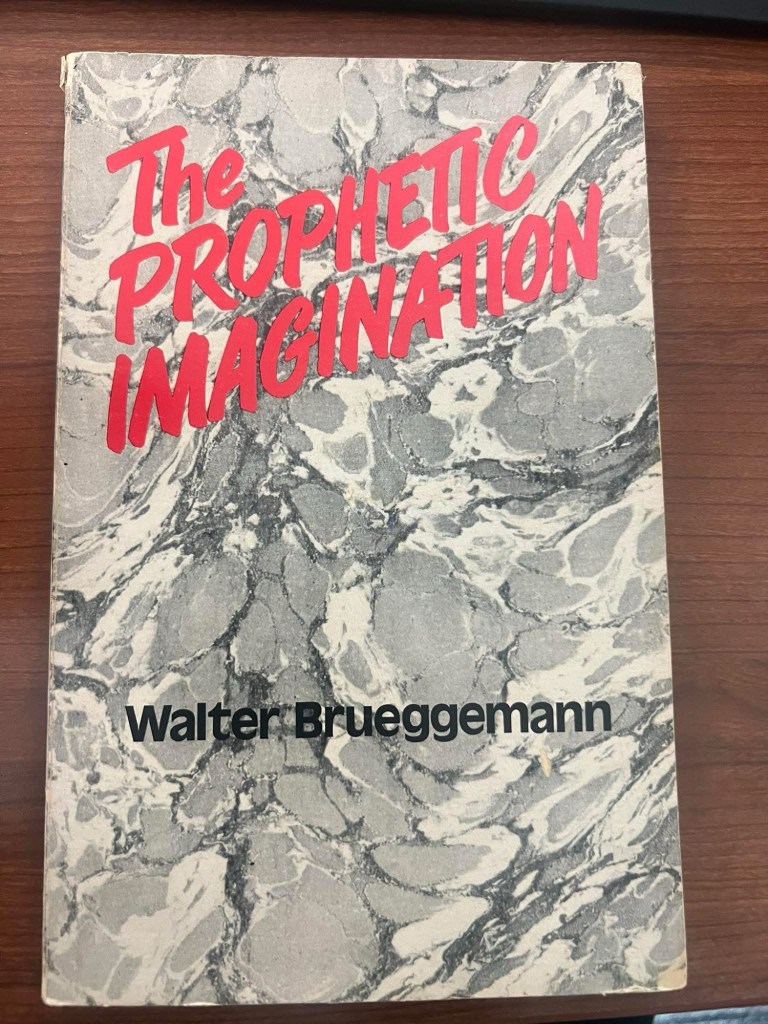
—Brueggemann, The Prophetic Imagination, pp. 24-5, 30
Brief Commentary
In the above text, Brueggemann establishes a clear distinction between Yahweh and the god/s of the Empire. The contrast between these two entities is best articulated in the way God acts in the world as compared to the way the god of the Empire behaves toward the people. Second, Brueggemann also establishes a remarkable contrast in respect to Yahweh’s nature and intervention in human affairs with those of the deity of the Empire.
It is natural for Yahweh to take sides with “marginalized communities” in order to set them free from the “oppressive orders of the day,” including the socioeconomic and political structures and policies of the Empire. In fact, the freedom of Yahweh is linked to his disposition to intervene in the political sphere so he could give the oppressed “a legitimate standing” against their collective experience, that is, the inflicted inhumane treatments and conditions under the Empire. Yahweh is not silent, but he is active in the world and understands the social realities of those who are suffering and being dehumanized by both oppressive systems and violent regimes/governments. Yahweh’s awareness of the human experience is also connected to his power and sovereignty, as well as his care for and compassion toward marginal people and the powerless.
By contrast, the god of the empire is neutral in decision-making and inattentive to systems of oppression that cause suffering and violence in the world. It is the inaction of the imperial god that fuels both human violence and destruction in human communities. The imperial deity is not concerned about the common good and human flourishing in society. Yahweh is the compassionate deity who cares, loves, hears, and acts. He reconstitutes his people and comforts the weak by being an ally.
Therefore, Brueggemann could argue that it is necessary for the prophetic message to articulate correctly the true character of God and for contemporary prophets to properly instruct the people that Yahweh does indeed take sides in decision-making and is committed to a “preferential option” for the oppressive and marginalized communities and people. Within this divine logic, those who are called to be “prophets” in such a time as this need to imitate both the character and attitude of Yahweh. They should be like God in the way they also should take sides in decision-making and walk in solidarity with suffering communities—for their liberation and dignity.
“Engaging and Citing Brueggemann: Prophetic Ministry in Contemporary America, and the Problem of Mislabeling Things” (Day 5)
The excerpted text below is quite long, but I invite you to read every word with care, understanding, and with a critical eye. Given the clarify of Brueggemann’s writing and message, it is unnecessary tor me to write a reflection on the text below.
“It is of enormous importance that the prophets of the Old Testament characteristically spoke in poetic language. By that I do not mean they created rhymes. Rather they spoke in elusive, metaphorical ways as a rhetorical strategy for escaping and challenging the powerful ideologies that had reduced social reality to control and social possibility to the capability of the dominant regime…
I do not believe there are easy, obvious, or direct connections from the ancient world of the Bible to our own contemporary world. But I will dare nonetheless, in what follows, to suggest an analogue whereby we may think again about “prophetic ministry” among us. Not unlike the Jerusalem ideology of chosenness or the imperial ideology of hegemony, pastors in U.S. churches live and work amid the American ideology of the National Security State. That ideology, massive in its influence but seldom lined out in a specific way, assumes U.S. exceptionalism, that is, that the United States is a special case in human history that is not subject to the ordinary conventions of life in the world. That exceptionalism assumes that we are, by right, an especially privileged, entitled people, blessed by God in peculiar ways. We are thereby given preeminence in the world and are entitled to more than our share of world’s goods in order to sustain an unparalleled and unsustainable standard of living. That exceptional privilege permits, requires, and legitimates unparalleled military strength, both in order to control markets and resources around the world, and to propagate the truth of “democratic capitalism” all over the world, including parts of the world that are not amenable to that ideology.
The pastoral reality is that this ideology of privilege sustained by power is so pervasive that it is the air we breathe and the water in which we swim. It is beyond question or criticism; it renders us incapable of thinking or imagining outside of its definitions of reality…
When things are mislabeled, then one need not see them as they are. A prayer by “Reverend Billy” indicates how the denial of euphemism works among us:
Dear Lord, We can’t believe that bombing is called security. We can’t believe that monopoly is called democracy. We can’t believe that gasoline prices are called foreign policy… We can’t believe that racism is called crime fighting! We can’t believe that sweatshops are called efficiency! We can’t believe that a mall is called the neighborhood! …. We can’t believe that advertising is called free speech! We can’t believe that love is called for sale! We can’t believe that you think there are two political parties! We can’t believe that you repeat the word “democracy” like it’s a liturgical chant from a lost religion.
There is no doubt that a society that traffics in violence and exploitation must disguise such policies and practices in order to protect the ideology that gives immunity….
It is surely the case that the U.S. church, largely settled into the ideology of U.S. exceptionalism, colludes in denial. Thus we have complete confidence in the “American way of life” that is much confused with the promises of the Gospel. Across the entire political spectrum, we imagine that our way in the world is the right way and are largely incapable of noticing the trouble and suffering evoked in the world by U.S. practices and policies. More than that, we try not to take with seriousness the unraveling of the human fabric in our society because of greed that very often eventuates in violence, even if covert violence. The undercurrents of our society, like those of ancient Jerusalem, might suggest we are very close to an emergency situation, given the failure of our institutions. But even the recent economic distress has not evoked any deep review of our policies and our practices that put our society at risk. Clearly, we are like ancient Jerusalem in our immense capacity for denial.
I suspect that in our time and place the capacity to penetrate the denial, and so to exhibit the failure and the pain generated by a self-sufficient system, is voiced not in anger or indignation. It is rather in sadness and loss. The sadness and loss need not be voiced in confrontational ways. The expression can be quiet and sober and unflinching in its resolve. The point is not to establish blame. The point, rather, is to make available the reality of hurt and loss, and to trace back the ways in which such hurt and loss are not an accident but are products of an ideological system. In this tradition, moreover, such an articulation that flies in the face of dominant ideology is not simply another opinion. It is rather a sounding of a deep holiness that cuts below our usual management of truth and speaks from a holiness that stands outside of our management. Our predecessors in prophetic office could do no better than to take their deep utterance as the word of God. And we do no better than that, as long as we remember the God who offers such a word is a God who notices and cares, and who knows that more denial will only bring more trouble.”
—-Walter Brueggemann, “Prophetic Leadership: Engagement in Counter-Imagination,” pp. 4-5, 9-10, 13
This video introduces foundational texts that have shaped the study of African American religion—works that explore the rich intersection of faith, identity, resistance, and culture. From slave narratives to theological reflections, these books reveal how Black religious thought has been a force of survival, liberation, and spiritual power. Perfect for students, scholars, or anyone curious about the roots and rhythms of Black faith traditions.
“African American Religion and Political and Social Activism: Key Texts”
This talk explores the powerful role of religion in African American political and social activism, highlighting key texts and studies that illuminate the enduring relationship between faith, resistance, and liberation. From the prophetic tradition in Black churches to the theological underpinnings of the Civil Rights and Black Power movements, the discussion will trace how religious belief and institutions have served as both spiritual refuge and strategic centers for mobilization. The talk invites reflection on how religion continues to shape African American struggles for justice, dignity, and equity today.
“Engaging and Citing Brueggemann: Shalom as Joy & Harmony” (Day 4)
“That persistent vision of joy, well-being, harmony, and prosperity is not captured in any single word or idea in the Bible; a cluster of words is required to express its many dimensions and subtle nuances: love, loyalty, truth, grace, salvation, justice, blessing, righteousness. But the term that in recent discussions has been used to summarize that controlling vision is shalom. Both in such discussion and in the Bible itself, it bears tremendous freight–the freight of a dream of God that resists all our tendencies to division, hostility, fear, drivenness, and misery.
Shalom is the substance of the biblical vision of one community embracing all creation. It refers to all those resources and factors that make communal harmony joyous and effective.” —Brueggemann, “Peace,” p. 14
Religion and Violence: Key Texts (Part 1 &2) This section explores foundational texts that examine the complex relationship between religion and violence. It includes both religious scriptures and scholarly interpretations that address how religious ideologies have been used to justify, provoke, or resist violence. Key texts may include passages from the Hebrew Bible, the Qur’an, and the New Testament, alongside influential works by thinkers such as René Girard, Karen Armstrong, and Mark Juergensmeyer. These readings offer diverse perspectives on whether violence is inherent to religious traditions or arises from historical, political, and social contexts in which religions operate.
In this conversation, I explore the subject of African Traditional Religion: Key Texts (Part 2), discussing foundational themes, significant oral and written sources, and the cultural and spiritual contexts that shape traditional African religious beliefs and practices. Key elements included an overview of cosmology, concepts of God, prayer, ancestor veneration, ritual practices, and the role of myths, proverbs, and sacred narratives in transmitting religious knowledge.
In this conversation, I explore the subject of African Traditional Religion: Key Texts (Part 1), discussing foundational themes, significant oral and written sources, and the cultural and spiritual contexts that shape traditional African religious beliefs and practices. Key elements included an overview of cosmology, concepts of God, prayer, ancestor veneration, ritual practices, and the role of myths, proverbs, and sacred narratives in transmitting religious knowledge.