The American Flag is Not Christian, and Christianity is not America, but It is okay to celebrate the Flag!

The American Flag is Not Christian, and Christianity is not America, but It is okay to celebrate the Flag!

To my Christian brothers and sisters: Do not undermine the patriotic zeal of those of us Americans who celebrate July 4th, America’s independence from imperial Britain. Do not say on this day true liberty and independence is from Christ. We know that already, and believe Jesus Christ provides everlasting freedom and joy for the soul! There is nothing more precious to live in Christ, for Christ, and with Christ. Nonetheless, there is always a context for everything. Spiritual freedom is not physical freedom. Physical freedom or mental freedom is certainly not spiritual freedom. Give to God what is God’s; give to Caesar what is Caesar’s!

Those of us whose countries have been colonized, neo-colonized, demonized, and dehumanized by both colonial and imperial forces know the real meaning of freedom and the reason to celebrate freedom and independence. Those of us whose ancestors have been enslaved also understand what it means to be free and have a voice today!

What we need to make clear is not to confuse (or mix up) the American flag with the cross of Christ. They are not the same. American nationality is not a substitute for Christian identity.The American Flag is not Christian, and Christianity is not America! Yet, it is okay to celebrate the flag and honor those who have given their lives in sacrifice for the sake of freedom and the common good.

Happy Independence Day!

Flag

My Commitment to Biblical Faithfulness and Care for the People of God

Progressively, I’m seeing myself rekindling my formative interest for biblical studies and Christian theology, my first academic love. Nonetheless, I can not do theology nor biblical studies the way I was taught and trained in seminary. ( I must acknowledge that I received a good liberal arts education, and a good theological and biblically-centered education at The Baptist College of Florida [B.A. Theology], The Southern Baptist Theological Seminary [Advanced Masters of Divinity in Biblical and Theological Studies], and Southwestern Baptist Theological Seminary [Th.M. New Testament]). Such theological discourse partially undermines the social concerns, the lived-worlds and the lived-experiences of the poor, the marginalized, and the oppressed communities. As a Christian minister, my commitment to biblical faithfulness, my understanding of the God of the Bible, and my deep concerns for the holistic welfare of the underrepresented families, the poor, and the disfranchised communities and their dignity have shaped both my theological method and biblical exegesis.
Theology should be used as a tool to radically transform culture, lead to social change, and the radical regeneration of the individual and the collective self. Theology should also be at the service of the marginalized groups and the masses; it should also empower the poor and marginalized communities to find their hope in God their Savior and Liberator.
True theology always leads to both doxology (the worship of the triune God) and praxis.
Christian ministry rooted in authentic biblical theology is about serving, loving, and caring for people.

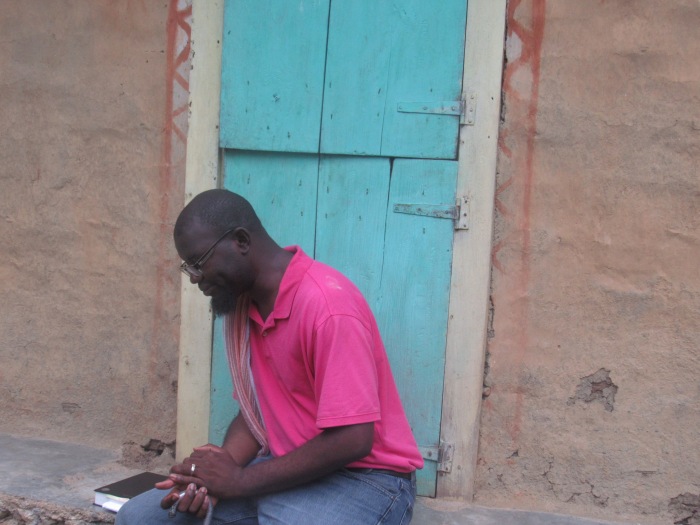
Dr.Joseph and social outreach in Port-Margot, Haiti (December 2015)


IMG_0507

Dr. Joseph praying during prayer walk and door- to- door evangelism: Port-Margot, Haiti Mission Trip (March 2016)

On the value of Black African view of man….

(An excerpt from my working chapter on Africana doctrine of humanity and Africana theological anthropology. This is a draft.)
 
On the value of Black African view of man….
 
It is assumed that traditional African perspective on man (humanity) stresses the value of community rather the individual, as it is commonly practiced in Western societies. Traditional African doctrine of humanity is more promising, dignifying, and liberating. The role and destiny of the individual is essentially determined within the framework of the community or kingship, and the individual’s active participation in the life of the community. That does not mean that the African people do not see any merit in the individual, nor do they undermine the worth and implications of individual choices or preferences; however, it does mean that the African people prioritize communal choices over individual preferences. The individual exists as a corporate entity.
 
The notion of “social man” or “corporate individual” (even “collective solidarity”) affirms that the individual knows his or her functions in and responsibilities to the community. It is only in this manner can he or she be deemed a genuine being in the African stance of corporate humanity. While one is born human (humanness), one has to become (evolutionary theory) a person (personhood) in the context of communal life and communal engagement. Being a human is a biological category; being a person is not. The person is the product of the community. Hence, African anthropology–both from a social and philosophical perspective— promotes the notion of radical dependence and radical interdependence since human beings are radically interdependent and dependent.
 
It is also assumed that traditional African philosophical ethics and humanism ought to be praised, as compared to those of the Western ethico-philosophical traditions. For example, in the African worldview and cosmology, all principles of morality and ethics are to be sought within the context of preserving human life and its power or force (See Laurenti Magesa, African Religion).
 
Traditional African view of man and moral philosophy promote an ethics of relationality and interpenetration, and make a clarion call upon us to the imperative and practice of sociability, bonding, and collective solidarity in the modern world.


Soyinka on Religion

I’m pleased to announce my newly-published article on Wole Soyinka

“‘Shipwreck of Faith: The Religious Vision and Ideas of Wole Soyinka” (Toronto School of Theology, 2016)

Abstract

“This article investigates the religious vision and ideas of Wole Soyinka in selected non-fiction writings. While African spirituality is deployed as a literary trope in Soyinka’s creative works and dramatic masterpieces such as Death and the King’s Horseman and A Dance of the Forests, scholars have given scarce attention to his engagement with religion in his non-fiction productions. To highlight that engagement, first, this article proposes the notions of radical skepticism and religious inclusivism as symbolic markers to describe Soyinka’s perspective on religion and his shipwreck of faith. His witness of religious violence and fanaticism in his home country of Nigeria and the host countries outside of his native land had shaped his religious experience and altered his religious vision. To call Wole Soyinka a radical agnostic and religious inclusivist in the humanist tradition is to confront the uneasiness and ambivalence of religion that had marked both his adolescent and adult life. Second, it argues that Soyinka’s abandonment of his Anglican faith, the “imported religion” of his childhood and Nigerian parents, was a consequence of his re-evaluation of the merits and liberalism of his ancestral faith: the Yoruba religious tradition and spirituality. Third, it contends that Soyinka rejected the Christian faith because of a theological crisis he encountered both as a teenager in Ake (his hometown) and as a student at the University College in Ibadan. The article resituates Soyinka’s religious sensibility not in the tradition of the Abrahamic religions but within the religious world view and cultural framework of African indigenous faiths and spirituality. Finally, it presents Wole Soyinka as a religious critic and radical theistic humanist.”


Keywords:Yoruba religion, religious fanaticism, religious inclusivism, African humanism, African spirituality

http://www.utpjournals.press/doi/10.3138/tjt.3845


Let’s Talk about Port-au-Prince’s Gun Culture Problem!

Port-au-Prince (Note: I said Port-au-Prince not Haiti) has a serious gun culture problem similar to the gun crisis in Southside of Chicago, Los Angeles, Louisiana, Philadelphia, Miami, New York City, Memphis, Oakland, Detroit, New Orleans, Baltimore, etc.However, this culture of violence in Haiti’s capital city is linked to the country’s high level of unemployment, the country’s backward political process, and the disregard for law and order. The gangstarization of the country’s Police forces just like in the United States also contributes to this predicament.

Interestingly, many gangsta politicians and the gangsta bourgeois-elite minority in the country make a grand economic profit out of the non-regulating gun ownership and the kidnapping activity in the capital city. What makes it worst is that many Haitian public intellectuals and cultural critics remain silent about this pivotal issue. An Ayiti tout moun se chef!

If we are serious about radically transforming our civil and political societies, we need to be engaging in critical self-reflection and bring to surface (in meaningful conversations) our internal forces and Haitian-made woes that are destroying us and deferring future emanticipating possibilities.

3 cautionary statements for and about PhD holders:

3 cautionary statements about PhD holders:

1. A PhD (Doctor of Philosophy) in any academic discipline does not make one a scholar.

2. A PhD does not give one authority to write on a non-specialized field or non-specialized discipline of study or even for any individual (the PhD holder) to pretend that he/she is a specialist and an expert in every academic field of learning.

3. A PhD does not make one a thinker or wiser.

* Knowledge is not equivalent to wisdom.
* Knowledge without wisdom is meaningless.
.
* The Doctorate degree should not make anyone arrogant or aloof; rather, it should humble you and make you want to know more and compel you to use your skills and credentials for the best interest of others…toward the common good.


What is Africa to Me? When Chinua Achebe is Wrong!

What is Africa to Me? When Chinua Achebe is Wrong!

In my current research for a book chapter, I’m investigating Chinua Achebe’s interpretation of African traditional humanism and African traditional religion (s). In reading his important work,  “The Education of a British-Protected Child,” Achebe articulates an  important statement about African pre-colonial past and achievement, and Black Existence and Dignity:

“I do not see that it is necessary for any people to prove to another that they build cathedrals or pyramids before they can be entitled to peace and safety. Flowing from that, it is not necessary for black people to invent a great fictitious pas in order to justify their human existence and dignity today. What they must do is recover what belongs to them–their story– and tell it themselves.”–Chinua Achebe, “The Education of a British-Protected Child”

Africad

Generally, I agree with the general intent of Chinua’s powerful statement above. Accordingly, I do not have to tell a racist that my ancestors had built great civilizations in precolonial Africa to prove my humanity as a black person. To put this simply, “I created therefore I am.” Chinua would reject this premise in the Cartesian logic.

Hence, we must separate black personhood and black achievement. They belong to two different categories or spheres. In the same line of thought, black dignity should not be dependent on racial achievement or heritage. In other words, Black lives matter regardless of the education, social standing, and wealth of black people. Black personhood is linked categorically and naturally to black existence, and that black dignity is premised on black existence. Black existence Is!

On the other hand, Chinua’s declaration has compelled me to reconsider a few more things. There are many problems with his articulated position. First, what if the process of recovering what rightfully belongs to them (the African people or the black Diaspora) involves the telling of their historical (pre-colonial) past–Isn’t that a belonging?–and the defense or vindication of their past achievements. Secondly, what if the process of recovering what rightfully belongs to them also entails their claim of entitlement of their historical accomplishments in global history?

Telling the collective story of a people could be construed as an attempt to teach and reteach others about what has been forgotten or intentionally ignored by others–such as the contributions of the people in question to universal civilizations and modernity.

For example, why should any black person be ashamed to affirm that W.E. B. Du Bois was the first African American of Haitian descent to receive a PhD from Harvard University? And the same Du Bois is a founding father of modern sociology? If our past is great and awesome, why not celebrating and making it known to the world?


New Book on Toussaint Louverture: A Revolutionary Life

Toussaint Louverture: A Revolutionary Life by Philippe Girard

Well, the controversial French historian Philippe Girard’s new biography on Toussaint Louverture, Toussaint Louverture: A Revolutionary Life (Basic Books, 2016), will be released in November. Girard’s interpretation and analysis of Haitian History–both colonial (Saint-Domingue) and contemporary (Haiti)– often departs from the traditional interpretation and what we Haitian scholars and students of Haitian history know about our own history and our own people, and the Haitian experience. In his scholarship, he often undermines African-Haitian self-determination, subjectivity, and our commitment “to live free or die.”

I hope this new book will shift the discourse and tell a more just historical account about the life and experiences of the enslaved African people in Saint-Domingue-Haiti, and their unrelenting commitment to revolutionary freedom, decolonization, radical humanism, and total independence. Let’s also hope in this new work, Prof. Girard upholds the integrity of our historical past, and not undermine the great achievements of revolutionary Haiti in the human narrative of freedom and universal civilization, and more particularly, the enduring contributions of Toussaint Louverture in the struggle against slavery and racism, for human emancipation, human rights, and African-Haitian dignity.

Toussaint

Description

“Toussaint Louverture’s life was one of hardship, triumph, and contradiction. He was born a slave on Saint-Domingue yet earned his freedom and established himself as a small-scale planter. He even purchased slaves of his own.

Philippe Girard shows how Louverture transformed himself from lowly freedman into revolutionary hero as the mastermind of the bloody slave revolt of 1791. By 1801, Louverture was governor of the colony where he had once been a slave. But his lifelong quest to be accepted as a member of the colonial elite ended in despair: he spent the last year of his life in a French prison cell. His example nevertheless inspired anticolonial and black nationalist movements well into the twentieth century.

Based on voluminous primary-source research, conducted in archives across the world and in multiple languages, Toussaint Louverture is the definitive biography of one of the most influential men in history.”

http://www.amazon.com/Toussaint-Louverture…/…/ref=sr_1_sc_2…

Vodou Books Discounted Order Forms/Flyers

Hello, Friends:  Attached are the discounted flyers and order forms for both books:  Vodou in Haitian Memory: The Idea and Representation of Vodou in Haitian Imagination (Lexington Books, May 2016) by Celucien L. Joseph and Nixon Cleophat,  and Vodou in the Haitian Experience: A Black Atlantic Perspective (Lexington Books, May 2016) by Celucien L. Joseph and Nixon Cleophat.

With this flyer and order form , you can purchase both texts at a substantial discounted price. Click on the individual link below to download the form. It is in the PDF format.

Please circulate widely!

vodouea

Joseph & Cleophat Vodou in the Haitian Experience International Flyer2

vodoub

Joseph & Cleophat Vodou in Haitian Memory International Flyer1

Chukwuka–“Chukwu is Supreme”: When Religious Beliefs Collide, and “Things Fall Apart”

“Neither of them succeeded in converting the other but they learned more about their different beliefs.” —Chinua Achebe, “Things Fall Apart” (1958)
 
Chukwuka–“Chukwu is Supreme”:
When Religious Beliefs Collide, and “Things Fall Apart”
I guess that I have not succeeded in convincing my students in my literature class–in which we have read Achebe’s Things Fall Apart, the most influential novel in the Anglophone Africa, written by Chinua Achebe in 1958– that the Igbo people of Nigeria are monotheists just like the Christians, Muslims, and Jews, they “worship” one God. Those how have written their final essay on the subject of religion in the novel or have done a comparative analysis of African traditional religion and Christianity as their subject of research have emphasized that the Africans are polytheists and believe in strange religious customs and traditions. (Not all of my students made that claim, but most of them do.)
Interestingly, in the story itself, there’s an important debate on the very nature of God in African theology, as well as what is deemed religious; this conversation about faith occurs between an important Igbo character and intellectual named Akunna and the British missionary named Mr. Brown who, along with the colonial administrators, came to “civilize” and “Christianize” the Igbo people. According to Akunna, Mr. Brown misses the mark and misinterprets both the nature of religion and the nature of God in Afrian religious tradition. Consider the following conversation:
“You say that there is one supreme God who made heaven and earth,” said Akunna on one of Mr. Brown’s visits. “We also believe in Him and call Him Chukwu. He made all the world and the other gods.”
“There are no other gods,” said Mr. Brown. “Chukwu is the only God and all others are false. You carve a piece of wood–like that one” (he pointed at the rafters from which Akunna’s carved Ikenga hung), “and you call it a god. But it is still a piece of wood.” The tree from which it came was made by Chukwu, as indeed all minor gods were. But He made them from His messengers so that we could approach Him through them. It is like yourself. You are the head of your church.”
“No,” protested Mr. Brown. “The head of my church is God Himself.”
“I know, said Akunna, “but there must be head in this world among them. Somebody like yourself must be the head here.”
“The head of my church in that sense is in England.”
“That is exactly what I am saying. The head of your church is in your country. He has sent you here as his messenger. And you have also appointed your own messengers and servants. Or let me take another example, the Disctrict Commissioner. He is sent by your King.”
“They have a queen,” said the interpreter on his own account.
“Your queen sends her messenger, the District Commissioner. He finds that he cannot do the work alone and so he appoints kotma to help him. It is the same with God, or Chukwu. He appoints the smaller gods to help Him because His work is too great for one person. “
“You should not think of Him as a person,” said Mr. Brown. “It is because you do so that you imagine He must need helpers. And the worst thing about it is that you give all the worship to the false gods you have created.”
“That is not so. We make sacrifices to the little gods, but when they fail and there is no one else to turn to we go to Chukwu. It is the right to do so. We approach a great man through his servants. But when his servants fail to help us, then we go to the last source of hope. We appear to pay greater attention to the little gods but that is not so. We worry them more because we afraid to worry their Master. Our fathers knew that Chukwu was the Overlord and that is why many of them gave their children the name Chukwuka–“Chukwu is Supreme.”
“You said one interesting thing,” said Mr. Brown. “You are afraid of Chukwu. In my religion Chukwu i a loving Father and need not be feared by those who do His will.”
“But we must fear HIm when we are not doing His will,” said Akunna.” And who is to tell His Will? It is too great to be known.” (Things Fall Apart, 178-281)
For Chinua Achebe, Christian missionaries from Western countries who have set their foot on the “dark soil” of the “Black Continent,”  have misinterpeted African traditional religion (s) and, as a result, misunderstood the African people, their culture, cosmology,  and worldview. Achebe has underscored this phenomenon as one of the major failures of (historic) colonial Christianity in colonial Africa in the project of mission civilatrice and christian evangelism. Sometimes, the real enemy is within. Unhealthy religious ideology just like cultural supremacy can be an arrogant thing, especially in the case that when one’s religious confession or piety becomes the very hindrance that blocks communication and defers understanding between people of different religious persuasion. Arrogant faith could be the most dangerous weapon that destroys faith itself, and hinders  interreligious dialogue and religious conversion.
I wish my students would have read the passage noted above more critically and responsibly. Indeed, Chukwuka–“Chukwu is Supreme.”