“10 Theses about Contemporary Christian International Mission and Cross-Cultural Evangelization”

“10 Theses about Contemporary Christian International Mission and Cross-Cultural Evangelization”

For many years, I have been thinking about the interreligious conflict between Christianity and other religions in the world, and the work of Christian missionaries in international mission and cross-cultural evangelization. In the context of Haiti, the conflict lies in the relationship between Vodou and Christianity, Christians and Vodouizan.

As will be observed, the essay below reveals many things about my values, ethics, theology, my understanding of human cultures and cross-cultural friendship, my understanding of the message of the Gospel and its demands upon people, and the infinite value of Jesus Christ and his atoning sacrifice for the world.

My target-audience is Christian missionaries who are investing in cross-cultural evangelization and international mission.

“10 Theses about Contemporary Christian International Mission and Cross-Cultural Evangelization”

Historically, the practice of Christian mission and evangelization, both at the cross-cultural and international level, has been influenced by American-Western ideology of conquest and an attempt to deracinate the culture and traditions of the people being evangelized. Correspondingly, Christian mission and evangelization has been operating from the foundational philosophy of the superiority of American and European cultures and value-systems, and the belief in the triumphal achievements of Western countries in global history. Also, the rhetoric of Christian mission and evangelization has also been shaped by the rhetoric of dehumanization and demonization, as circulated in American-Western books, media, and news outlets, of the non-white and Western people. In short, Christian international mission and cross-cultural evangelization has been detrimental to the values, cultures, and concerns of the brown and non-Western people.

Unfortunately, many Christian missionaries originated from Western and powerful countries support aggressively Western military interventions and wars, coups, economic sanctions and embargoes—often resulting in deaths, abject poverty, and underdevelopment—in the country they claim they are called to serve as missionaries and evangelists; to the great dishonor of the Gospel of peace, they would also interpret these human-made tragedies, catastrophes, suffering, and pain as part of the divine plan for the Gospel to penetrate that foreign land. To continue to contribute to the (on-going) misery and suffering of the people one is called to reach is the very antithesis of the Gospel of peace and reconciliation. Such attitude clearly indicates a grave misunderstanding of the task of the Christian missionary and the essence of biblical Christianity—as if one were to support a politics of human destruction and an ethics of death: social, existential, and physical.

In the same line of thought, the Christian missionary should never sustain international policies and diplomatic-immigration laws that will lead to the obliteration of (foreign) individuals, and the separation and dehumanization of the families of the people they are called to love and reach overseas. Because you are called to be a peacemaker and light of the world, God has also urged you to be on the side of the poor, the vulnerable, the economically-oppressed, and correspondingly, to defend their rights to exist and be free.The Gospel is about the activation of God’s justice and goodness in the world, and the application of divine justice in the social order; thus, the missionary-messenger should be a fierce bearer of human justice and a zealous promoter of God’s intended goal to harmonize everything and make all things right.
Moreover, because of the complexity of transmitting the message of the Gospel to a culture where Christ was not formerly known and to a people of different values than those of the Christian missionary, it creates a problem for the missionary to find the appropriate evangelistic strategy and missional method to bridge walls of division and isolation, to establish genuine human interactions and relationships, and ultimately, to share effectively the message of God’s saving grace, loving-kindness, and compassion. The insensitivity and ignorance of the Christian missionary to the culture of the non-Christian is another hindrance to the effective interpretation and proclamation of the Gospel. The presentation of the Gospel requires boldness, audacity, but not forceful conversion; by consequence, the messenger should not compromise the message, undermine the reality of human sin and oppression, and reciprocally, he/she should not negotiate the distinctive demands of the Gospel and the truths about God revealed in the character and deeds of Jesus Christ. The beauty of the Gospel lies in the person and saving work of Jesus Christ, and his message of grace, love, peace, and fraternity. It is never about the missionary’s wisdom, strength, and persuasion.

In summary, I articulate ten propositions regarding the attitude and actions of Christian missionaries engaging in international missionary endeavors and cross-cultural evangelistic activities and projects.

1. It is God who is the ground of human hope and Jesus Christ the light of cultures and the nations; it is not the culture of the missionary and certainly not the strength and resources of the missionary’s country.
2. The Christian missionary should not conflict the power of the Gospel with the political power of his/her native land; because of human greed and the longing of one nation to dominate or subdue another nation, the workings of the political power of powerful nation-states often leads to further human suffering and death, estrangement, and alienation.
3. The value and worth of the people the Christian missionary is called to reach do not lie in their knowledge of your own culture nor should you continually attempt to forcefully impose your culture upon them as if assimilation to your own culture is a prerequisite to salvation in Christ and the effective understanding of the Gospel.
4. In the same line of thought, the value and worth of the people you are commissioned to is not dependent upon them knowing your native (Western) language, as you may already and falsely assume that your language is far more superior than theirs; in fact, it will be more beneficial to your missionary outreach and effectiveness had you taken the time to learn well their language and be proficient in it. You are “the sent one” and “the commissioned one.” It is not the other way around.
5.While human sin and unrighteousness may bring about all forms of human suffering and destruction, the missionary should not rejoice in the suffering and death of the people he/she is trying to reach and thus interpret them explicitly as God-given opportunities to engage in Gospel-conversations. Certainly, without postulating a spirit of patronizing, there is an honorable way to discuss the hard life and economic poverty of the target people without undermining their worth and dignity—as they are also created in the Image of God.
6. The Christian missionary should develop a positive attitude toward the people he/she is called to evangelize and correspondingly, the messenger-missionary should foster a relationship of respect, mutual reciprocity, friendship, care, and interconnectedness. The alienated missionary is not a relational human being nor will he or she be an effective God’s servant in that given culture.
7. The Christian missionary ought to know that the saving power of the Gospel and the effective proclamation of Christ to a culture in desperate need of God’s intervening grace and redemption does not depend upon the missionary’s rhetoric of manipulation, fear, and aggression as he/she relates the message of the Gospel to the non-Christian believer in the foreign land.
8. The Christian missionary should know that the non-Christian is entitled to the exercise of religious freedom and right of his or her own religious tradition, and the deliberate practice of such a given faith. God is bigger than religious traditions, and the saving power of Christ transcends all religious authorities, rituals, and practices. Christ saves; religions do not!
9. It is not the conversion from one religion to another one that brings God’s salvation to the individual; Christ alone is the Redeemer of the human soul. The fundamental philosophy of biblical conversion and Christian mission is to make known the distinctive qualities of the person of Christ and the infinite value of his cross resulting in genuine repentance from and forgiveness of sins to the total surrender of the person’s life to God and the Lordship of Jesus Christ.
10.The end of Christian conversion is not to make new religious converts or proselytes, but to make genuine and permanent followers of Christ of all nations, cultures, and ethnic groups.

The Gospel is about the activation of God’s justice and goodness in the world, and the application of divine justice in the social order; thus, the missionary-messenger should be a fierce bearer of human justice and a zealous promoter of God’s intended goal to harmonize everything and make all things right.
“Cone and Baldwin: the problem of white dominion and the death of White Christianity”

“Cone and Baldwin: the problem of white dominion and the death of white Christianity”

If one wants to get a better understanding of James Cone’s righteous rage, just read James Baldwin. Cone repeatedly admits the enormous influence of Baldwin on his own thought & the way he writes about whiteness as power and dominion, white supremacy as a system, & theology’s racial identity.

James Cone interrogates and thus challenges an entire (white) theological system and (white) christian ethical framework that do not live up to the biblical standard of righteousness and justice. He refutes white American theology because of its silence on black pain & suffering, and black death. He debunks white theological vision of God, humanity, & the world because it is built structurally on the strict doctrine of white supremacy & white racial dominion. Cone understands that (theological) ideas have consequences…and black and brown people in America have become victims of those consequential ideas. Yet he presses that Christian actions bear more consequences in this life and the life to come.

In the same vein, Baldwin calls for the destruction of white supremacy that holds the black and brown body captive, and he also urges America to abandon the false Christianity that sustains the power and dominion of whiteness. Baldwin’s clarion call for the death of white dominion in America is akin to Cone’s urgent message to reject white American Christianity and theology. Baldwin’s vision of America’s redemption is grounded on an alternative world that begins with a fresh vision of American history and identity, and one that will reassess the dignity and worth of America’s black and brown citizens— without forgetting America’s past.

Both thinkers were aware that America’s dominant religion, white Christianity, and the internal force and system, white supremacy and dominion, that created a subhuman category and a marginalized citizenship in the American society needed to die for the total emancipation of this great nation. In other words, white dominion, supported by the narratives and perceptions of white Christianity, is a theological heresy.

James Cone and James Baldwin envisioned an alternative American narrative that is anti-white dominion and a new American saga that desecrates all the sacred places and functions whiteness embodies in the American society, as well as all the geopolitical zones and anti-black and brown narratives race sanctifies, concurrently.

Free Copy of “The New Life Catechism” for Christian parents, Pastors, and Clergy!

Free Copy of “The New Life Catechism” for Christian parents, Pastors, and Clergy!

Hope for Today Outreach (HTO) is giving away 20 free copies of Dr. C. Joseph’s new book, “The New Life Catechism.” HTO will honor the first twenty requests.

Offer ends: Friday, January 3, 2020

***If you would like to receive a free copy of the book, just make the request by sending us an email to hopefortodayoutreach@gmail.com

Please leave your mailing address in the email.

Happy New Year!

Book Description

“The New Life Catechism is about spiritual formation and development and so designed to teach children about the great theological truths and ethical practices of the Christian faith. It is written with great theological clarity and precision, and rhetorical eloquence. This gospel-focused guide directs our attention to the relationship between the Christian life, society, and doing good works, and also focuses on how Christian kids should live in society and with others relationally and peacefully. It teaches us about the importance of difference and unity, and the beauty of diversity and multiplicity expressed through God’s creation and the various cultures, races, and ethnic groups God made for his glory. This study can be used in Sunday school classes and small groups on spiritual formation for children. The target audience include two different age groups: 3-7, and 8-11, respectively. Christian Parents and educators will read the catechism to the first age group; children belonging to the second age group can read it by themselves. Nonetheless, individuals of any age group will find this summarized statement of the Christian faith informative, insightful, empowering, and doctrinally sound. The overall objective of this book is to lead individuals, especially Christian children, to love God more passionately and affectionately, as well as to grow more in grace and in our knowledge and understanding of the Triune God and to achieve gradual maturity in our relationships and interactions with our neighbor. I also hope that The New Life Catechism will help the church to construct this new radical life we are called to live in this world and to combat and thus solve the crisis of biblical illiteracy among Christian children and adults in our culture, especially in Christian circles. The book is also available in French and Creole.”

Top 25 Books I Read in 2019

Top 25 Books I Read in 2019

Top 25 Books I Read in 2019

  1. “Said I Wasn’t’ Gonna Tell Nobody” by James H. Cone
  2. “Democracy in Black: How Race Still Enslaves the American Soul” by Eddie S. Glaude Jr.
  3. “The Color of Our shame: Race and Justice in Our Time” by Christopher J. Lebron
  4. Paul and Gender: Reclaiming the Apostle’s Vision for Men and Women in Christ” by Cynthia Long Westfall
  5. “The Mind of the Spirit” Paul’s Approach to Transformed Thinking” by Craig S. Keener
  6. “Saved by Faith and Hospitality” by Joshua W. Jipp
  7. “For the Glory of God: Recovering Biblical Theology of Worship by Daniel I. Block
  8. ” Not in God’s Name: Confronting Religious Violence” by Rabbi Jonathan Sacks
  9. ” Rethinking Incarceration: Advocating for Justice That Restores” by Dominique Gilliard
  10. “Beyond Colorblind: Redeeming Our Ethnic Journey” by Sarah Shin
  11. ” The Myth of Equality: Uncovering the Roots of Injustice and Privilege” by Ken Wytsma
  12. “The End of White Christian America” by Robert P. Jones
  13. “White Awake: An Honest Look at What It Means to Be White” by Daniel Hill and Brenda Salter McNeil
  14. “Social Democracy in the Making: Political & Religious Roots of European Socialism” by Gary Dorrien
  15. “To Heal A Fractured World: Ethics of Responsibility” by Rabbi Jonathan Sacks
  16. “Sapiens: A Brief History of Humankind” by Yuval Noah Harari
  17. “The Lost World of Genesis One”: Ancient Cosmology and the Origins Debate” by John H. Walton
  18. “The End of Protestantism: Pursuing Unity in a Fragmented Church” by Peter J. Leithart
  19. “Dogmatic after Babel: Beyond the Theologies of Word and Culture” by Ruben Rosario Rodríguez
  20. “Frederick Douglass: Prophet of Freedom” by David W. Blight
  21. “Baron de Vastey and the Origins of Black Atlantic Humanism” by Marlene Daut
  22. ” Crucifixion of the Warrior God: Interpreting the Old Testament’s Violent Portraits of God in Light of the Cross. 2 Vols. by Gregory A. Boyd.
  23. “The Art of Death” by Edwidge Danticat
  24. “Haitian Epistemology” by DrPaul Camy Mocombe
  25. “Langston’s Salvation: American Religion and the Bard of Harlem” by Wallace D. Wallace Best

Start the new year 2020 with “The New Life Catechism”!

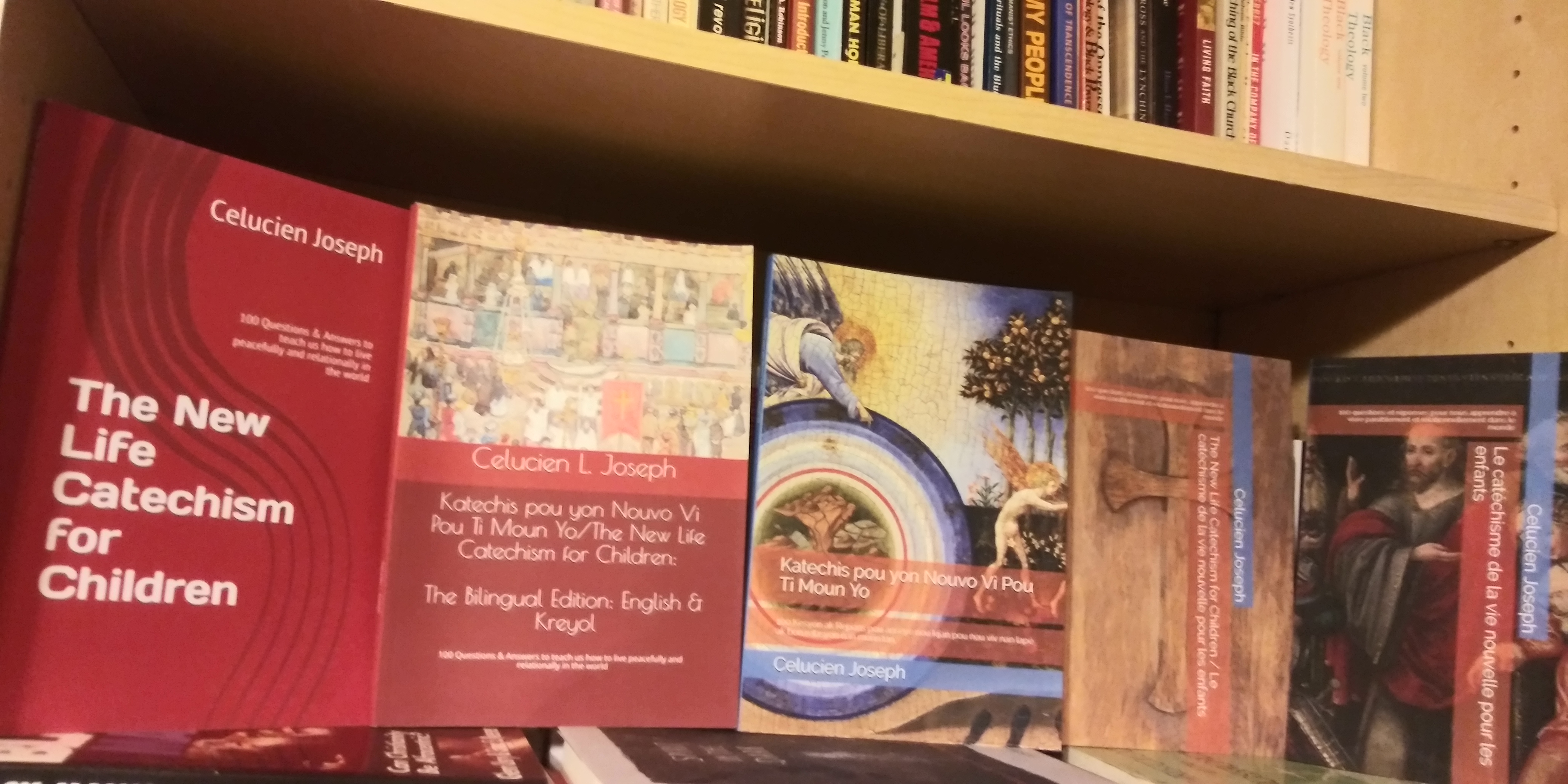
Folks: “The New Life Catechism” is now available in three languages and five editions:

  1. English only
  2. Kreyòl only
  3. French only
  4. English and Kreyòl
  5. English and French

***All can be purchased online on amazon, Hope for Today Outreach, or any online bookstore 📖

Start the new year 2020 with a catechism that will impart life in your new spiritual journey with God and one that will lead you and your family to life itself ❤. The book is written for children, two age groups: 3-7 (parents will read to them), and 8-11 (they can read the book themselves).

My New Book: “God our Maker and Caregiver: Creation, Fall, and Precepts: Book I” (January 2, 2020

“God our Maker and Caregiver: Creation, Fall, and Precepts: Book I” (Hope Outreach Productions, January 2, 2020)

–A new book (First book on a projected three volumes) for small group bible study and Sunday School setting, personal enrichment and devotional;
–145 pages + multiple conceptual charts;
–Focus on theological pedagogy, spiritual formation, biblical discipleship, and Christian education;
— divided into 21 lessons & 4 equal parts, recommended readings;
–practical group/study questions at the end of each lesson;
–each lesson includes a scriptural reading passage, a memory verse, key words and concepts, conceptual charts, & exegetical commentary and reflections;
–topics include the person and moral qualities of God, God, the natural world, and the created order, God, the poor, and the vulnerable, human beings and the ordinances of God, marriage, honoring parents, godly parenting, the conundrum of sin, Jesus and the law, Jesus and peacemaking and reconciliation;

–available for purchase on amazon;

https://www.amazon.com/dp/1650294271/ref=mp_s_a_1_21?keywords=celucien+l.+joseph&qid=1577337755&sprefix=celucie&sr=8-21#

“The New Life Catechism” is now available in French, and the English and French Bilingual Edition

“‘The New Life Catechism’ is now available in French and the English and French Bilingual Edition”

I’m pleased to announce the publication of the French version of my new book as well as the English and French bilingual edition of the same text.

1. The French Version

Description

Product description

Le Catéchisme de la nouvelle vie concerne la formation et le développement spirituel et est conçu pour enseigner aux enfants les grandes vérités théologiques et les pratiques éthiques de la foi chrétienne. Il est écrit avec une grande clarté et précision théologique et une éloquence rhétorique. Ce guide axé sur l’Évangile attire notre attention sur la relation entre la vie chrétienne, la société et les bonnes œuvres, et sur la manière dont les enfants chrétiens devraient vivre dans la société et avec les autres, dans leurs relations et dans la paix. Il nous enseigne l’importance de la différence et de l’unité, ainsi que la beauté de la diversité et de la multiplicité exprimées par la création de Dieu et les diverses cultures, races et groupes ethniques que Dieu a créés pour sa gloire. Cet étude peut être utilisée dans les classes dominicales et les petits groupes sur la formation spirituelle des enfants. Le public ciblé comprend deux groupes d’âges différents : 3 à 7 et 8 à 11 ans, respectivement. Les parents chrétiens et les éducateurs liront le catéchisme au premier groupe d’âge ; les enfants appartenant au deuxième groupe d’âge peuvent le lire par eux-mêmes.

Néanmoins, les personnes de tous les groupes d’âge trouveront cette déclaration résumée de la foi chrétienne informative, perspicace, stimulante et doctrinalement valable. L’objectif général de ce livre est d’amener les individus, en particulier les enfants chrétiens, à aimer Dieu avec plus de passion et d’affection, à grandir davantage dans la grâce et dans notre connaissance et notre compréhension du Dieu trinitaire et à atteindre une maturité progressive dans nos relations et interactions avec nos voisins. Nous espérons également que le Catéchisme de la nouvelle vie aidera l’église à construire cette nouvelle vie radicale que nous sommes appelés à vivre dans ce monde et à combattre et résoudre ainsi la crise de l’analphabétisme biblique chez les enfants et les adultes chrétiens de notre culture, en particulier dans les milieux chrétiens. Le livre est également disponible en anglais, français et en créole.https://www.amazon.com/gp/aw/d/1712708422/ref=dbs_a_w_dp_1712708422

2. The English and French Bilingual Edition

Description

Product description

The New Life Catechism is about spiritual formation and development and so designed to teach children about the great theological truths and ethical practices of the Christian faith. It is written with great theological clarity and precision, and rhetorical eloquence. This gospel-focused guide directs our attention to the relationship between the Christian life, society, and doing good works, and also focuses on how Christian kids should live in society and with others relationally and peacefully. It teaches us about the importance of difference and unity, and the beauty of diversity and multiplicity expressed through God’s creation and the various cultures, races, and ethnic groups God made for his glory. This study can be used in Sunday school classes and small groups on spiritual formation for children. The target audience includes two different age groups: 3-7, and 8-11, respectively. Christian Parents and educators will read the catechism to the first age group; children belonging to the second age group can read it by themselves. Nonetheless, individuals of any age group will find this summarized statement of the Christian faith informative, insightful, empowering, and doctrinally sound. The overall objective of this book is to lead individuals, especially Christian children, to love God more passionately and affectionately, as well as to grow more in grace and in our knowledge and understanding of the Triune God and to achieve gradual maturity in our relationships and interactions with our neighbor. We also hope that The New Life Catechism will help the church to construct this new radical life we are called to live in this world and to combat and thus solve the crisis of biblical illiteracy among Christian children and adults in our culture, especially in Christian circles. The book is also available in English, French, and Creole.

“Le Catéchisme de la nouvelle vie” concerne la formation et le développement spirituel et est conçu pour enseigner aux enfants les grandes vérités théologiques et les pratiques éthiques de la foi chrétienne. Il est écrit avec une grande clarté et précision théologique et une éloquence rhétorique. Ce guide axé sur l’Évangile attire notre attention sur la relation entre la vie chrétienne, la société et les bonnes œuvres, et sur la manière dont les enfants chrétiens devraient vivre dans la société et avec les autres, dans leurs relations et dans la paix. Il nous enseigne l’importance de la différence et de l’unité, ainsi que la beauté de la diversité et de la multiplicité exprimées par la création de Dieu et les diverses cultures, races et groupes ethniques que Dieu a créés pour sa gloire. Cet étude peut être utilisée dans les classes dominicales et les petits groupes sur la formation spirituelle des enfants. Le public ciblé comprend deux groupes d’âges différents : 3 à 7 et 8 à 11 ans, respectivement. Les parents chrétiens et les éducateurs liront le catéchisme au premier groupe d’âge ; les enfants appartenant au deuxième groupe d’âge peuvent le lire par eux-mêmes.Néanmoins, les personnes de tous les groupes d’âge trouveront cette déclaration résumée de la foi chrétienne informative, perspicace, stimulante et doctrinalement valable. L’objectif général de ce livre est d’amener les individus, en particulier les enfants chrétiens, à aimer Dieu avec plus de passion et d’affection, à grandir davantage dans la grâce et dans notre connaissance et notre compréhension du Dieu trinitaire et à atteindre une maturité progressive dans nos relations et interactions avec nos voisins. Nous espérons également que le Catéchisme de la nouvelle vie aidera l’église à construire cette nouvelle vie radicale que nous sommes appelés à vivre dans ce monde et à combattre et résoudre ainsi la crise de l’analphabétisme biblique chez les enfants et les adultes chrétiens de notre culture, en particulier dans les milieux chrétiens. Le livre est également disponible en anglais, français et en créole.

https://www.amazon.com/Catechism-Children-cat%C3%A9chisme-nouvelle-enfants/dp/1712438778/ref=mp_s_a_1_1?keywords=The+New+Life+Catechism%2FLa+nouvelle+catechisme+de+la+vie+nouvelle&qid=1575380710&sr=8-1https://www.amazon.com/Catechism-Children-cat%C3%A9chisme-nouvelle-enfants/dp/1712438778/ref=mp_s_a_1_1?keywords=The+New+Life+Catechism%2FLa+nouvelle+catechisme+de+la+vie+nouvelle&qid=1575380710&sr=8-1

*** Now, “The New Life Catechism” is available in three languages: English, French, and Kreyòl, as well the bilingual editions (English and Kreyòl, English and French). The audio book is available in Kreyòl. Both the French and English audio books are forthcoming. When you purchase a copy of “The New Life Catechism,” this effort will help sponsor the new school we started in Haiti in September 2019. 50% of the purchase price will go toward “Hope Academy of Bois d’eau” to help cover our monthly nutritional expenses.

Booth the paperback and the electronic versions (i.e. Kindle) can be purchased on amazon and any online bookstore.Thanks for your support!

“Short Reference List: Francophone African writers and the Problem of Western Colonialism,

“A Short Reference List: Francophone African writers and the Problem of Western Colonialism”

If you have an interest on how West African (Francophone) writers and intellectuals have responded to European colonization and civilization, and christian mission, here are some major or classic novels on the subject matter, written from 1950s-1970s:

1. “Le Pauvre Christ de Bomba” (1956; “The Poor Christ of Bomba”), and “Le Roi Miraculé” (1958; “King Lazarus”) by Mongo Beti (Cameroon)

2. “Mission terminée” (1957; “Mission to Kala” and “Mission Accomplished”) by Monbo Beti (Cameroon)

3. “Main basse sur le Cameroun” (1972; “Rape of Cameroon”) by Monbo Beti (Cameroon)

4. “Une Vie de boy” (1956; “Houseboy”) by Ferdinand Léopold Oyono (Cameroon)

5. “Le Vieux Nègre et la médaille” (1956; “The Old Man and the Medal”) by Ferdinand Léopold Oyono (Cameroon)

6. “Les Soleils des indépendances” (1968; “The Suns of Independence”) by Ahamadou Kourouma (Ivory Coast)

7. “Le Docker noir” (1956; “Black Docker”); “Ô pays, mon beau peuple! (1957; “O My Country, My Good People”), and “Les Bouts de bois de Dieu” (1960; “God’s Bits of Wood”) by by Ousmane Sembène (Senegal)

8. “Une si longue lettre” (1979; “So Long a Letter”) by Mariama Bâ (Senegal)

9. “Entre Les Eaux” (1973; “Between Tides”), and “Le Bel immonde” (1976; Before the Birth of the Moon”) by Valentin-Yves Mudimbe (V. Y.) Mudimbe (Democratic Republic of Congo)

10. “L’Enfant noir” (1953; “The African Child” or “The Dark Child”), and “Le Regard du roi” (1954; “The Radiance of the King”) by Camara Laye (Republic of Guinea)

————-
Bonus Texts

***The following historical texts (first two books on the list) are of enormous importance to understand the historical trajectories and politics of European-French colonialism in West Africa:

a) “A Mission to Civilize: The Republican Idea of Empire in France and West Africa, 1895-1930” (1997) by Alice L. Conklin

b) “Races on Display: French Representations of Colonized Peoples, 1886-1940” (2008) by Dana S. Hale

***The next three books are additional major fictions about the French-West African encounter and the colonial life:

c) “Batouala” (novel; 1921) by Rene Maran” (Martinique)

*** Rene Maran was the first black writer to win the prestigious French literary prize, the Prix Goncourt.

d) “L’Aventure Ambique” (1961; Ambigious Adventure”) by Cheikh Hamidou Kane (Senegal)

e) Climbié (1956), and “Un Nègre à Paris” (1959) by Bernard Binlin Dadié (Ivory Coast)

Vertieres: 18 November 1803-18 November 2019

Vertieres: 18 November 1803-18 November 2019
Haitians Celebrating Freedom and Independence

“In Praise of Vertieres, and In Praise of Freedom and the Haitian Revolution”

O Vertieres, how could we forget Thee!

You remind us that God created men and women to be free and not to be enchained and enslaved by men.

O Glorious Vertieres, where we wrought our freedom and independence through our shed blood, You will always be a scar on our hearts and the path of freedom and inspiration for today’s troubles.

Today, the Haitian people are celebrating the Battle of Vertieres (November 18, 1803) which gave birth to two significant events in world history: the end of slavery and the founding of the first postcolonial state and the first slave-free Republic of Haiti in the Western world. It was in Vertieres African revolutionarries and men and women who dared to die free and independent conquered the greatest military and imperial power in the world: France

To remember Vertieres is to never forget the danger and threat of the unholy trinity of institutional slavery, colonization, and White supremacy in the world.

To remember Vertieres also means to continue the fight against the vestiges of slavery (modern day slavery), colonization (neocolonization), imperialism, and any form of human oppression that engenders human suffering, dehumanizes people, defers human dignity, and challenges the image of God in humanity.

African Americans and the State of Haitian Studies

“African Americans and the State of Haitian Studies”

I would like to see more African American scholars writing more about Haiti’s national history & the Haitian Revolution. I believe their contribution will make a great impact–in terms of different perspectives, yet similar struggle, etc.) on the current state of Haitian Studies.

Beginning in the first half of the nineteenth century, African American writers and intellectuals were actively contributing to the field of Haitian studies; for example, James Theodore Holly

paved the way by publishing “Vindication of the Capacity of the Negro Race for Self-Governance and Civilized Progress” (1859); W. E. B. Du Bois discussed the significance of the Haitian Revolution in his Harvard doctoral dissertation, “The Suppression of the African Slave-Trade to the United States of America, 1638-1870 (1896) and also published a number of articles in The Crisis magazine during the American occupation in Haiti (1915-1934); James Weldon Johnson published “Self-Determining Haiti” and “The Truth about Haiti” (four articles in the 1920s); Zora Neale Hurston, “Tell My Horse: Voodoo and Life in Haiti and Jamaica” (1938);

Rayford Logan published one of the most important works on Haiti’s diplomacy history, “The Diplomatic Relations of the United States with Haiti, 1776-1891” (1941) and “Haiti and the Dominican Republic” (1968); Langston Hughes translated Jacques Roumain’s “Gouverneurs de la rosée” (1944) as “Masters of the Dew” (1948) in English; Mercer Cook, a friend of Dantes Bellegarde, published a number of seminal articles on Haitian literature and education; Carolyn Fowler published the first biography (1972) in English on Haiti’s most important Marxist and radical communist public intellectual Jacques Roumain; Brenda Gayle Plummer published “Haiti and the Great Power” (1988) and “Haiti and the United States” (2003); Katherine Dunham, “Island Possessed” (1994), etc. I can go on and on…

African American Studies scholars, activists, writers, anthropologists, intellectuals, historians, literary scholars, religious scholars, theologians, painters (Remember Jacob Lawrence’s majestic and stunning series of painting on Toussaint Louverture and the Haitian Revolution!): the Haitian people and Haitian Studies NEED you in such a time as this!

***Do check out Brandon Byrd’s excellent new book, “The Black Republic: African Americans and the Fate of Haiti” (2019) and of course, Gerald Horne’s important work, “Confronting Black Jacobins: The U.S., the Haitian Revolution, and the Origins of the Dominican Republic” (2015).