I wrote a new poem about the intersection of black love and freedom, and how black couples should nurture black love in the midst of racial trauma and violence in America. The strength to love while black is grounded on the liberating message of Blues and Jazz. I dedicated the poem to a “girl whose color is black and life.” The poem is called “Jazz on the Moon.”
“Jazz on the Moon”
When I look in the mirror, who do I see? I see ME, a man dressed in a black body, I see YOU, a black woman dressed in your color that is life, searching for a new melody; freedom through self-improvisation, bringing emotional satisfaction. Nothing will stop us from climbing to the top: old lyrics will not go, racism and sexism will find their way. My body has grown strong, your form is beauty to me, because of a new Jazz song. I will reach the mountain top, to a place beyond, to play the new Jazz song in the weary moon, chasing the rainbow, with the Blues, climbing the magic ladder, letting the new story unfold. You will be with me on the highest hill, escaping racial violence and trauma, liberating from the nation’s oppression. I am a prisoner of your love; You, an ambassador of my voice. No one can tell us otherwise.
I awoke last night to break anew with endless freedom and energy, a new song on my lips break-through. I will not delete the lyrics, I can’t stop the dance; for the journey has been a year-long. It is time for me to grandly arise. in their eyes, against their muse. Will you move your body on the dance floor, and join me to dance to the new beat? Let us do our swing. Our children will not be oppressed. The black man will not be put to death. The black woman will not be executed. We will enjoy liberation with the new song. Jazz will lead to a new birth.
Old memories of this land will cross the path, will suffer and die. our freedom will not be denied; we will escape the rain, riding on a new train. You and I will craft a new map for the world, on behalf of our people, for boys and girls, men and women, white and black, brown and yellow too, and for everyone in the race, exploring the new map for a new world. We will be divine, playing Jazz on the moon.
You and I will not die without swinging. You are no ordinary dancer. We can climb the highest mountain, Your body improvises through the Blues, initiating a swing that is new, the music moving deep in our soul, in a dozen ways, we will see the color of our destiny. in our own terms, we will rest in peace, forgetting all of our troubles in the land, the new Blues song sets us free. They say: “You are two swingers who dance Jazz in the moon to create a love supreme.”
We ain’t victimized no more. We ain’t looting the streets, nor terrorizing America. We are reclaiming our Godlike image. We are chanting our REVOLUTION.
We have become the prosecutor of an ill nation; hunting down a system that has looted us from 1619 till today. In fact, in those streets, we are consciously freeing ourselves; declaring our humanity; proclaiming our dignity; protecting lives in black and brown of this nation. We ain’t rioting.
We ain’t rioting; we ain’t looting the streets. freeing ourselves from the omnipresence of whiteness, abject poverty, systemic racism, inequality… liberating ourselves from historical trauma and injustice this is our REVOLUTION VIVRE our REVOLUTION!
The street prophets have spoken weeping for the liberation of an oppressed people; they have anointed our spirit to rebel. this ain’t no pacifying preaching; this ain’t no silent theology; we ain’t rioting. we are following the Christ Christ of the oppressed. “We ain’t rioting,” the street prophets say.
The God of the oppressed commands: “Follow my Son.” You must be a Christlike people: He protested, rebelled, damaged property; destroying commerce in the Holy Temple; preaching a theology for the oppressed. We ain’t rioting.
The Christ of the oppressed shouting out, “You ain’t rioting” breathe my people, breathe, breathe! run my brothers, run my sisters, run! jog my people, jog, jog! you are marginalized and cast aside; I will bring peace with a sword and restore my image in you to my likeness, your blackness is mine, your suffering I share. This is our theology, a rioting theology.
We bid goodbye to your religion. You who have taught our people the way of faith, but do not do the works of the faith. Your agents defend the life in the womb, but do not save the life outside the womb. Your teachers have nurtured our people in the way of peace, but do not support the talk for peace in the Middle East. Your preachers proclaim the Prince of peace, but do not believe in his Creed of Peace. You who despise the bastard children of the Empire, but do not renounce the Western Empire. We say farewell to your congregation.
You sing the love of God but support the racists who do not love. The Christ cared for the poor and carried those waited at the backdoor, but you rejected those living in the shadow of the front door. your actions shut the door to our pain; you complain because of our counterclaim. your saints win the lost soul, but do not have a soul; you say all are created in the image of the Father but treat our people as if they are not from the same Father. We shall not assemble with you again.
We shall bid goodbye to your christ because your message is not for us. Your hospitality is not for those in the ghetto; you follow those who reign in Washington D.C.; you associate only with those in your fraternity; We will not participate.
We shall bid goodbye to your god. your actions cause our desolation; your satisfaction, our suffocation; your silence, our alienation; your demonstrations do not lead to our restoration, or our liberation; We shall abandon your faith. We will not remember your deeds. We shall forget all your creeds. We will not sing your sad melodies nor play your despairing hymns of tomorrow. Your theology only brings us more sorrow; Your christ is imprisoned in a system; Your god is a friend of the system; We must now bid goodbye to your religion.
You want me to voice my rage in silence Like a good Christian and crucify me to the cross like the son of man Oh, you hypocrite Pharisees even the son was a thug Woe to you! I took my rage to the streets flipped the tables in temples stopped the highways burned the city Boom, boom, boom! my rage, my frustration my suffocation my injustice.
Can be heard in the big BOOM I will shake the city until my voice is heard I will shake the city until I am truly free I am a man, woman, mother, brother, sister, cousin.
You cannot call me thug, unruly Savage? I am not NO! NO! NO! you cannot enslave and imprison my mind I am free, My freedom came with a price If you don’t believe me, ask Toussaint, Dessalines, King, X, and Evers All bled in the streets to set me free Listen neo planters! 21st century massa! I will not be suffocated My voice will be heard in the big BOOM throughout the city throughout the country Your justice system creates prisons like plantations sucking life out of me Taking away my dream colonizing my thoughts.
A prisoner? NO! A nigger? YOUR NEGRO! I am not! Non plus! I declare it An agitator? I am for the cause of my people their freedom The city will hear my voice, hear my cry and my suffering too. BOOM is my rage my cry in the city for my humanity for my people.
my blackness is the main reason for my lynching, shooting, and killing,
my black and brown brothers and sisters were born into death row,
my existence is a threat to someone else’s privilege,
George Floyd will be lynched by the blue mob mafia,
the criminal system has contempt for black bodies,
my black and brown brothers and sisters’ blood are still being used as fertilizer for modern day prison plantation just as the blood and the sweat of our slave ancestors;
She did not tell me my blood; my black and brown sisters and brothers’ blood is not important for an oppressive system that is kneeling on our necks until it sucks the life out of us;
She did not tell me, in the 21st century, my black and brown sisters and brothers will still utter the words “I can’t breathe” just as our ancestor couldn’t breathe in the Transatlantic Passage.
She did not tell me that the modern-day lynch mob wants to Make America Great Again. Make America Great Again: a black person was lynched.
“Battle Ground in the ‘Gateway to the South’” for Breonna Taylor
Who are these strangers in our Land? monsters in gray invading the South side of the “Derby City”; the Blue force from the Highview; women in blue form from the Creek; boys in black, leaving their body cams in the East side; blue, gray, and black they wear in the River Side; rough fabric of the Devil on the Cross, maturing their view, purview, and counterview. Black boots and shiny helmets marching to the sound of the melody of “The Ville”; bearing banners painted with dying stars and fading red and white stripes, they walked in tight ranks; bearing flags decorating with abandoned crosses and human skulls, they waged war in the riverbanks; spilling petals of blood in the South side in one, two, three, four, five, six, seven, eight shots in Taylor’s chest; screaming, gossiping, and cheering after the fact; How long, the black mother screams, will I mourn the wrongful death of my Breonna?
Who are these strangers in our Land? beasts running in the “City of Beautiful Churches”; spies of the nation who have come in our homes to take our fruit; people who produce conditions of distress and tiredness in “The Fall City”; Where do these boys in blue come from? Who is their leader? we are trampled by thousands of boots; living in terror of their bloodroots; inhaling in fear because of their bitterroots; “they’re killing us…our songbirds are gone,” the youth rage.
The children on the other side of the East shout: “we cause no harm to human life.” “like a lion in a cage, waiting for reports and justice.” “Listen, do not call the FORCE in BLUE or dial 911 for RESCUE.” The elderly in the shadow of the East ask: “Who will flog those who have shed our blood in the South side of The Ville? The mothers outside of the Edgewood cry: “Is there no longer a steward in the Shively hood who can do it?” “We will remember Eight for One dead body.”
In harmony, they sing a new song of protest, lament, and a lyric of hope: “When you give weapons to the Kĩmendeeris, they smash and grind lives; when you arm idiots, they will become madmen, coward-men, and men of no shame; they will hate life, life in black, black existentia in the city; power in the service of urges, instincts, and patriotic zeal; power is loyalty to supremacy in white and privilege in Aryan wheel; at the sight of the men in uniform, we lament the death of our freedom, our humanity in black, and the desecration of blackness; we eat in silence, mourn in pain, breathe in suffering, experiencing a common anguish of City’s rejection; we’re learning how to manage our common plot; we try to banish the pain by praying, doing penance; many young and old, girls and boys in black have fallen in the struggle; at the very least, we should ask their leaders what these monsters in gray are doing on our land.
We will lift ourselves from within. We will rise above the battle ground in the Derby City; We will resist the arrest in the Bluegrass State; We will find the courage to continue the struggle and win the battle; We are ready to defend ourselves like Ali against this new rival; Our rebellion on the ground will nourish courage to fight the devils in the ‘Gateway to the South.’”
*** I wrote this poem for Breonna Taylor who was fatally shot eight times on March 13, 2020 by Louisville Metro Police Department officers Jonathan Mattingly, Brett Hankison and Myles Cosgrove at her home in Louisville, Kentucky. It is called “Battle Ground in the ‘Gateway to the South.”
In my dream, I saw millions of black men and women’s dried dead bones Bone to bone, mourning and crying for justice; Bone to bone, seeking to breathe again under the Transatlantic sea, and shackled in the land of the free.
In my dream, I saw shadows of Trayvon Martin, Jordan Davis, Eric Garner, Sandra Bland, Tamir Rice, Atiana Jefferson, Breonna Taylor, Ahmaud Arbery, George Floyd… haunting them in resurrection journey ; in unison, those dried dead bones cry out: If we can breathe again, it won’t be with our faces kissing the ground. If we must cry again, it won’t be in vain. If we must die again, it will be a glorious death.
If we shall live again, justice shall rise; our people shall stand. They will breathe. They will walk. They will exist. They will have peace; peace in their homeland, peace in the system.
Oh dried bones, awake and speak, so your people, our people can Run with peace; Walk in peace; Drive in peace; Sleep in peace.
Dried bones, if you must die again, We must breathe, we must breathe, we must breathe. Bone to bone, rise up!
I spent another sleepless night (It’s 4:38 AM. I can’t sleep) thinking about the unnecessary death of Ahmaud Arbery as if he were related to me or that I knew him personally. So, I wrote a poem for him.
“Freedom Shadows” for Ahmaud Arbery
If freedom could speak, how will it instruct you and me? What will it say to you in the morning? What will it teach the world? when the clock is broken; when the wound is not healed; when the pain is not new and stands still; a nightly song to us will it sing? Where will it meet us? at the center, in the prison cell, under the rainbow, or in the valley. The parrots sing to me: “Freedom shadows, freedom shadows, freedom shadows have no location and identity.”
If freedom were a lamp, where will it guide our path? to the stars; to a community of peace; or a country where it does not rain; to a place of despair; or a village where the people live in reconciliation blues. Please tell me if freedom were a shadow, whose image will it reflect? your resemblance; my likeness; or our common humanity. If freedom were a color, what will be its preference? Will it be brown, black, white, ultraviolet, or no color? The children in the streets whisper: “Monsieur, freedom is all the colors in one…at full brightness.”
Yet this country’s freedom betrays me and keeps us in shackles. Freedom here is cold and has no soul. this freedom does not make a loud noise, nor does it explode. It hides itself in the clouds of emptiness, in the sea of solitude, in the valley of ashes. It alienates us and does not restore brokenness. Freedom in this village is is a lie, not mine. It is just a dream, always a dream to me. It is the dream our people dreamed about.
In the land of my birth, freedom passes us like a shadow, in a home with one window, this freedom is shallow and suicidal. It tempts us like the devil. Freedom in this land is like a sacred space between us and them; a period that creates a distance, a sign that indicates a hindrance, a clause that breaks the bond. This freedom is here to stay.
This nation’s freedom does not visit us in the morning; It crosses over our path at dawn. Why is freedom so far away? The wings of the ostrich flap joyfully. The dolphin can dance beautifully. Even the little birds are set free. For you and me, our dance is not free. When our blues are new, our spirituals change the view. This freedom is not our preview; it is their honeydew.
Dreaming in a land where freedom will be for you and me; only if freedom can be a creed, I could use it as a need; Dreaming in a land where freedom could be a warranty deed; we could use it as a seal. only if freedom times can stop moving, I could start living. Dreaming in a land where freedom could be free for us and bond all of us; joy will be in all of us. the melody of freedom will find us; freedom dance will rebuild our people; peace will sustain this nation; love will remake us; These freedom shadows are only our shadows.
D-E-M-O-C-R-A-C-Y blending with D-E-A-T-H, which is true? Black death, I say, Lynching, they shout, Terror, together we agree. He refused to die in pain; he was lynched in vain. Breath stops the track. Death wins the match.
Is democracy for all? Lynching is for some. We bleed. We mourn. We grieve. We refuse to dance. We don’t beat the drum. We stop the music. We play our own song, A song of sorrow, A melody of melancholy, In a land of bitter and sour, Where the sun does not rise. This place does not give light to the moon and a smile to the stars.
This land is not our fatherland. Our mothers do not claim it. Bastard born they say we are. This country is not our own. This soil drinks our blood, at every moment, day and night, We bleed. We hurt. We die. Healing escapes our presence. Far away is our cure. Our hearts do not belong. Redemption bids goodbye. Democracy is not kind to us.
1, 2, 3…They lynched one, two, and three black bodies. small, young, and old One death, Two deaths, Even three at once.
***
I was tormented and traumatized last night about the slaughter of George Floyd. I went to bed at 4:00 A.M. While I was reflecting on Mr. Floyd’s execution, I wrote the poem as a song of lament and mourning:
“1, 2, 3…They Lynched Another One.” I dedicated the poem to George Floyd.
“The Case for Black Academic Recognition and the Significance of Intellectual Recognition and Reparations”
I begin this post with a preface. The goal of this post is not to initiate an intellectual battle or to make public enemies. Anyone who knows me personally also knows that I am a peaceable person and that I treasure sustaining friendship and good relationships, correspondingly. Yet as a writer and thinker and a person who is concerned about justice and equity in the world, I am not afraid to address conflicting intellectual ideas, cultural ideologies, and controversial issues—such as the pressing issues of social justice, unjust public policies, Police brutality, racial harmony and unity, anti-blackness, race concept, white supremacy, white privilege, economic inequality, the plot of the poor, the predicament of the economically-disadvantaged, the mistreatment of and oppression against women and the marginalized populations, etc.—deferring the common good and human flourishing in society and in the global village, respectively.
My ultimate aim in any of my academic and literary production is to seek and promote justice, truth, intellectual reparations, as well as to contribute to the improvement of the human condition in our society and in the world. Thus, the objective of this post is written within this line of thought and intellectual commitment. In sum, as a writer, I try to write with passion, zeal, and conviction. In this brief post, I would like to raise the issue of black academic recognition and the significance of intellectual recognition and reparations in the academia; however, there is another specific issue that I address in the subsequent paragraphs.
To move this conversation forward, allow me to bring your attention to this threefold question:
Do honesty, integrity, and truth matter in intellectual production, scholarship, and the academia?
Do writers and thinkers have a right to defend their intellectual property and claim what is rightful theirs?
Do I have the right, legitimacy, and freedom to defend my work, ideas, and the value of my scholarship?
If I may ask other related questions:
A. Who determines those rights and freedoms?
B. Are those rights and freedom given or does one have to claim or fight for them?
C.Who has the power to shut down or silence certain individuals and academic productions, and recognize and promote other intellectual achievements?
Something I’ve realized early in my academic journey that the academia was not made for a guy like me: black, Haitian, and black male. I also understand that its structures and systems and its gatekeepers do not value the contributions of black scholars and thinkers to various academic disciplines and fields of knowledge. Certain people in the academia interrogate the value of black reason and epistemology. They also undermine the significance of faculty of color in making a difference in the lives of students and the various ways black and brown thinkers continue to challenge certain practices in the academia; these same individuals also overlook their commitment to human freedom and transforming the intellectual scene where they belong. These gatekeepers (Frankly, I do not know their full identity, but do know they’re here and not silent.) also underestimate the intellectual productions of black (especially black women scholarship) and brown scholars in their respective discipline and cognate areas. It is evident that some faculty of color make a habit to interrogate certain academic traditions and intellectual discourses, counter false narratives and metanarratives, and dismissing certain exclusive epistemologies and neo-colonial scholarships.
Moreover, a year ago, I wrote a Facebook post on “Haiti: Then and Now” about a new book on Jacques Roumain entitled “Jacques Roumain: A Life Of Resistance” by Patti M. Marxsen. In the description, the book/author/publisher claimed to be the first biography (in English) on the Haitian public intellectual and Marxist writer. The book was published on April 4, 2019 by Educa Vision Inc. (322 pages).
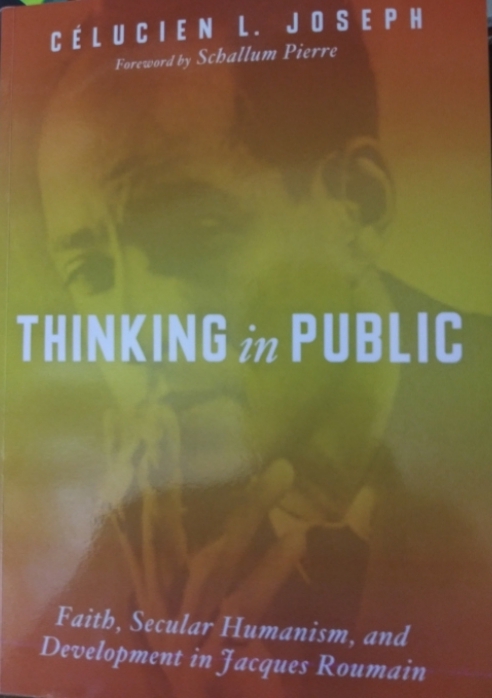
In my post, not only have I dismissed the exaggerated and false claim about this new book on Jacques Roumain; I informed the audience of “Haiti Then and Now” that two years ago, precisely on April 25, 2017, my book “Thinking in Public: Faith, Secular Humanism, and Development in Jacques Roumain” (496 pages) came out. My book is the most comprehensive study and intellectual biography on Jacques Roumain in the English language. It was published by Pickwick Publications, an imprint of Wipf and Stock Publishers. I also noted that in 1972 (republished in 1980), the eminent African American (woman) literary writer and biographer Carolyn Fowler (“Gerald”) published the “first biography” on Jacques Roumain in the English language. Dr. Fowler’s well-received and seminal work was published by Howard University Press; it was the product of her 1972 doctoral dissertation (“A Knot in the Thread: The Life and the Life and Work of Jacques Roumain”) at the University of Pennsylvania. In addition, in the post, I also shared a list of the most important works and criticisms written on Jacques Roumain, both in French and English, that preceded both my work and Patti Marxsen.
Interestingly, this morning (Tuesday, May 26, 2020) I received a strange and an unexpected message from Ms. Patti M. Marxsen, which I share below:
“Just a note to remind you, Celucien, that we are not friends. I’ll block or unfriend you today as I did not realize you were still receiving my FB posts. So just to be clear, any potential of a friendship of any kind was ruined when you and yr friends mobbed me on FB last year. During those days of insults–that you willingly participated in and encouraged–your supporters accused me of being a racist and a vampire, among other things, and you all worked hard to discredit my fine, meticulously researched, well-written biography of Jacques Roumain. So… please do not comment on any future FB posts of mine that you may come across. My FB friends are real friends and yr thoughts on anything I post are irrelevant.”
To respond to Marxsen’s note to me, first, I appreciate Marxsen’s biography on Jacques Roumain. It is a fine book that helps us to understand both the historical trajectories and the complex ideas of Roumain, as well as sheds tremendous light on Roumain’s Haiti. Second, it is a good addition to the existing scholarship on Roumain in the English language. Third, Marxsen’s work contributes to the importance of Haitian studies in English and in North America. Finally, I did not write my post on Facebook to jettison Marxsen’s book on Jacques Roumain. As a writer, I understand the hard work it takes to publish good, illuminating, and rigorous scholarship.
On the other hand, when I published my post on Marxsen’s new book, I was not attacking Marxsen’s personality or character nor did I support anyone who attempted to do so. (In fact, I have never met Patti Marxsen in person nor have I previously corresponded with her prior to writing the Facebook post.). Second, I do not remember anyone interacting with my post calling Patti a “racist” or accusing her of being a “vampire.” If those comments were there, they have accidentally escaped my attention. I sincerely apologize to Patti Marsxen. Third, the goal of my post was to seek intellectual justice and reparation, and to counter the false claim that Marxsen’s work was NOT the first biography on Roumain.
Prior to the publication of my biography and then Marxsen’s book on Roumain, many Haitian scholars and others have written very good and excellent biographies on Jacques Roumain. As scholars, it is important to recognize our intellectual antecedents, especially the value of good scholarship that preceded ours; this is just a common academic principle they teach us in graduate school. Unfortunately, it is an intellectual tradition in the Western academia to undermine and even silence the intellectual productions of black and brown scholars. As a black scholar, I believe it is both an intellectual and moral responsibility to recognize and promote the academic and intellectual works produced by faculty and people of color. It becomes a moral issue and a problem of intellectual integrity when our good works are not recognized, validated, and even silenced in the halls of the academia.
Finally, I would like to close this post with a thought I articulated in a previously-published article (“On Intellectual Reparations: Hegel, Franklin Tavarès, Susan Buck-Morss, Revolutionary Haiti, and Caribbean Philosophical Association,” Africology: The Journal of Pan African Studies, vol.9, no.7, September 2016, pp. 167-175):
“Intellectual reparation is the right thing to do. Joseph Anténor Firmin once declared, “Il faut réparer au nom de la philosophie morale” (“We must repair in the name of moral philosophy.”) In the same line of thought like Firmin, Frantz Fanon, and Walter D. Mignolo, the Haitian scholar and sociologist Jean Eddy Saint Paul has exclaimed, “Il faut réparer au nom de la décolonialité, une manière de faire justice aux damnés de la terre. Il faut réparer au nom de la désobéissance épistémique conçue ici comme contre-poétique décoloniale” (“We must repair in the name of decoloniality, a manner of doing justice to the wretched of the earth. We must repair in the name of epistemic disobedience as conceived here as decolonial poetics.”) Intellectual reparation is morally, ethically, and academically justified.”
*** I make this post public because Ms. Patti M. Marxsen has blocked me on Facebook (I was not aware of that until today when she informed me.); I was going to send this note directly to her. In making my thought public, I hope someone will communicate this message to her.
 drcelucienjoseph, "Thinking and Meditating"