“Doing justice means not showing partiality, not stealing, not swindling, not taking advantage of the weak because they are too uninformed or unconnected to stop you.”—Kevin DeYoung and Greg Gilbert
Doing justice also means to stop the rich, the bourgeois, and the wealthy as well as (big or small) corporations from exploiting the poor and abuse the economically-disadvantaged workers and individuals.
Doing justice also means for the government to create public policies and laws that would protect and preserve the life of the poor and to develop social programs to improve their living conditions in society as well as welfare projects that would restore their dignity and value and reinstate them as full members in society. This kind of justice would contribute to the economically-independence and freedom of the poor and help them to be equipped for the workforce and be responsible and transformed citizens in society.
The transition to the virtual school in the times of the coronavirus crisis reveals much about the brokenness and inadequacy of public education and system (K-12 Public Schools) in the United States. By any means am I advocating for private school education in the k-12 level; more than 95% of Americans are educated in public schools. Yet I believe as one of the richest and most resourceful countries in the world, it is time for the American government to take this matter seriously by fixing this crisis and investing in public education.
Now is the time to stop politicizing public education in this country.
Now is the time to invest adequately and constructively in the next generation through good schools, sound technology, and effective pedagogical programs and systems.
Now is the time to think critically and responsibly about the value of public education for the majority of this country’s population.
Now is the time to fully commit to human flourishing and a more promising future of this country through a radical transformation of its public education.
“I am an Immigrant: 25 Great Tips for Young Immigrants”
Young people from immigrant families or young immigrants in general need to know that they too can make tremendous contributions to the American society and their native land. Here are a few (21 tips) suggestions from me:
Acknowledge God in all you do and allow him to guide your path.
Be humble.
Be ambitious and goal-oriented.
Work had.
Commit yourself to achieving your dream or the career you want to pursue.
Avoid bad company.
Don’t do drugs.
Respect your parents.
Respect authority and elderly people.
Don’t mind people who make fun of you because you speak English with an accent. Speaking English without an accent or like a native-born American does not guarantee that you are/will be intelligent, have wisdom, and will be successful.
Be and trust yourself.
Have a few good role models in your life.
Read widely and interdisciplinarily.
Read good books and good authors.
Learn how to read and write well.
Don’t give up (on your dream) until you reach the highest star.
Remember who you are and where you come from.
Use your talents, skills, and assets to make a difference in your community.
Don’t forget those you have left behind, especially those in the country of your birth or your parents’ native land.
“Don’t change your name to make it sound Anglo.”
“Don’t give up your ethnic foods in your lunch box.”
“Celebrate your own holidays.”
“Be reminded that there is power, strength and insight at the margins of the dominant society. That is why you will make a significant contribution.”
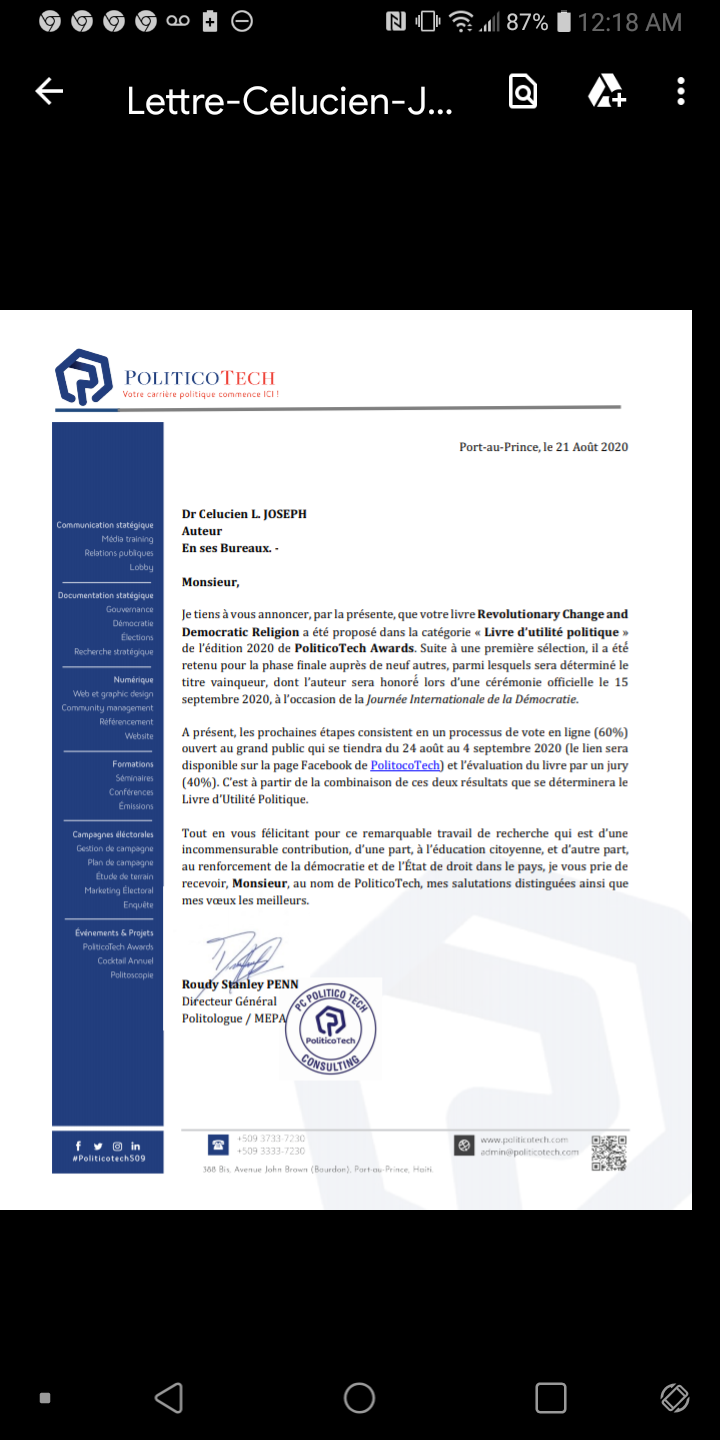
I just found out yesterday that my new book, “Revolutionary Change and Democratic Religion: Christianity, Vodou, and Securalism” (2020) was selected (among the top finalists) to receive the “Livre d’utilité politique” of the 2020 Edition PoliticoTech Awards.”
I have a new article published in “Black Theology: An International Journal”
“The Meaning of James H. Cone and the Significance of Black Theology: Some Reflections on His Legacy” Celucien L. Joseph Pages: 112-143 Published online: 22 Jun 2020
Biblical Christianity is a lifestyle. Christianity is how you treat people with love, compassion, care, understanding, and empathy. Christianity is the Jesus’ way to be in solidarity with the poor and the oppressed. It is also to hate all falsehood, human oppression and exploitation, and all forms of injustice that dehumanize people and reduce them to non-beings. Being a Christian means more than reciting a prayer to accept Jesus as your Lord and Savior. It is how you respond to and treat people who are different from you, even those who reject your Jesus, your Christianity, and your God. Christianity is more than words or head knowledge.
It is forgiveness. It is repentance. It t is action. It is reconciliation. It is peace. It is unity. It is hope. It is love. Christianity is love for people because God is love and God loves all people.
God does not care if you’re a Republican or Democrat just like he does not care if you’re Black, Asian, Brown, White, Hispanic, or Native American. This statement does not say however God is non-political and color-blind. Also, this assertion does not say that God does not care about political actions and public policies and how they make impact a nation and affect its citizens, such as the poor and the economically-disadvantahed population in society. God is a political Sovereign and acts politically every day. God’s politics is a mighty force for the promotion of justice and equity, human freedom and agency, harmony and balance, and mutual reciprocity and interdependence in society and in among individuals.
All rulers in the world make political choices. God is a ruler in the world. Therefore, God makes political choices. Yet God’s political interventions are not separared from his theological ideas and activism. The political is theological in the same way the theological is embedded in the political. Divine actions in human societies engage both the sphere of politics and the realm of theology. In other words, all God’s actions in the world are politico-theological.
Second, God is very conscious about the ethnic and racial diversity of his creation because he (God) created all people in his image. When people of various ethnic and racial groups fail to live in harmony and unity with one another, they lessen the image of God in themselves and diminish the glory of God which they bear in their humanity and essential nature. The belittling of God’s image in individuals may include ethical interventions and judicial forces that are unjust, inequitable, and anti-human flourishing.
Correspondingly, political actions that marginalize individuals and families and public policies that do not improve their living conditions do not affirm a positive anthropology associating with the divine stamp on people.
It is the image of God in individuals that makes the life of a particular racial and ethnic group meaningful in this world. It is also the designation and identiy of individuals as bearers of the divine imprint that makes life in this world worth living and sacred. The sacredness and dignity of an ethnic group or race is vital simply because of the intimate rapport with the divine validation of all lives. In the same line of thought, the image of God in the poor and oppressed man, the image of God in the single mother and the rape victim, and the image of God in the undocumented immigrant and refugee makes their individual and collective lives and experience the target of human attention and compassion, care and empathy, and humanization and valorization.
“Why I’m Politically and Morally Bias in the Presidential Election”
Arguably, I am politically bias and incorrect when it comes to voting in the presidential election in America. I must admit that my allegiance is not single or one. I’m politically and morally bias for five main reasons:
I’m a citizen of two countries: Haiti (birthright citizenship) and the United States (naturalized citizenship). Human lives and human flourishing in both countries matter to me.
In selecting a candidate in the presidential election, I pay close attention to that individual’s foreign policies, especially his or her regard toward the nations in the Global South or the developing nations like the “shithole” country of Haiti 🇭🇹.
How you (as the future president of the United States) will politically treat the people in my native land is indicative on how your administration will treat me, and other immigrants like me and refugees in your own country.
The moral, economic, judicial, and ethical decisions you will make as a president in the most powerful country in the world (the U.S.A.) will also have moral, economic, judicial, and ethical consequences on the lives of the people in the country of my birth and in the Global South.
If your political actions and national policies do not promote the equality and rights, and the human dignity for the people who look like me in your country, you will have no respect for the individuals who look like me in my native land or the individuals and families in the darker (and poor) nations. The lives and the future of the people back home and in the Global South matter and are sacred as much as the lives and the future of the people in these United States are.
“Index to (Re-)reading Saint Augustine’s “Confessions”: A 30-day Meditation”
I created an index for the 30 days of our (re-)reading of Saint Augustine’s Confessions and meditating upon his life, and his ideas and understandings of God. At the link, you will have access to the individual title and theme associating with each reading and reflection for all the past 30 days. Beginning in September, we will read again (for me it is a rereading; perhaps, for some of you, it will be a new reading. I will post a daily reflection or meditation on this text) through Saint Augustine’s masterpiece, The City of God. I hope you have enjoyed the spiritual and intellectual journey through The Confessions.
Day 1: Nothing in God Dies!
Day 2: God, the Most Beautiful One and the Most Present One
Day 3: You Made us for Thyself: We Rest in Thee
Day 4: God, the Infinite Life and the Infinite Being, is One and the Same!
Day 5: Honoring and Glorifying God through Reading and Writing, and Thinking and Scholarship
Day 6: Human Beings Cannot Hide Away from God, the Most Glorious One
Day 7: The Holy Scriptures are Better than the Prose of Cicero!
Day 8: God, the Immutable One, is the Life of souls, and the Life of lives
Day 9: Man’s Mind is Not Supreme!
Day 10: God, the Everlasting Good, and our True Strength
Day 11: In Quest for a Clearer Vision of You and and the Truth
Day 12: The Joy from Faith and Shallow Happiness
Day 13: No one is Better than God, the Incorruptible One
Day 14: Christ, the Perfect Man, and the Wisdom of God
Day 15: His Conversion
Day 16: Writing about God as Vocation
Day 17: In praise of the godly Mother
Day 18: On Jesus Christ as the Immortal and Eternal Word and Truth of God
Day 19: What was God doing before he made the heavens and the earth?
Day 20: God and Time, and the Natural World
Day 21: The Past and the Future Do Not Exist!
Day 22: God, the Most Majestic and the Most Beautiful One!
Day 23: Toward the Quest for True Happiness and Joy, and Truth
Day 24: The God Who Makes both Men and Women Feel Special!
Day 25: The Literary and Analogical Trinity of God
Day 26: The God who Commands: He is the Common Good of all
Day 27: Creation and the Creator
Day 28: God and the Power of Human Memory
Day 29: Representational Hermeneutics: The Spiritual Truths Revealed in the Created Order



 drcelucienjoseph, "Thinking and Meditating"