“The Value of Philosophy”
As I am waiting at the doctor’s office to be called, I find myself doing a little philosophic contemplation.” I always bring a book with me wherever I go.
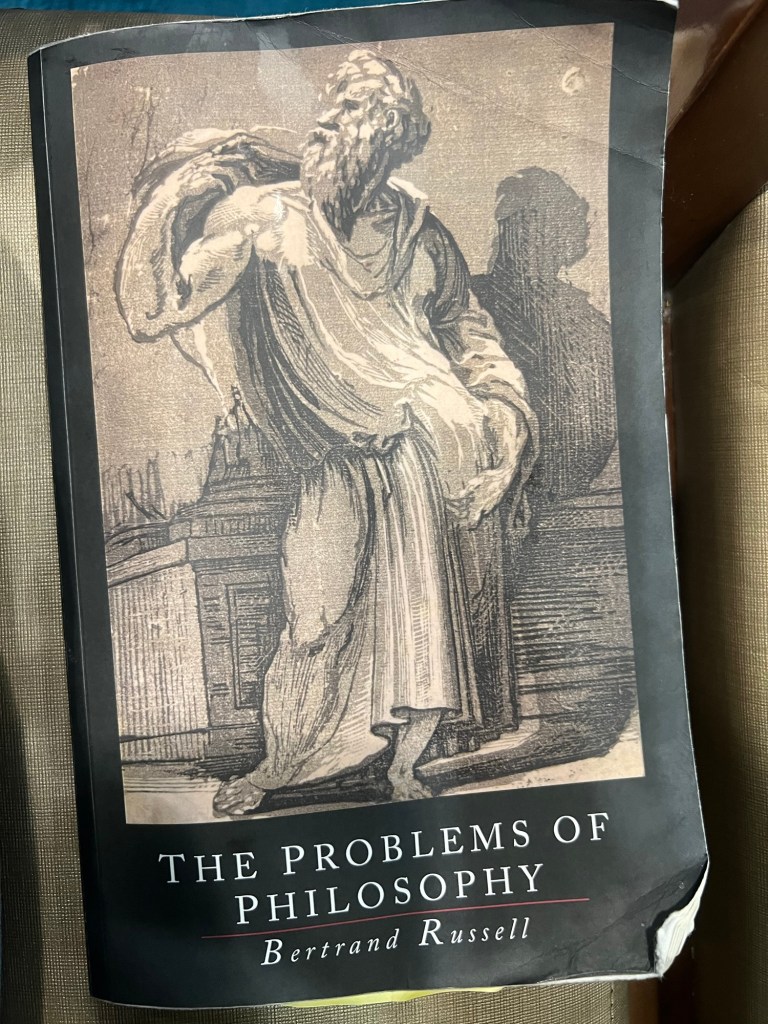
Several years ago, my philosopher-friend DrPaul Camy Mocombe recommended this book to me. Bertrand Russell is such a brilliant philosopher and good writer. It’s a joy to read his little book, “The Problems of Philosophy,” first published in 1912.
Interestingly, I began reading the book backwards (maybe, that’s a good hermeneutical practice; who knows? lol), starting with the last two chapters of the book: “The limits of philosophical knowledge,” in which Russell shows the limits of Hegel (The “Absolute Idea” vs the “Absolute Reality”), Descartes (“Methodical doubt”), and Kant (“the nature of space and time”)—three philosophical giants in Western philosophy—and “The Value of Philosophy.”
For Russell, if there’s any value in philosophy is the value of contemplation, taking us back to Aristotle’s thesis in “Nicomachean Ethics.” So he writes the following passage:
“One way of escape is by philosophic contemplation. Philosophic contemplation does not, in its widest survey, divide the universe into hostile camps—friends and foes, helpful and hostile, good and bad—it views the whole impartially. Philosophic contemplation, when it is unalloyed, does not aim at proving that the rest of the universe is akin to man. All acquisition of knowledge is an enlargement of the Self, but this enlargement is best attained when it’s not directly sought. It is obtained when the desire for knowledge is alone operative, by a study which does not wish in advance that its objects should have this or that character, but adapts the Self to the characters which it finds in its objects….In contemplation, on the contrary, we start from the not-Self, and through its greatness the boundaries of Self are enlarged; through the infinity of the universe the mind which contemplates it achieves some share in infinity.”
That’s the value of philosophy as “a criticism of knowledge.”
That’s the value of philosophy as “the great liberator of the imagination.”
That’s the value of philosophy as a path to critical thinking.
That’s the value of philosophy as intellectual inquiry.
Maybe, it might be helpful for (more) politicians and theologians to read (more) philosophy to avoid certain unnecessary hermeneutical errors and bad (political) decisions.😊
My central question is this : how do you philosophy correctly and ethically???
I’m concerned with the moral vision of philosophy as well as its intellectual integrity. I just don’t believe that philosophy is a “neutral” academic discipline. I think philosophy and ethics should go together. Every philosophy is built on ideas about people, justice, society power, civilization, and what it means to be human and live a good life. So I don’t think philosophy is ever completely neutral. Throughout history, philosophy has been used to defend injustice, but it has also been used to challenge it. The real question isn’t just whether an idea makes logical sense, but whether it respects or promotes human dignity, encourages us to question ourselves, and leads to a more just society toward human flourishing .
I believe the purpose of philosophy is not only to help us think better, but also to help us become better people.
Thanks, Paul!
 Celucien L. Joseph, PhD, Professor | Author | Public Scholar | Academic Consultant