***My book, “Theologizing in Black: On Africana Theological Ethics and Anthropology,” contains two full chapters on Cone’s theology. I still need to explore how James Baldwin has influenced Cone’s literary radicalism and theology of political activism. Cone’s creative engagement with the wider Black Atlantic intellectual Tradition and Radicalism is another aspect that needs further study. Finally, Cone’s “epistemological borrowings” and “literary echoes” within the framework of African American literary criticism and theory have not been explored in contemporary theological scholarship and Black studies. Interestingly, James H. Cone has not been placed within America’s public intellectual tradition. He was both a public intellectual and public theologian. We should thank Professor Anthony G. Reddie for writing an excellent and insightful introduction to James H. Cone’s theology. In James H. Cone’s literary corpus, we encounter both “theological fragments” and “literary borrowings.”
One day I will write an intellectual and theological biography on James Cone! Just give me three years 😊
“Farewell to my Students and Colleagues at Indian River State College”
Today is my last day of work at Indian River State College (IRSC), where I had the opportunity to serve as a professor and a mentor to students for about a decade. Those years have marked my life in a tremendous way, and language fails me to articulate with precision the impact the IRSC community has had in my life and family.
IRSC has given me the immense opportunity to teach, mentor, love, and guide many students who come to us from various parts of the world and socio-economic background. In countless ways, they have enriched my life meaningfully and contributed immeasurably to my growth as a human being, thinker, writer, educator, researcher, and a scholar. IRSC students have taught me to have a greater appreciation for our multicultural and inclusive world, diversity in thought and expression, and the world of difference and pluralism. An ethic of care has been my driven motive during those wonderful years at Indian River State College, and a politics of relationality has guided my pedagogy and approach to human knowledge and understanding toward the success of IRSC students.
During my years at Indian River State College, I was surrounded by a group of caring and committed educators, administrators, and staff, whose friendship and collegiality have added more meaning, love, and joy in my life. My colleagues and friends at IRSC have taught me about the value of education, the importance of nurturing the life of the mind, and the non-negotiable dedication to students’ learning and future. More importantly, I have learned that treating all students with love, respect, and dignity is where the real learning begins and ends. Yet I remain convinced that the goal of education is human formation and growth, and the goal of teaching is to seek understanding, and understanding is the heart of effective pedagogy and engaging teaching.
I am leaving Indian River State College to assume a new responsibility and a new adventure as the Chair of the English Department at San Jacinto College (Houston, Texas). I will miss my IRSC students, the Writing Club, which I sponsored for the past four years, and my remarkable colleagues in the English and Communications Department who have loved me and supported my career during those years.
At San Jac (San Jacinto College), as an administrator, I will have another opportunity to influence and mentor both faculty and students and contribute to a more perfect union and a robust democracy in this country, in which both faculty and students will be agents of change and human flourishing in their community and in the world. For me, the professor and the administrator share something in common: the spirit of servanthood.
My new position would allow me to continue my work in serving others and mentoring faculty to be persistent and robust about their vocation and commitment as citizens and educators—the commitment of a worthy cause: the cause of their country and the global community; the cause to fight against human oppression and to champion human dignity; and the cause of love, justice, equality, and the cause of freedom for all.
“In Praise of Books and Reading Well: My Journey with Books”
I love good and beautifully written books. I also admire and have great respect for writers who use language with precision and clarity and words with great economy, emotional and intellectual restraint, and linguistic control. I must admit the fact that I am a bibliophile and have always been a book enthusiast since I was a kid–growing up in Haiti, a country where books and good public libraries are rare. However, Haitian literature is very rich, and Haiti is a country of great writers, great minds, and great literature. Arguably, the country of Haiti has produced some of the most important, prolific, and influential writers in the Americas, writing in French, Spanish, and English languages.
Nonetheless, I became more conscious about my love for books, uncontrollable interest in good writing/ writers, and the weight and glory of good words and the correct usage of the right words when I was probably in 5th grade. In 7th grade, my passion for good books exploded with an enormous and enduring zeal that would eventually shaped my High school years, and eventually my academic life and my identity as a writer.
In Haiti, I attended an all-boys Roman Catholic School, Collège Notre Dame du Perpétuel Sécours (CNPS), a rigorous and college preparatory school that has trained some of the most brilliant minds, who originated from Northern Haiti; Haiti has ever produced, such as Jean-Bertrand Aristide, Arly Lariviére, etc. I was able to attend CNPS not because my parents could afford it financially; it was because of my high academic performance and excellence that granted me access to this bourgeois school in Cap-Haitien, Haiti. It was the school where all the rich kids and those in the upper class and the sons of the most powerful figures in society attended. My parents struggled to pay the semester-by-semester tuition and other related expenses. God is always on the side of the poor and the economically disadvantaged group; he generously provided for my brother and me every semester, while we were attending; I managed to make it through the academic year and until my final year of Middle School. The trajectories of my life would change when I immigrated to the United States at the age of 15; I attended a new school, in a foreign environment, a High School that was not like the one at home. Yet, I would find comfort and peace in and through books at the Broward County Public Library in Fort Lauderdale, where I would visit four to five times a week, when school was dismissed.
My favorite Middle School memory was not the time of recess or hanging out with friends, but the memorable Friday when my class would go to the library to check out novels. Oh yes, the visit to the library was the most delightful time in my childhood in Middle school. The school administration and librarian did not allow students to check out more than three books, at one time, but I attempted in several occasions to break the rule and to cheat. In fact, I would take four to five books at one time and take them to the library desk to check out. The library would kindly refuse the extra one or two. That one or two books that I couldn’t check out from the library were usually among the top ten novels I wanted to read for the next two weeks or for the month and before I would return to the library to check out more books.
Books give meaning to life. Good books deconstruct, construct, and reconstruct the human imagination and action, and they breathe new lives to dead souls and the spirit in the dark. They also bring dignity to human relationships and friendship. Books change history, culture, and society. Good books and good writers change people and contribute to human flourishing and the common good.
Rejection is natural to human Life and Experience.
Got rejected to the PhD program at Princeton University, Northwestern University, and University of Chicago; interestingly, I persevered and went on to earn three Masters degrees and two PhDs.
After I earned my PhD at #UT Dallas, during my first year as a PhD holder, I applied to over 50 academic positions, including both assistant professorships and postdoctoral fellowships; I didn’t get any of those positions. The good people at #IRSC – Indian River State College believed in me and gave me a job. Currently, I’m an Associate Professor there.
My first book proposal got rejected by at least five publishers before it found a home; second book proposal by at least three publishers before it was published; and third book proposal by at least four presses before it came out. Since then, I have published eight academic books in some good presses.
My first academic essay on the role of religion in the Haitian Revolution was rejected by my favorite academic Journal; a second essay on the religious philosophy of Price-Mars was first rejected by another favorite academic Journal; another essay on Jean-Bertrand Aristide was rejected by two journals. Since I’ve gotten my PhD, I’ve published more than a three-dozen peer-reviewed articles.
I’ve been rejected numerous times by people I call friends and those whom I truly loved, and even by pretty girls I really liked in High School and College; finally, one whom I really loved dumped me, hurt me badly, and left me behind for another boy 🙂
***The point of this post is not to lose heart and be discouraged after a rejection or many rejections, but to learn from them and improve yourself. A rejection is not a failure, nor does it say anything about your worth or that you are incapable of performing the task. Sometimes, rejections are good for your mental stability, psychological and emotional growth, and ultimately your success and welfare in this journey we call life.
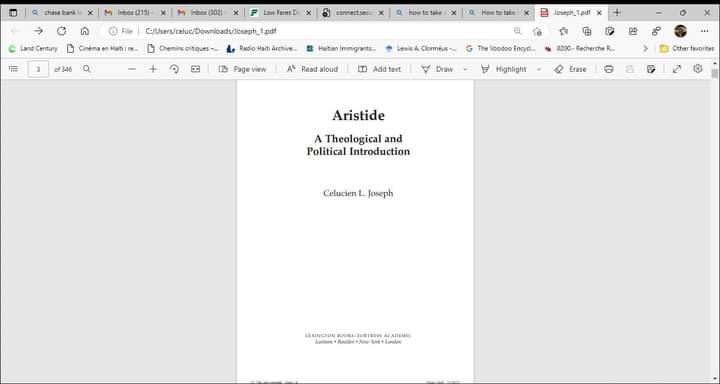
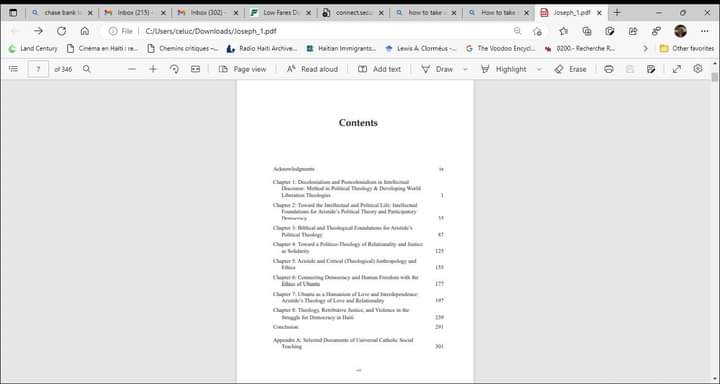
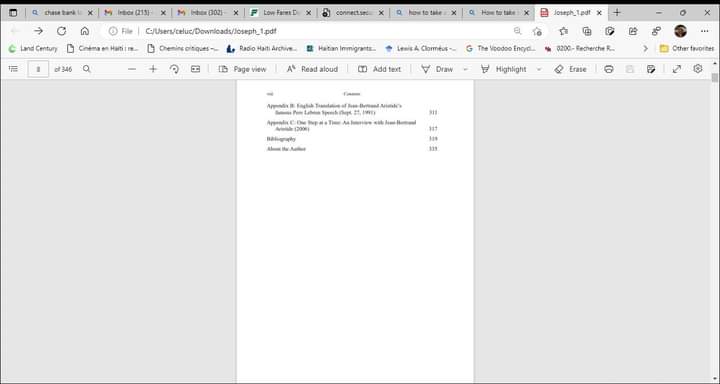
Finally, the good people at Fortress Academic sent me the proofs for my forthcoming book on Haiti’s first democratically-elected president and liberation theologian Jean-Bertrand Aristide. The book is entitled “Aristide: A Theological and Political Introduction” (Fortress Academic, 2023). The book is pp. 346 + index.
The proofs and the index are due to the publisher in two weeks. I am so thrilled about the publication of this important work.
“The First Human Group and the First Theology about God”
The first human group in human history is the first recipient of divine revelation, and it is to these human beings, not any religious system, God first revealed himself as Loving-Creator & Sustainer of the world. In other words, this first human group articulated the first theology about God. What we know about God (the knowledge of God) has its source in the theology of the first people of the world. We must also remember that the first people of the world were not Jews (Judaism), Christians (Christianity), nor Muslims (Islam). This is the first question about God Christian theology must respond to in the twenty-first millennium in order to get a proper understanding of God’s movements in the world and active engagements with his human creation.
The first theology about God by the first human group was a revealed theology that created a community of human proximity and a people whose vision of God did not embrace the logic of colonialism and human exploitation. The first (revealed) theology about God is (was) the theology of divine love and divine proximity because God’s first revelation to the first human beings was “love” and “presence.” God is love and loves human beings. God is present and near his creation.
I am not sure if this is an appropriate time to write a “love poem,” as we who live in Florida are facing a terrible storm: Mr. Ian. Well, love always wins, even in the midst of life’s greatest storms. Thus, I wrote this poem, “For a Thousand Suns,” to celebrate the infinite value and endurance of love. Love is stronger than a thousand hurricanes.
“For a Thousand Suns”
I love you with the fire of a thousand suns When darkness grows darker like the disappearing moon, You calm the storms of Jupiter You, the eternal fire, become a companion in the night When my days, were filled with woe You became my true champion in battle
I love you with the fire of a thousand suns By your pure, august ray, I may still sing the beauty of may When all the yellow suns shall go away from sight, Your eternal beauty shall transform the night
I love you with the fire of a thousand suns Your touch my shackled soul will save Your voice, proud, tender, is sacred Shine on me, you, abounding in kindness and glory In humble obedience, I shall learn your story
I love you with the fire of a thousand suns Ten thousand more years of youthful moments, Will you still love me freely? You, cabin warm and welcoming, cradle me in balm Of unforgettable dreams and delightful envies Our destiny? Who will dare limit our histories?
I love you with the fire of a thousand suns You, bearer of eternal beauty and unruly love, You, become my hopes, my prayers, and my visions Gone the pain thereof, For you I see, for a thousand years, And your voice I hear, from a thousand ears.
I just received word today from the Marketing Department that my new book “Theological Education and Christian Scholarship for Human Flourishing: Hermeneutics, Knowledge, and Multiculturalism” (Pickwick Publications: September 2022) has been published and can be ordered online.
This book explores the interconnection of theological education and Christian scholarship, cultural and theological hermeneutics, pedagogy and community knowledge, democracy and citizenship. Yet, the three major disciplines or discourses covered in this work include multicultural education, theology, and hermeneutics through the lens of human flourishing and the concept of the good life. From this angle, this project is written from three different methods and approaches that intersect with each other: a theology of contextualization, a hermeneutics of interculturality, and a pedagogy of cultural literacy and transformative community knowledge. The book advances the idea that theological education should be the starting point to foster candid conversations about the importance of democracy and human rights, civic engagement and the political life, inclusion and diversity, and pluralism and difference in our multicultural society. The book uses the tools of multicultural education and cultural knowledge to enhance democracy and promote fundamental human virtues that would sustain the good life and human flourishing in the world–in the Aristotelian sense and in the Socratic idea of local and world citizenship. Finally, this text offers an alternative vision to contemporary theological education, to deconstruct the white, male, and Eurocentric narratives of theological education and Christian scholarship.
——–
I am thankful to all the amazing and insightful scholars who first read the manuscript of the book in its early phase.
I am grateful to a group of thinkers and theologians who reviewed and endorsed the book.
I am grateful to all my seminary professors who introduced me to the world of Christian academia and theological education, and who invested in me as a Christian thinker, writer, and theologian.
I am thankful to the various churches, both white and black churches, that I have attended and served as member, leader, preacher, and teacher. The people of God in these various multiethnic and multicultural congregations have opened my eyes and given me a new and fresh perspective about the enormous value of diversity (ethnic, cultural, gender, racial), inclusion, and multiculturalism in theological education and in the training of both men and women for Christian ministry and academic vocation.
Finally, my patient and very generous wife has given me the freedom and flexibility to think, write, and research for this book. This is very important to me because I spent 20 years working spontaneously on this book, as my initial research for this book began in my second semester of seminary in 2002. This incredible woman was by my side and provided unconditional support when I started seminary in Louisville, Kentucky 20 years ago.
To the praise, glory, and excellency of the most gracious, the most beautiful, and the most merciful triune God!!!
How old is your soul? You are struck by the slap of love You crave attention and cover the pain with a mask He does not know the beauty in the dark, but I care about the fantasy of your pleasure Could his hands be a healing balm for your soul?
How old is your soul? You open your wings to the breathing sunrise He hides away from the beating sound of your heart He does not buy you heirloom roses in summer seasons, but I will cover your feet in the raging winter. Will he hold your hands when it rains?
How old is your soul? You are searching for the lyrics that make you smile and the home where you belong He does not know the story of your life, but I know the language of your love and will bring back the memories Will he carry you when it snows outside?
For the past two weeks, I’ve been trying to put in poetic imagination what happens when someone is taken away by desires and overwhelmed by passion. So today, my words and feelings are expressed in a poem called “desire.” Let me know what you think.
“Desire”
You grow in me, the sweet flame that burns I turn to you and am overwhelmed by your stormy gale You claim my parts and forge a steady path toward sacred passions Give me vision, I will be your faithful companion Lead me, I will be your intimate prostitute.
You move within me, the river whose streams make glad the face behind the veil You become the precious fruit in the garden of my heart and the loudest sound in the night I touch with care and step to the edge to gather love You rule my days and command my nights Teach me, I will be filled with the knowledge of beauty.
You live in me, the city with infinite candles of light I climb the stairway to heaven to find you You raise your lamp up high to see my world below Tears roll down, mixed with vague delights, I become your forever gaze, It is your feelings that become my remote control Dance with me, I will be your daring adventure.

 drcelucienjoseph, "Thinking and Meditating"