It’s been a little over three to four months since I have written a poem. Since yesterday, I have been thinking about the intersection of nature, romance, and human connection with nature. I just finished writing this new poem I called “Nature in Love” that explores these various dynamics and themes. It is a poem of three stanzas. Let me know what you think.
“Nature in Love”
Walking a lonely night, in a field where wildflowers sway,
Love blossomed in the light of day while we gazed at the sky.
We felt a sense of connection with celestial hosts, and a gentle breeze birthed nature’s song.
We experienced the healing power of nature’s grace, and a symphony of life filled the air.
A tender embrace at the dance of the leaves sealed two drifted hearts in a harmonious path.
On the other side of the forest, silence reigned supreme, and every shade created a story pure and true.
Underneath the starry sky, we heard our own voices, and we chased our dreams with resilient hope and creative imagination.
Your body, adorned with the tears of the forest birds, revealed the hidden secrets and pains untold.
The tranquility of the night made love a sacred art in every heart.
You and I wandered hand in hand in this vast and wondrous land.
Mountains rose with steadfast grace, the escape gate to a failed romance ensured the kiss of rain upon the earth.
Being surrounded by strange creatures that sustained the past and memory, nature and love joined forces to create the masterpiece of life.
In nature’s arms, we found our place.
In nature’s love, we recreated ourselves.
In every valley, every hill, love and nature will make human presence in the land soft and still.
“Consistent Faith (in God) and Stories of Faith in Moments of Grief”
“Consistent Faith (in God) and Stories of Faith in Moments of Grief”
To be honest, I don’t like listening to stories about people suffering.Yet I know that listening actively to those going through moments of grief and mourning can make us more humane and through which, we are given countless opportunities to grow in relentless compassion and mental maturity.
I have always done my best to emphasize with those who are experiencing seasons of grief and pain in their life. I often try to understand their backstory and their life trajectories so I could engage them in meaningful conversations with a purpose to find healing and provide guidance.
In the past few months or so, I have read various stories by people of faith, especially Christians, on unbearable terminal illnesses; stories about miscarriages and forced abortions; the devastated loss of a baby or a child; the passing of a dear mother or father; the unexpected death of a dear brother or sister; the problem of suffering and pain in life; and stories about disappointment and defeats, and stories about moments of challenge and darkness in life.
For example, I read a story about a single mother who worked two jobs to pay her car note and rent as well as to provide for her daughter and put food on the table. She said that I have been a faithful Christian and never missed a prayer meeting or a Bible study at my church. Yet “God has allowed the car dealer to repossess my car because I couldn’t keep up with all those bills. I have been faithfullly serving him. I just don’t understand why he let that happen.”
I read a story about a young married couple (they have been married for less than three years. The wife became pregnant in the second year of their married life.) who lost their baby while the mother was eight months pregnant. Their grief was unbearable; yet the mother writes, “I love you, my child. I know that I will see you again in heaven one day when all of us will be united.”
I read another story about a seminary couple. They have been married for about five years. Their precious 7 year-old daughter was going through a difficult time: a terminal cancer. She died at the local children’s hospital while the husband was in a seminary class learning about how to minister to youth and young adults. The young man was studying to be a Youth Pastor.
Yet I read another story about another family of five who were driving home from vacation. A teenager was speeding while driving, losing control of the wheel, and hit the family car. Four members of the family were pronounced dead at the scene.
What surprised me throughout these various stories was how these Christians were still firm in their faith and clinged more to God through Christ. They became more assertive about divine providence and God’s faithfulness in their journey of faith. Although some of them asked God difficult and challenging questions, they never doubt the grace and love of God in the midst of these challenges and moments of grief.
As I continue to reflect upon these stories of grief and devastated human experiences, I have somewhat become attached to the pain of these individuals, but at the same I am deeply moved by their shared suffering and cry for consolation and comfort from God and others. Listening with care and understanding to others who are grieving and suffering may pave the way towards our own healing and psychological relief.
James Cone and the contemporary American church
Six years ago, I wrote this essay on James Cone and the vocation of the contemporary church in America. As we begin the new year, if you want to hear a fresh perspective and a prophetic voice and message about the role of the church in society, check it out: “James H. Cone: The Vocation of Christian Theology and the Christian Church Today”
Happy New Year to you!
Happy New Year, Good People!
May the good and sovereign Lord guide and preserve you and your family!
May the love of God compel you to produce what is good, lovely, and harmonious!
May you walk humbly before the Lord!
May you grow in knowledge, empathy, tolerance, wisdom, compassion, understanding, humility, and love!
May you practice active forgiveness and participate in the process of reconciliation and unity in your community, city, and in your country!
May you contribute to other people’s flourishing; learn to love all people stronger and intentionally; show hospitality and acts of kindness to strangers everyday; and serve all people!
May you practice self-care, self-reflection, meditation, and have an active prayer life!
May your days be fruitful and your life be prosperous during the new year:2024
Searching for You: A Poem
“Searching for You”
In a world of rejection….
the tears of the moon become thick
The sky is darkened
The universe is sad because of you
Rough winds carry you afar
Sadness fills your shadow
The night devours my soul
The cold wind stings my heart
Loneliness surrounds my body
Longing for a new place to hope
Where the oceans kiss the blue sky
The shattered heart I cannot bear
A bruise that scars my soul
If I ever dream, dream of a new life,
dream of love in the future,
It is okay…it will be with you
If I see destruction and know suffering
It will be okay to suffer with you
If I go to a distant land, full of charm and your memories
You will come with me
Your love is my love
Book Launch Event: “Vodou and Christianity in Interreligious Dialogue”
Book Launch Event: “Vodou and Christianity in Interreligious Dialogue”
Dr. Celucien Joseph is inviting you to a scheduled Zoom meeting.
Topic: Book Launch Event: Vodou and Christianity in Interreligious Dialogue
Time: Nov 26, 2023 06:00 PM Central Time (US and Canada)
You are invited to a Zoom meeting.
When: Nov 26, 2023 06:00 PM Central Time (US and Canada)
Register in advance for this meeting:
https://us02web.zoom.us/meeting/register/tZwtd–rqz4iGtM-f0vKv4kT75pHsIKL84I8
After registering, you will receive a confirmation email containing information about joining the meeting.


November 2023 Itinerary and Speaking Engagements
November 2023 Itinerary and Speaking Engagements
Those of you who can and know how to pray, say a little prayer for brother Lou for the month of November. I need all the prayers in the world and all the angels in heaven to intervene on my behalf for these interesting speaking engagements. What was I thinking to say YES to all these events and invitations😊😊😊
· Thursday, November 7: I will be giving a paper at the Colloque International sur la Contribution d’Haïti à l’émancipation des peuples (lutte globale contre l’esclavage et la colonisation)/ International Conference on Haiti’s Contribution to the Emancipation of Peoples (global fight against slavery and colonization) on the recent literature on the Haitian Revolution, published in the past decade or so. It is called “Rethinking ‘The Haitian Turn,’ from 2012 to 2023: An Assessment of the Most Recent Literature on the Haitian Revolution in English.”
· Saturday, November 11: I will be interviewing Dr. Pierre St Louis on “Christian Mission and the transmission of the Gospel in Haiti” for the Center for Faith, Reason, and Dialogue (CFRD).
· Saturday-Monday, November 18-21: At the American Academy of Religion’s annual conference (San Antonio, TX), I will be presenting two papers. My first presentation will be on the topic of “Vodou and Christianity in Interreligious Dialogue and the Roots of Religious Disagreement.” My second presentation will be on the subject of “Pope John Paul II, the Haitian Episcopal Conference of the Catholic Bishops, and the Emergence of Liberation Theology in Haiti.”
· Sunday, November 26: I will be moderating the book launch event for my new co-edited book “Vodou and Christianity in Interreligious Dialogue ” (Pickwick Publications, 2023) via zoom. You will get to hear from the other coeditors and contributors of this excellent and much-needed volume.
· Wednesday, November 29: I will be giving a talk to a group of talented College Preparatory students at the Metairie Park Country Day School (Metairie, LA). The title of my talk is “Haitian Vodou and Haiti’s Connections with Louisiana through a common religious and cultural heritage.”
· Wednesday, November 29: Pascal Robert, the host of “This is Revolution podcast,” will interview me on “The Lifetimes and Significance of Jean Price-Mars.”
L
“Vodou and Christianity in Interreligious Dialogue” is Published!
Hello Good People!
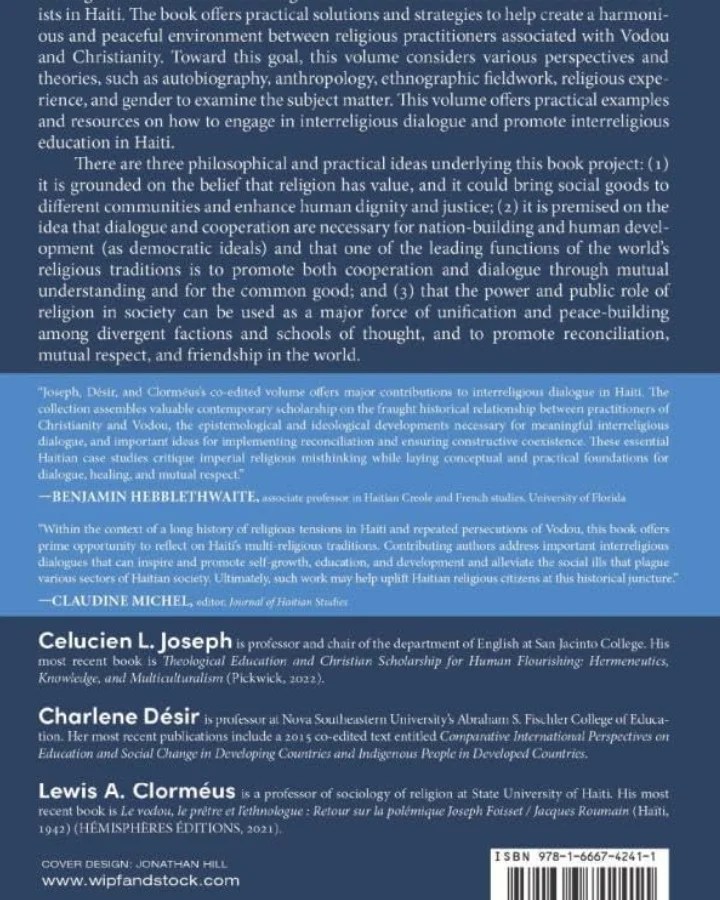
My new co-edited volume, “Vodou and Christianity in Interreligious Dialogue” is now available on Amazon to order. This is the first book in the English language that attempts to foster interreligious dialogue between Haiti’s two dominant religions. It will not be the first one.
Get it as your Christmas present and get a copy for your friends as well!


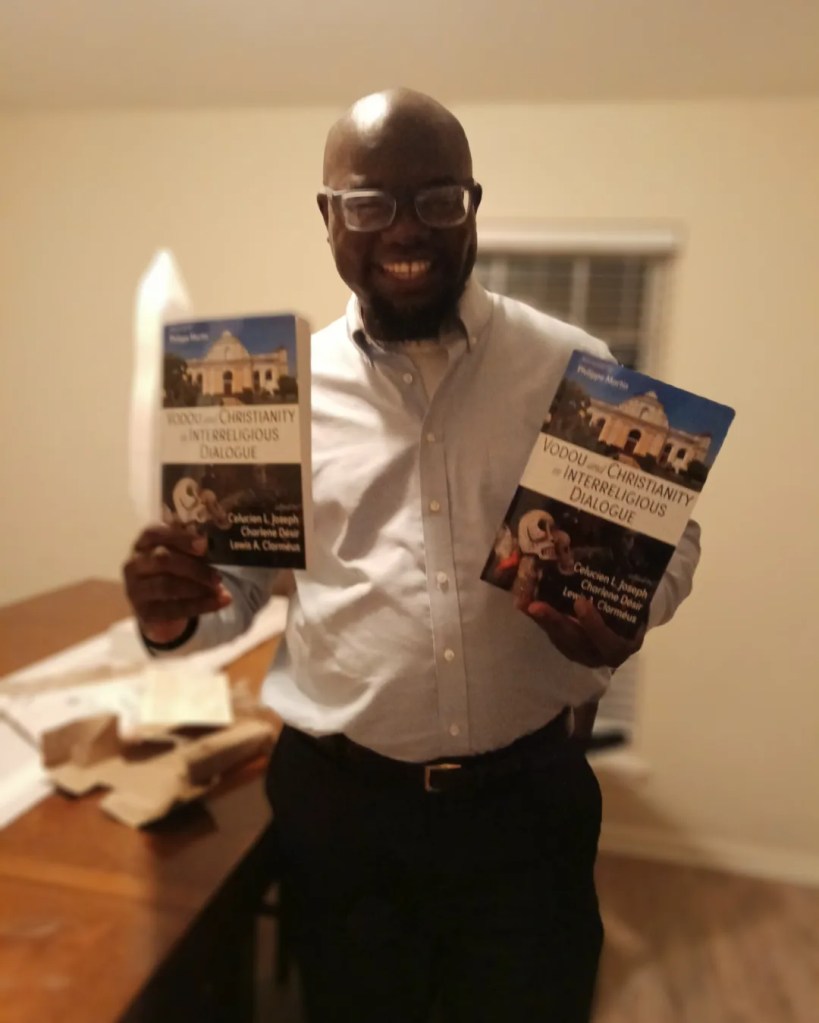
Author copies of my new book just arrived!
I am so happy this book is finally out. I’ve worked so hard on this book. In the process, God has been so gracious to me to grant me both physical and intellectual energy to complete this enormous task. Not only have I served as the book’s general editor; I translated three chapters ( 2, 6, 9) in English that were originally written in French. The book has ten chapters. I also contributed a chapter (chapter 10) to the book. In addition, I translated from French the foreword written by the renowned French religious scholar Philippe Martin. (This is not a complaint. I am not afraid to work hard. I am grateful to my amazing coeditors and the brilliant contributors as well as those who have endorsed the book.)
It was all a labor of love. I want both committed Vodouyizan and Christians to live in peace and harmony in Haiti and beyond Haiti, and my desire is for both groups to learn how to be tolerant and respectful toward each other. My prayers is that both committed Vodouyizan and Christians would use religion as a force for nation-building and a resource to maximize democracy in Haiti and its diaspora.
Ten Productivity Strategies
Ten Productivity Strategies
1. Prioritize people in all your work and success.
2. Have a broad vision of life and think about how it relates to the consequences of your ideas and work.
3. Know your strength and use it to inspire and empower people.
4. Do not be ashamed of your weakness; rely on others’ strength to fill in the gaps.
5. Value human relationships and do not mistreat the people you work with or those you depend on to get the work done.
6. Teach others what you know and do your work effectively.
7. Use your knowledge, skills, and talent to change the human condition in your community and in the world.
8. Do not focus too much about what you would like to become in life; rather, be committed to the steps that will take you there.
9. Do not lose a sweat about what people are thinking about you.
10. Be honest, treat all people with respect and kindness, and live in peace with all people.
Reflections on Ten Big Issues in the American Evangelical World
Reflections on Ten Big Issues in the American Evangelical World
1. Theory and Praxis: there exists a profound disconnect between the Evangelical theoretical understanding of the Christian faith, and the christological praxis of the faith or the call for followers of Christ to actively engage in the everyday reality (and mess) of the human experience (i.e., the existential struggles and traumas of the people in need). In this sense, American Evangelicalism has become a type of social problem, not the solution to the social problems in the culture.
2. Grace and empathy: Christian grace and empathy have become a rare thing to find in the Evangelical practice, especially concerning the existential problems of human pain and suffering in contemporary societies. As a practice, the Evangelical grace has been compartmentalized discriminatorily to respond to the needs of a selected few in society. Empathy has also become a preferential option expressed and demonstrated toward a selected group. The problem of grace and empathy could be particularly observed in the Evangelical reaction and response to the problem of mass incarceration, immigration debates, police brutality, food scarcity, the Israelite-Palestinian conflict, as well as in the American government’s response to the Russian-Ukraine war and the Israel-Hamas war.
3. Caring for the poor and the homeless: the biblical call to care for the poor and the homeless is a quality that is not inherent in today’s Evangelical faith and practice. Acts of kindness and charity toward the marginalized and the economically-disavantaged groups are often done and associated with certain seasons and holidays of the year ( Christmas, Thanksgiving, short-term mission trips to foreign countries). In other words, caring for the poor and the homeless is not a way of life in American Evangelical Christianity, and unfortunately, in many Evangelical circles, it is sometimes associated with socialism.
4. The sanctity of life: in American Evangelicalism, the concept of the sanctity of life is deeply connected to political decisions and legislations. It has become a political vote and an association with a political party. Life is deemed sacred because it could be secured through the process of political and judicial legality.
Also, the biblical mandate to preserve and defend life has been reduced to a particular
phase of the human development and a monolithic view of the human life: the stage of the unborn. It’s not carried through the whole life of the individual after birth.
5. Religious freedom: in the Evangelical mindset, religious freedom is connected directly to the rights and freedom of American Christians to practice their faith freely, openly, and without any restraints. Evangelicals defend and guarantee such rights and liberties for American Christians only; they are often silent on the struggle of other religious faiths and non-christian groups to have these same rights applied and guaranteed to them in society.
Evangelicals have become dependent on the state to make (and maintain) the practice of religion a freedom and a right, and the practice of freedom and rights a religious association, correspondingly.
6. Politics: in various American Evangelical circles, politics has become a partisan phenomenon that is based on a selective-value system or theory that is often short of a thorough moral assessment of political leadership and actions. This particular reaction to contemporary politics has become an accepted practice in contemporary American Evangelicalism, what we might call the demoralization of American politics. There is no moral compass deployed to assessing the value-system and ethical worldview of a political leader associated with the political party often aligned with American Evangelicals. Within this framework, it could be said that American Evangelical values and worldview when it comes to matters of legislations, and political leadership and actions are not universally shared with global (other) Christians elsewhere.
7. War and freedom: there’s an obsession with the culture of war that it is deeply ingrained in the Evangelical mind and commitment to the American state. American Evangelicals generally support the American government’s decision to go to war because the Christian faith has been taken captive by the government. The idea is that the survival and continuous maintenance of the Christian faith in the American society is dependent upon the preservation and the defense of American democracy and freedom within and in the world. Hence, Evangelicals not only support the American government’s decision to go to war because of the fear of losing national sovereignty; the matter also pertains to the Evangelical obsession in spreading the American gospel of democracy and freedom in the world. Hence, Evangelicals gave pledged its undivided allegiance to the state because they see the government as its ally, meaning it’s the guardian of Christian liberty and the American state as the advocate of Christianity in society.
8. Peace-building and peace-making: in the same line of thought with the previous thesis, American Evangelicals understand peace-making or peace-building in the most political sense. The project of Christian peace-making is often construed as the goal of the American government. American Evangelicals believe that genuine societal peace is intrinsically dependent upon the government’s decisions and interventions. To put it another way, the project of Christian peace-building is intertwined with the American Christian nationalist ideology. This is the antithesis of Jesus’ declaration to his followers to “become peacemakers” in the world. From a christological point of view, peace-making or peace-building is an intentional decision and a deliberate practice of children of God. It is the sons and daughters of God who are the peacemakers in the world, and it is this community of peace that is mandated to propagate and practice peace in society. The state is not inherently a practitioner, a doer, or a builder of peace in the world.
9. Justice and Fairness: justice in Evangelical circles does not necessarily mean transformative justice and holistic justice for all people and for those who might be culturally and ethnically different. Because of the close association with American Evangelicalism and Christian nationalism, not only justice as a concept is associated with the task of the American government; many Evangelicals have blindly subscribed to a definition of justice, as defined politically by the state or the American government. In other words, the biblical concept of justice (rooted in the ethical character of God) and the Christian call to practice justice (grounded in God’s moral attributes) have become subservient to the legal practice and judicial sense of justice, which is often flawed, partial, and non-transformative.
In the biblical narrative, justice is not only an essential attribute of God. It is the fundamental rule or moral compass that God deploys to govern the world and assess morally the decisions and affairs of world governments and the global populations. Divine mercy is often associated with divine mercy, and justice is said to be one of the most visible markers of the people of God in the world.
10. Theory of the Good life: the concept of the good life in American Evangelicalism is measured by American exceptionalism and triumphalism in the world, as well as the idea of Western democracy and freedom as a global phenomenon. American exceptionalism and Western concept of democracy and freedom challenge the biblical understanding of Christian liberty and “freedom in Christ;” they also contradict the biblical virtues and the call to pursue (and practice) humility, hospitality, global peace, reconciliation, harmony, servant leadership, and not to regard oneself far more superior than another individual. This theory of the good life also promotes the doctrine of the (cultural) superiority of nations and the (cultural) inferiority of other nations.
The christological definition of the good life lies in the imitation of Christ’s character, that is to be a servant to others and to promote human dignity and preserve the sanctify of life.

