On Intellectual Reparations: Hegel, Franklin Tavarès, Susan Buck-Morss, Revolutionary Haiti, and Caribbean Philosophical Association (CPA)
by Celucien L. Joseph, PhD
About six to seven years ago in a short note, I voiced my concern about the decision of the Board of Caribbean Philosophical Association (CPA) to grant the Frantz Fanon 2009 Book Award to Susan Buck-Morss for her brilliant book on Hegel, Haiti, and Universal History (University of Pittsburgh Press, 2009). Professor Buck-Morss’ basic thesis is that the revolutionary events (1791-1803) in Saint-Domingue-Haiti had substantially influenced Georg Hegel’s master-slave dialectic in his major work “The Phenomenology of Spirit,” which he published in 1807—only four years after the Haitian Revolution—and that revolutionary Haiti had a profound impact on Western history of ideas and universal history, respectively. While Buck-Morss mentioned the writings of the African historian and intellectual Pierre Franklin Tavarès in her work, she failed to give serious attention to his major claims concerning Hegel and Haitian History.
The CPA board, as I mentioned in my previous message to them, has also failed to recognize the meritorious contribution of the African historian who was actually the first scholar to argue, in a series of articles based on his doctoral dissertation (1989) at Sorbonne, that Hegel’s dialectic thesis was influenced by the Haitian Revolution, and that Haiti had had a tremendous impact on Enlightenment modernity, and the history of thought in the West. The Frantz Fanon 2009 Book Award should have been given to Dr. Pierre Franklin—not Prof. Susan Buck-Morss whose thesis is heavily dependent on Tavarès.
In May 1992, the Haitian journal Chemins Critiques, Revue Haïtiano-Caraíbéenne, published an excerpt of Tavares’s 1989 doctoral dissertation ; the article is entitled “Hegel et Haiti ou le silence de Hegel sur Saint Domingue” (Chemins Critiques, Revue Haïtiano-Caraíbéenne, Vol. 2, No. 3, mai 1992, pp. 113-131.) The chief editor of the journal at that time was the renowned Haitian sociologist, anthropologist, and theologian Laënnec Hurbon; Georges Castera, Syto Cavé, Delano Gilbert, Monique Lafontant, Franklin Midy, Bérard Cénatus, Jacky Dahomay, Laënnec Hurbon, Georges Mauvois, Michèle D. Pierre-Louis, and Frantz Voltaire served on the editorial board of Chemins Critiques. Below is the first page of Tavares’ article that was published in Chemins Critiques:

(The interested reader is encouraged to consult some of Pierre Franklin Tavarès’ writings on the subject matter: “Hegel, critique de l’Afrique : introduction aux études critiques sur l’Afrique” (PhD dissertation, Paris 1 Panthéon Sorbonne, 19989) ; the article is entitled “Hegel et Haiti ou le silence de Hegel sur Saint Domingue” (Chemins Critiques, Revue Haïtiano-Caraíbéenne, Vol. 2, No. 3, mai 1992, pp. 113-131.) ; “Hegel et l’abbé Grégoire : question noire et révolution française” (Annales historiques de la Révolution française, 1993) ; “À propos de Hegel et Haïti Lettre de Pierre Franklin Tavares à Jean Ristat” (L’Humanité, 2006.
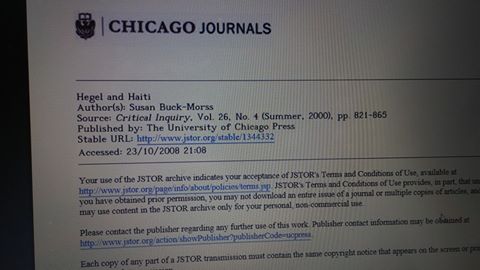
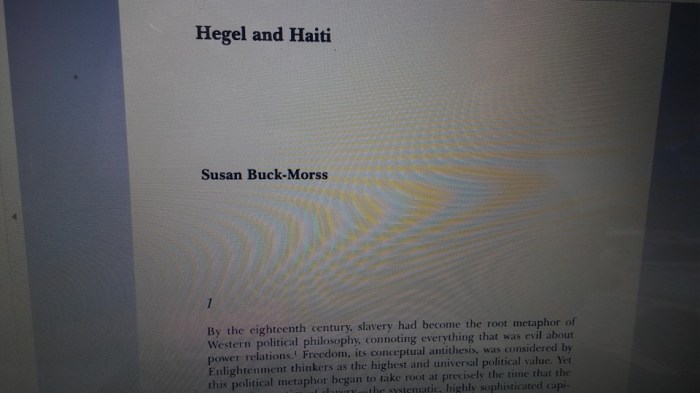
By contrast, eight years later after the publication of Tavares’s article in Chemins Critiques, in Summer 2000, Susan Buck-Morss would publish the influential essay entitled “Hegel and Haiti” in Critical Inquiry (Vol. 26, No. 4 (Summer, 2000), pp. 821-865)—published by The University of Chicago Press. Below is the first page of Buck-Morss’ essay, which she would expand in her 2009 book, Hegel, Haiti, and Universal History:
In my doctoral dissertation, “The Haitian Turn: Haiti, Black ‘The Haitian Turn’: Haiti, the Black Atlantic, and Black Transnational Consciousness” (University of Texas at Dallas, 2012), I coined the expression “The Haitian Turn” to reclaim the significant impact of Haiti and Haitian history in the emergence of Black internationalism, Pan Africanism, and Black radicalism, as well as Haiti’s major impact on modern history of ideas in the West and the Black Atlantic; I also coined the theoretical concept of “black transnational consciousness” to explain and analyze the nature, content, and workings of black internationalism in the first half of the twentieth-century. In the same line of thought, I rightly acknowledged Tavarès’ vital contributions to scholarship and Haitian revolutionary studies. Subsequently, in a major article I wrote about the recent studies on the Haitian Revolution, I gave the credit to where it is due—to Dr. Tavarès (See, “’The Haitian Turn’: An Appraisal of Recent Literary and Historiographical Works on the Haitian Revolution,” The Journal of Pan African Studies, 5:6 (September 2012):37-55)
Allow me to reproduce below an important paragraph from the essay noted above:
In a 1989 Sorbonne dissertation, “Hegel, critique de l’Afrique,” Pierre Franklin Tavares strikingly argues that the revolution in Saint Domingue and the birth of Haiti—as a double event—were the main historical sources (but not unique) of the famous “figure of consciousness” entitled “Domination and bondage of the Phenomenology of Spirit,” which incorrectly named “the dialectic of master and slave.” Building on Tavares’s thesis, more recently, in an article (“Hegel and Haiti”) published in Critical Inquiry in 2000 and later extended in book form as Hegel, Haiti, and Universal History in 2009, Susan Buck-Morss contends that the events of revolutionary Haiti inspired the young Hegel distinctively in his development of the lord-servant dialectic, and substantially provides the concrete experimental resources for theorizing freedom and the process of history. She also insists that the Haitian Revolution has contributed significantly to European critical discourses on subjectivity, freedom, identity, and consciousness. Although the news about the revolution was censored in the French media after 1803, Buck-Morss informs us, “newspapers and journals in Britain (also in the United States and Poland) highlighted the events of the final revolutionary struggle in Saint-Domingue” (43-44). Buck-Morss asserts, “The Haitian Revolution was the crucible, the trial by fire for the ideals of the French Enlightenment. And every European who was part of the bourgeois reading public knew it” (44).
Furthermore, in the same article, I also wrote: “Buck-Morss and Tavares have convincingly demonstrated Hegel’s philosophy of freedom and philosophy of right (Nesbitt, “Troping Toussaint” 19-33) also were dependent on the Haitian Revolution, a signal event in human narrative of liberty that provided him the empirical data to think through freedom.”
Interestingly, in a recent essay, “Global History and The African: A New Reading of Hegel,” published this month (February, 2016) in Tanbou, Haitian writer Wilson Décembre, who understands the value and imperative of intellectual reparation, wrote these important paragraphs about the implication of Pierre Frankly Tavarès’s thesis in regard to Hegel, Haiti, and universal history:
“Franklin Tavarès has written a series of articles that grew out of his work on a doctoral dissertation. All these articles are about the connection between Hegel and the African participation in History. In the letter that he has sent to the French journalist Jean Ristat, he gave a short and clear explanation of his points of view. As I already pointed it out, he is the first scholar to ask the question whether Hegel was inspired by the revolutionary events of Saint-Domingue or not. For him, the African Revolution in Saint-Domingue and the birth of Haiti as a State must be considered as the main historical source (not the only one) of the famous “figure of consciousness” called “dominion and servitude” but that is improperly called, “the master-slave dialectic”. Nevertheless, for him, The Phenomenology of Mind refers to the Revolution of 1789 and to the victorious slave uprising in Saint-Domingue only as “figures of consciousness”. It’s up to the reader to find out the times and the historical events behind these figures of consciousness. For this reason, he affirms that the figure called “dominion and servitude” had many sources (Old Testament, Hercules, Spartacus, etc.) but that the main source is the book of L’Abbé Raynal, Histoire philosophique des établissements européens dans les deux Indes, in which, Raynal and Diderot, for the first time, announce the future victory of a Black slave over his master in the Black world. According to many historians, Toussaint Louverture, the leader of the Revolution in Saint-Domingue, has read the book.
According to Tavarès, Hegel read the book when he was in Berne. And by reading it, he became aware of the horrors of slavery. From then on, he became a violent opponent of slavery in the Caribbean. Because of that—and this is one of the points on which Susan Buck-Morss disagrees with him—Tavarès refuses to consider Hegel as a racist. He points out that Hegel had a long relationship with Abbé Grégoire friends’ circle. Moreover, he criticizes Buck-Morss for ignoring that particularly in The Philosophy of Mind, Hegel completely destroyed the racist and racialist arguments of his time, notably by criticizing and making a mock of Gall’s phrenology. According to Tavarès, Hegel is not the author of the texts that are attributed to him (Cf. in this report: “Hegel and Africa”). Hegel is considered as a racist because of texts that are apocryphal.”
Source: http://www.tanbou.com/2016/GlobalHistoryAndTheAfrican.htm#.Vrz2fgcE1e8.facebook
On the Importance of Intellectual Reparations
At the beginning of his short essay, Professor Décembre also wrote convincingly about Tavarès:
“Pierre Franklin Tavarès, a Cap-verdian born Hegelian scholar educated at the Sorbonne, is the one who started it all. He was the first to raise the question whether Hegel was inspired by events happening in Saint-Domingue at the end of the eighteen-century. He wrote a series of articles in the nineties in which he showed that Hegel was not unaffected by the issue of slavery that was very important at his time. He showed that Hegel criticized slavery in many texts even though the criticism is not obvious, due to many references made by Hegel to the ancients, notably Aristotle. Tavarès stated that Hegel read Diderot and Abbé Raynal’s History of the Indies in the center of which was the issue of slavery in the Caribbean. Therefore, for Tavarès, Hegel was aware of the problem and he was an abolitionist throughout his life.”
He also commented: “Susan Buck-Morss gave credit to Tavarès. Drawing on his conclusion, in her book called Hegel, Haiti and Universal History, she showed that the master and the slave that Hegel speaks of in the Phenomenology of Spirit are in fact “real slaves revolting against real masters” in a context that is the one of the Haitian Revolution of the end of the 18th century.”
Intellectual Reparation, which aims at acknowledging and recognizing the contributions of non-Western writers and those who have been placed in the margins of universal history and the human narrative, has always been an important concern for African, Black, Asian, Hispanic, Latino/a, and non-Western thinkers in the history of Western scholarship and history of intellectual exclusion in Western academia. Intellectual historian Peter K. J. Park has brilliantly argued for intellectual reparations in his groundbreaking study: Africa, Asia, and the History of Philosophy: Racism in the Formation of the Philosophical Canon, 1780-1830 (SUNY Press, 2014). The content of the book is described in these words:
“In this provocative historiography, Peter K. J. Park provides a penetrating account of a crucial period in the development of philosophy as an academic discipline. During these decades, a number of European philosophers influenced by Immanuel Kant began to formulate the history of philosophy as a march of progress from the Greeks to Kant—a genealogy that supplanted existing accounts beginning in Egypt or Western Asia and at a time when European interest in Sanskrit and Persian literature was flourishing. Not without debate, these traditions were ultimately deemed outside the scope of philosophy and relegated to the study of religion. Park uncovers this debate and recounts the development of an exclusionary canon of philosophy in the decades of the late eighteenth and early nineteenth centuries. To what extent was this exclusion of Africa and Asia a result of the scientization of philosophy? To what extent was it a result of racism?
This book includes the most extensive description available anywhere of Joseph-Marie de Gérando’s Histoire comparée des systèmes de philosophie, Friedrich Schlegel’s lectures on the history of philosophy, Friedrich Ast’s and Thaddä Anselm Rixner’s systematic integration of Africa and Asia into the history of philosophy, and the controversy between G. W. F. Hegel and the theologian August Tholuck over “pantheism.”
I wholeheartedly applaud the board of CPA for recognizing the value and implications of this important study; Professor Peter’s book has won The Frantz Fanon Award for Outstanding Book in Caribbean Thought in 2016.
Aldon Morris, in his award-winning and stimulating book, The Scholar Denied: W. E. B. Du Bois and the Birth of Modern Sociology (University of California Press, 2015) — 2016 R.R. Hawkins Award, PROSE Award for Excellence—has also made the case for intellectual reparations in the example of the laudable contributions of W.E.B. Du Bois and his writings in the foundation of American sociology. As the blurb of the book reads:
“In this groundbreaking book, Aldon D. Morris’s ambition is truly monumental: to help rewrite the history of sociology and to acknowledge the primacy of W. E. B. Du Bois’s work in the founding of the discipline. Calling into question the prevailing narrative of how sociology developed, Morris, a major scholar of social movements, probes the way in which the history of the discipline has traditionally given credit to Robert E. Park at the University of Chicago, who worked with the conservative black leader Booker T. Washington to render Du Bois invisible. Morris uncovers the seminal theoretical work of Du Bois in developing a “scientific” sociology through a variety of methodologies and examines how the leading scholars of the day disparaged and ignored Du Bois’s work.”
Like Du Bois, the Haitian anthropologist and thinker Joseph Anténor Firmin—the first Black anthropologist—whose pioneering study, De l’égalité des races humaines : anthropologie positive (The Equality of Human Races/University of Illinois Press, 2002)) , which he published in 1885 at the emergence of anthropology as an academic discipline in the West, has been a victim of Western academic isolation. It was recently Firmin was recognized as a “pioneer of anthropology (for further detail, see Carolyn Fluehr-Lobban’s seminal article, “Anténor Firmin: Haitian Pioneer of Anthropology” (American Anthropologist, Vol. 102, No. 3 (Sep., 2000), pp. 449-466); however, Firmin’s work is not widely known in the academia in the Anglophone world, and unfortunately, Joseph Anténor Firmin as a founding father of Western anthropology is not widely accepted, for example, by American Anthropological Association. In the academic practice of intellectual exclusion and epistemic disobedience, The Association of Black Anthropologists (ABA), which was founded in 1970, has yet to officially recognize Firmin as a founding father of Black anthropology. Nonetheless, careful scholarship does reveal that the history of thought in Francophone Black Atlantic, Hispanophone Black Atlantic, or Anglophone Black Atlantic, etc. intersect, converge, and confluence. This observation, however, does not undermine the prominence of décalage, and intellectual conflicts and misapprehensions in the wider Black Atlantic and African Diasporic thought and culture.
To bring this short reflection to a close, allow me to take us back to the core of the issue: unfortunately, the board of the Caribbean Philosophical Association who decided on The Frantz Fanon Award in 2009 has also missed the mark. It is never too late (to practice) for intellectual reparations. Pierre Franklin Tavarès is still alive!!! An important scholarly and professional guild like CPA cannot practice what it is been fighting for since its foundation that is “Shifting the geography of reason.” To me, the motto of CPA calls for our continuous efforts and collaboration to interrogate the (exclusive and absolute) value of Western intellectual hegemony and the practice of academic isolation—as it pertains to the works and ideas of Non-Western thinkers.
Intellectual reparation is the right thing to do. Joseph Anténor Firmin once declared, “Il faut réparer au nom de la philosophie morale” (“We must repair in the name of moral philosophy.”) In the same line of thought like Firmin, Frantz Fanon, and Walter D. Mignolo, the Haitian scholar and sociologist Jean Eddy Saint Paul has exclaimed, “Il faut réparer au nom de la décolonialité, une manière de faire justice aux damnés de la terre. Il faut réparer au nom de la désobéissance épistémique conçue ici comme contre-poétique décoloniale” (“We must repair in the name of decoloniality, a manner of doing justice to the wretched of the earth. We must repair in the name of epistemic disobedience as conceived here as decolonial poetics.”) Intellectual reparation is morally, ethically, and academically justified.
*This essay is also available as a PDF document. Click on the link below to access it: