“The English Language DOES NOT Humanize the Haitian People”
The American academic world produces some of the most arrogant and selfish academics and thinkers in the world. Because most American scholars and historians write and publish in the English language the same history or story that’s already been published by Haitian/African/Caribbean writers who write in French or Spanish, they give more intellectual value to their own work simply because it is written in English, and it is not because they are assessed as quality scholarship or good research. I call this attitude “intellectual imperialism” relating to the politics of the American Empire in the world to undermine the intellectual and literary productions of writers and historians in the Global South or developing world. Haiti, because of its complex history with the United States and the West, as well as with American and Western academics and writers, is a primary victim of this intellectual climate.
- Some of them (American academics) do not even bother to cite, for example, Haitian writers who have written on the same issue 50 years ago before they were even born or received an American doctoral (research) degree. C’mon, good people: you cannot just pretend that Haitian historians and writers did not exist in the 18th century, or nobody in Haiti wrote about Haitian national history or Haitian intellectual history from 18thto 20th century, for example.
- Haitian historians, writers, and scholars have been marginalized in their own discipline (s) of study, especially those who write in French about Haitian national history and Haitian political history.
- Not because one writes in English for an English-speaking (or American) audience means that individual has to deliberately disengage with a body of scholarship produced in a different language. It is intellectual dishonesty not to give credit or acknowledge intellectual predecessors. For example, you do not give Haitian studies legitimacy because it is done in the English language by American writers, nor do you humanize the Haitian people because you write in English about Haiti and the Haitian experience. Here, I am not referring to Haitian-born writers or those of Haitian descent who write or produce in English. This is not my point here!
- Unfortunately, in the American academia, producing academic works in the English language does come with academic entitlement or pedigree; nonetheless, I have to state that English as a language does not make one naturally more intelligent than others who write in a different language. I know this is a popular attitude among Americans, even among some American academics that speaking or writing in English is connected with high civilization or culture, intelligence, and fame. By contrast, I also understand writing in English comes with a great deal of academic privileges and reputation because the English language has now become more connected with the politics and expansion of the United States as the world’s most powerful country and empire today. Interestingly, this is a colonial practice in American academia. Such attitude needs to go, what we call decolonization or decolonial practice (See Ngũgĩ wa Thiong’o, “Decolonising the Mind,” 1986)
- Nobody expects American academics to be fluent (In fact, some of you are fluent in other languages) in French, Spanish, Kreyòl, Swahili, Swahili, Yoruba, Igbo, Fula, or another language than your native tongue: English. At least, if you are going to work or specialize on a non-English speaking country as a scholar or academic specialist, it is important to try to “read in translation” or even to “cite in translation.” Or you can seek the help of an expert. DO NOT JUST IGNORE THE NATIVE WRITERS and THEIR INTELLECTUAL PRODUCTIONS!
- Interestingly, American academics do not express this same attitude toward, for example, French, German, or English writers or historians. This is a rare tradition if they are writing about the history and experience of any of the countries in the West: Germany, France, Italy, England, Spain, Switzerland, etc. Haiti and Haitian writers, for example, continue to be victims of this tradition.
How to move forward and change this BAD academic practice in America’s intellectual or academic landscape. I want to use Haiti, as an example. Haitian writers and historians have written prolifically and produced good works about some of the key issues in Haitian national history:
· The Haitian Revolution
· Haiti’s colonial history/Slavery and colonization in Haiti
· Haitian resistance to slavery and Western imperialism
· France’s economic exploitation of Haiti (the indemnity/the debt)
· The 1860 revolution
· American military occupation and invasion in Haiti (1915-1934)
· The rise of Haitian radicalism and Marxism in the 20thcentury
· The rise of Feminist movement in Haiti
· Haiti’s popular culture
· The foreign relations between Haiti, the United States, and the West
· The Duvalier regime
· The Aristide phenomenon and the 2nd American military invasion in Haiti
· Haitian Vodou
· Haitian anthropology and ethnology
· The politics of NGOS in Haiti
· Haiti’s economic development and dependency
· Haiti’s public health system
· Haiti’s education system
· Haiti’s environmental issue
Below, I highlight some of the major Haitian writers and thinkers to get acquainted with their writings, especially those published in the French language. For each historical period, I list 30 to 45 well-known writers and thinkers.
A. The 19th century
- Louis Félix Mathurin (“Boisrond-Tonnerre”
- Pompée Valentin Vastey (“Baron de Vastey”)
- Hérard Dumesle
- Joseph Saint Remy
- Anténor Firmin
- Beaubrun Ardouin
- Coriolan Ardouin
- Celigny Ardouin
- B. Lepinasse
- Antone Dupre
- Jean-Baptiste Romane
- J. Leger
- Démesvar Delorme
- Bénito Sylvain
- Louis-Joseph Janvier
- F.É. Dubois
- Thomas Madiou
- Frederic Marcelin
- Hannibal Price
- Pauléus Sannon
- Etzer Vilaire
- Justin Lhérisson
- Juste Chanlatte
- Jules Solime Milscent
- Massillon Coicou
- Ignace Nau
- Emeric Bergeaud
- P. Lochard
- Oswald Durand
- Antoine Innocent
B. The 20th century
- Marie Vieux-Chauvet
- Duracine Vaval
- Dantès Bellegarde
- François Duvalier
- Paulette Poujol-Oriol
- Marie-Thérèse Colimon-Hall
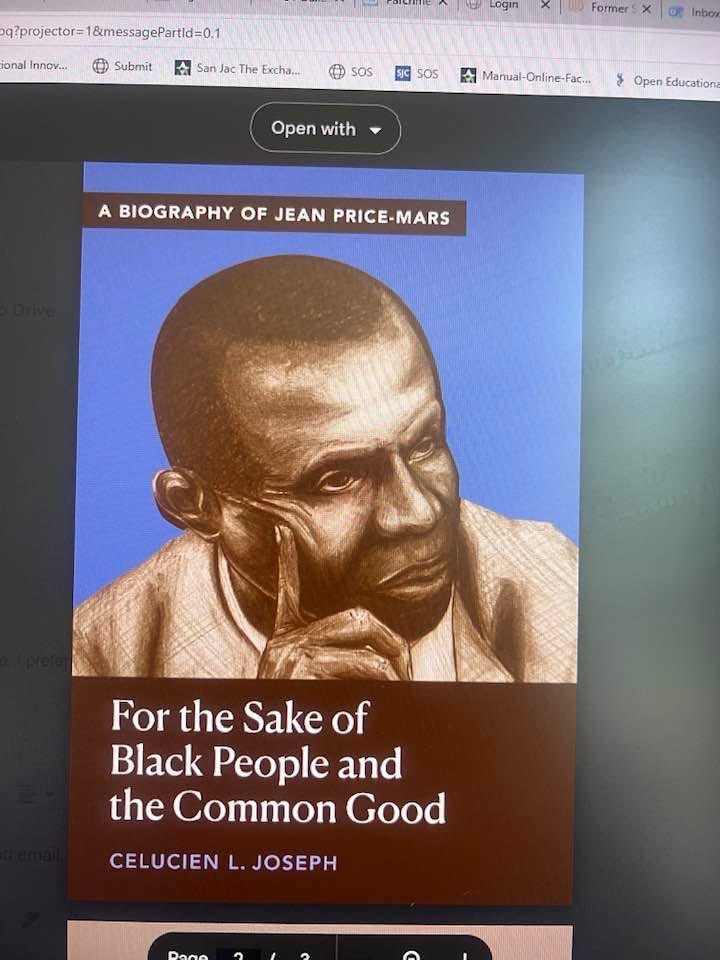
- Jean Price-Mars
- Jacques Roumain
- Jacques Stephen Alexis
- René Depestre
- Alfred Auguste Nemours
- Horace Pauleus Sannon
- Henock Trouillot
- Michel-Rolph Trouillot
- Ernst Trouillot
- Jean Fouchard
- Gérard Mentor Laurent
- Madeleine Sylvain-Bouchereau
- Suzanne Comhaire-Sylvain
- Pradel Pompilus
- Laennec Hurbon
- Fernand Hibbert
- Jean-Baptiste Cineas
- Philippe Thoby-Marcalin
- Pierre Thoby-Marcalin
- J. C. Dorsainvil
- Leon Laleau
- Catts Pressoir
- Louis Borno
- Roger Gaillard
- Normil Sylvain
- Cleante Valcin
- Suzy Castor
- Roussan Camille
- Edris Saint-Amand
- Ida Salomon Faubert
- Jacques Stephen Alexis
- Franketienne
- Jean Cassimir
- Morisseau-Leroy
- Ghislain Gouraige
- Edwidge Danticat
- Dany Laferrière
- Jean F. Brière
- Carl Brouard
- Georges Sylvain
- Felix Morisseaux
- George Anglande
- Christophe Philippe-Charles
- Anthony Phelps
- René Philoctète
- Laroche Maximilien
- Enock Trouillot
- Georges Corvington
- Gergard Barthemy
- Roger Dorsainvil
- Leslie F. Manigat
- Catts Pressoir
- Roger Gaillard
- Timoléon C. Brutus
- Damase Pierre-Louis
C. Late 20th century and early 21st century
- Patrick Bellegarde-Smith
- Danny Laferriere
- Georges Castera
- Louis Philippe Dalenbert
- Evelyn Trouillot
- Josaphat Robert Large
- Marie-Celie Agnant
- Yanick Lahens
- Jessica Fievre
- Felix Morisseaux
- Kettly Mars
- Lyonel Trouillot
- Odette Roy Fombrun
- Roussan Camille
- Jean-Bertrand Aristide
- Lemete Zephyr
- Robert Fatton
- Alex Dupuy
- . Edwidge Danticat
- Michel S. Laguerre
- Myriam J. A. Chancy
- Patrick Bellegarde-Smith
- Laennec Hurbon
- Louis-Philippe Dalembert
- Gary Victor
*** Of course, I am missing other influential thinkers in my list and may have repeated some writers twice. I wrote this post in response to a series of important articles published in the New York Times (“The Ransom: 6 Takeaways About Haiti’s Reparations to France”; “The Ransom: A Look Under the Hood”; Investigating Haiti’s ‘Double Debt”; “The Root of Haiti’s Misery: Reparations to Enslavers”). Please do not misunderstand the intent of my post! As an academic, I clearly understand academic scholarship is a teamwork that engages the labor of other scholars, for which I am thankful. I also understand academics or scholars depend on previous works done by others to further their own contribution in the field of study or advance knowledge in a particular discipline–hopefully toward the common good and human flourishing in the world. In other words, no one works in isolation, and no one can claim intellectual monopoly when it comes to academic studies, research, and epistemology. Yet we must not ignore those who are writing on the margins and work predominantly from the context of a developing country in the Global South. Their work matters! Their ideas are worth citing (in English)! Their contribution is worth acknowledging in public.
There are actually existing “traditions,” a reference to the way of thinking, intellectual practices, and of perceiving and interpreting the Haitian world and other worlds in Haitian history, and those traditions encompass various worldviews, and fields of study and different areas in the human and Haitian experience, including literary, religious, historical, political, philosophical, and ideological traditions.
It is my idea of the “Haitian canon.” In the same way, throughout the Haitian history, since its birth in 1804, there existed movements, such as labor, feminist, economic, human rights, political movements that have shaped the human experience in Haiti. Haitian writers and historians have documented their own histories and stories, experiences and living conditions, and such (literary) receipts could be traced to the country’s first piece of writing: Haiti’s Declaration of Independence (1 January 1804). In other words, Haitian writers have not been silenced about the Haitian experience in the world.

 drcelucienjoseph, "Thinking and Meditating"