She whispers into my ear, revealing love’s quiet secret: happiness lives in a smile.
She leans toward me, desiring my peace, my assurance, resting her head against my chest: waiting, breathing in slow motion, as if my heart itself must learn how to curve into joy, her delight the soft seduction of love.
I feel it rise slowly, that gentle awakening, a smile forming not just on my lips but in the quiet spaces between us, where breath meets breath and longing softens into warm embrace .
A smile, I say to her, is an eternal gesture of bliss, of desire, of memory being born in the fragile now.
A smile has a soul, she whispers. It dwells at the edge where love and happiness speak in silence, where tenderness becomes knowing, where intimacy is the quiet secret of commitment.
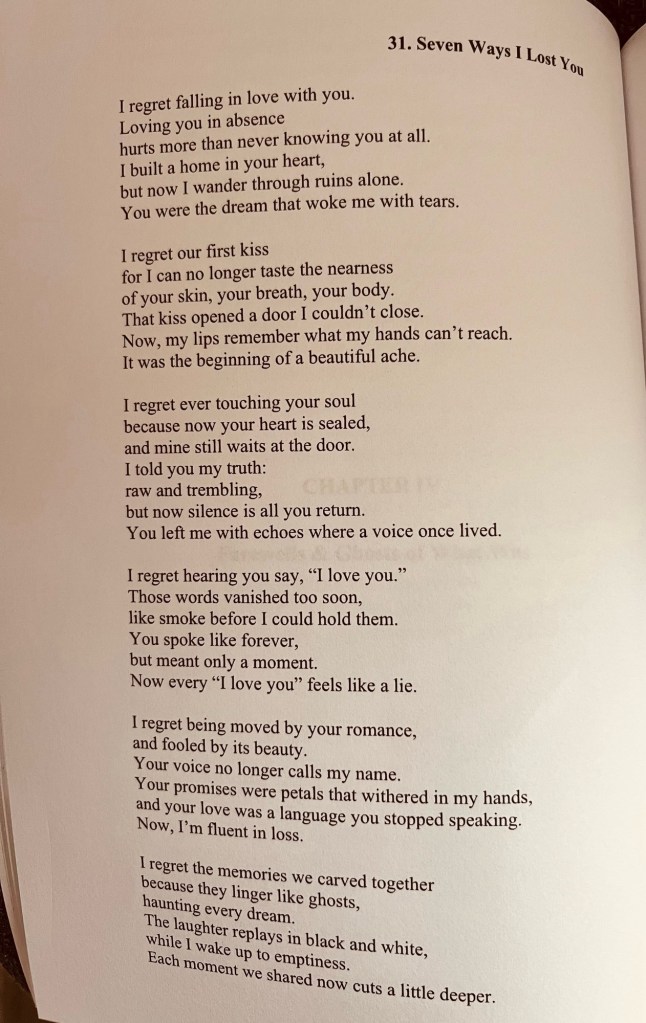
My second poem of January unfolds as a narrative of emotional exposure: raw, unguarded, and aching. It speaks to the quiet devastation of loving deeply while remaining unloved. The speaker stands as a witness to a fragile relationship he labored to nurture and protect, only to lose both the beloved and the love he poured into her.
“Notes from a Fragile Love”
I let you go because the tenderness I offered was never returned. The passion I carried became too heavy to hold alone.
When I told you I missed you, you turned away, as if longing were a foreign language you refused to learn.
When I reached out for comfort, you said, “You’re a man; deal with it.” In that moment, you taught me that vulnerability had no shelter with you. You wanted emotional connection in theory, but when it was mine, it became inconvenient.
You wanted to hold my hand in public: not for love, not for passion, but to be seen, to borrow visibility without commitment. You wanted the appearance of us, not the responsibility.
You rationed the words “I love you,” as if they were scarce. I gave them freely, infinitely, to seal your heart and mine. You wanted us hidden when it mattered, a secret folded into convenience. I wanted love that could stand in the light.
I carried your words inside me like scripture; you erased mine as if they never mattered. I remembered your heartbreak line by line, while you put on earbuds to silence mine.
I treasured your moans during lovemaking, the way your body spoke trust intimacy desire connection yet in motion, you called his name, and I learned my presence was never singular.
When I spoke of a future with you, you said you weren’t ready. When I imagined a child, a son bearing both our names.
You laughed, and my hope became a joke.
That is when I understood: I was listening with my whole soul to someone who had already tuned me out.
And that is why I let you go. Not because I stopped loving you, but because I finally loved myself enough to stop offering intimacy where it could not rest.
Drops of tender tears, fall silently on staring nights. Bed sheets hold the weight of unforgettable tears, each one a whisper of you.
Memories that once were near have become the enemy of the heart. Familial places turn into sites of alienation. Even the smiles of joy transform into moments of sadness, haunting the quiet spaces where I once felt your presence.
Yet silence seals my lips, and words die in the shadow of longing, unspoken, carried only by the tears of the night that fall on the moon.
I long to speak to you, to feel your presence near, to look at you, but silence blocks my words My heart lost its way.
I dream of you, and woke up empty. Loliness walks beside me now, the night reminds me of pain & tears: faithful, uninvited, my only companion. But it is you I wait for.
Most of us do not know how to live. Untrained in the art of the good life, we move forward by learning how to endure the circumstances that shape and constrain us.
“To live is the rarest thing in the world. Most people exist, that is all.” —Oscar Wilde
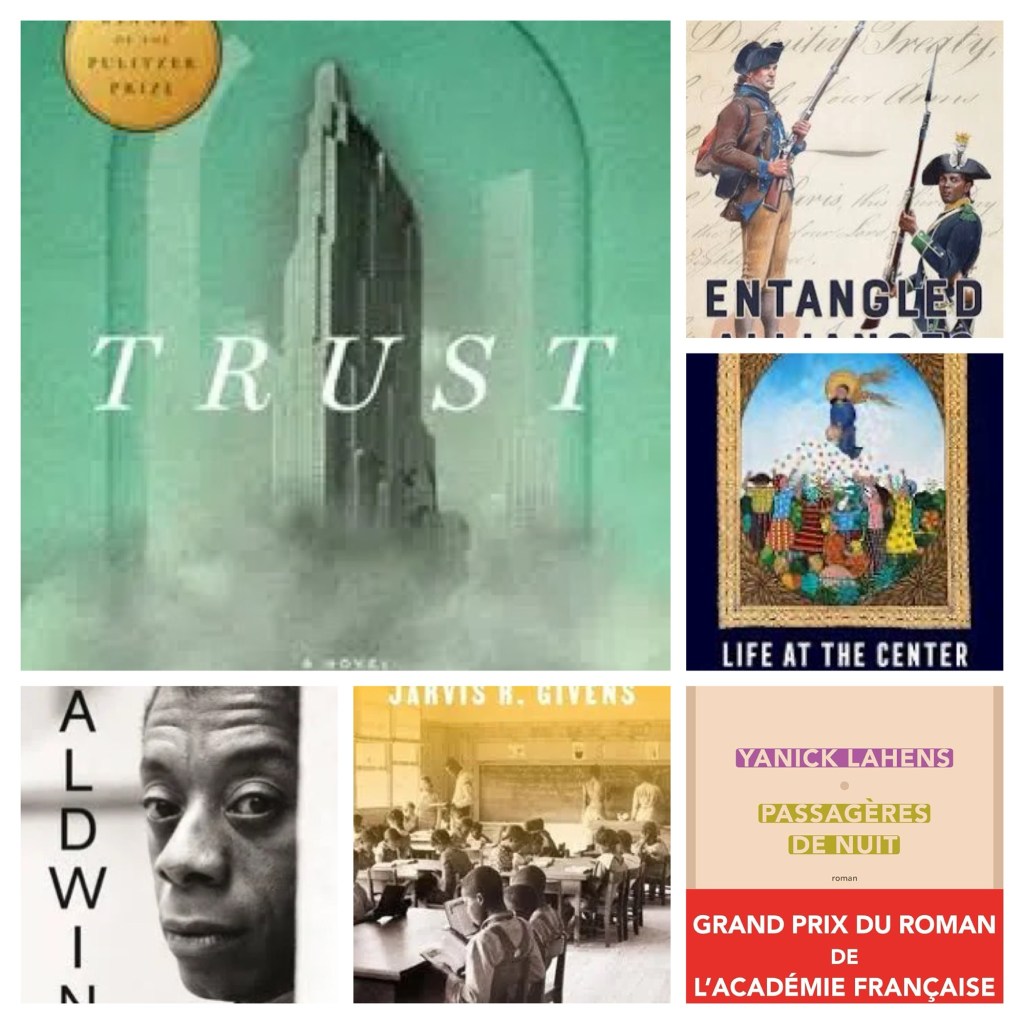
For the new year, I am going to keep my reading list reasonable. My intention is to read the following 15 books for the year; however, based on past experience, I don’t usually succeed in reading all the books in my reading list. Hey, we have to start somewhere. Don’t you agree?
What books are you reading for the new year?
“An African History of Africa: From the Dawn of Humanity to Independence”by Zeinab Badawi
“The Dawn of Everything: A New History of Humanity” by David Graeber
“Imaginer le féminisme haïtien: Enjeux théoriques et épistémologiques” by Sabine Lamour
“Baldwin: A Love Story” by Nicholas Boggs
“Black Religion in the Madhouse: Race and Psychiatry in Slavery’s Wake” by Judith Weisenfeld
“Voodoo: The History of a Racial Slur” by Danielle N. Boaz
“Yoruba Traditions and African American Religious Nationalism” by Tracey E. Huck
“Passagères de nuit” by Yanick Lahens
“The Darkened Light of Faith: Race, Democracy, and Freedom in African American Political Thought” by Melvin L. Rogers
“The Colony and the Company: Haiti after the Mississippi” by Malick W. Ghachem
“Entangled Alliances: Racialized Freedom and Atlantic Diplomacy During the American Revolution” by Ronald Angelo Johnson
“Life at the Center: Haitians and Corporate Catholicism in Boston” by Erica Caple James
“Fugitive Pedagogy: Carter G. Woodson and the Art of Black Teaching” by Jarvis R. Givens
“Ancient Christianities: The First Five Hundred Years” by Paula Fredriksen





 drcelucienjoseph, "Thinking and Meditating"