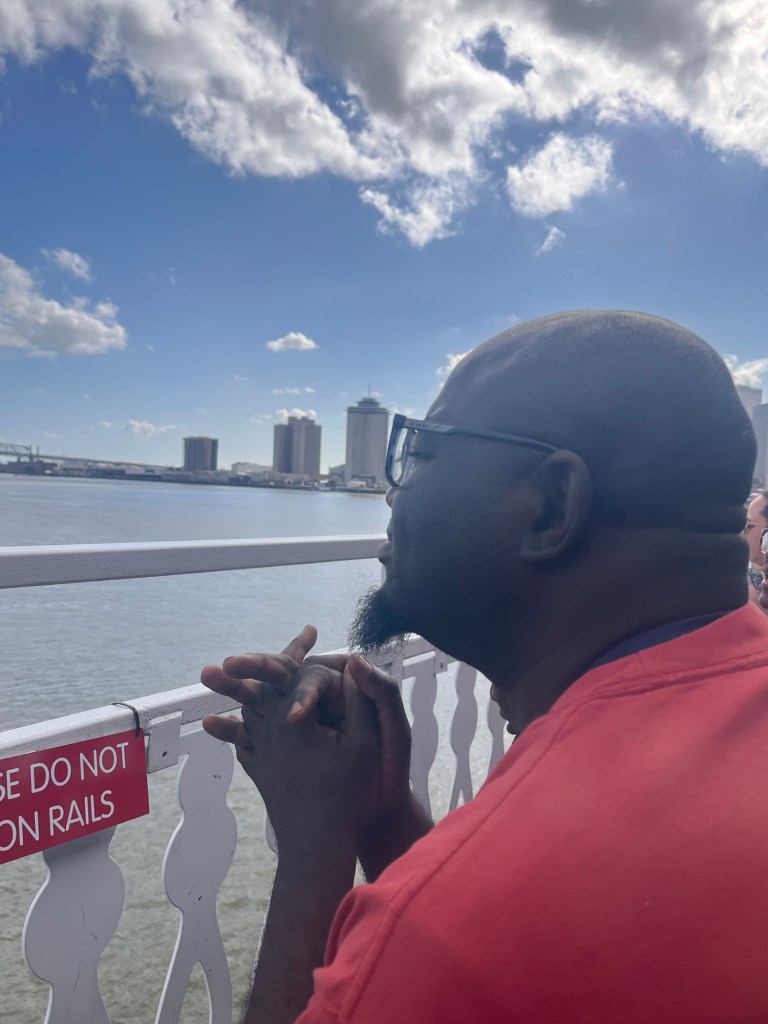
“What Life Has Taught Me at 48”
At 48 years old, life has taught me many lessons, such as clarity is more valuable than approval or recognition, and that conviction is the bedrock of one’s character. There was a time when I tried to explain myself to everyone, to be understood by all. At this age, I understand that inner peace often begins with self-assessment, and it is also where explanation ends. I also realized that being humble is an expression of inner strength and practical wisdom.
Life has taught me to center my life on what matters most: loving God, following Jesus, and loving people. These are no longer abstract ideals, but daily commitments that shape how I live, lead, think, and relate to others. They’re foundational cores to the good and fulfilled life. I have learned to love my family more intentionally, that is, to be a present and faithful father to my children, and a committed and loving husband to my wife. These roles are not secondary to my purpose; they are at the very heart of it and linked to my identity and what I am becoming.
For some critics, loving God and being a committed follower of Christ in this post-post- modern world pauses a grave threat to a life deeply committed to serious thinking, rigorous academic research, and honest writing or scholarship. Personally, I have never seen a contradiction between the two: the life of faith and the life of the mind, being a committed follower of Christ and being a serious scholar. I don’t claim to speak for every Christian thinker, but for me it is the Spirit of God who illuminates the mind towards new discovery, new knowledge, fresh interpretive reading and insight, guiding the human intellect hermeneutically to make sense of complex ideas and translating them into practical wisdom and solutions toward human transformation and understanding. True scholarship should prioritize wisdom and the common good—virtues stemmed from the work of the Spirit—and that human welfare is an essential characteristic of innovative research and transformative writing and education.
Moreover, I’ve come to value human relationships differently and to be more sensitive to the human experience and the fragility of life in this world. I confess that to be a good and supportive friend and colleague is not simply about proximity, but about presence, loyalty, and integrity. I understand that not every relationship is meant to last or endure, but every relationship has something to teach, and that every person matters. Human life is not only sacred. It deserves protection and care at all cost.
Life has also refined my understanding of the art of leadership and collaboration. It is not about titles; rather, it is about responsibility, service, and mentorship. Leadership is about how you steward trust, how you show up when it is difficult, and how you remain grounded when expectations are high. It is about how you model courage and mutuality in decision-making and coaching others. Finally, it is also how you manage people from an ethic of care and being in solidarity with others in time of need or grief.
At this stage in life, I am committed to living a moral life shaped by compassion, justice, hospitality, and kindness toward all people, especially the poor and the marginalized. I believe in serving and defending the cause of the vulnerable, and in doing what is morally right and ethically sound even when it comes at a cost. From that perspective, I have learned the importance of speaking with courage, of taking a stand for justice and for what is right. Silence is not always wisdom or disorientation. Sometimes, personal conviction requires a voice and a position. You must take a stand against the forces of darkness and the power of human cynicism!
At the same time, life has taught me the quiet strength of humility and the art of listening to others. To wrap oneself in humility is to remain teachable, to seek wisdom in all things, and to recognize that growth does not have a point of destination nor is it a straight route. It’s also to acknowledge others and recognize their equal value, knowing that they also have something meaningful to contribute to the common good and human flourishing. Hence, I am learning to live a life of conviction, integrity, and commitment, where my values and my actions are aligned with my character and what I hope to become and model for others. I don’t believe success should be measured by recognition, but by faithfulness and commitment: to my vocation/calling, to my values and principles, and to the people entrusted to my care.
I am also committed to cultivating both the intellectual life and the life of faith and understanding that true wisdom requires both reflection and devotion, intellectual commitment and praxis, and study and spiritual formation. Ideas should shape how one lives and acts in this world. I am also aware that I am morally responsible for my own ideas or the way they shaped my past and transform both my present and future. Perhaps most importantly, life has taught me that the human experience is severely fractured, but healing is possible and ongoing. I believe that an individual can be accomplished and still be becoming. Life itself continues to evolve with us and in us, and that the human experience is intrinsic to this life of transition, process, transformation, and becoming.
At 48, I am less interested in proving my worth, value, and humanity. I am more pessimistic about the future and more intentional about discovering the unknown and navigating the uncertainty. I am more committed to becoming a better human being and more grounded in my faith as an anchor and sanctuary. Above all, I seek to continue living my life to the glory of God.
 drcelucienjoseph, "Thinking and Meditating"