With the violent arrival and disruptive intrusion of Christopher Columbus and his crew on the island of Hispanola (modern-day Haiti and Dominican Republic) on December 5, 1492, the land that would become Haiti was transformed into a testing ground for three of the most destructive evil forces of the modern world: the rise of European colonization, the entrenchment of European chattel slavery, and the ascendancy of white supremacy in the Western Hemisphere. This unholy trinity marked a profound collapse of human dignity, rights, and freedom.
Paradoxically, this same island would later become the emblem and proving ground of universal emancipation, the affirmation of human rights and human dignity, and the abolition of slavery and European colonial domination in the modern world—a radical achievement realized in what historians appropriately call the Haitian Revolution of 1804.
Haiti is important in modern history because it produced the first successful slave revolution, became the second independent republic in the Western Hemisphere and the first Black republic in the world, catalyzed global abolition movements, embodied anti-colonial resistance, challenged white supremacy, advanced a foundational vision of human rights, and exposed the long-term consequences of colonial punishment and racial capitalism.
Joshua Barron provides a balanced, critical, and careful assessment of my book, “Theological Education and Christian Scholarship for Human Flourishing: Hermeneutics, Knowledge, and Multiculturalism (Pickwick Publications, 2022). The review was published in the Religious Studies Review, Volume 51: Number 3 (September 2025): 834-835. I am grateful for his review.
THEOLOGICAL EDUCATION AND CHRISTIAN SCHOLARSHIP FOR HUMAN FLOURISHING: HERMENEUTICS, KNOWLEDGE, AND MULTICULTURALISM. By Celucien L. Joseph. Eugene, Oregon: Pickwick Publications, 2022. Pp. xlv + 310. $45.00/£36.00, paperback; $65.00 / £52.00, hardback.
Celucien L. Joseph, a Haitian- American literature professor and theologian, is an erudite scholar—his degrees include an MDiv, an MTh in NT, an MA in French literature, a PhD in literary studies, and a second PhD in Systematic Theology and Christian Ethics—and a prolific writer who has the gift of a storyteller. He is passionate about teaching and about education that moves beyond the transfer of knowledge from teacher to student, seeking instead formation and transformation of his students. In this book, he tells part of his own story with the instincts of a prophet. His MDiv is from the Southern Baptist Theological Seminary, and his MTh is from Southwestern Baptist Theological Seminary. In his seminary experience, he found that theological education and Christian scholarship were often divorced from concerns with human flourishing. In this book, he offers rather sharp critiques of traditional Southern Baptist (SBC) theological pedagogy. He does so, however, from the point of view of an insider and with love and compassion, proposing an alternative way forward. Of course, many Western institutions embrace similar pedagogies and so his reflections and proposals are broadly applicable.
Traditional Western theological education, Joseph observes, typically ignores the contexts and questions of those “who live on the margins of society.” As an immigrant of non-Anglo-Saxon ethnocultural heritage, he writes, “I started to notice that the theological education I was receiving was not culturally contextualized to respond to the various pressing needs of the people in my community. It was not contributing to human flourishing and the common good of the individuals whose history and experience have been left out in the dominant theological conversations and in the theological curriculum.” Joseph laments that the pedagogy he experienced as a seminary student was simply the transactional depositing of knowledge into the students’ brains; long decades after Freire’s publication of Pedagogy of the Oppressed, what Freire calls the banking model continues to be the reigning model of theological pedagogy. Instead of this, Joseph insists that “human flourishing should be integral to theological education and Christian scholarship, and a Christocentric theological education will contribute to the common good and the democratic life.”
This book may be uncomfortable for some light- skinned Euro- Americans to read, as it can be hard for us to acknowledge—or even to see—that the theology of “certain Evangelical theologians and Christian educators … is written from a position of privilege and power. American- centric Evangelical theology is the embodiment of the peculiar world, white values, and the white worldview; it deliberately excludes alternative worldviews, perspectives, and values that challenge its content, structure, message, and the American- centric piety it proclaims.” Writing both in and to a North American context, Joseph offers fair critiques of the political indoctrination that can take place in conservative educational institutions—although perhaps gentler critiques than I would offer—but does not reference similar patterns of indoctrination in left-leaning institutions. This can be excused, however, because he is writing from the inside: both as a graduate of such institutions and primarily addressing such institutions. In addition, he does elsewhere critique “the pitfalls of identity politics,” which is a plague on all sides of the political spectrum.
Joseph’s positive recommendations outweigh his critiques. Though Joseph does not engage with Andrew F. Walls, he offers practical suggestions to implement the practice of reconciliation and integration of Wallsian Ephesian Moments. Lamenting that “theological tribalism in theological education and Christian formation causes alienation and defers the possibility for friendship and to embrace difference,” he acknowledges that in its best- known manifestations, “American Evangelicalism has never articulated a robust political theology of social justice and of divine sovereignty that prioritized the Kingdom of God above the Kingdom of America.” He offers practical steps that theological educators and administrators can take to amend these lacks (see the book for details). Those steps are built on a challenge to current underlying pedagogical theory, as he calls theological instructors and schools to “shift their epistemological paradigm and hermeneutical practices to construct a transformative theological curriculum anchored in community knowledge and experience.”
Joseph’s conviction that “the chief end of theological education” is “thinking and living Christianly,” in the context of robust human flourishing, resonates with the insistence of Andrew F. Walls that “theology does not arise from the study or the library even if it can be prosecuted there. It arises from Christian life and activity, from the need to make Christian choices, to think in a Christian way” (Crossing Cultural Frontiers: Studies in the History of World Christianity. Maryknoll, NY: Orbis Books, 2017, 74). This “thinking and living Christianly” is necessarily culturally bound: What works in Western contexts might well “be inadequate, incomplete, and even irrelevant” in various non- Western contexts. Thus Joseph offers a clarion call to decolonize and dewesternize the enterprises of “the theological curriculum and Christian production of knowledge.”
Joseph’s lengthy introduction, a detailed call to rethinking theological education, is worth the book’s price. He then explores fruitful ways to cultivate “the Life of Faith and the Life of the Mind” together with “Our Shared Humanity,” in effect bridging together Tertullian’s fides quaerens intellectum (‘faith seeking understanding’), so important to the Western intellectual tradition, and the African emphasis on ubuntu. He challenges theological, ethnocultural, and ideological tribalisms, offering healthier (and more biblical) ways forward. While biblical and theological literacy are important, Joseph makes the case that theological knowledge should not end with such literacy but should also be transformative—of both individuals and communities. In his conclusion, he returns to the theme of human flourishing to propose “A hermeneutic of Trust and a Pedagogy of Hope.” Finally, in several appendices, Joseph offers sample syllabi that aim to put his ideas into practice.
There is little to critique in this book. Because Joseph is specifically concerned with calling for reformation of theological pedagogy in the SBC institutions where he was trained, there is a large section of the book that is so particular to the SBC that it might be less applicable for other contexts. When discussing “the dual project of Christianization and colonization,” Joseph hints at a conflation of conversion and proselytization. Historically (and even currently), there certainly has been such a conflation, but it is crucial to note that Joseph’s valid critiques against mainstream (whether “conservative” or “liberal”) Western theological education are ultimately a critique of the practice of proselytization.
This book should be required reading for everyone involved in theological education. University and seminary librarians: Please add Theological Education and Christian Scholarship for Human Flourishing to your collections. While I hope that Joseph’s SBC American colleagues will take his proposals to heart, I also heartily recommend this book to my own colleagues in theological institutions across Africa.
Joshua Robert Barron Association for Christian Theological Education in Africa
“Ten Lessons from a Temporary World or The Illusion of Permanence”
I’ve been up since 3:00 a.m. My mind has been wandering, it seemed, without a place to rest itself. I couldn’t go back to sleep. As my mind was processing many things and ideas simultaneously, reflecting on the “uncertainty” of “all” things, and the “uncertainty” of life itself, I wrote the following ten propositions that are critical of the human (our) quest and desparation for permanence, stability, and coherence in this changing world.
Perhaps, one of the most honest truths about life itself is “the reality of impermanence,” and the human (our) quest for eternity—core elements of the human condition, relationships, and experience in this world—in a fleeting world.
“Lessons from a Temporary World or The Illusion of Permanence”
Sexual or physical pleasure is a temporary joy. It is a brief flame, flickering, and vanishing with time.
Life in this world is a temporary experience, a passing moment wrapped in years.
Children born from your body will grow, depart, and walk paths without you.
Your memories of loved ones will fade and ultimately depart when you die.
The career or education you devoted years to will one day no longer be accessible to you as age weakens the body and silences (human) strength.
Material things, once treasured, such as a beautiful house, an expensive car, a prized watch, will one day rust, lose their value, and eventually decline.
The body you build and discipline through regular exercise and dietary contol remains vulnerable to strain, sickness, and death.
Marriage is not guaranteed to be permanent; a spouse may leave or die by illness or natural cause.
Happiness and joy, though deeply sought, offer only a fleeting sense of delight in this world. They can only be experienced once in a lifetime, but do not remain.
The pursuit of freedom and safety holds meaning only while we live; death reframes their existential purpose.
The night is beautiful, like your smile. Yet even its darkness cannot rival the light of your heart.
Tonight is silent because you are not here. The shadows grow bolder in the distance of your love.
Come near. Draw closer. So you and I may share the joy of the moon tonight.
Come nearer, not in body
but in becoming.
Let our silence touch,
so the moon may confess
what it has been hiding
from the world.
*As I was doing my nightly jogging/walk tonight, I was starring at the beautiful moon and the stillness of the waters, I stopped and took a deep breath and wrote the words of this poem.
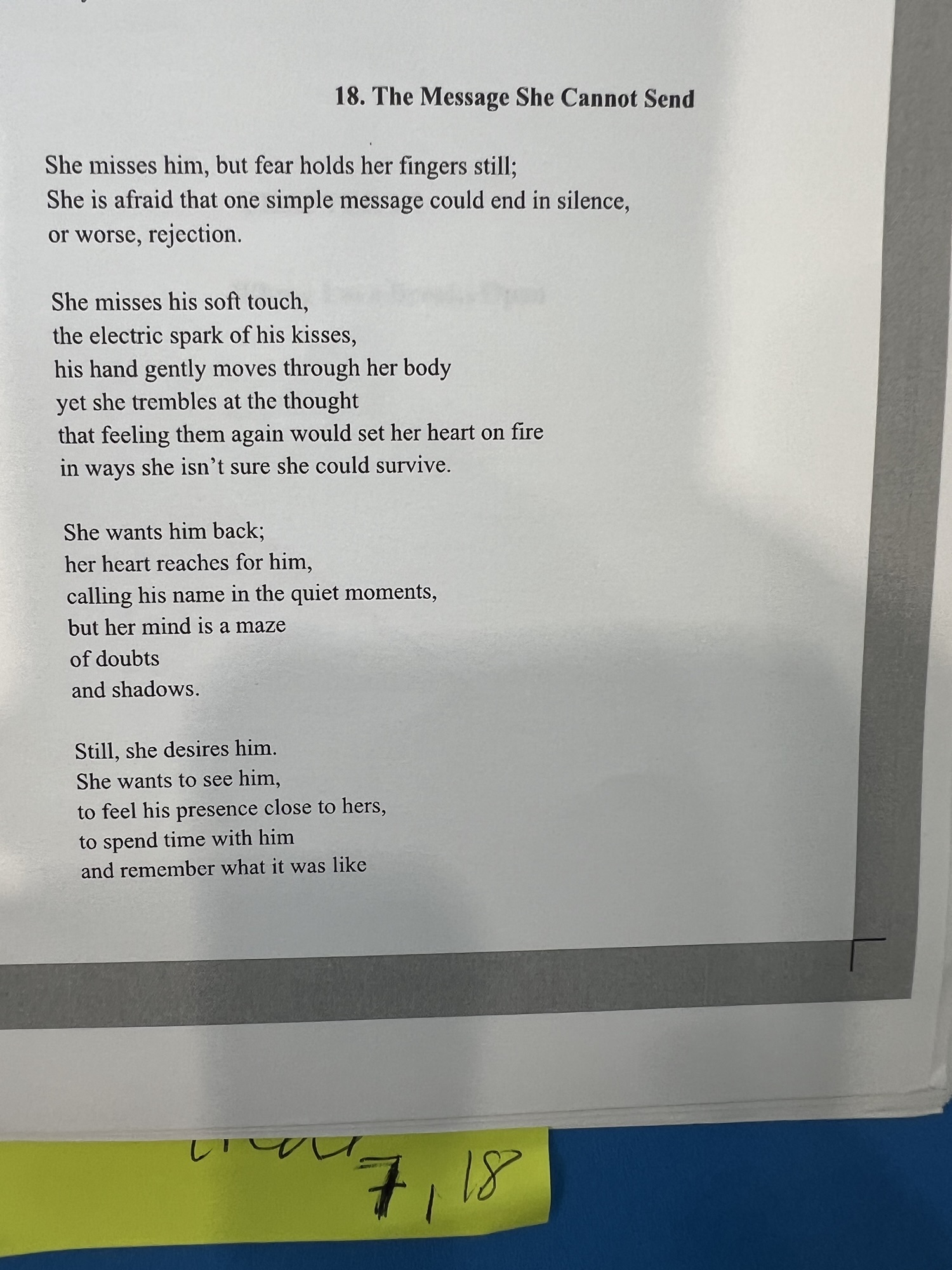
She enters his life not to love, but to wound, to misuse his heart, to teach him the ache of regret.
He gives everything: his loyalty, his strength, his sacrifice, loving without conditions, without limits.
Yet in return for devotion, he receives betrayal. In place of gratitude, he meets only disrespect. His kindness, once offered as a gift, is mistaken for weakness.
Slowly, trust fades. Love turns cold, not because it was ever false, but because it was broken in careless hands.
Now he stands, unsure whether his heart will ever dare to love again.











 drcelucienjoseph, "Thinking and Meditating"