“The Moral Crisis at the Heart of the Nation”

“The Moral Crisis at the Heart of the Nation”

If there is one significant and deeply practical virtue this country is lacking, it is empathy. Closely behind it are compassion, hospitality, and kindness. The soul of this nation is wounded, hardened by fear, division, and indifference to suffering. As a people, we cannot continue living as though cruelty and xenophobia are strengths or silence is neutrality. A society that loses its capacity to feel the pain of others ultimately loses its humanity, and no nation on earth can survive that loss unscathed. We are not the exception!

As a nation, we cannot continue living as if policies can replace conscience or power can substitute for human care and dignity. Without a renewed ethical commitment to one another and to the stranger and the most vulnerable in our midst, democracy itself becomes hollow and human virtues become a thing of the past. Healing will require us to slow down, listen deeply, and recover the courage to care again.

Finally, we must remember that what is declared legal by human courts is not always just in the sight of God. Law may permit what conscience forbids, and judicial decisions may comply with statutes while violating the deeper demands of love, mercy, and empathy. True justice is measured not only by legality, but by how well it honors the sacred dignity of every man and woman, every boy and girl, of every race and nation, and by how faithfully it protects the vulnerable among us and to act with compassion.

“The Paradox of Heroism in the Modern World”

“The Paradox of Heroism in the Modern World”

Heroism is not defined by one’s religion, nationality, or race. Heroes and sheroes take many forms: a Muslim teacher, a Hindu mechanic, a Christian basketball coach, or a Vodou physician. At its best, heroism is expressed through deliberate acts of kindness and empathy, a commitment to human dignity and development, and the consistent courage to challenge the existing order and transform unjust social systems and practices.

In this sense, heroes inspire others to become their best, to stretch boundaries, and to recognize sacrifice in service of the common good and human flourishing. They do not act for glory or self-interest; rather, they are driven by a passion to help people flourish and to contribute to the improvement of the human condition and the shared human experience.

Yet heroism, as it functions in global history and public memory, does not always align with such moral or ethical commitments toward life, politics, diplomatic relations, social issues, etc. Heroes are often produced by events, circumstances, and social narratives rather than by a consistent posture toward justice and human rights for all people. One may be celebrated as a hero by one’s people, race, or tribe, while simultaneously being viewed as a villain or enemy by another. Some are elevated because they resist oppression and confront unjust treatment of others; paradoxically, other individuals are made heroes for the very opposite reasons: using power and influence to oppress, to inflict suffering on marginalized communities, or to exploit the underrepresented in order to preserve privilege, dominance, and honor for their own group.

Laënnec Hurbon on the Role of Vodou in the Haitian Revolution

Laënnec Hurbon on the Role of Vodou in the Haitian Revolution

“Quelques malentendus sur le vodou et son rôle dans la
révolution haïtienne doivent être sinon levés, du moins éclaircis.
Toute une frange d’intellectuels appartenant au courant littéraire dit indigéniste des années 1940 a tendance à croire que le vodou a fait la révolution de 1791-1804, comme si les idéaux de la révolution française n’avaient eu aucune influence sur les esclaves. Certes, bien des mesures ont été très tôt prises pour empêcher que soient distribués à Saint-Domingue les journaux et pamphlets apportant des nouvelles de la révolution en France. Mais comment pouvait-on contrer cette influence puisque et les petits blancs et les libres de couleur revendiquaient sur la base même de la déclaration de 1789 ? D’un autre côté, l’insurrection n’a pas été une guerre religieuse contre les colons : elle a plutôt fourni un imaginaire qui a pu renforcer les capacités de lutte et le sentiment de solidarité entre insurgés. Il faut également signaler que de nombreux prêtres eurent à soutenir explicitement l’insurrection, dont le Père Cachetan, curé de Petite-Anse, et le père Philémon, curé du Limbé. D’autres encore ont agi en
négociateurs entre insurgés et colons. Il est révélateur que, capturé,Boukman, qui mena la révolte d’août, subit le même sort que le père Philémon : tous deux eurent au même moment la tête tranchée et exposée sur un pic sur la place d’armes du Cap. C’est dire que les influences ont été diverses. Avant tout, rappelons que la conscience des droits naturels chez les esclaves a été très forte car c’est elle qui les a mis en situation de révoltes régulières et poussés à la création d’une culture nouvelle, celle du vodou comme monde propre différencié de celui des maîtres. Par ailleurs, la franc-maçonnerie, présente notamment parmi les affranchis noirs et mulâtres, semble avoir eu une certaine influence dans le mouvement de révolte….

En revanche, même s’il est difficile d’établir en toute rigueur les faits (des divergences existent dans les récits sur les dates et parfois sur les lieux précis), force est de reconnaître que l’insurrection ne pouvait être menée en dehors de tout rapport au vodou…Le vodou a pu effectivement renforcer le courage des
insurgés en 1791 et des soldats dans leur combat pour l’indépendance en 1804. On peut dire que tandis que la révolution française s’enferme dans un universel abstrait des droits de l’homme (les Noirs et les femmes étant encore à cette époque maintenus exclus de ces droits, symptôme de l’ambiguïté des Lumières du dix-huitième siècle face à l’esclavage), on assiste à Saint-Domingue au travail de l’universel concret des droits de l’homme, c’est-à-dire à la mise en pratique effective de l’universalisme des droits de l’homme, en quoi apparaît l’originalité de la révolution haïtienne dans l’histoire universelle.”
–Laënnec Hurbon, “Le vodou et la révolution haïtienne” (2018)

English translation

” Some misunderstandings about Vodou and its role in the Haitian Revolution must, if not fully dispelled, at least be clarified. A whole segment of intellectuals belonging to the so-called indigéniste literary movement of the 1940s tends to believe that Vodou made the revolution of 1791–1804, as if the ideals of the French Revolution had had no influence on the enslaved population. Certainly, many measures were taken very early on to prevent newspapers and pamphlets bringing news of the revolution in France from being distributed in Saint-Domingue. But how could this influence have been countered, given that both the petits blancs and free people of color were making claims on the very basis of the Declaration of 1789?

On the other hand, the insurrection was not a religious war against the colonists; rather, Vodou provided an imaginative framework that could strengthen the capacity for struggle and the sense of solidarity among the insurgents. It should also be noted that many priests explicitly supported the insurrection, among them Father Cachetan, parish priest of Petite-Anse, and Father Philémon, parish priest of Limbé. Others acted as negotiators between insurgents and colonists. It is revealing that when captured, Boukman, who led the August revolt, suffered the same fate as Father Philémon: both had their heads severed at the same time and displayed on a pike in the main square of Cap-Haïtien. This shows that the influences at work were diverse.

Above all, it should be recalled that the enslaved had a very strong consciousness of natural rights, for it was this awareness that placed them in a situation of repeated revolts and pushed them toward the creation of a new culture—Vodou—as a distinct world, differentiated from that of the masters. Moreover, Freemasonry, present in particular among freed Blacks and mulattoes, seems to have had a certain influence on the movement of revolt.

By contrast, even if it is difficult to establish the facts with complete rigor (there are divergences in the accounts concerning dates and sometimes precise locations), it must be acknowledged that the insurrection could not have been carried out without some relationship to Vodou. Vodou did indeed strengthen the courage of the insurgents in 1791 and of the soldiers in their struggle for independence in 1804.
One may say that while the French Revolution locked itself into an abstract universalism of the rights of man (with Blacks and women still excluded from these rights at that time—a symptom of the ambiguity of the Enlightenment in the eighteenth century with regard to slavery), in Saint-Domingue we witness the working out of a concrete universalism of the rights of man—that is, the effective practical realization of the universalism of human rights. In this lies the originality of the Haitian Revolution in universal history.”
–Laënnec Hurbon, “Le vodou et la révolution haïtienne” (2018)

“Honoring Laënnec Hurbon at 85”

“Honoring Laënnec Hurbon at 85”

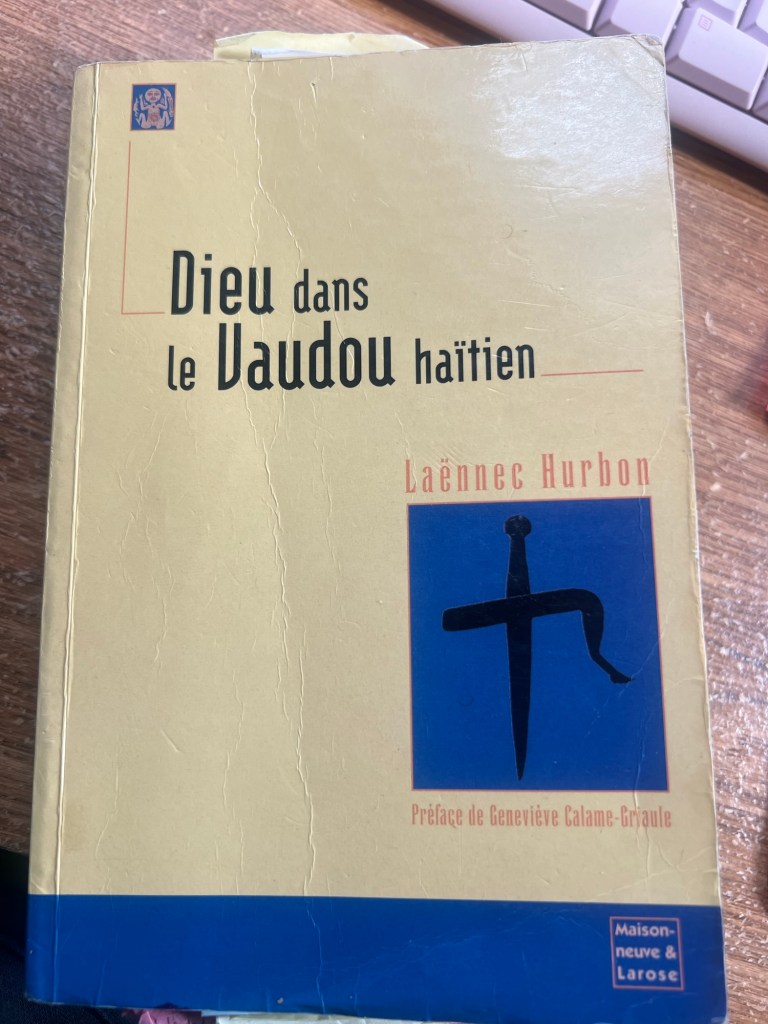
The most important and epoch-making monograph, “Dieu dans le Vaudou haïtien” (God in Haitian Vodou) on the function and idea of God in Haitian Vodou was published by Laënnec Hurbon—a brilliant Haitian theologian, interdisciplinary scholar, public intellectual, and sociologist— in 1972. This book stands as a classic in the field and is the first scholarly and rigorous theological assessment about God in Vodou, as practiced by the Haitian people. It’s a book that demonstrates the author’s theological originality, intellectual rigor, and cultural sensitivity. It’s probably the first book written from a decolonial-before la lettre—theological framework and perspective on God in Vodou. In other words, Hurbon employs decoloniality both as epistemology and method to theologize about God in the Vodou tradition. He engages all the major scholarship of that period, including prominent scholars and historians of comparative religion, ethnologists of African traditional religion and African diaspora religions, and Protestant (Protestant and Catholic) theologians.

To my knowledge, there are no contemporary studies or there have been any significant monographs that study God theologically in Haitian Vodou—after the publication of “God in Haitian Vodou” in 1972. All the major contemporary studies on Vodou focus on the historical, anthropological, sociological, cultural, and visual aspects of the religion. I should also mention the increasingly-focus on gender studies in Vodou. This year, Dr. Hurbon just released a new book on the role of women in Vodou. He has been criticized by scholars for not engaging women in his tour-de force book, “Dieu dans le Vodou haïtien.”

Professor Hurbon is now 85 years old. He is still writing, supervising doctorsl students at universities in France, Haiti, and other countries. A former Catholic priest, he is probably the most cited contemporary Haitian scholar in the world. In 2016, I was contacted by an editor to publish a biographical assessment about his work for “The Dictionary of Caribbean and Afro-Latin American Biography, edited by Henry Louis Gates Jr, published in 2017 by Oxford University. In subsequent years, I published two major articles about his writing and ideas.

Since 2016, I have been wanting to go back to Hurbon to engage his theological ideas, especially his concept of God in the book mentioned above. Several years ago, I wrote a draft article on the subject matter; now, I decided to go back to Hurbon. I tentatively title the article “Laënnec Hurbon and Re-Theologizing God in Haitian Vodou,” and I hope to send it to a journal during the first half of the new year 2026. When the arricle is published, Professor Hurbon will turn 86 years old.

Let’s celebrate Professor Laënnec Hurbon for his extraordinary scholarship and contributions to interdisciplinary scholarship and Haitian Studies.

“Advent in the Age of Broken Borders and the so-called ‘Christian Nation’”

“Advent in the Age of Broken Borders and the so-called ‘Christian Nation’”

In this Advent season, we long for light in a world heavy with shadows, in the age of broken borders, and in era of social and political injustices toward the most vulnerable groups in society, especially immigrant families.

Advent is the story of a God who steps into human history, and this God-Man in the person of the Jewish Palestinian Jesus, the adopted son of a poor Jewish carpenter (Joseph) and the biological son of a poor Jewish peasant (Mary), experienced the uncertainty of a broken world and the vulnerability of human condition in his milieu. This God, who became a “human being,” an immigrant on earth in the land of Egypt, did not disrupt the country of his birth with the power of empire but with the vulnerability of a child so that the poor, the immigrant, and the disfranchised may hear good news, the oppressed may rise, and the broken may be restored.

Yet we come to this season with honest questions: How can we sing “Joy to the World” while immigrant families weep in our communities and cities, as well as at our borders?

How can we celebrate the birth of the Prince of Peace while the homeless and the vulnerable do not have a place to rest their heads and foods to put on their tables?

How can we light candles of hope when children of God are being detained, deported, and dehumanized?

How can we proclaim peace in a nation that calls itself Christian, yet turns its back on the stranger and the undocumented Christ commands us to welcome?

Further, Advent invites us to face these tensions with truth, love, and compassion. For the Christ we await is the Christ who confronts the cruelty of political powers, who identifies Himself with the refugee, the oppressed, and the displaced. The birth of Jesus is not a sentimental escape; it is God’s uprising against systems of darkness and structures of human oppressionand degradation. As we enter this Advent meditation, we dare to believe that Christ still comes among the vulnerable, still calls the powerful to account, and still summons his people to practice radical hospitality, courageous compassion, and justice that mirrors his kingdom and the Jesus’ Way.

Advent reminds us that your country of origin does not determine your destiny or your worth. No birthplace makes one person more human than another. It reinforces the fundamental belief that every human being carries equal value, regardless of country or origin.

Advent is not merely a season of waiting. It is a season of awakening, a moment to express radical compassion and love, and a reflective season to defend the weak and advocate for the most vulnerable people in our communities, cities, and states. Advent is about God’s radical freedom and grace, human liberation from all forms of oppression, and it reminds us about our shared humanity and responsibility towards all God’s children, especially the refugees, the immigrants, and the undocumented.

“Why Haiti Is Important in Modern History”

“Why Haiti Is Important in Modern History”

With the violent arrival and disruptive intrusion of Christopher Columbus and his crew on the island of Hispanola (modern-day Haiti and Dominican Republic) on December 5, 1492, the land that would become Haiti was transformed into a testing ground for three of the most destructive evil forces of the modern world: the rise of European colonization, the entrenchment of European chattel slavery, and the ascendancy of white supremacy in the Western Hemisphere. This unholy trinity marked a profound collapse of human dignity, rights, and freedom.

Paradoxically, this same island would later become the emblem and proving ground of universal emancipation, the affirmation of human rights and human dignity, and the abolition of slavery and European colonial domination in the modern world—a radical achievement realized in what historians appropriately call the Haitian Revolution of 1804.

Haiti is important in modern history because it produced the first successful slave revolution, became the second independent republic in the Western Hemisphere and the first Black republic in the world, catalyzed global abolition movements, embodied anti-colonial resistance, challenged white supremacy, advanced a foundational vision of human rights, and exposed the long-term consequences of colonial punishment and racial capitalism.

Review of my book “Theological Education and Christian Scholarship for Human Flourishing”

Joshua Barron provides a balanced, critical, and careful assessment of my book, “Theological Education and Christian Scholarship for Human Flourishing: Hermeneutics, Knowledge, and Multiculturalism (Pickwick Publications, 2022). The review was published in the Religious Studies Review, Volume 51: Number 3 (September 2025): 834-835. I am grateful for his review.

THEOLOGICAL EDUCATION AND CHRISTIAN SCHOLARSHIP FOR HUMAN FLOURISHING: HERMENEUTICS, KNOWLEDGE, AND MULTICULTURALISM. By Celucien L. Joseph. Eugene, Oregon: Pickwick Publications, 2022. Pp. xlv + 310. $45.00/£36.00, paperback; $65.00 / £52.00, hardback.

Celucien L. Joseph, a Haitian-­ American literature professor and theologian, is an erudite scholar—his degrees include an MDiv, an MTh in NT, an MA in French literature, a PhD in literary studies, and a second PhD in Systematic Theology and Christian Ethics—and a prolific writer who has the gift of a storyteller. He is passionate about teaching and about education that moves beyond the transfer of knowledge from teacher to student, seeking instead formation and transformation of his students. In this book, he tells part of his own story with the instincts of a prophet. His MDiv is from the Southern Baptist Theological Seminary, and his MTh is from Southwestern Baptist Theological Seminary. In his seminary experience, he found that theological education and Christian scholarship were often divorced from concerns with human flourishing. In this book, he offers rather sharp critiques of traditional Southern Baptist (SBC) theological pedagogy. He does so, however, from the point of view of an insider and with love and compassion, proposing an alternative way forward. Of course, many Western institutions embrace similar pedagogies and so his reflections and proposals are broadly applicable.

Traditional Western theological education, Joseph observes, typically ignores the contexts and questions of those “who live on the margins of society.” As an immigrant of non-Anglo-­Saxon ethnocultural heritage, he writes, “I started to notice that the theological education I was receiving was not culturally contextualized to respond to the various pressing needs of the people in my community. It was not contributing to human flourishing and the common good of the individuals whose history and experience have been left out in the dominant theological conversations and in the theological curriculum.” Joseph laments that the pedagogy he experienced as a seminary student was simply the transactional depositing of knowledge into the students’ brains; long decades after Freire’s publication of Pedagogy of the Oppressed, what Freire calls the banking model continues to be the reigning model of theological pedagogy. Instead of this, Joseph insists that “human flourishing should be integral to theological education and Christian scholarship, and a Christocentric theological education will contribute to the common good and the democratic life.”

This book may be uncomfortable for some light-­ skinned Euro-­ Americans to read, as it can be hard for us to acknowledge—or even to see—that the theology of “certain Evangelical theologians and Christian educators … is written from a position of privilege and power. American-­ centric Evangelical theology is the embodiment of the peculiar world, white values, and the white worldview; it deliberately excludes alternative worldviews, perspectives, and values that challenge its content, structure, message, and the American-­ centric piety it proclaims.” Writing both in and to a North American context, Joseph offers fair critiques of the political indoctrination that can take place in conservative educational institutions—although perhaps gentler critiques than I would offer—but does not reference similar patterns of indoctrination in left-­leaning institutions. This can be excused, however, because he is writing from the inside: both as a graduate of such institutions and primarily addressing such institutions. In addition, he does elsewhere critique “the pitfalls of identity politics,” which is a plague on all sides of the political spectrum.

Joseph’s positive recommendations outweigh his critiques. Though Joseph does not engage with Andrew F. Walls, he offers practical suggestions to implement the practice of reconciliation and integration of Wallsian Ephesian Moments.
Lamenting that “theological tribalism in theological education and Christian formation causes alienation and defers the possibility for friendship and to embrace difference,” he acknowledges that in its best-­ known manifestations, “American Evangelicalism has never articulated a robust political theology of social justice and of divine sovereignty that prioritized the Kingdom of God above the Kingdom of America.” He offers practical steps that theological educators and administrators can take to amend these lacks (see the book for details). Those steps are built on a challenge to current underlying pedagogical theory, as he calls theological instructors and schools to “shift their epistemological paradigm and hermeneutical practices to construct a transformative theological curriculum anchored in community knowledge and experience.”

Joseph’s conviction that “the chief end of theological education” is “thinking and living Christianly,” in the context of robust human flourishing, resonates with the insistence of Andrew F. Walls that “theology does not arise from the study or the library even if it can be prosecuted there. It arises from Christian life and activity, from the need to make Christian choices, to think in a Christian way” (Crossing Cultural Frontiers: Studies in the History of World Christianity. Maryknoll, NY: Orbis Books, 2017, 74). This “thinking and living Christianly” is necessarily culturally bound: What works in Western contexts might well “be inadequate, incomplete, and even irrelevant” in various non-­ Western contexts. Thus Joseph offers a clarion call to decolonize and dewesternize the enterprises of “the theological curriculum and Christian production of knowledge.”

Joseph’s lengthy introduction, a detailed call to rethinking theological education, is worth the book’s price. He then explores fruitful ways to cultivate “the Life of Faith and the Life of the Mind” together with “Our Shared Humanity,” in effect bridging together Tertullian’s fides quaerens intellectum (‘faith seeking understanding’), so important to the Western intellectual tradition, and the African emphasis on ubuntu. He challenges theological, ethnocultural, and ideological tribalisms, offering healthier (and more biblical) ways forward. While biblical and theological literacy are important, Joseph makes the case that theological knowledge should not end with such literacy but should also be transformative—of both individuals and communities. In his conclusion, he returns to the theme of human flourishing to propose “A hermeneutic of Trust and a Pedagogy of Hope.” Finally, in several appendices, Joseph offers sample syllabi that aim to put his ideas into practice.

There is little to critique in this book. Because Joseph is specifically concerned with calling for reformation of theological pedagogy in the SBC institutions where he was trained, there is a large section of the book that is so particular to the SBC that it might be less applicable for other contexts. When discussing “the dual project of Christianization and colonization,” Joseph hints at a conflation of conversion and proselytization. Historically (and even currently), there certainly has been such a conflation, but it is crucial to note that Joseph’s valid critiques against mainstream (whether “conservative” or “liberal”) Western theological education are ultimately a critique of the practice of proselytization.

This book should be required reading for everyone involved in theological education. University and seminary librarians: Please add Theological Education and Christian Scholarship for Human Flourishing to your collections. While I hope that Joseph’s SBC American colleagues will take his proposals to heart, I also heartily recommend this book to my own colleagues in theological institutions across Africa.

Joshua Robert Barron
Association for Christian Theological Education in Africa