I am currently working on an article that offers a critical analysis of Dézafi (1975), the first novel written in Haitian Kreyòl by Nobel Prize nominee and literary icon Frankétienne. This essay examines the production of moral evil as constructed violence within the twin settings of the novel, the villages of Ravin Sèch and Bouanèf.
While many critics have interpreted Dézafi as “a potent commentary on a country haunted by a history of slavery” or as an allegory for the zombification of the Haitian people under the Duvalier regime, my analysis challenges these dominant readings. Instead, I argue for a twofold approach: first, that the concept of zombi/zombification in the novel should be read “at face value,” without allegorical or metaphorical interpretation; and second, that Dézafi serves as Frankétienne’s critical assessment of zombification as a form of moral evil and constructed violence within Haitian Vodou. To support this argument, I explore the novel’s reliance on Haitian oral traditions—particularly proverbs and witty (and “pithy”) sayings—which function as moral frameworks for evaluating religious sensibilities, beliefs, social relations, and human behavior.
The tentative title of the article is “Moral Evil as Constructed Violence: Zombification and the Critique of Vodou in Frankétienne’s Dézafi.”

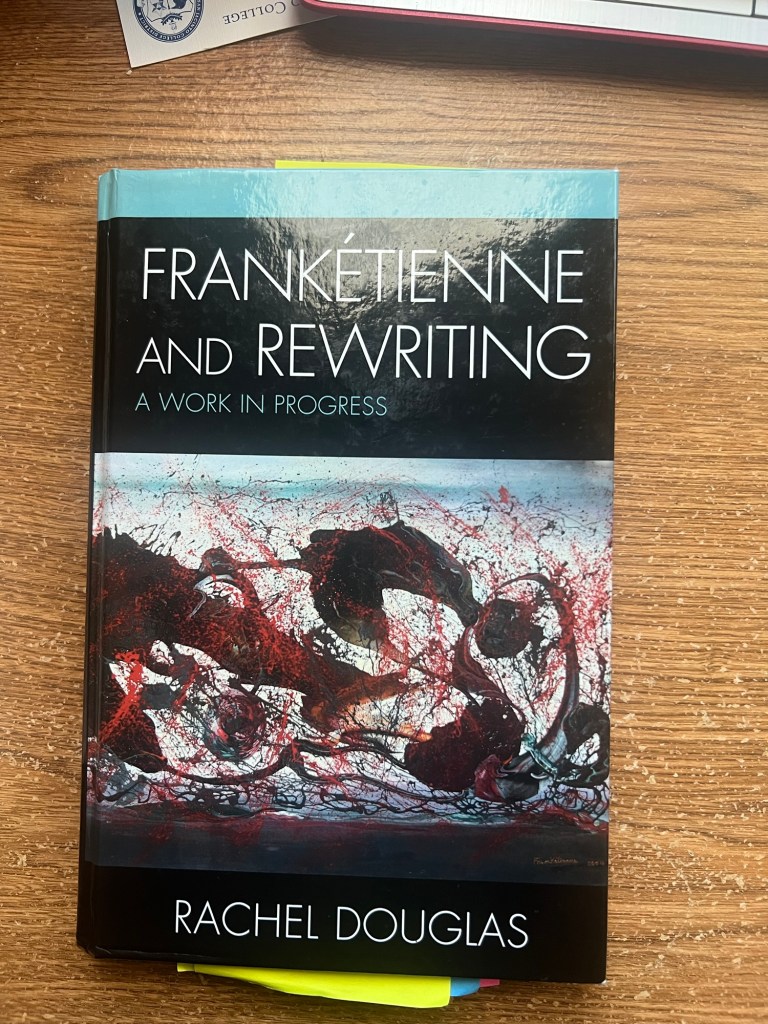

The classic critical work on Frankétienne’s major works in French.
 drcelucienjoseph, "Thinking and Meditating"