Well, I was honored today with the Faculty/Teacher of the Year Award!
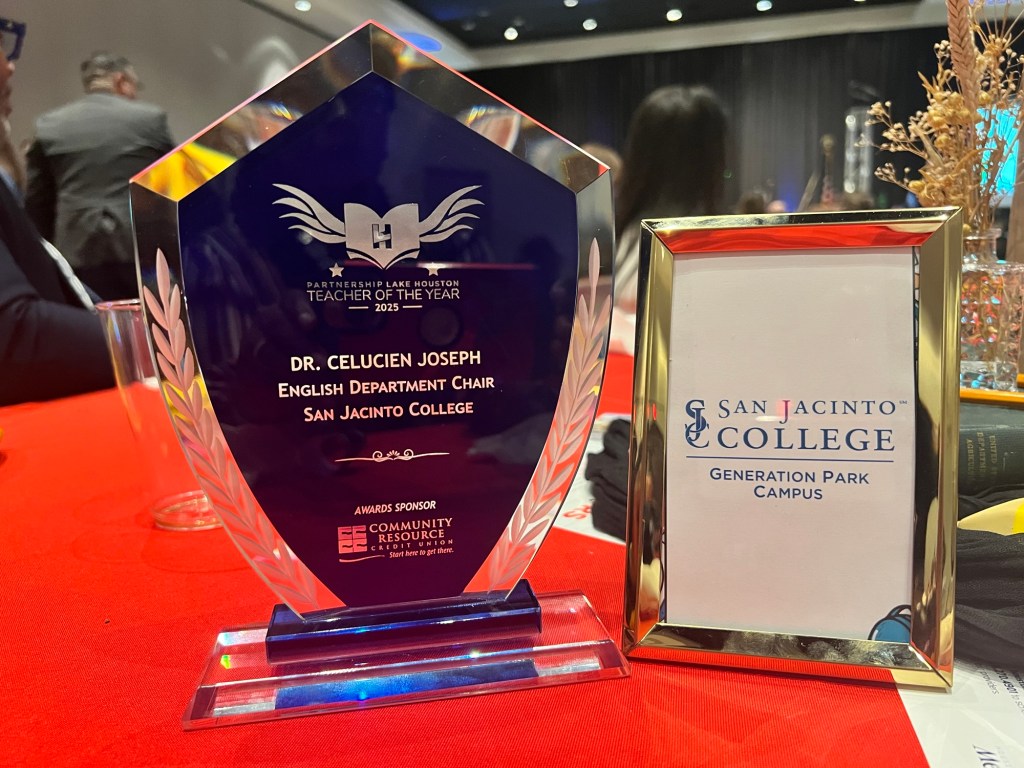


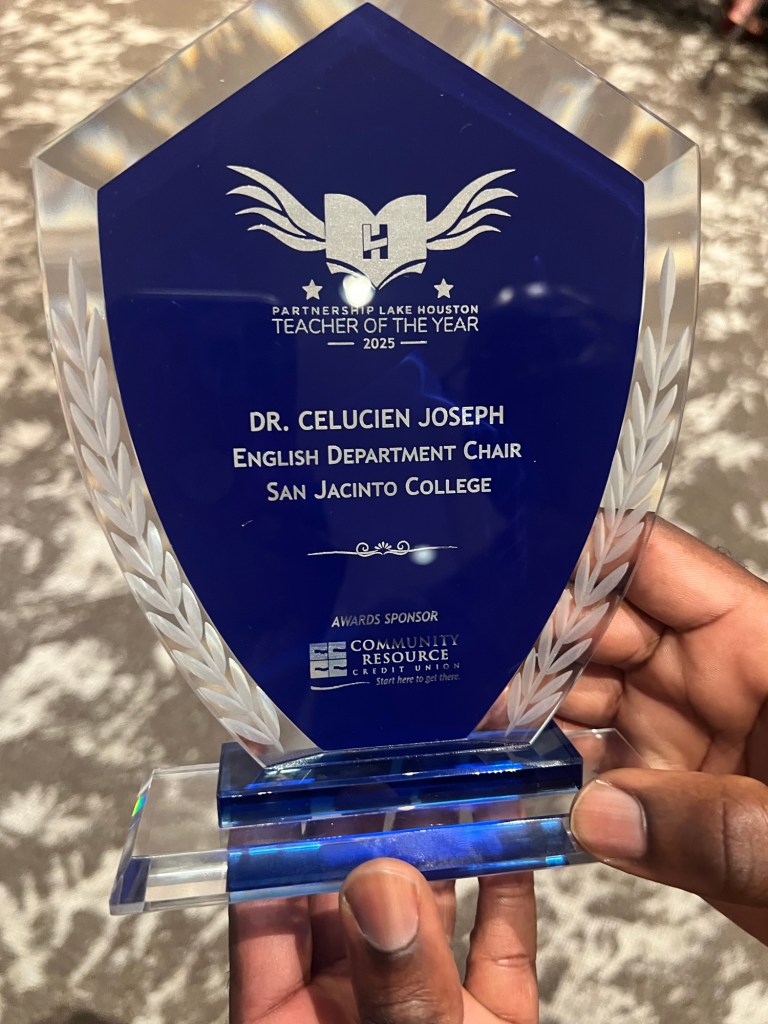
Well, I was honored today with the Faculty/Teacher of the Year Award!
I am currently working on an article that offers a critical analysis of Dézafi (1975), the first novel written in Haitian Kreyòl by Nobel Prize nominee and literary icon Frankétienne. This essay examines the production of moral evil as constructed violence within the twin settings of the novel, the villages of Ravin Sèch and Bouanèf.
While many critics have interpreted Dézafi as “a potent commentary on a country haunted by a history of slavery” or as an allegory for the zombification of the Haitian people under the Duvalier regime, my analysis challenges these dominant readings. Instead, I argue for a twofold approach: first, that the concept of zombi/zombification in the novel should be read “at face value,” without allegorical or metaphorical interpretation; and second, that Dézafi serves as Frankétienne’s critical assessment of zombification as a form of moral evil and constructed violence within Haitian Vodou. To support this argument, I explore the novel’s reliance on Haitian oral traditions—particularly proverbs and witty (and “pithy”) sayings—which function as moral frameworks for evaluating religious sensibilities, beliefs, social relations, and human behavior.
The tentative title of the article is “Moral Evil as Constructed Violence: Zombification and the Critique of Vodou in Frankétienne’s Dézafi.”

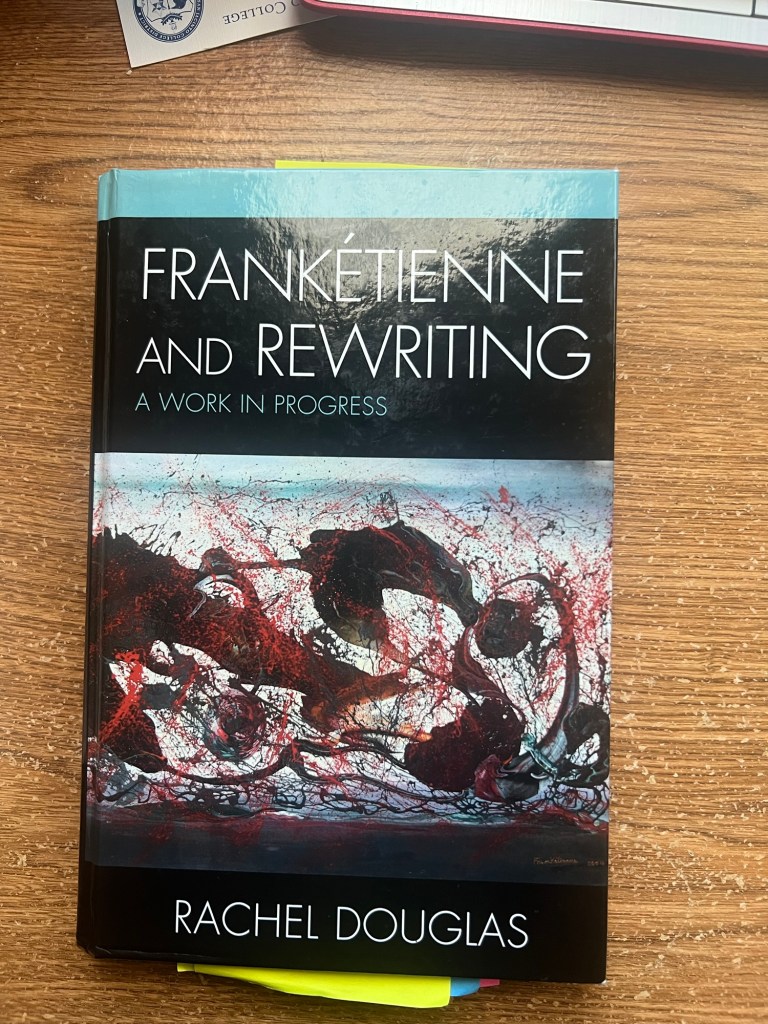

The classic critical work on Frankétienne’s major works in French.


Dr. Celucien Joseph is inviting you to a scheduled Zoom meeting.
Join Zoom Meeting
https://us02web.zoom.us/j/89061665559?pwd=xj25fvzENufIDgaDLKHGU2iuJACsFZ.1
Meeting ID: 890 6166 5559
Passcode: 343441
—
One tap mobile
+13462487799,,89061665559#,,,,*343441# US (Houston)
+12532158782,,89061665559#,,,,*343441# US (Tacoma)
—
Dial by your location
• +1 346 248 7799 US (Houston)
• +1 253 215 8782 US (Tacoma)
• +1 669 444 9171 US
• +1 669 900 9128 US (San Jose)
• +1 719 359 4580 US
• +1 253 205 0468 US
• +1 309 205 3325 US
• +1 312 626 6799 US (Chicago)
• +1 360 209 5623 US
• +1 386 347 5053 US
• +1 507 473 4847 US
• +1 564 217 2000 US
• +1 646 558 8656 US (New York)
• +1 646 931 3860 US
• +1 689 278 1000 US
• +1 301 715 8592 US (Washington DC)
• +1 305 224 1968 US
Meeting ID: 890 6166 5559
Passcode: 343441
Find your local number: https://us02web.zoom.us/u/kLRBJEpRf
My new poem is called “A Love’s Gentle Passage & Memory.” It does have an unusual structure, as it pertains to its poetic content and meaning. There are four speakers assigned different roles.
At the sound of the first musical beat—a piano—, the first speaker, a young woman who mourns the love she once enjoyed, opens up the poem with an existential question—bearing an emotive quality.
The second speaker, a young man who also mourns the memory of a triumphant love, asks a series of questions which he hopes will console his heart. This stanza is accompanied by the sound of a different musical instrument, preferably a violin.
The final speakers are a couple who just begin their love journey, an experiment they hope will bring greater joy and excitement. This final stanza is accompanied by the rhythmic sound of a French horn, as these new lovers sing the poetic lines in unison.
“A Love’s Gentle Passage & Memory”
Speaker 1
What happens when romantic love dies?
Where does it go?
What will it become?
How much could we hold on to it?
How much could we hope without it?
Does a love that fades away become a ghost in the night?
Does a love that we mourn become only a whisper at dawn?
Does it stop our heart beating?
Can hope still blossom amid love’s ashes?
Speaker 2
What happens when lovers exhale their final breath?
Where does their breeze finds its rest?
Can the vision of a dying love rekindle its passion?
How much warmth still remains from its fire?
Speaker 3
Love does not die; it only transforms.
Love becomes a ghost in echoes, a silent kiss in the wind.
It fades to ember, dissipates like fog.
It touches our memory’s marrow, shaping lovers’ hearts long after the summertime of the soul.
Romantic love stains the spirit, pressing into silence.
“Held by the Wind”
The moon is beautiful, yet far away,
But you stay near, beating in my heart.
Every road I take to forget you
Leads me back to where you are.
Birds have feathers so they can fly—
Yet yours keep my mind from drifting away.
I just found out two days ago that San Jacinto College posted this picture of me on its LinkedIn page during the celebration of Black History Month.
I am grateful for the nomination and the opportunity to continue serving our students, the English Department faculty and staff, and the San Jacinto College. Thank you, San Jac Family!


 drcelucienjoseph, "Thinking and Meditating"