My new poem, “Beyond the Noise, Only You,”
captures a profound love set against the lively, chaotic streets of Cap-Haïtien, Haiti, where I grew up and left for the states when I was 15 years old. If you’ve been to Okap, you will understand not only the meaning of the poem, but the dynamics between incessant horn blowings from both Tap-Tap and motorcycles. However, the speaker in the poem found love and pleasure in the midst of the noise and beyond the noise 😊
Amid the bustling scene—crowded streets, honking cars, and wild motorcycles—the poet finds himself entirely captivated by his beloved, the new girl he just meets while waiting for the bus in the midst of the noise. While others may be overwhelmed by the city’s noise and disorder, the poet sees only beauty, focusing solely on the presence of his new love.
When they reach the boulevard—as a kid, this is the place I used to spend my afternoons riding my bike and eating ice cream with friends—where bright lights illuminate the night, the poet feels that the true light radiates from within him—a love that is unwavering, enduring, and powered by an inner force that only death can extinguish. Through this vivid setting, the poem illustrates how true love can create a sense of eternity, belonging, even amidst life’s chaos, grounding the poet in a powerful and everlasting devotion to his new lover he meets in Okap’s boulevard.
“Beyond the Noise, Only You”
On bended knees, feet pressed to stone,
I hear your voice, soft and low,
Creole words spun sweet and slow,
As if meant only for my soul.
We meet, we meld, and love becomes us.
We stroll the streets with hearts unbound,
Innocent, untroubled, with no care to be found.
The city’s pulse, its noise and beat,
We welcomed both, in rhythm sweet.
Come, let’s walk through Okap’s streets,
Where chaos and life collide and meet—
Motorcycles and drivers wild,
Horns blaring, crowds like rivers untamed,
Yet all I see is you, my love, new and eternal,
And nothing else can call my name.
Amid the clamor, loud and wild,
I found my peace, my heart beguiled—
Beyond the noise, in quiet grace,
Your love whispered soft, and I embraced its trace.
The noise was wild, but I stayed calm,
Unmoved by the city’s relentless hum—
Yet your first smile, quiet and sweet,
Stirred a storm that swept me off my feet.
We reach the boulevard, where lights blaze bright,
But if you’d look, you’d see a light
Shining deeper in my eyes, my heart,
The fire that love ignites and sparks.
In every sound, in every stride,
We found love’s whisper, side by side—
As we embraced the chaos, we felt it too,
Love blooming in the noise, pure and true.
This love, unending, fierce and pure,
Runs on a pulse no storm can cure—
Powered by a generator deep in my soul,
This flame will burn until I grow cold.
No one here in Okap knows
How these dusty streets, loud and bold,
Can make a “Kapwa” behold
The boundless sight of eternity’s road.
* The Kreyòl word “Kapwa” refers to the native of the city of Cap-Haitien.
* The Kreyol word “Okap” is the equivalent of Cap-Haitien, Haiti’s second largest city.
Year: 2024
Moving Forward after the Election!
Regardless of the outcome of the presidential election, whether your candidate wins or loses, consider following these principles:
1. Treat others with kindness, even those who hold opposing political views or ideologies.
2. Uphold human dignity, civility, and tolerance, whether in moments of victory or disappointment.
3. Use your actions and ideas to support our democracy and foster human flourishing.
4. Avoid vengeance, and refrain from spreading hate, xenophobia, or fear, whether in public or private.
5. Act with love and understanding in all that you do.
#lovewins
#lovewinseverytime
Tough Questions for a Big God
“Tough Questions for a Big God”
The greatest external challenge to the divine will and sovereignty of God in the world is the human capacity for individual will and freedom. This freedom complicates the workings of divine love and justice in the world. God’s justice will not be fully achieved without human cooperation, and divine love and power alone is not sufficient to make all things right in the cosmos.
A God who honors human autonomy cannot simply remove suffering and eradicate evil at will. This phenomenon explains the mystery of the intersection between divine freedom, human freedom, and the enduring problem of evil—the heart of theodicy.
Moreover, since the beginning of creation and human history, there are few recorded events where God directly eradicates evil within human communities. Such instances of divine triumph are rare in global history. In contrast, human communities worldwide have seen a persistent rise in evil and the spread of suffering across nations. In other words, we lack concrete evidence, past or present, that God has decisively eradicated evil or is actively doing so in these fragile and uncertain times for contemporary societies.
How can we be sure that God will ultimately create a future world better than the present one?
How can we trust that human beings will attain greater moral goodness in the world to come?
How can we be confident that, in the end, God will eliminate all forms of suffering and evil in the universe?
More Books to Write!
Happy Tuesday, Good People! Here are the book contracts that I’ve signed with four different academic publishers:
1. “Haiti in a Global Frame: An Intellectual History” (University Presss of Mississippi)
Status: I finished writing this manuscript two years ago, but was not pleased with the way I structured the manuscript and the topics that were part of my conversation. The book has eight chapters. Since I have radically restructured the manuscript, it will take me a year or two to finish the first draft.
In this book, I have three chapters on Jean-Jacques Dessalines, one on Toussaint, one on Haiti’s first Constitution, one on the concept of God in Haitian poetry, and two on contemporary Haitian women fiction. So half of the book is on the founder of the Haitian nation.
2. “For the sake of the world and for his people : An intellectual Biography of Jean Price-Mars” (Vanderbilt University Press)
Status: I finished writing this manuscript a year ago (July 2023) and sent it off to the publisher. I received good feedback from the editors and reviewers, and I am currently doing revisions. It is close to 600 pages.
This will be the first “intellectual biography” on Price-Mars in English. There are only two biographies on Price-Mars written in English, but they are not intellectual biographies in the sense of the word or concept.
3. “Apostle of Human Equality: An Intellectual Biography of Anténor Firmin” (SUNY Press)
Status: This book is halfway done. It is divided into six chapters. I have already written three of those chapters.
It will be the first intellectual biography in English on Firmin.
4. “Christ and the Lwa: Christian Theology and Haitian Vodou” (Orbis Books)
Status: This book is divided into seven chapters. I have written only one of the chapters and the rest is in my mind 😊
This will be the first monograph in the English language on this subject matter. This is the book I have always wanted to write✍️
5. “Christian Theology and Afro-Caribbean Religions: A Comparative Analysis” (pending book contract with one of my favorite academic presses. Willl let you know the name later)
Status: This book contains six chapters. I wrote two of them, and the rest is in my big head 😊
This will be the first book in English on the subject matter. This is another book that I have always wanted to write.
Good People: If you see me disappear from social media engagement and if I choose not to participate in future writing and academic commitments for a long time, you will have a sense of understanding of my justification. I need five to six years to finish writing all these books. In the meantime, I will keep writing poetry. lol
A Recent Talk on Haitian Vodou and Christianity
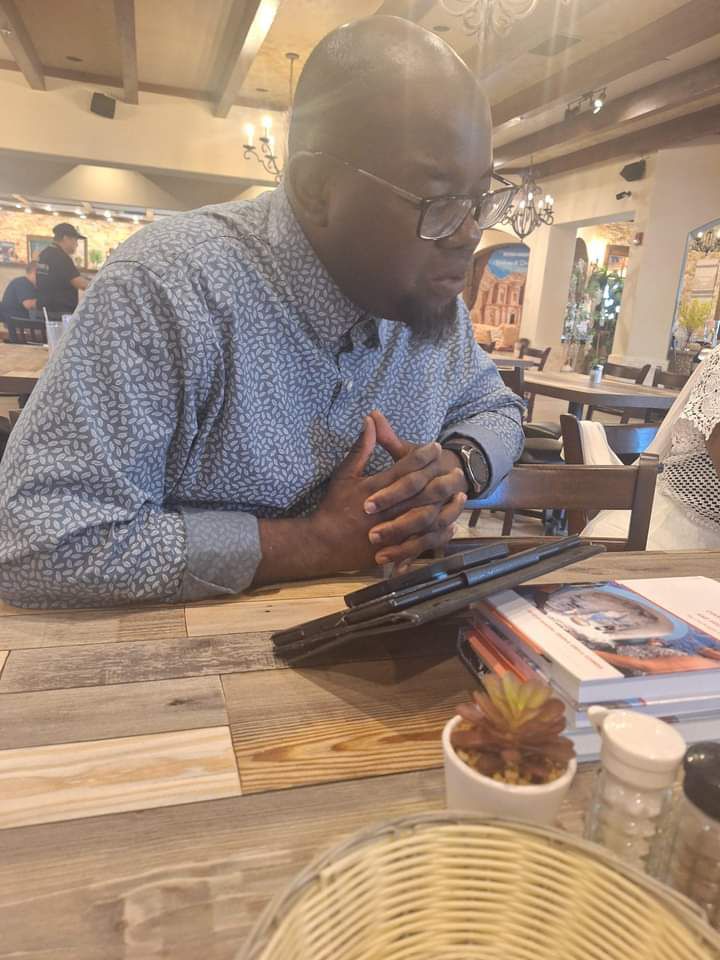
Last Saturday (October 26), a group of African brothers and sisters known as the Association of Brotherhood Academic Scholars-USA invited me to give a talk on Haitian Vodou. It is a Christian professional academic organization. The venue was inviting, intimate, and simply beautiful, and it was quite a relaxing atmosphere. The highlight of my conversation was my interaction with the audience and to be able to answer their questions (there were a lot of them. lol).
Because the audience was primarily Christian, in my explanation of Vodou as religion, I also used Christian concepts and comparative religious ideas (i.e. the Yoruba tradition) The President of the organization wrote this beautiful letter to me:
“To Dr. Celucien Joseph,
Head of the English Department
San Jacinto College, Pasadena, Texas,
Dear Dr. Celucian,
We wish to express our deep appreciation for your generous time and presence at our gathering on Saturday, the 26th of October, 2024. Your intellectual expertise, humanistic approach, insights on the African diaspora, and wisdom on the strengths of the black community were truly remarkable.
Your patient explanation of the concept of Voodoo and willingness to address our inquiries made the session truly exceptional, and your kind demeanor did not go unnoticed.
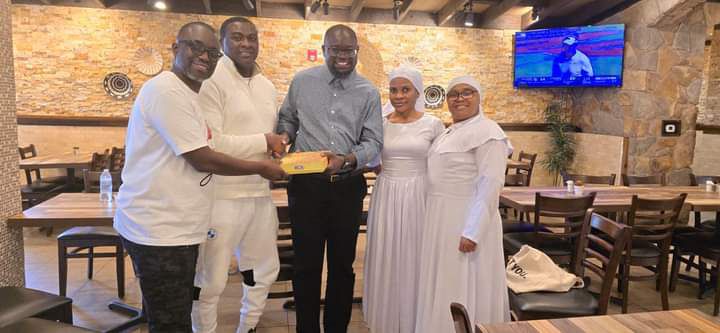
We also thank you for graciously accepting our gift of the Everlasting Gospel, trusting it will be a valuable addition to your collection of research materials.
May God continue to inspire and bless you as you share your scholarly knowledge with others. In the name of our Lord Jesus Christ, Amen.
Sincerely,
Brother Aeroezona Obiadazie
Christ Ambassador
President
ABAS-USA
Oct. 28, 202”
Here are a few photos they sent me.

“Torn Threads of Affection”: A New Poem
My new poem, titled “Torn Threads of Affection,” draws inspiration from two poignant sources. The first is Labrinth’s hauntingly beautiful song “Jealous,” which has the power to reshape our understanding of love, revealing the delicate balance between love and jealousy. I’ve listened to this song a million times and profoundly wondered about the meaning of its lyrics and the wild passions they evoke.
The second inspiration comes from the dynamic between two high school students who are best friends; they share classes, lunch breaks, and spend quality time together. The young man’s deep affection for the girl is undeniable; yet it is his friend who receives her love, touch, and passion, creating a bittersweet tension in their relationship. The rest is a story untold, or a tapestry of moments yet to be revealed.😊
“Torn Threads of Affection”
Weighed down by the human hand,
That draws close to your body,
Reaching deeper than my fingers ever could.
I lament how he shattered your garment,
A place where my shadow has never tread.
In his grasp, your will was silenced.
He stole your essence in the darkest of nights.
It is his touch you idolize, his image you memorize.
Inside, I wither like a flower in winter’s grasp.
I’ve offered you treasures coming from undiscovered lands,
And guided you to untraveled paths.
I crafted memories that dance in your heart,
And to move the fabric of your soul.
I starved my desires so your hunger could fade,
And spilled my lifeblood so your heart would beat on.
It wounds my heart that my offerings go unseen.
The silent burdens I’ve carried for your sake
are buried in the shadows of your indifference.
I feel the sadness in the way you light up for him,
Though I’ve given my all just to see you smile each day.
Consumed by jealousy as you text him endlessly,
At dawn when you rise, at midnight before sleep calls.
It stings to know you spend more time with him than with me,
After all this love I’ve carried through the years.
He shattered your trust,
Leaving you to rebuild in the ruins of betrayal.
Where will you seek solace now?
Who will bring you comfort in a world where doubts bloom like wildflowers?
I envy the nights he shares with you,
Every moment you lie beside him,
Every smile you give that he takes for granted,
Every breath exchanged while he’s unkind to your warmth.
He doesn’t treat you with the gentleness I offer.
I can’t help but wonder— is this love?
His heart lacks the depth of the love I hold for you.
Though you seek warmth in fleeting moments,
I hold the light of a love that is true.
“The Weight of Your Heart”: A New Poem
I dedicate my new poem “The Weight of your Heart” to those who’ve experienced what I call a transient love, an ephemeral joy, and to the one who has been betrayed by love. The French translation, “Le poids de ton coeur,” is followed.
“The Weight of Your Heart”
I carry you in my heart,
It’s over, but you linger,
A ghostly touch that never fades,
You left me without a final word, not even a text to remember.
Yet your heart, it still travels with me.
The moments we lost—could they be saved?
I could have held you tighter,
So I would never miss you again.
You are my forever companion, unseen but near
A love that exploded in sight cannot be tamed.
Nothing can hold back a woman in love.
But you don’t want it from me—
Not the way I craved,
Not the way my soul longs for you.
I stand in the naked distance of (your) love.
I don’t feel alone,
But without you, the distance stretches,
Like naked space,
Peeling away layer by layer,
Until only the lingerie of our feelings remain.
I miss you—come back to me,
My window to the world is cold,
I want you, not in the way of flesh,
But in the way of life—your hands on my face,
Your breath on my neck, your lips on mine,
Fingers tangled in your hair,
legs intertwined until the morning light.
I want to wake to your smile,
To hold the moon with you.
But you played with my feelings,
And now you don’t care.
So I began this love story,
but you were the one who wrote its end.
It’s from you that I learned the fire of love.
And from you I learned its burn.
I don’t need perfection,
Just someone afraid to lose me,
Someone who respects the fragility of what we had,
But now, all that remains is fear—
Fear of writing a love letter
That will be met with rejection.
I can’t move on.
No matter how you’ve torn me apart,
A piece of you is forever stuck to me.
You taught me love,
Unconditional, sacrificial,
But you also taught me pain,
A lesson I never wanted,
From the one who showed me what it means to love
And to lose.
——
“Le Poids de ton Cœur”
Je te porte dans mon cœur,
C’est fini, mais tu persistes,
Un toucher fantomatique qui ne s’efface jamais,
Tu es parti sans un dernier mot, même pas un texte pour m’en souvenir.
Pourtant, ton cœur voyage encore avec moi.
Les moments que nous avons perdus—pouvaient-ils être sauvés ?
J’aurais pu te serrer plus fort,
Pour ne plus jamais te manquer.
Tu es mon compagnon pour toujours, invisible mais proche,
Un amour qui a explosé à vue ne peut être dompté.
Rien ne peut retenir une femme amoureuse.
Mais tu n’en veux pas de moi—
Pas comme je le désirais,
Pas comme mon âme te désire.
Je me tiens dans la distance nue de (ton) amour.
Je ne me sens pas seule,
Mais sans toi, la distance s’étire,
Comme un espace nu,
S’effeuillant couche après couche,
Jusqu’à ce qu’il ne reste que la lingerie de nos sentiments.
Tu me manques—reviens-moi,
Ma fenêtre sur le monde est froide,
Je te veux, pas dans la chair,
Mais dans la vie—tes mains sur mon visage,
Ton souffle dans mon cou, tes lèvres sur les miennes,
Doigts emmêlés dans tes cheveux,
Jambes entrelacées jusqu’à la lumière du matin.
Je veux me réveiller à ton sourire,
Tenir la lune avec toi.
Mais tu as joué avec mes sentiments,
Et maintenant tu t’en fiches.
C’est moi qui ai commencé cette histoire d’amour,
Mais c’est toi qui en as écrit la fin.
C’est de toi que j’ai appris le feu de l’amour.
Et de toi j’ai appris sa brûlure.
Je n’ai pas besoin de perfection,
Juste de quelqu’un qui a peur de me perdre,
Quelqu’un qui respecte la fragilité de ce que nous avions,
Mais maintenant, il ne reste que la peur—
La peur d’écrire une lettre d’amour
Qui sera accueillie par un rejet.
Je ne peux pas passer à autre chose.
Peu importe comment tu m’as déchirée,
Un morceau de toi est à jamais collé à moi.
Tu m’as appris l’amour,
Inconditionnel, sacrificiel,
Mais tu m’as aussi appris la douleur,
Une leçon que je n’ai jamais voulue,
De celui qui m’a montré ce que c’est d’aimer
Et de perdre.
“Unwritten Futures”: A New Poem
I call this new poem of mine “Unwritten Futures.” It is a story that revolves around a very attractive woman who is torn between two men. While she has strong feelings for both, her heart truly belongs to one, and she dreams of a life with him. Meanwhile, the other man remains unaware of her secret romance 🙂
“Unwritten Futures”
She stands at the crossroads, torn in two,
With hearts entwined, yet mine feels blue.
He came first, she whispers, eyes cast low,
In love’s embrace, there’s room to grow.
But I can’t help but wonder—
what is the cost?
In her heart’s garden,
am I just a ghost?
In her gaze, I’m shadowed,
lost in his light.
She weighs my heart against his might.
She says, “He knows me whole, accepts my flaws,”
Her daggered words, a silent war.
Each word reflects pain,
.Comparisons drown me like falling rain.
She weaves her tales,
a web of lies, only to be torn apart.
hiding the truth behind her eyes.
She whispered,
“He was here before you,
the first chapter of my story.’”
In his arms, her heart ignites,
While I’m but echoes of a fading name.
He knows nothing of my presence,
the secret we weave in the dark, a stranger to the truth.
While I hold her close,
lost in the moments he can’t see.
She said, “He will never know about us,”
as if our moments are shadows,
fading at dawn.
Yet in the depths of her heart,
she dreams of a future with him,
of growing old,
while I hold her now,
just a fleeting whisper in her story.
A web of trust, then swiftly tore.
Her laughter dances in another’s light,
In every glance, her heart takes flight,
For him she loves more, beyond my reach.
Her days are filled with his embrace,
While I wait in empty space.
In stolen moments, their laughter rings,
And silence wraps my heart in strings.
I stand,
lost in fading night.
“Journey of our Hearts”: A New Poem
I wrote this poem last month and gave it the interesting title “Journey of our hearts.” I also translated it in Kreyòl, but the Kreyòl translation does not capture all the nuances the English original possesses.
“Journey of our Hearts”: A Poem
Let’s go, let’s go, my heart’s open wide.
It knows your worth.
I can’t promise you the world, but I’ll be by your side.
With secrets to share, and dreams to unfold,
In the warmth of your presence, a love to behold,
Let’s walk this path by my side.
Even if nothing on earth is perfect and bright, it’s true,
I want you in my life—this secret’s for you.
Let me take you somewhere where youth won’t decay,
A place where we will play
Together, we’ll dance in the rain.
Let’s go, let’s go, to a place where love thrives,
The greatest treasure we’ll find, the spark that survives.
A bond that grows stronger, two hearts intertwined.
A garden of laughter, you and I will share.
Let’s go, let’s go, where the sun lights our way.
If we wait for wealth or riches to make our dreams whole,
We might lose the essence, the heart of our soul.
But knowing you is a blessing so bright,
In the glow of our love, just me and you.
Let’s go, let’s go, and chase love’s endless light.
Let’s go, let’s go, hand in hand we will stride,
With you in my life, I have nothing to hide.
Those who doubt our journey, who say we’ve lost reason,
Don’t see the blessing that’s in every season.
So here’s my heart, in this journey we’ll tread,
In a world filled with wonder, with you as my guide.
“Vwayaj Kè Nou”: Yon Pwezi
Ann ale, ann ale, kè mwen louvri laj,
Li konnen valè ou, se pa yon maji.
Mwen pa ka pwomèt ou mond lan, men mwen la bò kote ou,
Avèk sekrè pou pataje, ak rèv pou devwale tou.
Menm si anyen sou tè a pa pafè ak klere,
Se laverite, mwen vle ou nan lavi mwen—sekrè sa a se pou ou.
Kite m mennen ou yon kote kote jèn pa pèdi,
Yon plas kote nou ka jwe ansanm, anba lapli.
Ann ale, ann ale, nan yon kote kote lanmou fleri,
Pi gwo trezò n ap jwenn, sa ki kenbe vivan.
Yon lyen ki vin pi fò, de kè ki entwine,
Yon jaden ri, ou menm ak mwen ap pataje.
Ann ale, ann ale, kote solèy la klere chemen nou.
Si nou tann pou richès oswa byen pou reyalize rèv nou,
Nou ka pèdi esans lan, kè nan nanm nou.
Men, konnen ou se yon benediksyon ki klere,
Nan limyè lanmou nou, se mwen ak ou sèlman.
Ann ale, ann ale, pou chache limyè lanmou san fen.
Ann ale, ann ale, men nan men n ap avanse,
Avèk ou nan lavi mwen, mwen pa gen anyen pou kache.
Sa yo ki doute vwayaj nou, ki di nou pèdi rezon,
Pa wè benediksyon ki nan chak sezon.
Men kè mwen, nan vwayaj sa a n ap fè,
Nan yon mond plen etonnman, avèk ou kòm gid mwen.
Pope Francis & Navigating Cultural Perspectives on God
Navigating Cultural Perspectives on God: Some Fundamental Questions to Consider (Part 1)
If there exists a singular Deity/God who has disclosed himself/herself in various cultures worldwide, it follows that this Deity/God, both in essence and in personal attributes, must exhibit a consistent nature across these diverse cultural contexts. While different cultures may interpret the nature and identity of God in varied ways based on their unique perspectives and cultural frameworks, the fundamental ontological unity of God should remain unchanged. For instance, whether viewed as a singular entity or a trinity, this ontological understanding of God should ideally transcend cultural boundaries, hermeneutics, and epistemologies.
However, despite the universal availability of divine revelation, cultural interpretations of God can diverge significantly. Why, then, do some cultures perceive God as singular while others perceive God as triune? If God represents the ultimate reality and truth, shouldn’t human understanding of God align with the manner in which God has revealed himself/herself, reflecting a consistent truth?
Let us explore these issues important questions below:
1. Is it conceivable that certain cultures grasp a more accurate understanding of God than others? If so, how can these cultures be confident that their comprehension aligns closely with God’s original intent and revelation?
2. Could it be that some cultures’ conceptions of God represent a departure from the authentic divine revelation?
3. Is there a possibility that all interpretations of divine revelation and knowledge about God are fundamentally flawed? How can humanity ultimately come to know God accurately or truthfully?
These questions delve into the complexities of theological interpretation across cultures, prompting reflection on how diverse human perspectives shape our understanding of the divine.
While it can be challenging to contemplate and express certain concepts about God without filtering them through our cultural perspectives, it’s crucial to differentiate between the concept of culture and the concept of God. When God is exclusively seen through the lens of a specific culture, there’s a risk that this cultural framework might distort the true essence of God. Conversely, if God is not considered within certain cultural traditions and practices, that God may seem unfamiliar or foreign to those within that culture.
If God indeed transcends our cultural constructs and exceeds our imaginations, it becomes necessary to somewhat disentangle God from our cultural biases and specificities. A God who mirrors human behaviors may not rise above human conceptions of God. Conversely, a God who transcends human imagination and cultural boundaries is not confined to such habits or specificities.
Moreover, let’s revisit my previous discussion about Pope Francis’s remarks regarding God and how different cultures or religions perceive and interpret God. Christianity and Islam, for example, are particularly noteworthy due to their explicit claims about the authority of salvation. For example, Jesus asserts his divinity as the sole true messenger of God on Earth, describing himself as the exclusive gateway to God. Crucially, Jesus also claims to be God incarnate.
(Pope Francis recently made this declaration in public, but the statement cannot be both true and false at the same time and in light of the exclusive claims of Christianity and Islam—Christianity concerning Jesus as the “Christ” and Islam concerning Prophet Muhammad as God’s “Final Prophet”—for example:
“All religions are paths to reach God. They are—to make a comparison—like different languages, different dialects, to get there. But God is God for everyone. If you start to fight saying ‘my religion is more important than yours, mine is true and yours isn’t’, where will this lead us? There is only one God, and each of us has a language to arrive at God. Some are Sheik, Muslim, Hindu, Christians; they are different ways to God.”
—-Pope Francis)
Pope Francis’s statements have several implications:
1. All religions are perceived as equal and provide an equivalent path or access to God.
2. All religions essentially tell the same universal story about God, albeit with cultural variations.
3. God does not belong exclusively to any religious system nor is God bound by any particular tradition.
4. God is a shared inheritance and possession of all religions and their adherents; in other words, God belongs to the people.
5. God transcends all religious traditions and their doctrines.
In reality, religions do not universally share the same language or beliefs about God; often, they contradict each other in their teachings and doctrines. Nevertheless, God is aware of and acknowledges the languages and belief systems created by humans because God is and has been present within every culture and left a mark on each. To put it differently, God exists simultaneously here and there.
For instance, in Haitian Vodou, “Bondye” (God) is viewed as a distant and transcendent deity whom no one can directly approach. Instead, Bondye created and delegated the lwa (spirits) to assist humans; thus, it is through the lwa that Bondye interacts with people within this tradition. Conversely, in Judaism, Christianity, and Islam, God is seen as the supreme ruler of the universe, and he is actively involved in human history and affairs, while also being transcendent and omnipresent. Another example contrasts Christianity, where Jesus is regarded as the cosmic Savior and Lord, with Prophet Muhammad, who did not make similar claims. Similarly, the Yoruba and Vodou religions do not espouse the concept of a cosmic Savior and Redeemer. Despite these differences, all religions offer elements of truth regarding God, human origins, ethics, and human relationships, albeit with varying goals and interpretations.
In conclusion, while religious pluralism and epistemic relativism acknowledge the diversity among religions, it’s essential to recognize that religions differ significantly in their perspectives. Ultimately, every religion may present distinct concepts of God and varying teachings, yet God understands and embraces the diverse languages and beliefs of all religions, having left an imprint in every culture.
 drcelucienjoseph, "Thinking and Meditating"