Christian Theology, Affirmative Action, and Reframing a different Human Future (Part 1)
In light of the recent reversal of Affirmative Action by the US Supreme Court, I have been thinking about the role of Christian theology to assist us to move forward post-racially as a nation and a people. As a Christian theologian, I must first confess that theology is fundamentally a human invention, and theological doctrines are the product of human imagination and coordination. By articulating this perspective, I am also affirming the epistemological limits of the discipline of theology itself, and the many ways it may not contribute fully to improve social relations, political arrangements, and human dynamics in society. Secondly, I am also attesting to the intellectual constraints of theology to break certain barriers in society, including economic, political, cultural, gender, educational, or ethnic. In other words, I do not believe theology or theological thinking is adequate or has all the resources to help us solve all the mysteries and complexities in contemporary societies—especially those in the polarized contemporary American society. However, I believe that we should investigate the theological resources that are available to us to assist us in imagining and conceptualizing the possibility of a post-racial society and in reframing a different human future?
By stating that theology has both epistemological and intellectual limits, I am simply pointing out that every theological system or tradition (Liberal theology, Liberation theology, Feminist theology, Openness theology, Constructive theology, Black theology, Reformed theology) is grounded in a specific cultural tradition and geography that shapes its language, contents, and ways of expression. If geography and culture support the numerous ways we think and live theologically in the world and in communion with others, our theological tradition also reflects our respective culture and geography; thus, the temptation to rise above our own theological tradition to engage transculturally and globally calls for both intellectual modesty and theological humility.
Most Christian theologians believe that there is a revelatory aspect to Christian theology. The idea that God has voluntarily revealed his nature and perfect attributes, both communicable and incommunicable, transcendent and immanent, in the sacred pages of Scripture testify to this position. The belief that the Scriptures also have a revelatory character of the Divine provides the resource to think theologically both about the Scripture and God himself. A third proposition most Christian theologians embrace is that the moral qualities of God point us to the moral life we should aim for in this world, and that divine perfections are adequate to help humans create government, the arrangements of society and culture, the institution of laws, and the distribution of justice and equity in society. Finally, most Christian theologians maintain that the way of Jesus is a model for human living and relations, and that in the character of Jesus humanity finds the best available resources to foster the deeply-formed life in a tragically-fractured world.
Yet we must bear in mind everything that I said above about the virtues and merits of Christian theology is a form of hermeneutical exercise, but it is a form of intellectual gymnastics that has some consensual value among theologians, universally and globally. The theological vision of the Bible includes certain emancipatory concepts and ideas promising us there’s another way to live together in this world and correspondingly, there’s another way to (re-)organize human societies. The revelatory nature of Biblical theology provides a good orientation to explore the possibility to live, think, act, and govern post-racially in our contemporary moments.
Given that we already affirmed the revelatory character of both Biblical theology and Theological anthropology, we have adequate resources available to point us to the right direction, that is, to think anew and reimagine creatively a present and future that are not based on racial identities and categories in modernity. If the revelation of God provides enlightenment to the dark world and if divine revelation is the antithesis to anything that defers human flourishing and life together, then Biblical theology is an empowering enterprise we can lean on to progress toward personal growth and the collective realization of God’s original intent for human societies and governments.
I would like to close the first part of this conversation with this question: Could Christian theology provide us with a different language to undo the race concept and get rid of racial categories in society that are often deployed to describe certain human relationships, demonize certain populations, grant privileges and advantages to certain groups, and delay the common good in society?
Month: June 2023
My Interview with John Morehand on Vodou and Christianity in Interreligious Dialogue
Last week, I had an opportunity to have a conversation with John Morehead, the host of Multifaith Matters, about interreligious dialogue between Vodou and Christianity. It was fun!
phttp://johnwmorehead.podbean.com/e/celucien-joseph-on-christianity-and-vodou-in-dialogue-in-haiti/
“Price-Mars: A Lesson on Perseverance and Commitment”
“Price-Mars: A Lesson on Perseverance and Commitment”
Here’s a lesson about commitment, perseverance, and dedication that I want to share with you from the life of Jean Price-Mars.
At 19 years old, Jean Price-Mars began his medical training at the National School of Medicine, Haiti’s only medical school at that time, located in the capital city of Port-au-Prince. In 1899, he received a government scholarship to finish his medical studies at “La Sorbonne”/University of Paris, in Paris, France. Due to financial difficulty, his studies were interrupted in 1901. Hence, he was forced to return to Haiti before getting his medical degree.
Twenty-two years later (I say 22 years later!), Price-Mars resumed his medical school in 1922 at the School of Medicine affiliated with Université d’État d’Haiti/the State University of Haiti. In 1923, he was awarded with his medical degree (M.D.) at 47 years old. Yes, he was 47 years old when he became a physician!
Immediately, he joined a medical team/clinic in Port-au-Prince to provide medical care to and cure the illnesses of the Haitian people. Because of his commitment to the Haitian peasants, the marginalized group in Haiti, he spent a lot of time riding his horse in the mountains and hills of Kenskoff to treat their diseases and make their life better. It was during his visits in Haiti’s countryside while spending time with the rural people that he began to do ethnological studies and attended more than 100 Vodou ceremonies. Jean Price-Mars would become the Father of Haitian ethnology and train thousands of students in the discipline.
His son, Louis Mars, following the footsteps of his famous father, also became a medical doctor. In fact, Dr. Louis Mars became the first Haitian psychiatrist. Like his father, he has written prolifically on the relationship between Vodou, psychiatry, and spirit possession. It should be noted that it was his father who inspired him to study psychiatric medicine, and he devoted his entire life caring for the Haitian people.

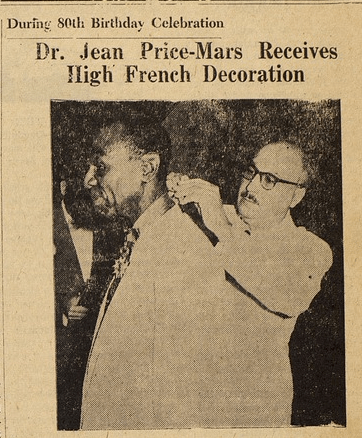
“Some Updates about My Intellectual Biography on Jean Price-Mars”
“Some Updates about My Intellectual Biography on Jean Price-Mars”
I published my first academic essay on Jean Price-Mars eleven years ago, the same year I graduated with my PhD from the University of Texas at Dallas (#UTDallas). The title of the essay is “The Religious Philosophy of Jean Price-Mars.” Journal of Black Studies 43.6 (2012): 620–645. Little that I knew back then that I would be devoting the next eleven years of my life working on an intellectual biography on the man.
I was introduced to Price-Mars in a course on “The African Diaspora” while I was working on my master’s degree at the University of Louisville (KY). The brilliant African-American professor, activist, and educator Dr. J. Blaine Hudson (1949 – 2013), who also served as the Chair for the Department of Pan-African Studies and the Dean of Arts and Sciences at the UofL introduced me to some of the most influential intellectual giants and activists in Black Studies and the African Diaspora, including W.E. B. Du Bois, Jean Price-Mars, Ida B. Wells, Anna Julia Cooper, Aime Cesaire, Marcus Garvey, Amy Jacques Garvey, Francis Kwame Nkrumah, Stokely Carmichael, Amílcar Cabral, etc. That happened 20 years ago.
Interestingly, this class with Dr. Hudson has prompted me to pursue deeper knowledge and understanding about the histories, stories, experiences, and struggles of the people of African descent in the African diaspora, with a special attention on Black America and Haiti.
When I originally applied for the admission to the PhD program at the University of Texas at Dallas, I was accepted to the doctoral program in (Intellectual) History. At first, I wanted to do European history, especially contemporary European thought/history of ideas as academic research. I spent a whole year in the PhD program in History and took courses in the discipline. After my first year, I decided to change my major to (English) Literary Studies with an emphasis in three academic areas of research: African American Intellectual History, African American Literature, and Caribbean Literature and Culture. It was through my academic interest in African American Intellectual History that I encountered Jean Price-Mars for a second time. It was another life-changing experience for me. In addition to W.E. B. Du Bois, Price-Mars suddenly became my intellectual idol and dead mentor/teacher.
According to some people, if you have a keen interest in African American Studies and want to get a good handle of its intellectual enterprise, you just have to read everything W. E. B. Du Bois (1868-1963) has written on the Black experience in American history. In the same line of thought, it is impossible to have a good grasp of Haitian history and its intellectual side without reading and understanding Price-Mars. Jean Price-Mars is the very embodiment of Haitian intellectual thought, both present and past, and reading Price-Mars is learning about Haiti and the Haitian people in all their complexity, dimensions, and challenges. Contemporary Haitian intellectual history is a footnote to the writings and ideas of Jean Price-Mars (1876 – 1969).
The current manuscript (the intellectual biography) is 479 pages + a 20-page bibliographic reference. Today, I finalized this exceptionally long and detailed bibliography (Chicago Style). It has been quite a tedious task, to say the least. As I am writing this note to you, I am thinking whether I should add a few appendices (maybe 3) that will offer an outline of Price-Mars’ life and writings–as I have done in my book on Jacques Roumain. What do you think? Would you find the appendices on the subject matter helpful in a book that is already long?
My conversation with Patrick Jean-Baptiste on Jean Price-Mars: Part 1
My conversation with Patrick Jean-Baptiste on Jean Price-Mars: Part 1
 drcelucienjoseph, "Thinking and Meditating"