Mezanmi Get you Black History Lesson on Slavery Right!

Mezanmi Get you Black History Lesson on Slavery Right!

The institution of slavery did not begin in 1619 in Virginia, that is, in what is known today as “The United States of America.” In 1517, 15,000 African slaves were brought in Santo Domingo (modern day Haiti). In fact, the first sugar mill, in which the slaves worked, was probably constructed in 1516 in Santo Domingo. The first slaves in the Americas were not Africans, but the indigenous people of the Continent, that is the Taíno Indians.

My New article: “James Cone and the Crisis of American Theology”

My second article on James H. Cone is now published and can be accessed for free online:

“James Cone and the Crisis of American Theology,” Missionala Vol 46, No(2) (2019), 197-221

***The article is part of a special issue on the legacy of James H. Cone, which Missionala, a South African Theological Journal, publishes. The editor of the Journal contacted me early last year to contribute this article.

Abstract

“The objective of this essay is to investigate the public function of Christian theology in the politico-theological writings and hermeneutics of James H. Cone. It is also to articulate a critique of white American theology. In Cone’s work, Christian theology is expressed as a public discourse and testimony of God’s continuing emancipative movements and empowering presence in society with the goal (1) to set the oppressed and the vulnerable free, (2) to readjust the things of the world toward divine justice and peace, and (3) to bring healing and restoration to the places in which volitional (human) agents have inflicted pain, suffering, oppression, and all forms of evil. This essay is an attempt to imagine creatively with new hermeneutical lenses and approaches—anti-imperial, liberative, and postcolonial—the task of Christian theology as public witness to carry out the emancipative agenda and reconciling mission (salvation, healing, hospitality, wholeness, reconciliation, and peace) of God in contemporary societies and in our postcolonial moments. The basic argument of this essay is twofold. First, it contends for the essential role of liberation theology as a public witness in redefining Christian theology in general. Rather than being a “special interest” or merely political theme in theology, it suggests that black liberation theology has a special role to play in “freeing” Christian theology from racism, oppression, and imperialism. Second, by promoting some new understanding of Cone’s work and applying it in some new context, this article is deploying Cone’s public theology to critique or awaken dominant white theology to a new way of thinking about the whole field of theology in the 21st century.”

Keywords
James H. Cone, Black Liberation Theology, Anti-Black Racism, White American Theology, White American Church

http://missionalia.journals.ac.za/pub/article/view/309/pdf

“The Problem with Evangelical Sexual Ethics in Christian Churches and Institutions”

“The Problem with Evangelical Sexual Ethics in Christian Churches and Institutions”

One thing that is not debatable about the character of the biblical God is that he hates sin and evil, despises oppression and injustice, turns his face away from abuse and exploitation, and certainly God does not take side with those who pretend to be religiously righteous and pious, but externally they produce the fruit of political devils and cultural demons and are in solidarity with those who despise truth, beauty, and a Christ-centered life/lifestyle–both in thought and action.

One of the crises in Evangelical Christianity in this culture that pervades in contemporary churches is the sin of religious hypocrisy manifested through the sexual abuse of little boys and girls in churches, sexual rape of church women by church leaders and ministers, sexual harassment of young girls and boys by their youth pastors and ministers, what have you? Most of these sexual charges happen in church parishes and facilities. (Please see the recent report on sexual scandal in SBC Evangelical Churches and Institutions, and Dr. Russell Moore and J. D. Greear’s response to the culture of sexual sins in the SBC and Evangelical churches.)

A lot of people stop going to church for congregational participation is not because they hate God or don’t like to associate with Christians or Christianity; the reasons are multiple, but let me suggest five of them:

1. The lack of transparency and accountability in church leadership and christian institutions

2. The devastating problem of religious hypocrisy in (Evangelical) churches and church leadership

3. The silence and support of sexual violence and oppression toward women by church clergy and christian organizations

4. The silence and support of violence and dehumanization toward the LGBTQ community and same-sex couples by Evangelical Christians and Christian organizations

5. The appropriateness and incorporation of the extremist political culture and ideologies in sermons, christian teachings, and in the structure of churches, christian institutions, ecclesiastical thought and practices

The church is no longer a safe place for little girls and women. As one biblical authors warns all of us, especially followers of Jesus Christ and those who love and do the will of God, “God will not be mocked.” God shows no partiality to anyone, nation, people, religious group, political affiliation, racial affiliation, ethnic group, sexual orientation, gender orientation, economic and social classes, what have you?–when it comes to the defense of his holiness and sacred name, and his command to his people to walk in justice, love, and truth.

“A New Book for a New Year: In Praise of Edwidge Danticat”

“A New Book for a New Year: In Praise of Edwidge Danticat”

We have an exciting (and a much-needed) forthcoming book (“Approaches to Teaching the Works of Edwidge Danticat”) with Routledge on the renowned Haitian-American writer Edwidge Danticat, whose coeditors include my amazing and brilliant colleagues DrDanny Hoey, Suchi Banerjee, and Marvin Hobson. Some individuals (instructors) have already emailed us inquiring about the publication date. They would like to assign the book in their course. This is very encouraging for us editors.

I just recounted the manuscript today. It is 480 pages, double-spaced. The book contains 15 chapters. What was I thinking? I wrote two chapters (“A Comprehensive Resource Guide to Reading and Teaching Brother, I’m Dying
in American Classrooms: Background, History, and Context: Part A,” and “A Comprehensive Resource Guide to Reading and Teaching Brother, I’m Dying in American Classrooms: Criticisms, Thematic Analysis, & An Eight-Week Teaching Model: Part B” ), which amount to 86 pages, on how to read and interpret Danticat’s “Brother, I’m Dying” (BID). Was I drunk? lol

We just hope instructors of English Composition and literature (especially our beloved Danticat) and their cognate disciplines, will be pleased with the outcome of this work. We sincerely apologize to our contributors for the delay to the publication of this book. We have been consumed with work and other responsibilities. Please forgive us! We hope Routledge will publish our book, “Approaches to Teaching the Works of Edwidge Danticat,” before the fall semester starts.

While we are talking and writing about her work, Danticat just released a new book, “Everything Inside: Stories” (Knopf; August 27, 2019)

Can Americans Think?

We have produced a culture in this country that discourages people to think and to think critically, responsibly, and rightly. As a result, some individuals in this country refuse to take responsibility for their actions and be held accountable for the damage and pain they have caused to other individuals. This group has become insensitive and cold to the suffering and hardships of other Americans.

On White Fragility and Race in the Classroom!

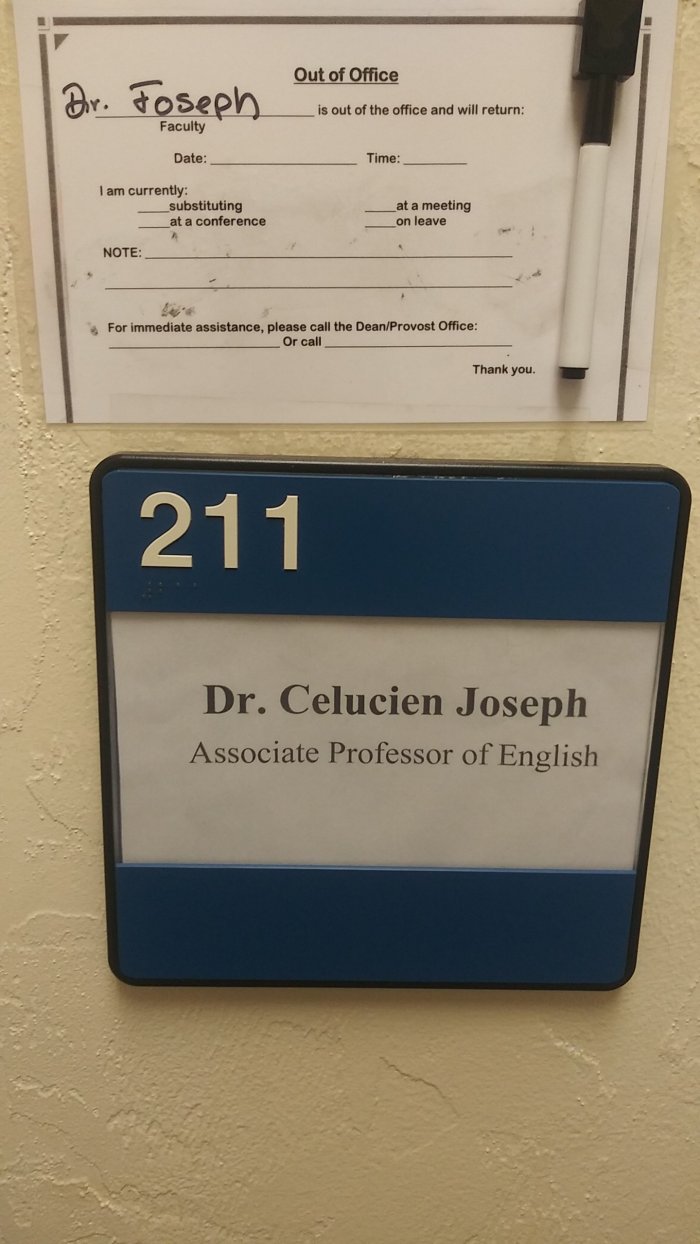
This morning’s breaking news: As I was about to open my office door this morning, a student quickly stopped by and looked at the office sign that reads, “Dr. Celucien L. Joseph, Associate Professor of English,” and stared at me for a moment. He asked, “What do you teach,” and I responded, “English.” He stated, “Is it English for Spanish People.”

Last week in class as we were discussing the relationship between feminist criticism and patriarchal society, a young white male student got very offended at another student, who is from the Dominican Republic, because she said to him “as a male, you have male privilege; in fact, as a white male, you have white male privilege.” Both were going back and forth, as the white male student was insisting that “I have no ‘male privilege’ and no ‘white male privilege.'”

As the oldest adult in the classroom, I intervened in the conversation by attempting to clarify and explain to the class the history of the mess we call the “race concept” and its rapport to white privilege, which we have created in this country, and how it has affected America’s race relations and the history of the economically-and-socially disenfranchised communities in this country.

The same white student interrupted me and said “Why are you so loud? You need to be quiet.” He also said that “I did not pay for this class to learn about politics. I paid to learn about English.”

Oh well, Happy and Blessed Black History Month!

“My Urgent Plea to American and European Historians and Scholars Who Write About the Haitian Revolution and Haiti’s National History”

“My Urgent Plea to American and European Historians and Scholars Who Write About the Haitian Revolution and Haiti’s National History”

Sometimes, I find myself very worried, annoyed, and even upset when American or European historians and scholars recommend works on the Haitian Revolution make no reference to works written by Haitian historians or thinkers. Most contemporary American historians who write about the Haitian Revolution have a good command of the French language and are familiar with the works of Haitian historians on the Haitian Revolution who wrote in French, including Valentin Pompée de Vastey, Thomas Madiou, Céligny Ardouin, Joseph Saint-Rémy, Alfred Auguste Nemours, Horace Pauleus Sannon, Ernst Trouillot, Jean Fouchard, Timoléon C. Brutus, etc.

Please stop it!
Stop silencing works written by Haitian writers!
Give them Credit in your work!
Interact with their ideas and writings!
Do not Ignore Them!
Acknowledge their contribution to knowledge and to what you now know about your subject matter–even when you are teaching and writing in English!

That should be the attitude of a collaborative and honest historian, thinker, or scholar.

****More often, the contemporary studies in English about the story of the Haitian Revolution is arguably a recapitulation of what Haitians historians have already written about how their ancestors gained their freedom, delivered themselves from the yoke of slavery, and founded the Republic of Haiti. I know some people will call me arrogant by voicing my opinion on this crucial matter; if you are well-versed in Haitian revolutionary studies in French, you will probably confirm my statement.

Also, would you make it an intellectual habit when you write about Haiti in general or discuss Haiti’s national history in public or in your classroom, would you include Haitian scholars in your conversation and acknowledge their contribution. Interact with them in your scholarship, and do not ignore their work!

Blessed Black History Month!

#SCHOLARSHIPINBLACKMATTERS!
#HISTORYINBLACKMATTERS!
#THEBLACKNARRATIVEMATTERS!

Life Before and After Birth

The affirmation of the sanctity of the life of the unborn should not be equated with the preservation and protection of that life when he or she is born. A rigorous humanistic and Christian philosophy of the dignity of human life, both unborn and born, must entail the active caring and sustaining of the human life, both before and after birth.

If we can create laws and public policies to safeguard the life of the unborn, correspondingly, we should create legislations to improve human life in general and allow it to flourish and grow socially, intellectually, relationally, and economically; likewise, we should be diligent and proactive to make laws to challenge the negative forces and infrastructures (i.e. cultural, political, economic, ideological) in our culture that dehumanize certain lives and demonize human dignity in our society.

Yes, W. E. B. Du Bois’s father, Alfred Du Bois, was born in Haiti and was a Haitian mulatto!

Yes, W. E. B. Du Bois’s father, Alfred Du Bois, was born in Haiti and was a Haitian mulatto!

Du Bois, in his third autobiography, discusses that his grandfather attended the Trinity Parish of the Episcopal church, and that he was one of the “few colored communicants” (“The Autobiography of W.E.B. DuBois,” pp. 67, 65-68); Du Bois’s great grandfather, Dr. James Du Bois, was a physician in Poughkeepsie. He was born in 1750. Du Bois wrote, “Whether, as is probable, he took a slave as a concubine, or married a free Negro man–in either case two sons were born, my grandfather Alexander in 1803 and a younger brother, John” (p. 65). By consequence, Alexander Du Bois, W.E.B. Du Bois’s grandfather was a mulatto, a man of a mixed raced: from a French man (James Du Bois) and an African woman. After their African mother died in Saint-Domingue-Haiti, Du Bois’s great grandather (Dr. James Du Bois, who died in 1820) moved with both of his sons to New York, in 1810. Du Bois wrote, “Both were white enough to ‘pass,” and their father entered them in the private Cheshire School in Connecticut” (p. 65). In other words, both John and Alexander were members of the Saint-Dominguan gens de couleur class, that is, they were mulattoes, men of two mixed races: White and African. Du Bois also remarked, “Just what happened to John, I do not know. Probably he continued as white, and his descendants, if any, know nothing of their colored ancestry” (p. 66).

Du Bois’s grandfather (Alexander) went back to Haiti around 1820s; he married a woman there, most likely a mixed woman or black woman. He and his wife gave birth to a son, Alfred Du Bois (W.E.B. Du Bois’s father) in 1825. In the next sentence, Du Bois tells us that His father “may have married into the family of Elie Du Bois, the great Haitian educator” (p.66). Du Boi’s grandfather left Haiti in 1830 with his son, Alfred, for New Haven. Alfred was only five years old. Moreover, In Du Bois’ second autobiography, “Dusk of Dawn,” which he published in 1940 (“The Souls of Black Folk,” as being his first autobiography was published in 1901; “The Autobiography of W.E. B. Du Bois,” his third autobiography, which he published in 1968), asserted, “My father, a light mulatto, died in my infancy so that I do not remember him” (p. 12).

Finally, in an article from an online archive about Du Bois’s mother, Mary Silvina Burghardt, associated with the University of Massachusetts’ research library, the writer discusses the mother’s family and her mulatto-husband Alfred Bu Bois in this way: “According to family tradition, Adelbert’s father was Mary Silvina’s first cousin, John Burghardt, but Adelbert himself later claimed that his father was Charles Craig. Either way the fact that he was illegitimate tarnished Mary’s reputation and probably limited her future choices. Certainly by the time she met Alfred Du Bois—light skinned with Franco-Haitian ancestry, an appealing and exotic combination—she was ready to marry with the hope of improving her station in life” (http://scua.library.umass.edu/duboisopedia/doku.php…). The point is this: Alfred Du Bois, W.E.B. Du Bois’s father, was a Haitian man and mulatto!!!