Finding God in the Wasteland: God is the God of life and the God of hope:

Finding God in the Wasteland: God is the God of life and the God of hope
“Thus would God have us walk through the valley of death and find ourselves, our voyage at an end, at the sunlit crossroads of life; so would God have us travel nightmarish highways of rain and gloom and murder only to pull into a carefree village at sunrise in our exhausted car with its four flat tires; so would God have us fight for life in battlefields of blood and entrails, and harvest life from fields of bone and ashes. There in the wasteland where you had not thought to find life, you will suddenly find the signs of God’s renewal, blooming and flowering and bursting forth from the dry earth with great energy, God’s energy. In the driest month, you will find on the branches’ tips new shoots of life. Under the rock in the desert will sprout a flower, a delicate bud of the new life.”–Jean-Bertrand Aristide, “In The Parish of the Poor,” p. 64.
* I make a sharp distinction between what I phrase the three existential Aristides–one single person who embodies a divided and troubling soul–who perform as a politician, literary genius or a rhetorician, and Aristide the theologian. I’m more interested in the “Theological Aristide” and the “Literary Aristide” for the sake of the current research’s emphasis I’m conducting on Jean-Bertrand Aristide the Theologian-President. I suppose there are/will be possible consequences –such as scholarly misapprehension and intellectual misjudgment-about my preferential option for the two Aristides, which may betray my scholarship as an intellectual historian, and a confessional christian theologian.
On the other hand, it does not mean I have overlooked/will overlook the shortcomings of Aristide the politician and the pitfalls of Aristide the theologian who has fallen from grace. While the practical life of a theologian may sometimes betray his theology, his theology should never be divorced  from his personal life. This is exactly the problem with American evangelicalism today: the betrayal of a transformed christian life, which could be construed as the very predicament of doing genuine theological praxis and relational theology in both spheres: public and private.
To get a good understanding of my ideological choice, I direct your attention to an essay I published on Aristide two years ago: “Toward a Politico-Theology of Relationality: Justice as Solidarity and the Poor in Aristide’s Theological Imagination,” Toronto School of Theology 30: 2 (December 2014): 269-300.

The American Flag is Not Christian, and Christianity is not America, but It is okay to celebrate the Flag!

The American Flag is Not Christian, and Christianity is not America, but It is okay to celebrate the Flag!

To my Christian brothers and sisters: Do not undermine the patriotic zeal of those of us Americans who celebrate July 4th, America’s independence from imperial Britain. Do not say on this day true liberty and independence is from Christ. We know that already, and believe Jesus Christ provides everlasting freedom and joy for the soul! There is nothing more precious to live in Christ, for Christ, and with Christ. Nonetheless, there is always a context for everything. Spiritual freedom is not physical freedom. Physical freedom or mental freedom is certainly not spiritual freedom. Give to God what is God’s; give to Caesar what is Caesar’s!

Those of us whose countries have been colonized, neo-colonized, demonized, and dehumanized by both colonial and imperial forces know the real meaning of freedom and the reason to celebrate freedom and independence. Those of us whose ancestors have been enslaved also understand what it means to be free and have a voice today!

What we need to make clear is not to confuse (or mix up) the American flag with the cross of Christ. They are not the same. American nationality is not a substitute for Christian identity.The American Flag is not Christian, and Christianity is not America! Yet, it is okay to celebrate the flag and honor those who have given their lives in sacrifice for the sake of freedom and the common good.

Happy Independence Day!

Flag

My Commitment to Biblical Faithfulness and Care for the People of God

Progressively, I’m seeing myself rekindling my formative interest for biblical studies and Christian theology, my first academic love. Nonetheless, I can not do theology nor biblical studies the way I was taught and trained in seminary. ( I must acknowledge that I received a good liberal arts education, and a good theological and biblically-centered education at The Baptist College of Florida [B.A. Theology], The Southern Baptist Theological Seminary [Advanced Masters of Divinity in Biblical and Theological Studies], and Southwestern Baptist Theological Seminary [Th.M. New Testament]). Such theological discourse partially undermines the social concerns, the lived-worlds and the lived-experiences of the poor, the marginalized, and the oppressed communities. As a Christian minister, my commitment to biblical faithfulness, my understanding of the God of the Bible, and my deep concerns for the holistic welfare of the underrepresented families, the poor, and the disfranchised communities and their dignity have shaped both my theological method and biblical exegesis.
Theology should be used as a tool to radically transform culture, lead to social change, and the radical regeneration of the individual and the collective self. Theology should also be at the service of the marginalized groups and the masses; it should also empower the poor and marginalized communities to find their hope in God their Savior and Liberator.
True theology always leads to both doxology (the worship of the triune God) and praxis.
Christian ministry rooted in authentic biblical theology is about serving, loving, and caring for people.

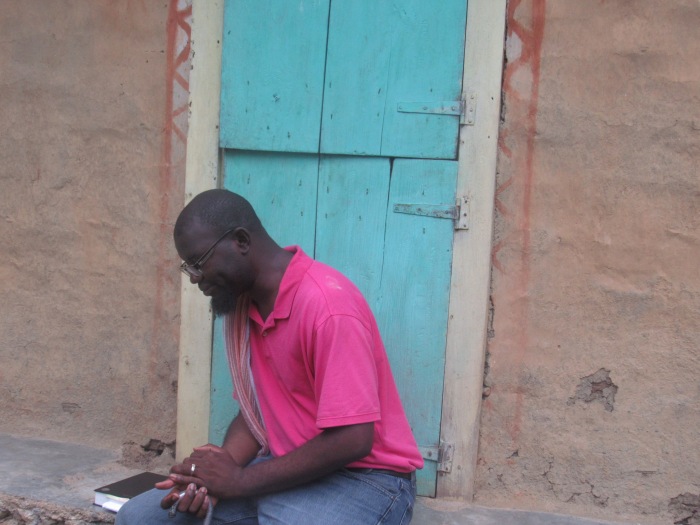
Dr.Joseph and social outreach in Port-Margot, Haiti (December 2015)


IMG_0507

Dr. Joseph praying during prayer walk and door- to- door evangelism: Port-Margot, Haiti Mission Trip (March 2016)