“In Praise of Books and Reading Well: My Journey with Books”

“In Praise of Books and Reading Well: My Journey with Books”

I love good and beautifully written books. I also admire and have great respect for writers who use language with precision and clarity and words with great economy, emotional and intellectual restraint, and linguistic control.

I must admit the fact that I am a bibliophile and have always been a book enthusiast since I was a kid–growing up in Haiti, a country where books and good public libraries are rare. However, Haitian literature is very rich, and Haiti is a country of great writers, great minds, and great literature. Arguably, the country of Haiti has produced some of the most important, prolific, and influential writers in the Americas, writing in French, Spanish, and English languages.

Nonetheless, I became more conscious about my love for books, uncontrollable interest in good writing/ writers, and the weight and glory of good words and the correct usage of the right words when I was probably in 5th grade. In 7th grade, my passion for good books exploded with an enormous and enduring zeal that would eventually shape my High school years, and eventually my academic life and my identity as a writer.

In Haiti, I attended an all-boys Roman Catholic School, Collège Notre Dame du Perpétuel Sécours (CNPS), a rigorous and college preparatory school that has trained some of the most brilliant minds, who originated from Northern Haiti; Haiti has ever produced, such as Jean-Bertrand Aristide, Arly Lariviére, etc. I was able to attend CNPS not because my parents could afford it financially; it was because of my high academic performance and excellence that granted me access to this bourgeois school in Cap-Haitien, Haiti. It was the school where all the rich kids and those in the upper class and the sons of the most powerful figures in society attended. My parents struggled to pay the semester-by-semester tuition and other related expenses. God is always on the side of the poor and the economically disadvantaged group; he generously provided for my brother and me every semester, while we were attending; I managed to make it through the academic year and until my final year of Middle School. The trajectories of my life would change when I immigrated to the United States at the age of 15; I attended a new school, in a foreign environment, a High School that was not like the one at home. Yet, I would find comfort and peace in and through books at the Broward County Public Library in Fort Lauderdale, where I would visit four to five times a week, when school was dismissed.

My favorite Middle School memory was not the time of recess or hanging out with friends, but the memorable Friday when my class would go to the library to check out novels. Oh yes, the visit to the library was the most delightful time in my childhood in Middle school. The school administration and librarian did not allow students to check out more than three books, at one time, but I attempted on several occasions to break the rule and to cheat. In fact, I would take four to five books at one time and take them to the library desk to check out. The library would kindly refuse the extra one or two. That one or two books that I couldn’t check out from the library were usually among the top ten novels I wanted to read for the next two weeks or for the month and before I would return to the library to check out more books.

Books give meaning to life. Good books deconstruct, construct, and reconstruct the human imagination and action, and they breathe new lives to dead souls and the spirit in the dark. They also bring dignity to human relationships and friendship. Books change history, culture, and society. Good books and good writers change people and contribute to human flourishing and the common good.

“Jesus: An Old Story for a Dying American Christianity, Desperate Humanity, and Disoriented World”

“Jesus: An Old Story for a Dying American Christianity, Desperate Humanity, and Disoriented World”

The most important Person in Christianity and Christian history was an Immigrant Refugee and a Person of Color

1. Who challenged the Capitalist banking system of the Roman Empire.
2. Was an anti-imperial fighter.

3. Challenged the structures, forces, powers, and the government (and the class system and the individuals that support them) that oppressed the Poor, the underclass, and the Outcast.
4. Who fed the poor and the hungry.
5. Who provided free healthcare to the uninsured.
6. Who tablefellowshipped with the homeless, and the street prostitutes and gangsters.
7. Who told all of these people and groups named above that he was sent to serve them, to improve their lives, to love them, and to die sacrificially and willingly so they could be free spiritually from both social and spiritual oppressions and sins.

*This Jesus is absent in most conservative-evangelical Theology books, ministerial-seminary training schools, preaching, churches, and Sunday school lessons. The problem is that this Jesus is not a power-seeking-and-hungry Lord and Savior. His teaching, leadership style, and ethics–that is his cultural, economic, moral, and political preferences and choices– contradict those of the contemporary Christian churches and American Evangelicalism. His moral vision is the antithesis of the contemporary economic model, globalization, world-systems, and worldviews, which contemporary American Christianity supports.

Most Contemporary Christians in America prefer the majestic and glorious Jesus as God and not the Jesus as Man, the lover of the poor, the homeless, the refugee, the immigrant and the friend of the underclass, the wage worker, the exploited, and the colonized.

This Jesus was committed wholeheartedly to the practice and promotion of justice, equality, human dignity, and godliness. This Jesus who was/is a social reformer and “The Way” to God was God-incarnate in the human flesh.

“Covenant Faithfulness and God’s Very Good Purposes for Marriage”

“Covenant Faithfulness and God’s Very Good Purposes for Marriage”

Tomorrow morning (December 2) at Jesus Center, I will be teaching about faithfulness and sexual purity in marriage and the main objectives of (Christian) marriage. I invite you to be part of this conversation.

Worship service at Jesus Center Community Church begins at 10:00 am; however, we come half and hour early ( about 930 am) for coffee☕, fellowship, and conversation before the service.

You are our special guest. Please bring a friend with you.

“The Word Became Flesh: The Reason I write”

“The Word Became Flesh: The Reason I write”

The most fundamental reason I love writing and publishing my thoughts on certain issues and share them with the world is this: I love words and believe that ideas communicated through words can change the world, transform the course of society, heal and restore broken lives and friendships, and orient us to an alternative future and more promising way of life. This is the reason I write and the most important thing about me as a writer and citizen of the world.

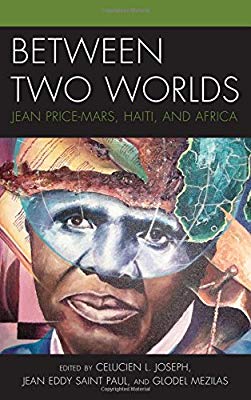
“Between Two Worlds: Price-Mars, Haiti, and Africa”

“Understanding Price-Mars: Africa First not Haiti” (Part 2)

The single passion of Jean Price-Mars was to become “a great man for his nation (Haiti) and race (black people).” In his (45-page) controversial response to René Piquion (“Lettre ouverte au Dr. René Piquion, directeur de l’École normale supérieure, sur son Manuel de la négritude”: Le préjugé de couleur est-il la question sociale?” 1967), he informed us that was his mother’s driven vision for him: to be an exemplary man of valor to the Haitian people, the people of Africa, and those of African ancestry in the Black Diaspora. Because of this obsessive childhood dream (or a dream driven by a passion for Haiti and Africa), in his scholarship and public intellectual activism, Price-Mars resisted the separation of Africa, Haiti, and the black diaspora.

Unlike other Haitian intellectuals (i.e. Baron de Vastey, Joseph Antenor Firmin, Hannibal Price, Louis Joseph Janvier, etc.) who portrayed Haiti and interpreted the history of Haiti, by the virtue of its existence as the first postcolonial state and Black Republic, and its successful revolution and tremendous contributions to universal emancipation, human rights, and the end of slavery (as the rehabilitation of the black race in modernity), Price-Mars constructed an alternative narrative of Haitian history and Haitian society premised on the history of Africa and the Old Continent’s contributions to universal civilization in human history.

On one hand, Price-Mars would not use African traditional society and life, or the culture of Haitian peasants, which is African in content and practice, as a model to “build” the contemporary Haitian society. On the other hand, he would urge Haitian intellectuals and the country’s elite-minority to reconsider the African retentions on Haitian soil and Haiti’s indebtedness to Africa. The Price-Marsian clarion call to affirm the African presence in Haiti does not mean that Price-Mars has undermined Haiti’s triple heritage: Africa, Native American, and Western. It does convey, however, Africa is first, and that the “Black Continent” should shape and occupy the Haitian imagination.

A Good Book For the Holidays!

Warning: Self-Promotion!

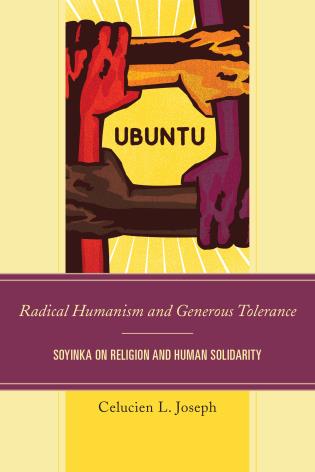
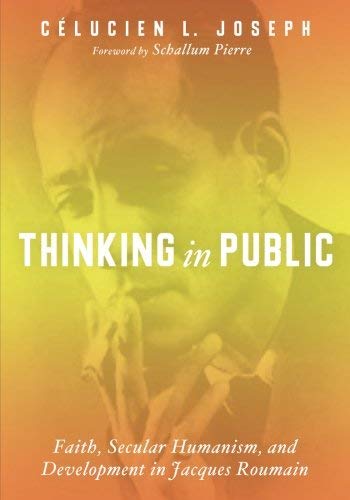
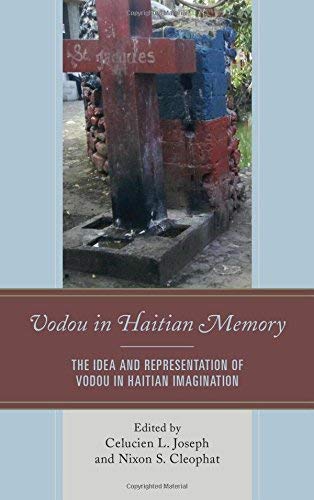
If you’re looking for a good present to give to a friend and even yourself during the Winter Holiday, consider buying some of my books.

I

n all of my books, I seek to interpret the human condition through the Black experience in modernity and explore the intersection of history, anthropology, literature, race, religion, theology, and history of ideas. As an intellectual historian, literary scholar, and theologian, I use my scholarship as a medium to promote human flourishing, the common good, and foster better interpersonal relationships between individuals and the various races and ethnic groups in the world–to the glory of God.

h

*** All the profits I gain from my books are donated to Haiti to contribute to the leadership, educational (literacy), medical, and religious education and training of the Haitian people.

ttps://www.amazon.com/Celucien-L.-Joseph/e/B00ATZKOX4

“The Misappropriation of the Concept of Culture in Black Diasporic Religions: The Case for the ‘Black Church’ and ‘Haitian Vodou'”

“The Misappropriation of the Concept of Culture in Black Diasporic Religions: The Case for the ‘Black Church’ and ‘Haitian Vodou'”

One of the major issues in Black Diasporic Religious History is the misinterpretation and misappropriation of the concept of “culture” to the sphere of (Black) religion. While African Americans scholars have argued that “The Black or Negro Church” is the birthplace of Black culture, similarly, Haitian scholars have contended that “Vodou” is Haiti’s culture. In both perspectives, black culture is identified with religion as an essential category of black life and existence. In other words, black existence is essentially a religious phenomenon the same way black culture is essentially a religious practice.

It seems to me we’re dealing with a categorical misappropriation and conceptual misunderstanding in both contexts: that of African American, and that of Haitian. Culture includes the sum of all (human) practices, beliefs, philosophy, ideologies, traditions, lifestyle, language, food, music, food, clothing, painting, the arts, ideas of beauty, aesthetics, values, worldviews, rites of passage, family, morality, ethics, etc. Culture is not restricted to just and only one (“cultural”) phenomenon or (“cultural”) element, as noted above. Culture is a broad concept that encompasses multiple (human) expressions, modalities, and the soul of the human experience.

It is a false misappropriation of the concept of culture when one posits that one particular item such as religion constitutes a people’s full and integral culture. The existence of a nation, a people’s or racial group is not contingent to its religious worldview–as important as religion as a human tradition is and might be to help us see through the soul of a people or racial category. Religion is not the sole denominator of a people’s dignity and personhood, in the collective sense. While we understand that religion is an essential characteristic in human existence, but human existence should not be equated restrictively with religion. Religion is not just spiritual, it is a form of social identity in the same way human beings are spiritual as much as they are also relational, rational, and social animals or beings.

Therefore, as social animals, human beings express their humanness (or ontology) through music, painting, food, dance, or any form of entertainment that articulates the human experience in the world. These are different forms of human communication, which do not necessarily associate with faith or which do not have to be linked to religion. Religion is a form of human connection and communication.
In the same line of thought, human beings as complex entities articulate their sense of themselves and ways of being in the world through various ethical, religious, and philosophical beliefs and worldviews. A belief does not have to be associated with religion the same way religion can be construed as a body of thought (belief) and as a body of practical rituals, performances, and physical expressions. A philosophy as a body of knowledge is not essentially connected to religion; all philosophical systems are not essentially religious ideas the same way that all ethical frameworks are not essentially philosophical, moral, or religious. On the other hand, there are some philosophical and moral beliefs that have a religious connection or basis.

Further, religion not only constitutes a system of belief–whether theological, moral, ethical, philosophical, political–but also a system of practices or rituals. Religion is not only a body of ideas; it also includes everyday practices, but not all ideas are religious in nature and not all everyday practices are (and should be) essentially religious.

Comparatively, it is also a terrific misunderstanding of the idea of religion to be the engine of culture just because of the fact of the complexity of human nature and the various expressions of human interplays in the world. The human (“The Black Experience”) experience is not one of a religion, but some experiences can be religious and non-religious, equally. The elevation of religion to the whole of the human experience in the world, as “The Black Church” (or “The Negro Church”), a form of religion and an expression of the African American culture, is said to be the “birthplace of black culture” and that the whole of the Haitian culture and identity (cultural identity) is essentially linked to “Haitian Vodou,” a form of religion and an expression of Haitian culture, is a categorical fallacy, which needs to be reassessed, even rejected in contemporary African American Religious scholarship and contemporary Haitian Religious scholarship.

Culture is not religion, and religion is not culture. Nonetheless, religion is a constituent of culture or a cultural element and expression just like language, music, dance, food, and painting are various forms of cultural communication. These various forms of culture are either religious and non-religious, profane and spiritual. Religion is one category of the broad concept of culture. Black Diasporic and African-derived religions such as the Shango of Trinidad and Grenada; the Candomblé of Brazil; the Vodou of Haiti, the Santería of Cuba, Puerto Rico, and the Dominican Republic; the Kunina and Obeah of Jamaica; the Kele of St Lucia; the Confa Obeah of Guyana; and the Vodou and Hoodoo of the United States had their genesis in the broad notion of (Afro-Diasporic) culture; they are all cultural expressions in religion. By consequence, “The Negro Church” is not the birthplace of Black (the African American) culture, both before and after slavery. From the same perspective, Haitian culture is not originated in Haitian Vodou. As previously argued, religion has always been a cultural category and an essential element of culture, both in continental Africa and before the institution of slavery, and after the emancipation of the African people in the United States and the nation of Haiti. While the “The Black Church” emerged from the system of slavery and it is in fact a form of slave culture, African American religion is connected to the pre-slavery (Black African Religious) tradition. This same argument can be made for Haitian Vodou and Haitian culture.